Please mind our dust!

We are currently working on revamping our website!
Thank you for your patience!

CRD Solutions

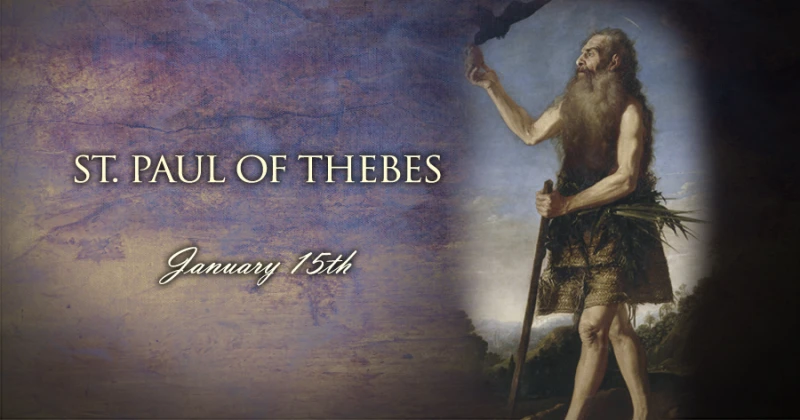
St. Paul of Thebes


St. Paul of Thebes

Feast date: Jan 15

On Jan. 15, the Catholic Church remembers Saint Paul of Thebes, whose life of solitude and penance gave inspiration to the monastic movement during its early years.

Surviving in the Egyptian desert on a small amount of daily food, St. Paul the Hermit lived in close communion with God. Before the end of his life at age 113, he met with St. Anthony the Great, who led an early community of monks elsewhere in the Egyptian desert.

Born in approximately 230, the future hermit Paul received a solid religious and secular education, but lost his parents at age 15. During the year 250, the Roman Emperor Decius carried out a notorious persecution of the Church, executing clergy and forcing laypersons to prove their loyalty by worshiping idols. The state used torture, as well as the threat of death to coerce believers into making pagan sacrifices.

Paul went into hiding during the Decian persecution, but became aware of a family member’s plan to betray him to the authorities. The young man retreated to a remote desert location, where he discovered a large abandoned cave that had once been used as a facility for making counterfeit coins. He found that he could survive on water from a spring. A raven brought him half a loaf of bread daily.

Forced into the wilderness by circumstance, Paul found he loved the life of prayer and simplicity that it made possible. Thus, he never returned to the outside world, even though he lived well into the era of the Church’s legalization and acceptance by the Roman Empire. Later on, his way of life inspired Catholics who sought a deeper relationship with God through spiritual discipline and isolation from the outside world.

One of these faithful was Anthony of Egypt, born in the vicinity of Cairo around 251, who also lived to an old age after deciding during his youth to live in the desert out of devotion to God. Paul of Thebes is known to posterity because Anthony, around the year 342, was told in a dream about the older hermit’s existence, and went to find him.

A similar knowledge about Anthony had been mysteriously given to the earlier hermit. Thus, when he appeared at Paul’s cave, they greeted each other by name, though they had never met. Out of contact with the Roman Empire for almost a century, Paul asked about its condition, and whether paganism was still practiced. He told Anthony how, for the last 60 years, a bird had brought him a ration of bread each day – a mode of subsistence also granted to the Old Testament prophet Elijah.

After 113 years, most of them spent in solitary devotion, Paul understood that he was nearing the end of his earthly life. He asked Anthony to return to his own hermitage, and bring back a cloak that had been given to the younger monk by the bishop St. Athanasius. That heroically orthodox bishop had not yet been born when Paul first fled to the desert, and Anthony had never mentioned him or the cloak in question. Amazed, Anthony paid reverence to Paul and set out to fulfill his request.

During the return trip, Anthony was shown a vision of St. Paul of Thebes’ soul, glorified and ascending toward Heaven. On returning to the first hermit’s cave, he venerated the body of its inhabitant, wrapped him in Athanasius’ cloak, and carried him outdoors. Saint Jerome, in his “Life of St. Paul the First Hermit,” attests that two lions arrived, demonstrated their reverence, and dug a grave for the saint.

Having given him Athanasius’ cloak, St. Anthony took back to his hermitage the garment which St. Paul of Thebes had woven for himself from palm leaves. Anthony passed on the account of his journey and the saint’s life to his own growing group of monastic disciples, and it was written down by St. Jerome around the year 375 – approximately 33 years after the death of the first hermit.

Venerated on the same day by Roman Catholics, Eastern Catholics and Eastern Orthodox Christians, St. Paul of Thebes is also the namesake of a Catholic monastic order – the Order of Saint Paul the First Hermit – founded in Hungary during the 13th century and still in operation.

St. Paul of Thebes Read More »
Friday of the First Week in Ordinary Time

Reading I 1 Sm 8:4-7, 10-22a

All the elders of Israel came in a body to Samuel at Ramah
and said to him, “Now that you are old,
and your sons do not follow your example,
appoint a king over us, as other nations have, to judge us.”

Samuel was displeased when they asked for a king to judge them.
He prayed to the LORD, however, who said in answer:
“Grant the people’s every request.
It is not you they reject, they are rejecting me as their king.”

Samuel delivered the message of the LORD in full
to those who were asking him for a king.
He told them:
“The rights of the king who will rule you will be as follows:
He will take your sons and assign them to his chariots and horses,
and they will run before his chariot.
He will also appoint from among them his commanders of groups
of a thousand and of a hundred soldiers.
He will set them to do his plowing and his harvesting,
and to make his implements of war and the equipment of his chariots. 
He will use your daughters as ointment makers, as cooks, and as bakers.
He will take the best of your fields, vineyards, and olive groves,
and give them to his officials.
He will tithe your crops and your vineyards,
and give the revenue to his eunuchs and his slaves.
He will take your male and female servants,
as well as your best oxen and your asses,
and use them to do his work.
He will tithe your flocks and you yourselves will become his slaves.
When this takes place,
you will complain against the king whom you have chosen,
but on that day the LORD will not answer you.”

The people, however, refused to listen to Samuel’s warning and said,
“Not so!  There must be a king over us.
We too must be like other nations,
with a king to rule us and to lead us in warfare
and fight our battles.” 
When Samuel had listened to all the people had to say,
he repeated it to the LORD, who then said to him,
“Grant their request and appoint a king to rule them.”

Responsorial Psalm 89:16-17, 18-19

R. (2)       For ever I will sing the goodness of the Lord.
Blessed the people who know the joyful shout;
            in the light of your countenance, O LORD, they walk.
At your name they rejoice all the day,
            and through your justice they are exalted.
R.        For ever I will sing the goodness of the Lord.
For you are the splendor of their strength,
            and by your favor our horn is exalted.
For to the LORD belongs our shield,
            and to the Holy One of Israel, our King.
R.        For ever I will sing the goodness of the Lord.

Alleluia Lk 7:16

R. Alleluia, alleluia.
A great prophet has arisen in our midst
and God has visited his people.
R. Alleluia, alleluia.

Gospel Mk 2:1-12

When Jesus returned to Capernaum after some days,
it became known that he was at home.
Many gathered together so that there was no longer room for them,
not even around the door,
and he preached the word to them.
They came bringing to him a paralytic carried by four men.
Unable to get near Jesus because of the crowd,
they opened up the roof above him.
After they had broken through,
they let down the mat on which the paralytic was lying.
When Jesus saw their faith, he said to him,
“Child, your sins are forgiven.”
Now some of the scribes were sitting there asking themselves,
“Why does this man speak that way?  He is blaspheming.
Who but God alone can forgive sins?”
Jesus immediately knew in his mind what 
they were thinking to themselves, 
so he said, “Why are you thinking such things in your hearts?
Which is easier, to say to the paralytic,
‘Your sins are forgiven,’
or to say, ‘Rise, pick up your mat and walk’?
But that you may know
that the Son of Man has authority to forgive sins on earth”
–he said to the paralytic,
“I say to you, rise, pick up your mat, and go home.”
He rose, picked up his mat at once, 
and went away in the sight of everyone.
They were all astounded
and glorified God, saying, “We have never seen anything like this.”

– – –

Lectionary for Mass for Use in the Dioceses of the United States, second typical edition, Copyright © 2001, 1998, 1997, 1986, 1970 Confraternity of Christian Doctrine; Psalm refrain © 1968, 1981, 1997, International Committee on English in the Liturgy, Inc. All rights reserved. Neither this work nor any part of it may be reproduced, distributed, performed or displayed in any medium, including electronic or digital, without permission in writing from the copyright owner.

Friday of the First Week in Ordinary Time Read More »

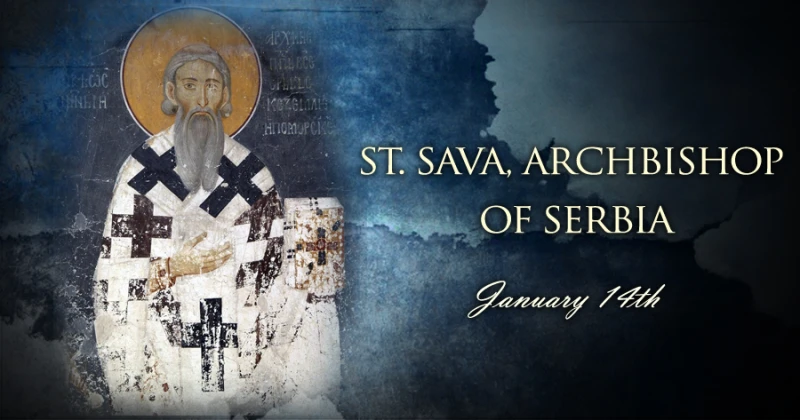
St. Sava, Archbishop of Serbia


St. Sava, Archbishop of Serbia

Feast date: Jan 14

Originally Prince Rastko Nemanjic, he was the first Patriarch of Serbia (1219-1233) and is an important Saint in the Serbian Orthodox Church.

In his youth (around 1192) St. Sava escaped from home to join the Orthodox monastic colony on Mount Athos and was given the name Sava. He first traveled to a Russian monastery and then moved to a Greek monastery, Vatoped. At the end of 1197 his father, King Stefan Nemanja, joined him.

In 1198 the former prince and king restored the abandoned monastery Hilandar, which was at that time the center of Serbian Christian monastic life.

St. Sava’s father took the monastic vows under the name Simeon, and died in Hilandar on February 13, 1200. He is also canonized, as Saint Simeon.

After his father’s death, Sava retreated to an ascetic monastery in Kareya which he built himself in 1199. He also wrote the Kareya typicon both for Hilandar and for the monastery of ascetism.

St. Sava managed to persuade the Patriarch of the Greek/Byzantine Orthodox Church to elevate him to the position of the first Serbian archbishop, thereby establishing the independence of the archbishopic of the serbian church in the year of 1219.

Saint Sava is celebrated as the founder of the independent Serbian Orthodox Church and as the patron saint of education and medicine among Serbs. Since the 1830s, Saint Sava has become the patron Saint of Serbian schools and students.

After participating in a ceremony called “blessing of the waters” he developed a cough that progressed into pneumonia. He died from pneumonia in the evening between Saturday and Sunday, January 14, 1235. He was buried at the Cathedral of the Holy Forty Martyrs in Trnovo. He remained in Trnovo until May 6, 1237, when his sacred bones were moved to the monastery Mileseva in southern Serbia. Three-hundred and sixy years later the Ottoman Turks dug out his bones and burnt them on the main square in Belgrade.

The temple of Saint Sava in Belgrade, whose construction was planned in 1939 and began in 1985 is built on the place where his holy bones were burned.

St. Sava, Archbishop of Serbia Read More »

Thursday of the First Week in Ordinary Time

Reading I 1 Sm 4:1-11

The Philistines gathered for an attack on Israel.
Israel went out to engage them in battle and camped at Ebenezer,
while the Philistines camped at Aphek.
The Philistines then drew up in battle formation against Israel.
After a fierce struggle Israel was defeated by the Philistines,
who slew about four thousand men on the battlefield.
When the troops retired to the camp, the elders of Israel said
“Why has the LORD permitted us to be defeated today
by the Philistines?
Let us fetch the ark of the Lord from Shiloh
that it may go into battle among us
and save us from the grasp of our enemies.”

So the people sent to Shiloh and brought from there
the ark of the LORD of hosts, who is enthroned upon the cherubim.
The two sons of Eli, Hophni and Phinehas, were with the ark of God.
When the ark of the LORD arrived in the camp,
all Israel shouted so loudly that the earth resounded.
The Philistines, hearing the noise of shouting, asked,
“What can this loud shouting in the camp of the Hebrews mean?”
On learning that the ark of the LORD had come into the camp,
the Philistines were frightened.
They said, “Gods have come to their camp.”
They said also, “Woe to us! This has never happened before. Woe to us!
Who can deliver us from the power of these mighty gods?
These are the gods that struck the Egyptians
with various plagues and with pestilence.
Take courage and be manly, Philistines;
otherwise you will become slaves to the Hebrews,
as they were your slaves.
So fight manfully!” 
The Philistines fought and Israel was defeated;
every man fled to his own tent.
It was a disastrous defeat,
.in which Israel lost thirty thousand foot soldiers.
The ark of God was captured,
and Eli’s two sons, Hophni and Phinehas, were among the dead.
 

Responsorial Psalm 44:10-11, 14-15, 24-25

R.        (27b)  Redeem us, Lord, because of your mercy.
Yet now you have cast us off and put us in disgrace,
            and you go not forth with our armies.
You have let us be driven back by our foes;
            those who hated us plundered us at will.
R.        Redeem us, Lord, because of your mercy.
You made us the reproach of our neighbors,
            the mockery and the scorn of those around us.
You made us a byword among the nations,
            a laughingstock among the peoples.
R.        Redeem us, Lord, because of your mercy.
Why do you hide your face,
            forgetting our woe and our oppression?
For our souls are bowed down to the dust,
            our bodies are pressed to the earth.
R.        Redeem us, Lord, because of your mercy.

Alleluia See Mt 4:23

R. Alleluia, alleluia.
Jesus preached the Gospel of the Kingdom
and cured every disease among the people.
R. Alleluia, alleluia.

Gospel Mk 1:40-45

A leper came to him and kneeling down begged him and said,
“If you wish, you can make me clean.”
Moved with pity, he stretched out his hand,
touched the leper, and said to him, 
“I do will it. Be made clean.”
The leprosy left him immediately, and he was made clean.
Then, warning him sternly, he dismissed him at once.
Then he said to him, “See that you tell no one anything,
but go, show yourself to the priest
and offer for your cleansing what Moses prescribed;
that will be proof for them.”
The man went away and began to publicize the whole matter.
He spread the report abroad
so that it was impossible for Jesus to enter a town openly.
He remained outside in deserted places,
and people kept coming to him from everywhere.

– – –

Lectionary for Mass for Use in the Dioceses of the United States, second typical edition, Copyright © 2001, 1998, 1997, 1986, 1970 Confraternity of Christian Doctrine; Psalm refrain © 1968, 1981, 1997, International Committee on English in the Liturgy, Inc. All rights reserved. Neither this work nor any part of it may be reproduced, distributed, performed or displayed in any medium, including electronic or digital, without permission in writing from the copyright owner.

Thursday of the First Week in Ordinary Time Read More »

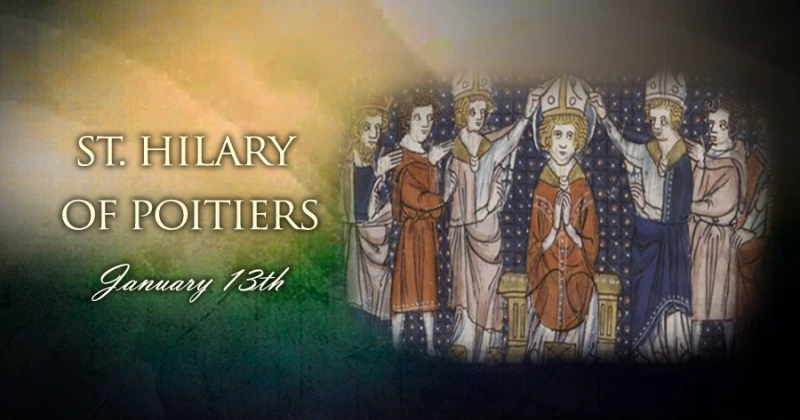
St. Hilary of Poitiers


St. Hilary of Poitiers

Feast date: Jan 13

On January 13, Catholics celebrate St. Hilary of Poitiers, a fourth-century philosopher whose studies made him a champion of Orthodox Trinitarian theology during one of the most difficult periods of Church history. He protected the Church and its members by brilliantly defending the sacred humanity of Jesus while also defeating Arianism which denied Christ’s placement within the Trinity. St. Hilary was a gentle and courteous man, devoted to writing some of the greatest theology on the Trinity, and was like his Master in being labeled a “disturber of the peace.” In a very troubled period in the Church, his holiness was lived out in both scholarship and controversy.

Little is known about St. Hilary’s life before he became a bishop. Fittingly, what historians do know about him derives mostly from personal details contained within his extensive theological works. Those remarks indicate that Hilary was born to a pagan family in present-day France, most likely around 310 – three years before the Roman Empire declared its official toleration of Christianity.

Hilary himself grew up apparently without any significant Christian influence, but received an otherwise comprehensive education in the Latin and Greek classics. Not unusual for his era, he rigorously studied both Greek philosophy and the Bible. Like many other early Church Fathers, he came to accept the truth of the Bible by recognizing its compatibility with philosophy and the sciences.

This was a gradual process for him, however, and it was not until 345 – by which time he was already married, and had a daughter– that Hilary committed himself to full membership in the Catholic Church by receiving baptism with the rest of his family. His rise within the Church, however, was not gradual at all: around 353, the people of Poitiers called for him to be made their bishop.

By its nature, the position involved tremendous responsibility, as well as significant personal sacrifice. While the early church permitted some married men to become bishops, they were traditionally required to practice celibacy within marriage, and many adopted a radically simplified lifestyle akin to monasticism. There are indications that Hilary followed this ascetic path, once ordained.

Moreover, Hilary’s election as the Bishop of Poitiers coincided with the second wave of the Church’s first great doctrinal controversy, in which he would play a significant role. Although the Council of Nicaea in 325 had confirmed the Church’s rejection of Arianism – which claimed Jesus was only human, not divine – powerful forces within both the Church and the empire clung to the heresy.

Only a few years after his assumption of episcopal rank, Hilary found himself virtually alone in defending Jesus’ deity before a hostile crowd of bishops in the southern French region of Gaul. The bishops appealed to Emperor Constantius II, who favored a modified version of Arianism and declared Hilary’s exile from Gaul.

Constantius II did not likely suspect that by banishing Hilary to Phrygia he would inspire the bishop to mount an even greater defense of orthodox theology. There, he wrote his most important work, “On the Trinity,” showing the Bible’s consistent witness to the central mystery of Christian faith.

Remarkably, this staunchly Orthodox bishop also showed great charity toward those he believed were honestly mistaken. He worked closely with groups of clergy and faithful whose formulations of dogma he perceived to be merely imperfect or imprecise, but not intentionally heretical, to support what was correct in their understanding and lead them into full adherence with tradition.

Hilary even traveled to Constantinople during his exile, to explain to the city’s bishops why their emperor was not orthodox. After the death of Constantius II in 361, Hilary was able to return to his diocese at Poitiers. Once exiled for opposing Arianism in Gaul, he lived to see it squarely condemned in the local church after his return.

Although deeply committed to the leadership of his own diocese, Hilary took steps late in his life to support orthodox teaching in other regions. Most significantly, he denounced Auxentius, the Arian bishop of Milan. Subsequent opposition to Auxentius led to his succession by St. Ambrose of Milan, who, in turn, greatly influenced the conversion of St. Augustine.

St. Hilary died at Poitiers in 367, after having passed on his teachings and way of life to a number of students, including St. Martin of Tours.

Long regarded and celebrated as a saint within the Church, St. Hilary was also declared a Doctor of the Church in 1851.

St. Hilary of Poitiers Read More »