
Please mind our dust!

We are currently working on revamping our website!
Thank you for your patience!

CRD Solutions

Wednesday of the First Week in Ordinary Time

Reading I 1 Sm 3:1-10, 19-20

During the time young Samuel was minister to the LORD under Eli,
a revelation of the LORD was uncommon and vision infrequent.
One day Eli was asleep in his usual place.
His eyes had lately grown so weak that he could not see.
The lamp of God was not yet extinguished,
and Samuel was sleeping in the temple of the LORD
where the ark of God was.
The LORD called to Samuel, who answered, “Here I am.”

Samuel ran to Eli and said, “Here I am.  You called me.”
“I did not call you,” Eli said.  “Go back to sleep.” 
So he went back to sleep.
Again the LORD called Samuel, who rose and went to Eli.
“Here I am,” he said. “You called me.”
But Eli answered, “I did not call you, my son. Go back to sleep.”
At that time Samuel was not familiar with the LORD,
because the LORD had not revealed anything to him as yet.
The LORD called Samuel again, for the third time.
Getting up and going to Eli, he said, “Here I am. 
You called me.”
Then Eli understood that the LORD was calling the youth.
So Eli said to Samuel, “Go to sleep, and if you are called, reply,
‘Speak, LORD, for your servant is listening.’” 
When Samuel went to sleep in his place,
the LORD came and revealed his presence,
calling out as before, “Samuel, Samuel!”
Samuel answered, “Speak, for your servant is listening.”

Samuel grew up, and the LORD was with him,
not permitting any word of his to be without effect.
Thus all Israel from Dan to Beersheba
came to know that Samuel was an accredited prophet of the LORD.

Responsorial Psalm 40:2 and 5, 7-8a, 8b-9, 10

R.        (8a and 9a)  Here am I, Lord; I come to do your will.
I have waited, waited for the LORD,
            and he stooped toward me and heard my cry.
Blessed the man who makes the LORD his trust;
            who turns not to idolatry
            or to those who stray after falsehood.
R.        Here am I, Lord; I come to do your will.
Sacrifice or oblation you wished not,
            but ears open to obedience you gave me.
Burnt offerings or sin-offerings you sought not;
            then said I, “Behold I come.”
R.        Here am I, Lord; I come to do your will.
“In the written scroll it is prescribed for me.
To do your will, O my God, is my delight,
            and your law is within my heart!”
R.        Here am I, Lord; I come to do your will.
I announced your justice in the vast assembly;
            I did not restrain my lips, as you, O LORD, know.
R.        Here am I, Lord; I come to do your will.

Alleluia Jn 10:27

R. Alleluia, alleluia.
My sheep hear my voice, says the Lord.
I know them, and they follow me.
R. Alleluia, alleluia.

Gospel Mk 1:29-39

On leaving the synagogue
Jesus entered the house of Simon and Andrew with James and John.
Simon’s mother-in-law lay sick with a fever.
They immediately told him about her.
He approached, grasped her hand, and helped her up.
Then the fever left her and she waited on them.

When it was evening, after sunset,
they brought to him all who were ill or possessed by demons.
The whole town was gathered at the door.
He cured many who were sick with various diseases,
and he drove out many demons,
not permitting them to speak because they knew him.

Rising very early before dawn, 
he left and went off to a deserted place, where he prayed.
Simon and those who were with him pursued him
and on finding him said, “Everyone is looking for you.”
He told them, “Let us go on to the nearby villages
that I may preach there also.
For this purpose have I come.”
So he went into their synagogues, preaching and driving out demons 
throughout the whole of Galilee.

– – –

Lectionary for Mass for Use in the Dioceses of the United States, second typical edition, Copyright © 2001, 1998, 1997, 1986, 1970 Confraternity of Christian Doctrine; Psalm refrain © 1968, 1981, 1997, International Committee on English in the Liturgy, Inc. All rights reserved. Neither this work nor any part of it may be reproduced, distributed, performed or displayed in any medium, including electronic or digital, without permission in writing from the copyright owner.

Wednesday of the First Week in Ordinary Time Read More »
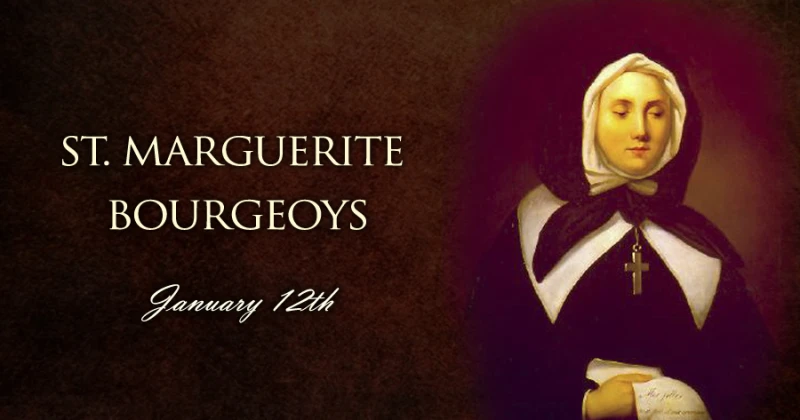
St. Marguerite Bourgeoys


St. Marguerite Bourgeoys

Feast date: Jan 12

On Jan. 12, Roman Catholics remember Saint Marguerite Bourgeoys, who not only founded a religious congregation, but was also instrumental in establishing the Canadian city of Montreal.

Marguerite Bourgeoys was born on Good Friday of 1620 during a period of both colonial expansion and religious strife for Europe. She was the seventh of thirteen children born into the middle-class household of Abraham Bourgeoys, a candle-maker, and Guillemette Gamier, in the northeastern province of Champagne in France.

By her own account, Marguerite had been “very light-hearted and well-liked by the other girls” while growing up. Her turn toward God’s calling began in 1640, not long after her mother’s death. On Oct. 7 of that year, during a procession honoring Our Lady of the Rosary, Marguerite had a mystical experience involving a statue of the Virgin Mary at Notre-Dame Abbey.

“We passed again in front of the portal of Notre-Dame, where there was a stone image above the door,” Marguerite later recounted. “When I looked up and saw it I thought it was very beautiful, and at the same time I found myself so touched and so changed that I no longer knew myself, and on my return to the house everybody noticed the change.”

In later life, Marguerite would live out a profound imitation of the Virgin Mary – who was, as she noted, “not cloistered,” but “everywhere preserved an internal solitude” and “never refused to be where charity or necessity required help.” During the 17th century, it was unusual for consecrated women to have an active apostolate outside the cloister as Marguerite would go on to do.

From 1640 to 1652, she belonged to the non-cloistered “external” branch of the Congregation of Notre-Dame at Troyes, consisting of women trained as teachers in association with the order. She also sought admission to several religious orders, including the Carmelites, but was rejected. Being turned down, the teacher from Troyes was free to volunteer for a 1653 voyage to the Canadian colony of Quebec.

Life in the colony was physically very difficult. When Marguerite arrived, she found that children were not likely to survive to an age suitable for attending school. Nevertheless, she began to work with the nurse in charge of Montreal’s hospital, and eventually established her first school in a stable in 1658.

She traveled back to France that year, and returned to Montreal with three more teachers and an assistant. Because of their association with the original French Congregation of Notre-Dame, these women were called the the “Daughters of the Congregation.”

They would eventually become a religious order in their own right: the Congregation of Notre-Dame de Montreal, whose sisters sacrificed comfort and security to teach religion and other subjects to the children of the territory then known as “New France.” They would live in poverty and travel wherever they were needed, offering education and performing the works of mercy.

The founding of the order involved two further trips to France in 1670 and 1680. During the first, Marguerite’s project received approval under civil law from King Louis XIV. The church hierarchy, however, showed reluctance toward a women’s order with no cloistered nuns. Their rule of life would not receive final approval until 1698, though the Bishop of Quebec had authorized their work in 1676.

Meanwhile, Marguerite and her companions persisted in their mission of teaching and charity. This work proved so integral to life in Quebec, that Marguerite became known as the “Mother of the Colony.”

Though the teaching sisters often lived in huts and suffered other hardships, the order grew. They did not dedicate themselves solely to teaching children, but also set up schools where they taught new immigrants how to survive in their surroundings. As the order expanded, Marguerite passed leadership on to one of the sisters.

During the last two years of her life, the foundress – known by then as Sister Marguerite of the Blessed Sacrament – retired to pray in solitude. On the last day of 1699, after a young member of the community became sick, Sister Marguerite prayed to God to suffer in her place. The young woman recovered, while the aged foundress suffered for twelve days and died Jan. 12, 1700.

Blessed Pope John Paul II canonized St. Marguerite Bourgeoys in 1982, as the first woman saint of the Catholic Church in Canada.

St. Marguerite Bourgeoys Read More »

Tuesday of the First Week in Ordinary Time

Reading I 1 Sm 1:9-20

Hannah rose after a meal at Shiloh,
and presented herself before the LORD;
at the time, Eli the priest was sitting on a chair
near the doorpost of the LORD’s temple.
In her bitterness she prayed to the LORD, weeping copiously,
and she made a vow, promising: “O LORD of hosts,
if you look with pity on the misery of your handmaid,
if you remember me and do not forget me,
if you give your handmaid a male child,
I will give him to the LORD for as long as he lives;
neither wine nor liquor shall he drink,
and no razor shall ever touch his head.”
As she remained long at prayer before the LORD,
Eli watched her mouth, for Hannah was praying silently;
though her lips were moving, her voice could not be heard.
Eli, thinking her drunk, said to her,
“How long will you make a drunken show of yourself?
Sober up from your wine!”
“It isn’t that, my lord,” Hannah answered.
“I am an unhappy woman.
I have had neither wine nor liquor;
I was only pouring out my troubles to the LORD.
Do not think your handmaid a ne’er-do-well;
my prayer has been prompted by my deep sorrow and misery.”
Eli said, “Go in peace,
and may the God of Israel grant you what you have asked of him.”
She replied, “Think kindly of your maidservant,” and left.
She went to her quarters, ate and drank with her husband,
and no longer appeared downcast.
Early the next morning they worshiped before the LORD,
and then returned to their home in Ramah.

When Elkanah had relations with his wife Hannah,
the LORD remembered her. 
She conceived, and at the end of her term bore a son
whom she called Samuel, since she had asked the LORD for him.

Responsorial Psalm 1 Samuel 2:1, 4-5, 6-7, 8abcd

R.        (see 1) My heart exults in the Lord, my Savior.
“My heart exults in the LORD,
            my horn is exalted in my God.
I have swallowed up my enemies;
            I rejoice in my victory.”
R.        My heart exults in the Lord, my Savior.
“The bows of the mighty are broken,
            while the tottering gird on strength.
The well-fed hire themselves out for bread,
            while the hungry batten on spoil.
The barren wife bears seven sons,
            while the mother of many languishes.”
R.        My heart exults in the Lord, my Savior.
“The LORD puts to death and gives life;
            he casts down to the nether world;
            he raises up again.
The LORD makes poor and makes rich;
            he humbles, he also exalts.”
R.        My heart exults in the Lord, my Savior.
“He raises the needy from the dust;
            from the dung heap he lifts up the poor,
To seat them with nobles
            and make a glorious throne their heritage.”
R.        My heart exults in the Lord, my Savior.

Alleluia See 1 Thes 2:13

R. Alleluia, alleluia.
Receive the word of God, not as the word of men,
but as it truly is, the word of God.
R. Alleluia, alleluia.
 

Gospel Mk 1:21-28

Jesus came to Capernaum with his followers, 
and on the sabbath he entered the synagogue and taught.
The people were astonished at his teaching,
for he taught them as one having authority and not as the scribes.
In their synagogue was a man with an unclean spirit;
he cried out, “What have you to do with us, Jesus of Nazareth?
Have you come to destroy us?
I know who you are–the Holy One of God!” 
Jesus rebuked him and said, “Quiet!  Come out of him!”
The unclean spirit convulsed him and with a loud cry came out of him.
All were amazed and asked one another,
 “What is this?
A new teaching with authority.
He commands even the unclean spirits and they obey him.”
His fame spread everywhere throughout the whole region of Galilee.

– – –

Lectionary for Mass for Use in the Dioceses of the United States, second typical edition, Copyright © 2001, 1998, 1997, 1986, 1970 Confraternity of Christian Doctrine; Psalm refrain © 1968, 1981, 1997, International Committee on English in the Liturgy, Inc. All rights reserved. Neither this work nor any part of it may be reproduced, distributed, performed or displayed in any medium, including electronic or digital, without permission in writing from the copyright owner.

Tuesday of the First Week in Ordinary Time Read More »

St. Theodosius Abbot


St. Theodosius Abbot

Feast date: Jan 11

Born to a pious family in 423 A.D., Theodosius began his studies at an early age, and became a lector while still an adolescent. The example of Abraham led him to leave home in order to properly follow God. He met Saint Simeon Stylites in Antioch, and Simeon recognized him as a holy man and leader, and invited Theodosius onto his pillar for prayer, blessing, and advice. He then traveled to Jerusalem where legend says he worked with Saint Longinus, who would have been nearly 500 years old at the time. After a time, he was given charge of a small church near Bethlehem, however his time there did not last long.

Dreading the vanity that comes from the esteem of men and unable to live in solitude with the multitude of admirers, he retired to a cave in the desert of Judah where he led a hermit’s life. Word of his holiness began to attract disciples, and Theodosius built a monastery at Cathismus to house them. So many came that there had to be sections built for Greeks, for Armenians, for Persions, etc., but they all happily worked and prayed together. Next to the monastery he built a hospital for the sick, a hospice for the aged, and a mental hospital. He became a friend of and co-worker with Saint Sabbas, and was later appointed visitor to all cenobitical communities of Palestine, the patriarch of Jerusalem.

He opposed heresies, including Eutychianism and Monophysitism. Emperor Anastatius, a supporter of Eutychianism, once sent Theodosius a large bribe, hoping to sway the influential monk to his thinking, however Theodosius distributed the money to the poor, and continued to preach against heresy. Because of his orthodox views, Anastatius removed him from his position in 513, but he soon resumed his duties under emperor Justinian.

He continued to work until his health gave out, and spent the rest of his time praying for his community. He died at the age of 105.

St. Theodosius Abbot Read More »

Monday of the First Week in Ordinary Time

Reading I 1 Sm 1:1-8

There was a certain man from Ramathaim, Elkanah by name,
a Zuphite from the hill country of Ephraim.
He was the son of Jeroham, son of Elihu,
son of Tohu, son of Zuph, an Ephraimite.
He had two wives, one named Hannah, the other Peninnah;
Peninnah had children, but Hannah was childless.
This man regularly went on pilgrimage from his city
to worship the LORD of hosts and to sacrifice to him at Shiloh,
where the two sons of Eli, Hophni and Phinehas,
were ministering as priests of the LORD.
When the day came for Elkanah to offer sacrifice,
he used to give a portion each to his wife Peninnah
and to all her sons and daughters,
but a double portion to Hannah because he loved her,
though the LORD had made her barren.
Her rival, to upset her, turned it into a constant reproach to her
that the LORD had left her barren.
This went on year after year;
each time they made their pilgrimage to the sanctuary of the LORD,
Peninnah would approach her,
and Hannah would weep and refuse to eat.
Her husband Elkanah used to ask her: 
“Hannah, why do you weep, and why do you refuse to eat?
Why do you grieve?
Am I not more to you than ten sons?”

Responsorial Psalm 116:12-13, 14-17, 18-19

R.        (17a)  To you, Lord, I will offer a sacrifice of praise.
or:
R.        Alleluia.
How shall I make a return to the LORD
            for all the good he has done for me?
The cup of salvation I will take up,
            and I will call upon the name of the LORD. 
R.        To you, Lord, I will offer a sacrifice of praise.
or:
R.        Alleluia.
My vows to the LORD I will pay
            in the presence of all his people. 
Precious in the eyes of the LORD
            is the death of his faithful ones.
O LORD, I am your servant;
            I am your servant, the son of your handmaid;
            you have loosed my bonds.
R.        To you, Lord, I will offer a sacrifice of praise.
or:
R.        Alleluia.
My vows to the LORD I will pay
            in the presence of all his people,
In the courts of the house of the LORD,
            in your midst, O Jerusalem.
R.        To you, Lord, I will offer a sacrifice of praise.
or:
R.        Alleluia.

Alleluia Mk 1:15

R. Alleluia, alleluia.
The Kingdom of God is at hand;
repent and believe in the Gospel.
R. Alleluia, alleluia.

Gospel Mk 1:14-20

After John had been arrested,
Jesus came to Galilee proclaiming the Gospel of God:
“This is the time of fulfillment.
The Kingdom of God is at hand.
Repent, and believe in the Gospel.”

As he passed by the Sea of Galilee,
he saw Simon and his brother Andrew casting their nets into the sea;
they were fishermen.
Jesus said to them,
“Come after me, and I will make you fishers of men.”
Then they left their nets and followed him.
He walked along a little farther
and saw James, the son of Zebedee, and his brother John.
They too were in a boat mending their nets.
Then he called them.
So they left their father Zebedee in the boat
along with the hired men and followed him.


– – –

Lectionary for Mass for Use in the Dioceses of the United States, second typical edition, Copyright © 2001, 1998, 1997, 1986, 1970 Confraternity of Christian Doctrine; Psalm refrain © 1968, 1981, 1997, International Committee on English in the Liturgy, Inc. All rights reserved. Neither this work nor any part of it may be reproduced, distributed, performed or displayed in any medium, including electronic or digital, without permission in writing from the copyright owner.

Monday of the First Week in Ordinary Time Read More »