Please mind our dust!

We are currently working on revamping our website!
Thank you for your patience!

CRD Solutions

St. Apollinaris


St. Apollinaris

Feast date: Jan 08

St. Apollinaris was one of the first great martyrs of the church.  He was made Bishop of Ravenna by St. Peter. The miracles he conducted in Ravenna soon attracted official attention, for they and his preaching won many converts to the faith. However, at the same time, his words and works brought upon the fury of the pagan people who beat Apollinaris cruelly on several occasions.

During one beating, Apollinaris was cut with knives, and scalding hot water poured over his wounds, then put on a ship to be sent to Greece. 

In Greece the same course of preachings, and miracles, and sufferings continued. In fact, after a cruel beating by Greek pagans, he was sent back to Italy.

When Emperor Vespasian issued a decree of banishment against the Christians, Apollinaris was kept hidden for some time, but as he was leaving, passing through the gates of the city, he was attacked and savagely beaten.  He lived for seven days, foretelling that the persecutions would increase, but that the Church would ultimately triumph.

St. Apollinaris Read More »

Friday after Epiphany

Reading I 1 Jn 5:5-13

Beloved:
Who indeed is the victor over the world
but the one who believes that Jesus is the Son of God?

This is the one who came through water and Blood, Jesus Christ,
not by water alone, but by water and Blood. 
The Spirit is the one who testifies,
and the Spirit is truth. 
So there are three who testify,
the Spirit, the water, and the Blood, 
and the three are of one accord. 
If we accept human testimony,
the testimony of God is surely greater. 
Now the testimony of God is this,
that he has testified on behalf of his Son. 
Whoever believes in the Son of God
has this testimony within himself.
Whoever does not believe God has made him a liar
by not believing the testimony God has given about his Son. 
And this is the testimony:
God gave us eternal life,
and this life is in his Son. 
Whoever possesses the Son has life;
whoever does not possess the Son of God does not have life.

I write these things to you so that you may know
that you have eternal life,
you who believe in the name of the Son of God.

Responsorial Psalm 147:12-13, 14-15, 19-20

R.        (12a)  Praise the Lord, Jerusalem.
or:
R.        Alleluia.
Glorify the LORD, O Jerusalem;
            praise your God, O Zion.
For he has strengthened the bars of your gates;
            he has blessed your children within you.
R.        Praise the Lord, Jerusalem.
or:
R.        Alleluia.
He has granted peace in your borders;
            with the best of wheat he fills you.
He sends forth his command to the earth;
            swiftly runs his word!
R.        Praise the Lord, Jerusalem.
or:
R.        Alleluia.
He has proclaimed his word to Jacob,
            his statutes and his ordinances to Israel.
He has not done thus for any other nation;
            his ordinances he has not made known to them. Alleluia.
R.        Praise the Lord, Jerusalem.
or:
R.        Alleluia.

Alleluia See Mt 4:23

R. Alleluia, alleluia.
Jesus proclaimed the Gospel of the Kingdom
and cured every disease among the people.
R. Alleluia, alleluia.

Gospel Lk 5:12-16

It happened that there was a man full of leprosy in one of the towns where Jesus was;
and when he saw Jesus,
he fell prostrate, pleaded with him, and said,
“Lord, if you wish, you can make me clean.” 
Jesus stretched out his hand, touched him, and said,
“I do will it.  Be made clean.” 
And the leprosy left him immediately. 
Then he ordered him not to tell anyone, but
“Go, show yourself to the priest and offer for your cleansing
what Moses prescribed; that will be proof for them.” 
The report about him spread all the more,
and great crowds assembled to listen to him
and to be cured of their ailments,
but he would withdraw to deserted places to pray.

– – –

Lectionary for Mass for Use in the Dioceses of the United States, second typical edition, Copyright © 2001, 1998, 1997, 1986, 1970 Confraternity of Christian Doctrine; Psalm refrain © 1968, 1981, 1997, International Committee on English in the Liturgy, Inc. All rights reserved. Neither this work nor any part of it may be reproduced, distributed, performed or displayed in any medium, including electronic or digital, without permission in writing from the copyright owner.

Friday after Epiphany Read More »

St. Raymond of Penafort


St. Raymond of Penafort

Feast date: Jan 07

Saint Raymond of Penafort, a Dominican priest who worked to aid Christian captives during the era of the Crusades and also helped organize the Church’s legal code, will be celebrated liturgically on Jan. 7.

A contemporary of Saint Thomas Aquinas, he inspired the theologian to write the “Summa Contra Gentiles” for the conversion of non-Catholics. At least 10,000 Muslims reportedly converted as a result of St. Raymond’s evangelistic labors.

Descended from a noble family with ties to the royal house of Aragon, Raymond of Penafort was born during 1175 in the Catalonian region of modern-day Spain near Barcelona.

He advanced quickly in his studies, showing such a gift for philosophy that he was appointed to teach the subject in Barcelona by age 20. As a teacher, the young man worked to harmonize reason with the profession and practice of Catholic faith and morals. This included a notable concern for the poor and suffering.

Around age 30 the Spanish scholar went to study secular and Church law at Bologna in Italy. He earned his doctorate and taught there until 1219, when the Bishop of Barcelona gave him an official position in the diocese. During 1222, the 47-year-old Raymond joined the Dominican order, in which he would spend the next 53 years of his remarkably long life.

As a penance for the intellectual pride he had once demonstrated, the former professor was asked to write a manual of moral theology for use by confessors. The resulting “Summa Casuum” was the first of his pioneering contributions to the Church. Meanwhile, in keeping with his order’s dedication to preaching, the Dominican priest strove to spread the faith and bring back lapsed and lost members of the Church.

During his time in Barcelona, Raymond helped Saint Peter Nolasco and King James of Aragon to establish the Order of Our Lady of Mercy, whose members sought to ransom those taken captive in Muslim territory. During this same period Raymond promoted the Crusades through preaching, encouraging the faithful to defend their civilization from foreign threats.

Pope Gregory IX called the Dominican priest to Rome in 1230, asking him to compile the Church’s various decisions and decrees into one systematic and uniform collection. The resulting five books served for centuries as a basis of the Church’s internal legal system. Raymond was the Pope’s personal confessor and close adviser during this time, and nearly became the Archbishop of Tarragona in 1235. But the Dominican did not want to lead the archdiocese, and is said to have turned down the appointment.

Later in the decade, Raymond was chosen to lead the Dominicans, though he did so for only two years due to his advancing age. Ironically, however, he would live on for more than three decades after resigning from this post. During this time he was able to focus on the fundamentals of his vocation: praising God in prayer, making him known through preaching, and making his blessings manifest in the world. Raymond’s later achievements included the establishment of language schools to aid in the evangelization of non-Christians.

St. Raymond of Penafort’s long pilgrimage of faith ended on Jan. 6, 1275, approximately 100 years after his birth. Pope Clement VIII canonized him in 1601. His patronage extends toward lawyers in general, and canon lawyers in particular.

St. Raymond of Penafort Read More »

Thursday after Epiphany

Reading I 1 Jn 4:19–5:4

Beloved, we love God because
he first loved us. 
If anyone says, “I love God,”
but hates his brother, he is a liar;
for whoever does not love a brother whom he has seen 
cannot love God whom he has not seen. 
This is the commandment we have from him:
Whoever loves God must also love his brother.

Everyone who believes that Jesus is the Christ is begotten by God,
and everyone who loves the Father
loves also the one begotten by him. 
In this way we know that we love the children of God
when we love God and obey his commandments. 
For the love of God is this,
that we keep his commandments.
And his commandments are not burdensome,
for whoever is begotten by God conquers the world. 
And the victory that conquers the world is our faith.

Responsorial Psalm 72:1-2, 14 and 15bc, 17

R.        (see 11)  Lord, every nation on earth will adore you.
O God, with your judgment endow the king,
            and with your justice, the king’s son;
He shall govern your people with justice
            and your afflicted ones with judgment.
R.        Lord, every nation on earth will adore you.
From fraud and violence he shall redeem them,
            and precious shall their blood be in his sight.
May they be prayed for continually;
            day by day shall they bless him.
R.        Lord, every nation on earth will adore you.
May his name be blessed forever;
            as long as the sun his name shall remain.
In him shall all the tribes of the earth be blessed;
            all the nations shall proclaim his happiness.
R.        Lord, every nation on earth will adore you.

Alleluia Lk 4:18

R. Alleluia, alleluia.
The Lord has sent me to bring glad tidings to the poor
and to proclaim liberty to captives.
R. Alleluia, alleluia.

Gospel Lk 4:14-22

Jesus returned to Galilee in the power of the Spirit,
and news of him spread throughout the whole region. 
He taught in their synagogues and was praised by all.

He came to Nazareth, where he had grown up,
and went according to his custom
into the synagogue on the sabbath day. 
He stood up to read and was handed a scroll of the prophet Isaiah. 
He unrolled the scroll and found the passage where it was written:
            The Spirit of the Lord is upon me,
                        because he has anointed me
                                    to bring glad tidings to the poor.
            He has sent me to proclaim liberty to captives
                        and recovery of sight to the blind,
                                    to let the oppressed go free,
            and to proclaim a year acceptable to the Lord.

Rolling up the scroll, he handed it back to the attendant and sat down,
and the eyes of all in the synagogue looked intently at him. 
He said to them,
“Today this Scripture passage is fulfilled in your hearing.” 
And all spoke highly of him
and were amazed at the gracious words that came from his mouth. 

– – –

Lectionary for Mass for Use in the Dioceses of the United States, second typical edition, Copyright © 2001, 1998, 1997, 1986, 1970 Confraternity of Christian Doctrine; Psalm refrain © 1968, 1981, 1997, International Committee on English in the Liturgy, Inc. All rights reserved. Neither this work nor any part of it may be reproduced, distributed, performed or displayed in any medium, including electronic or digital, without permission in writing from the copyright owner.

Thursday after Epiphany Read More »

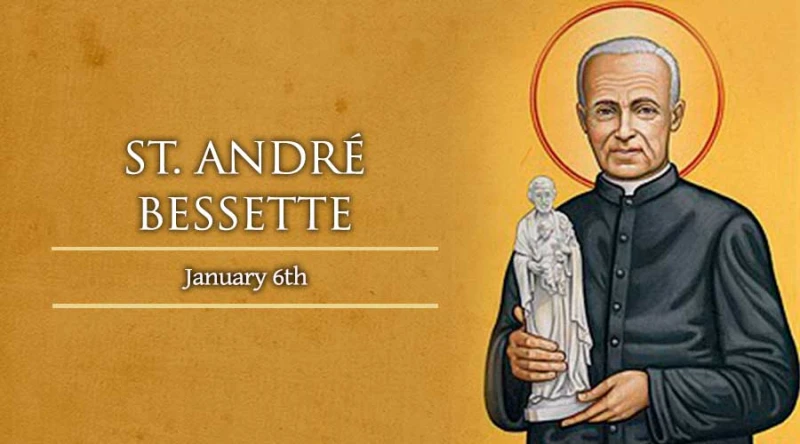
St. Andre Bessette


St. Andre Bessette

Feast date: Jan 06

Brother André was born Alfred Bessette to a poor Quebec family in 1845, a biography from St. Joseph’s Oratory says. His father died in a work accident when he was nine, and his mother died three years later. His large family was split up and the future Brother André, barely literate and physically weak from birth, moved from job to job for years.

In 1870 he presented himself as a candidate for the novitiate of the Congregation of Holy Cross in Montreal. They did not wish to accept him due to his sickness, but assigned him a very humble job when the bishop implored them to. He was made porter at Notre-Dame College, where his daily tasks consisted of washing floors and windows, cleaning lamps, carrying firewood and working as a messenger.

Bro. André use to say, “It is with the smallest brushes that the artists paint the most beautiful pictures.”

He welcomed the sick and heartbroken, inviting them to pray to St. Joseph. His reputation grew as people reported that their prayers had been answered. He received visitors regularly for twenty-five years. Out of devotion to St. Joseph, he built a chapel with help from friends and money he earned from giving haircuts to students.

Larger versions of the chapel were constructed as more and more pilgrims came.

Brother André died in 1937. Over a million people attended his wake and burial.

Bishop Pierre Morissette of Saint-Jérôme, on Feb. 19, 2010, said “Brother André lived his life with great humility.”

“Guided by a deep faith and devotion to Saint Joseph, he dedicated his life to praying, serving the poor, welcoming strangers, healing the sick and comforting the suffering,” the bishop commented. “To this day, his memory remains an important witness to all Canadians of faith and love.”

St. André Bessette was canoninzed by Pope Benedict XVI on October 17, 2010 in Saint Peter’s Square.

St. Andre Bessette Read More »