Please mind our dust!

We are currently working on revamping our website!
Thank you for your patience!

CRD Solutions

St. James Intercisus


St. James Intercisus

Feast date: Nov 27

A soldier and courtier to King Yezdigerd I of Persia in the early fifth century, James was a Christian who, during Yezdigerd’s persecution of Christians, renounced his faith for fear of death.

His family, who had not apostacized, contacted James upon the death of the king, and thus the end of the persecution, and chastised him for having renounced his Heavenly King before the worldy king of Persia.

Upon hearing the rebukes of his family for the denial of his faith, James was thrown into a deep crisis of conscience, and he went through a true, deep conversion, uniting and conforming himself to the living God. Wanting to make amends, he professed his faith before the new king, Bahram and was condemned to death.

He is referred to as ‘Intercisus’ because the name literally means ‘hacked to pieces,’ and this name was given to him documenting the manner of his death. He was hung from a beam and slowly cut into 28 pieces, beginning with his fingers and then his toes, hands, and so forth until his beheading, the final cut.

Even though the crowd, made up of many Christians, urged him to renounce his faith and worship the sun because they could not bear to see him suffer such excruciating torture, he never renounced his faith. Instead, he made every piece cut from his body an offering to the Living God, and won the crown of martyrdom.

James Intercisus is the patron saint of lost vocations and torture victims.

St. James Intercisus Read More »

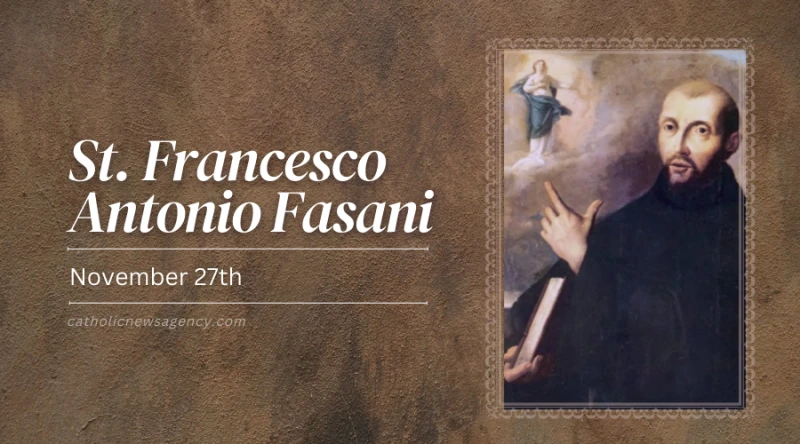
St. Francesco Antonio Fasani


St. Francesco Antonio Fasani

Feast date: Nov 27

St. Francesco (Francis) Antonio Fasani was born as Giovanneillo in Lucera, Italy in 1681, the son of Giuseppe Fasani and Isabella Della Monaca. He entered the Conventual Franciscans in 1695 and took the names of St. Francis and St. Anthony. He spent much of his time studying, and was ordained a priest 10 years after entering the order. He then taught philosophy to younger friars, served as the guardian of his friary, and later became provincial of his order. When his term of office as provincial ended, Francesco became a novice-master, and eventually pastor in his hometown. In all his various ministries, he was loving, devout and penitential. He was a sought-after confessor and preacher. One witness at the canonical hearings regarding Francesco’s holiness testified, “In his preaching he spoke in a familiar way, filled as he was with the love of God and neighbor; fired by the Spirit, he made use of the words and deed of Holy Scripture, stirring his listeners and moving them to do penance.” Francesco showed himself a loyal friend of the poor, never hesitating to seek from benefactors what was needed. He was also a mystic, known for his deep prayer life and supernatural gifts, and was known to levitate while praying. The people of Lucera were known to compare him with St. Francis of Assisi, from whom he derived his name. He died in 1742 and was canonized in 1986.

St. Francesco Antonio Fasani Read More »

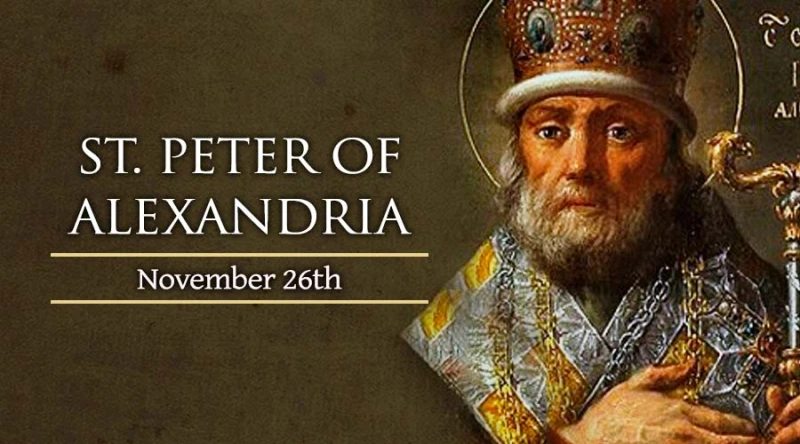
St. Peter of Alexandria


St. Peter of Alexandria

Feast date: Nov 26

Local commemorations of the fourth-century martyr Saint Peter of Alexandria will take place on Nov. 25 and 26. Although his feast day in the Western tradition (on the latter date) is no longer a part of the Roman Catholic Church’s universal calendar, he remains especially beloved among Catholic and Orthodox Christians of the Egyptian Coptic tradition.

Tradition attests that the Egyptian bishop was the last believer to suffer death at the hands of Roman imperial authorities for his faith in Christ. For this reason, St. Peter of Alexandria is known as the “Seal of the Martyrs.” He is said to have undertaken severe penances for the sake of the suffering Church during his lifetime, and written letters of encouragement to those in prison, before going to his death at the close of the “era of the martyrs.”

Both the date of Peter’s birth, and of his ordination as a priest, are unknown. It is clear, however, that he was chosen to lead Egypt’s main Catholic community in the year 300 after the death of Saint Theonas of Alexandria. He may have previously been in charge of Alexandria’s well-known catechetical school, an important center of religious instruction in the early Church. Peter’s own theological writings were cited in a later fifth-century dispute over Christ’s divinity and humanity.

In 302, the Emperor Diocletian and his subordinate Maximian attempted to wipe out the Church in the territories of the Roman Empire. They used their authority to destroy Church properties, imprison and torture believers, and eventually kill those who refused to take part in pagan ceremonies. As the Bishop of Alexandria, Peter offered spiritual support to those who faced these penalties, encouraging them to hold to their faith without compromise. 

One acute problem for the Church during this period was the situation of the “lapsed.” These were Catholics who had violated their faith by participating in pagan rites under coercion, but who later repented and sought to be reconciled to the Church. Peter issued canonical directions for addressing their various situations, and these guidelines became an important part of the Eastern Christian tradition for centuries afterward.

Around the year 306, Peter led a council that deposed Bishop Meletius of Lycopolis, a member of the Catholic hierarchy who had allegedly offered sacrifice to a pagan idol. Peter left his diocese for reasons of safety during some portions of the persecution, giving Meletius an opening to set himself up as his rival and lead a schismatic church in the area.

The “Meletian schism” would continue to trouble the Church for years after the death of Alexandria’s legitimate bishop. Saint Athanasius, who led the Alexandrian Church during a later period in the fourth century, claimed that Meletius personally betrayed Peter of Alexandria to the state authorities during the Diocletian persecution.

Although Diocletian himself chose to resign his rule in in 305, persecution continued under Maximinus Daia, who assumed leadership of the Roman Empire’s eastern half in 310. The early Church historian Eusebius attests that Maximinus, during an imperial visit to Alexandria, unexpectedly ordered its bishop to be seized and killed without imprisonment or trial in 311. Three priests – Faustus, Dio, and Ammonius – were reportedly beheaded along with him.

St. Peter of Alexandria’s entry in the “History of the Patriarchs of the Coptic Church of Alexandria” (a volume first compiled by a Coptic Orthodox bishop in the 10th century) concludes with a description of the aftermath of his death. 

“And the city was in confusion, and was greatly disturbed, when the people beheld this martyr of the Lord Christ. Then the chief men of the city came, and wrapped his body in the leathern mat on which he used to sleep; and they took him to the church … And, when the liturgy had been performed, they buried him with the fathers. May his prayers be with us and all those that are baptized!”
St. Peter of Alexandria Read More »

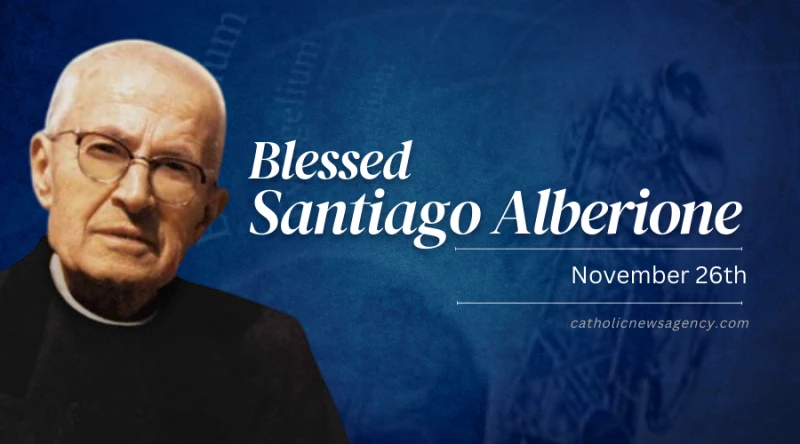
Blessed Santiago Alberione


Blessed Santiago Alberione

Feast date: Nov 26

Santiago Alberione was born on April 4, 1884, the fourth of six children in a devout working class family in San Lorenzo di Fossano, Cuneo, Italy. From a young age, he felt God calling him, and on his first school when the teacher asked him what he wanted to be when he grew up, he responded, “I want to be a priest.”

This desire of his came true when he entered the seminary in Alba. During the night of December 31 1900 to January 1 1901 while still in the seminary, he prayed for four hours in front of the Blessed Sacrament. He saw a light shine forth from the Host, and from that moment he had an unusually powerful certainty that God was calling him to do something for the people of the new century.

He was ordained on June 29, 1907 and was assigned to a parish in Narzole.  He served as spiritual director for youth and altar servers in the Alba seminary beginning October 1, 1908 and in September of 1913 he became director of the weekly publication Gazzetta d’Alba.

He founded the Society of Saint Paul on August 20, 1914, the Daughters of Saint Paul on June 15, 1915, the  Sisters Disciples of the Divine Master on February 10, 1924 and the Sisters of Jesus Good Shepherd in Rome in August 1936. These congregations, under his leadership and still today, publish books and other materials for spreading of the word of God, thus fulfilling his intense conviction at the turn of the century of helping the people of the 20th century of Christianity.

During the course of his priestly and parochial ministry, he grew in the certainty that his call was to reach out to as many people as possible using new technology and media. To this end, he founded the Pauline family. The family grew as there was an increase in both mens and womens vocations, and the apostolate began to take shape rapidly. He founded various women’s orders whose charisms were the publication and dissemination of books, and ministry to Pastors, among other things.

Alberione’s work can best be summed up in the words of Pope Paul VI, who never held back his admiration for the Pauline ministry. “Father Alberione has given the Church new instruments with which to express herself, new means with which to invigorate herself and to amplify her apostolate, new capacity, and a new consciousness of the validity and the possibility of her mission in the modern world with modern means.

He died on November 26, 1971 in Rome, and was beatified by Pope John Paul II on April 27, 2003.

Blessed Santiago Alberione Read More »

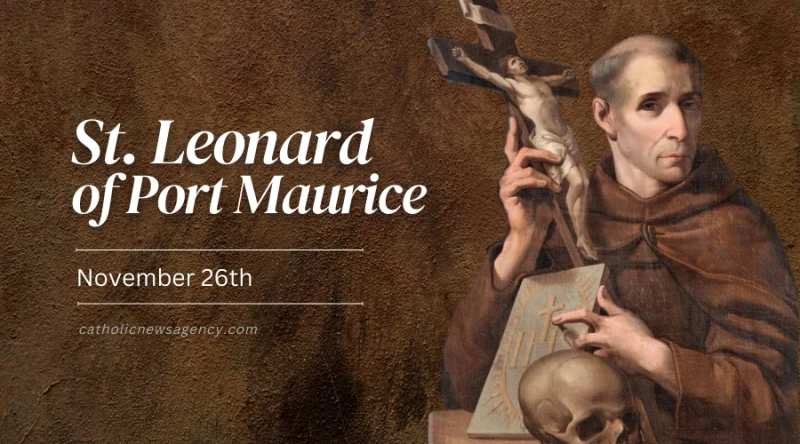
St. Leonard of Port Maurice


St. Leonard of Port Maurice

Feast date: Nov 26

St. Leonard was born on December 20, 1676 in Porto Maurizio, Italy. He was given the name Paul Jerome Casanova by his father, Domenico Casanova, a sea captain, and his mother, Anna Maria Benza.

When he was 13, he was placed with his uncle Agostino to study for a career as a physician, but when the boy decided against medicine, his uncle disowned him. He then began to study at the Jesuit College in Rome.

On October 2, 1697, he joined the Franciscans of the Strict Observance and took the name Brother Leonard. He was ordained in Rome in 1703. He taught for a while, and expected to become a missionary in China, but a bleeding ulcer kept him in his native Porto Maurizio for the four years it took for him to recover and regain his strength.

In 1709, St. Leonard of Port Maurice was sent to Florence where he preached in the city and nearby region. A great preacher, he was often invited to visit and preach in other areas. He worked to increase devotion to the Blessed Sacrament, Sacred Heart, Immaculate Conception, and the Stations of the Cross.

One of his accomplishments was to set up the Stations of the Cross in over 500 different places, including the Colosseum. He was sent as a missionary to Corsica by Pope Benedict XIV in 1744 and restored discipline to the holy orders there, but local politics greatly limited his success in preaching.

He returned to Rome exhausted, and died that night on November 26, 1751 at the monastery of Saint Bonaventure in Rome.

From St. Leonard of Port Maurice, a Modern Catholic can find an example of great servitude and spiritual stamina. One may look at how he lived his life with Christian perseverance, always seeking out opportunities to build the Kingdom of God, until his death.

St. Leonard of Port Maurice Read More »