Please mind our dust!

We are currently working on revamping our website!
Thank you for your patience!

CRD Solutions

St. Catherine of Alexandria
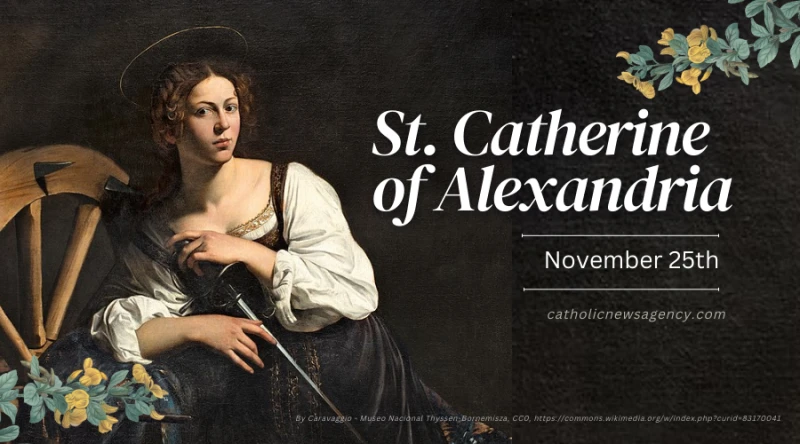

St. Catherine of Alexandria

Feast date: Nov 25

Catholics and other Christians around the world celebrate today, Nov. 25, the memorial of St. Catherine of Alexandria, a revered martyr of the fourth century.

St. Catherine was the subject of great interest and devotion among later medieval Christians. Devotees relished tales of her rejection of marriage, her rebuke to an emperor, and her decision to cleave to Christ even under threat of torture. Pope John Paul II restored the celebration of her memorial to the Roman Catholic calendar in 2002.

Catherine’s popularity as a figure of devotion, during an era of imaginative hagiography, has obscured the facts of her life. It is likely that she was of noble birth, a convert to Christianity, a virgin by choice (before the emergence of organized monasticism), and eventually a martyr for the faith.

Accounts of Catherine’s life also agree on the location where she was born, educated, and bore witness to her faith. The Egyptian city of Alexandria was a center of learning in the ancient world, and tradition represents Catherine as the highly educated daughter of a noble pagan family.

It is said that a vision of the Virgin Mary and the child Jesus spurred her conversion, and the story has inspired works of art which depict her decision to live as a virginal “spouse of Christ.”

The Emperor Maxentius ruled Egypt during Catherine’s brief lifetime, a period when multiple co-emperors jointly governed the Roman Empire. During this time, just before the Emperor Constantine’s embrace and legalization of Christianity, the Church was growing but also attracting persecution.

Catherine, eager to defend the faith she had embraced, came before Maxentius to protest a brutal campaign against the Church. At first, the emperor decided to try and persuade her to renounce Christ. But in a debate that the emperor proceeded to arrange between Catherine and a number of pagan philosophers, Catherine prevailed – with her skillful apologetics converting them instead.

Maxentius’ next stratagem involved an offer to make her his mistress. She not only rebuffed the emperor, but also reportedly convinced his wife to be baptized.

Enraged by Catherine’s boldness and resolve, the Emperor resolved to break her will through torture on a spiked wheel. Tradition holds that she was miraculously freed from the wheel, either before or during torture. Finally, she was beheaded.

Maxentius later died in a historic battle against his Co-Emperor Constantine in October of 312, after which he was remembered disdainfully, if at all. St. Catherine, meanwhile, inspired generations of philosophers, consecrated women, and martyrs.

Ironically, or perhaps appropriately – given both her embrace of virginity, and her “mystic marriage” to Christ – young women in many Western European countries were once known to seek her intercession in finding their husbands. Regrettably, the torture wheel to which she herself may have been subjected was subsequently nicknamed the “Catherine wheel,” and used even among Christian kingdoms.

Today, St. Catherine of Alexandria is more appropriately known as the namesake of a monastery at Mount Sinai that claims to be the oldest in the world.

St. Catherine of Alexandria Read More »
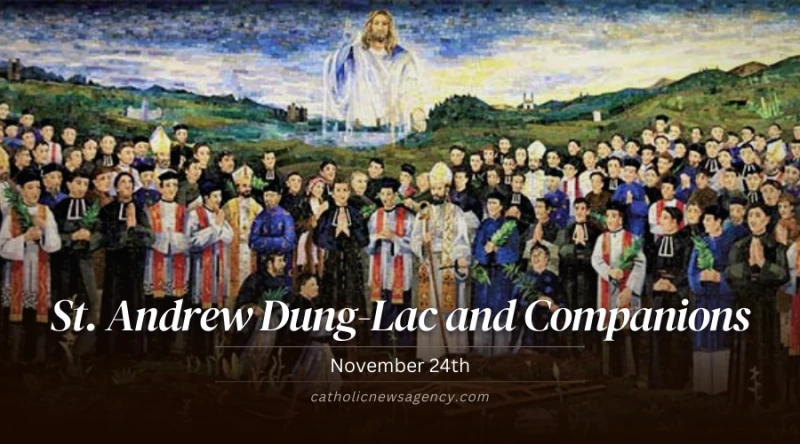
St. Andrew Dung-Lac and Companions


St. Andrew Dung-Lac and Companions

Feast date: Nov 24

During his papacy, Pope John Paul II canonized a group of 117 martyrs who died for the Roman Catholic Faith in Vietnam during the nineteenth century. The group was made up of ninety-six Vietnamese, eleven Spaniards, and ten French. Eight of the group were bishops, fifty were priests and fifty-nine were lay Catholics including a 9-year-old child. Some of the priests were Dominicans, others were diocesan priests who belonged to the Paris Mission Society.

This feast day, and the witnesses of the lives of the martyrs, give testament to the sufferings inflicted on the Vietnamese Church, which are among the most terrible in the long history of Christian martyrdom.

St. Andrew Dung-Lac and Companions Read More »

Wednesday of the Thirty-fourth Week in Ordinary Time

Reading 1 RV 15:1-4

I, John, saw in heaven another sign, great and awe-inspiring:
seven angels with the seven last plagues,
for through them God’s fury is accomplished.

Then I saw something like a sea of glass mingled with fire.
On the sea of glass were standing those
who had won the victory over the beast
and its image and the number that signified its name.
They were holding God’s harps,
and they sang the song of Moses, the servant of God,
and the song of the Lamb:

“Great and wonderful are your works,
Lord God almighty.
Just and true are your ways,
O king of the nations.
Who will not fear you, Lord,
or glorify your name?
For you alone are holy.
All the nations will come
and worship before you,
for your righteous acts have been revealed.”
 

Responsorial Psalm PS 98:1, 2-3AB, 7-8, 9

R. (Rev. 15: 3b) Great and wonderful are all your works, Lord, mighty God!
Sing to the LORD a new song,
for he has done wondrous deeds;
His right hand has won victory for him,
his holy arm.
R. Great and wonderful are all your works, Lord, mighty God!
The LORD has made his salvation known:
in the sight of the nations he has revealed his justice.
He has remembered his kindness and his faithfulness
toward the house of Israel.
R. Great and wonderful are all your works, Lord, mighty God!
Let the sea and what fills it resound,
the world and those who dwell in it;
Let the rivers clap their hands,
the mountains shout with them for joy.
R. Great and wonderful are all your works, Lord, mighty God!
Before the LORD, for he comes,
for he comes to rule the earth;
He will rule the world with justice
and the peoples with equity.
R. Great and wonderful are all your works, Lord, mighty God!


Alleluia RV 2:10C

R. Alleluia, alleluia.
Remain faithful until death,
and I will give you the crown of life.
R. Alleluia, alleluia.

Gospel LK 21:12-19

Jesus said to the crowd:
“They will seize and persecute you,
they will hand you over to the synagogues and to prisons,
and they will have you led before kings and governors
because of my name.
It will lead to your giving testimony.
Remember, you are not to prepare your defense beforehand,
for I myself shall give you a wisdom in speaking
that all your adversaries will be powerless to resist or refute.
You will even be handed over by parents,
brothers, relatives, and friends,
and they will put some of you to death.
You will be hated by all because of my name,
but not a hair on your head will be destroyed.
By your perseverance you will secure your lives.”

– – –

Lectionary for Mass for Use in the Dioceses of the United States, second typical edition, Copyright © 2001, 1998, 1997, 1986, 1970 Confraternity of Christian Doctrine; Psalm refrain © 1968, 1981, 1997, International Committee on English in the Liturgy, Inc. All rights reserved. Neither this work nor any part of it may be reproduced, distributed, performed or displayed in any medium, including electronic or digital, without permission in writing from the copyright owner.

Wednesday of the Thirty-fourth Week in Ordinary Time Read More »

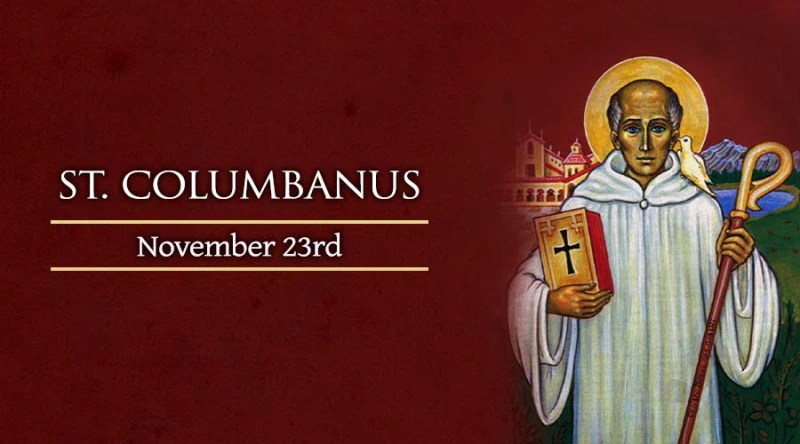
St. Columbanus


St. Columbanus

Feast date: Nov 23

An originator of Ireland’s unique monastic tradition, who went on to serve as a missionary to continental Europe during the early Middle Ages, the abbot Saint Columbanus – also known as St. Columban – is honored by the Catholic Church on Nov. 23.

Despite their similar names and biographies, St. Columbanus is not the same person as Saint Columba of Iona, another monk from Ireland who spread the faith abroad and lived during the same time period.

In a June 2008 general audience on St. Columbanus, Pope Benedict XVI said he was “a man of great culture” who also “proved rich in gifts of grace.” The Pope recalled him as “a tireless builder of monasteries as well as an intransigent penitential preacher who spent every ounce of his energy on nurturing the Christian roots of Europe which was coming into existence.”

“With his spiritual energy, with his faith, with his love for God and neighbor,” St. Columbanus “truly became one of the Fathers of Europe.” According to Pope Benedict, the course of the Irish monk’s life “shows us even today the roots from which our Europe can be reborn.”

Born during 543 in the southeastern Irish region of Leinster, Columbanus was well-educated from his early years. Handsome in appearance, he was tempted by women and was eventually advised by a nun to follow her example and flee from temptation by embracing monasticism. His mother disapproved of this intention, but his will prevailed even when she tried to prevent him from leaving home.

The aspiring monk studied initially with Abbot Sinell of Cluaninis, before moving on to a monastery headed by the abbot later canonized as Saint Comgall. It was under his direction, in the Abbey of Bangor in County Down, that Columbanus formally embraced the monastic calling, as one of a growing number of monks drawn to the Bangor community’s ascetic rigor and intellectual vitality.  

Though Columbanus was known as a dedicated monk and scholar, around the year 583 he felt called to undertake foreign missionary work. Initially denied permission by the abbot, he was eventually allowed to depart with a band of twelve men, with whom he sailed to Britain before reaching France around 585. There, they found the Church suffering from barbarian invasions and internal corruption.

Received with favor by King Gontram of Burgundy, Columbanus and his companions founded a monastery in an abandoned Roman fortress. Despite its remote location in the mountains, the community became a popular pilgrimage site, and also attracted so many monastic vocations that two new monasteries had to be formed to accommodate them.

These monastic communities remained under Columbanus’ authority, and their rules of life reflected the Irish tradition in which he had been formed. Meanwhile, as they expanded, the abbot himself sought greater solitude, spending periods of time in a hermitage and communicating with the monks through an intermediary.

As heirs to the Irish monastic tradition, Columbanus and his monks ran into differences with the bishops in France, partly over the calculation of the date of Easter. He also met with opposition from within the French royal family, because of his insistence that King Thierry should not live with a woman outside of wedlock. He had been urged to do so by his grandmother Queen Brunehild, who thought a royal marriage would threaten her own power.

Columbanus’ moral stand for marriage led first to his imprisonment, from which he escaped. But the king and his grandmother had him driven out of France by force, and they separated him from his monks by insisting that only those from Ireland could accompany him into exile. This group traveled and evangelized in present-day Germany, though political circumstances eventually forced them to cross the Alps into northern Italy.

Welcomed by the ruling Lombards, Columbanus nonetheless found the Italian Church troubled by heresy and schism. The monk wrote against the Arian heresy (which claimed that Christ was not God but only a highly exalted creature), and asked Pope Saint Boniface IV to help restore the unity of the Church in the region. Columbanus himself was involved in a theological dispute with Pope Boniface, but he remained “bound to the Chair of Peter” and acknowledged the Pope’s authority.

Having received a grant of land from the Lombard king, Columbanus founded his last monastery in the town of Bobbio during 614. Although St. Columbanus died on Nov. 23 of the following year, the abbey at Bobbio remained a center of theological orthodoxy and cultural preservation for centuries afterward.

St. Columbanus Read More »

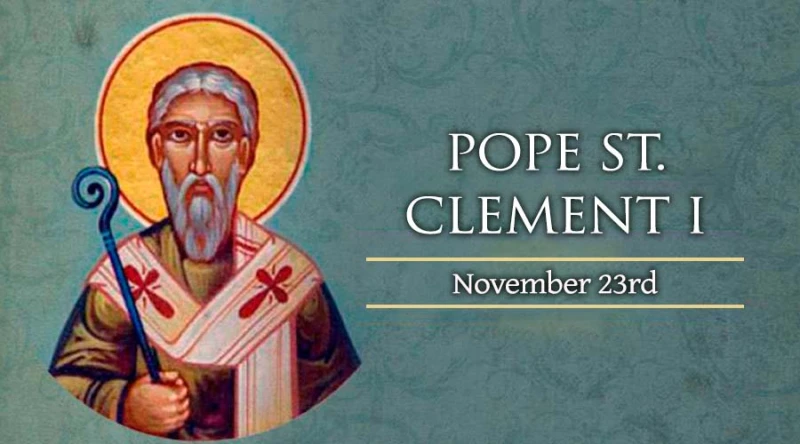
Pope St. Clement I


Pope St. Clement I

Feast date: Nov 23

On Nov. 23 Roman Catholics remember the fourth Pope, St. Clement I, a disciple of the apostles who inherited the authority of St. Peter in the first century. Eastern Catholics celebrate his feast on Nov. 25.

The details of Clement’s life, before his conversion and even afterward, are largely unknown. Some aspects of his writings have led scholars to believe that the fourth Pope either came from a Jewish background, or had converted to Judaism earlier in life before entering the Catholic Church.

Tradition suggests that Clement was the son of a Roman named Faustinus, and that he joined the Church in Rome during its early years through the preaching of Saint Peter or Saint Paul. He went on to share in the missionary journeys of the apostles, and may even have assisted the first Pope in running the Church on a local level.

After the deaths of St. Peter’s first two successors, the canonized Popes Linus and Cletus, Clement took up St. Peter’s position of primacy in the Church around the year 90. One of his most important tasks, during nearly 10 years as Pope, was to resolve serious problems in the Church of Corinth, which St. Paul had also struggled to discipline.

Clement’s own letter to the Corinthians, though not part of the biblical canon, offers an important look at the role of authority and charity in the early Church. Its introduction suggests that Pope Clement composed it while his own local Church faced persecution from the Roman Emperor Domitian.

In the letter, the Pope describes how the Corinthians had once been “distinguished by humility,” being “in no respect puffed up with pride” and “more willing to give than to receive.” But in time, “the worthless rose up against the honored, those of no reputation against such as were renowned, the foolish against the wise, the young against those advanced in years.”

“Let us give up vain and fruitless cares, and approach to the glorious and venerable rule of our holy calling,” Pope Clement wrote in his call to repentance. “Let us attend to what is good, pleasing, and acceptable in the sight of him who formed us.”

Order and discipline, he noted, are at least as important in the Church as they are in the rest of creation, where the powers of nature follow God’s decrees. The Pope also warned the Corinthians to follow “those who cultivate peace with godliness,” rather than “those who hypocritically profess to desire it.”

The Church Clement headed was one that honored tradition and right order as fundamentals of its life.

“It behooves us to do all things in order, which the Lord has commanded us to perform at stated times,” he told the Corinthians. God, he said, “has enjoined offerings and service to be performed … not thoughtlessly or irregularly, but at the appointed times and hours.”

“Where and by whom (God) desires these things to be done, he himself has fixed by his own supreme will, in order that all things being piously done according to his good pleasure, may be acceptable to him.”

The fourth Pope’s writings reveal much about the early Church, but little about his own life. According to one later account, he died in exile during the reign of the Emperor Trajan, who purportedly banished Clement to Crimea (near modern Ukraine) and had him killed in retaliation for evangelizing the local people. In 868 the Greek missionary St. Cyril claimed to have recovered St. Clement’s bones.

St. Clement I probably died around the year 100. He is among the saints mentioned in the Western Church’s most traditional Eucharistic prayer, the Roman Canon.

Pope St. Clement I Read More »