Please mind our dust!

We are currently working on revamping our website!
Thank you for your patience!

CRD Solutions

Blessed Miguel Pro Juarez

Blessed Miguel Pro Juarez

Feast date: Nov 23

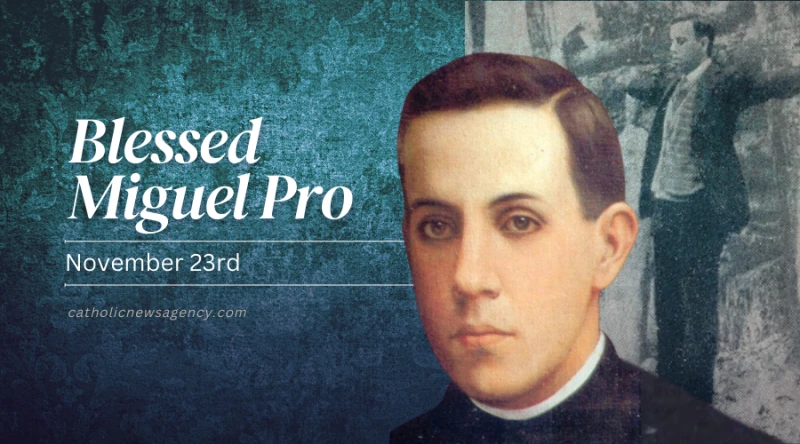
Born in Guadalupe on January 13, 1891, Miguel Pro Juarez was one of 11 children. Miguel was, from an early age, intensely spiritual and equally intense in his mischievousness, frequently exasperating his family with his humor and practical jokes. As a child he had a daring precociousness that sometimes went too far, tossing him into near death accidents and illnesses. Miguel was particularly close to his older sister, and after she entered a cloistered convent he began to discern his own vocation, leading him to enter the Jesuit novitiate in El Llano, Michoacan at the age of 20. He studied in Mexico until 1914 when a tidal wave of governmental anti-Catholicism crashed down upon Mexico, forcing the order to flee to Los Gates, California. He then taught in Nicaragua from 1919 until 1922.

By the time Fr. Pro was ordained a priest in Enghien, Belgium in 1925, the political situation in Mexico had deteriorated: all Catholic churches were closed, bishops, priests, and religious were rounded up for deportation or imprisonment, and those caught trying to elude capture were shot. The celebration of the sacraments was punishable by imprisonment or death, and the Church was driven underground. Fr. Pro received permission from his superiors to return to Mexico incognito and to carry on his ministry undercover. Fr. Pro slipped into Mexico City and immediately began celebrating Mass and distributing the sacraments, often under imminent threat of discovery by a police force charged with the task of ferreting out hidden pockets of Catholicism. He became known throughout the city as the undercover priest who would show up in the middle of the night dressed as a beggar or a street sweeper to baptize infants, hear confessions, distribute Communion, or perform marriages. Several times, disguised as a policeman, he slipped unnoticed into the police headquarters itself to bring the sacraments to Catholic prisoners before their execution. Using clandestine meeting places, a wardrobe of disguises and coded messages to the underground Catholics, Fr. Pro carried on his priestly work for the Mexican faithful under his care.

A failed attempt in November 1927 to assassinate the President of Mexico which only wounded him provided the state with a pretext for arresting Fr. Pro with his brothers Humberto and Roberto. They were put in jail and held without trial for ten days, accused of the attempted assassination. On July 17, 1928, President Calles ordered Fr. Pro to be executed, ostensibly for his role in the assassination plot, but in reality for his defiance of the laws banning Catholicism. As Fr. Pro walked from his cell to the prison courtyard, he blessed the firing squad and then knelt and prayed silently for a few moments. Refusing a blindfold, he stood, faced the firing squad, and with a crucifix in one hand and a rosary in the other, he held his arms outstretched in the form of a cross and in a loud, clear voice cried out, “May God have mercy on you! May God bless you! Lord, Thou knowest that I am innocent! With all my heart I forgive my enemies!” As the soldiers lifted their rifles, he exclaimed in a loud voice, “Viva Cristo Rey!” – “Long live Christ the King!” A volley rang out and Fr. Pro fell to the ground riddled with bullets. A solider stepped up and discharged his rifle at point blank range into the priest’s temple. 30,000 people attended his funeral procession. Fr. Miguel Pro was beatified on September 25, 1988 by Pope John Paul II.

Fr. Pro used his natural gifts of intense determination and courage, seen throughout all parts of his life, to further the kingdom of God. Modern Catholics may follow Fr. Pro by taking courage and using their natural talents and gifts as God asks of them.

Blessed Miguel Pro Juarez Read More »
Memorial of Saint Cecilia, Virgin and Martyr

Reading 1 RV 14:14-19

I, John, looked and there was a white cloud,
and sitting on the cloud one who looked like a son of man,
with a gold crown on his head and a sharp sickle in his hand.
Another angel came out of the temple,
crying out in a loud voice to the one sitting on the cloud,
“Use your sickle and reap the harvest,
for the time to reap has come,
because the earth’s harvest is fully ripe.”
So the one who was sitting on the cloud swung his sickle over the earth,
and the earth was harvested.

Then another angel came out of the temple in heaven
who also had a sharp sickle.
Then another angel came from the altar, who was in charge of the fire,
and cried out in a loud voice
to the one who had the sharp sickle,
“Use your sharp sickle and cut the clusters from the earth’s vines,
for its grapes are ripe.”
So the angel swung his sickle over the earth and cut the earth’s vintage.
He threw it into the great wine press of God’s fury.
 

Responsorial Psalm 96:10, 11-12, 13

R. (13b) The Lord comes to judge the earth.
Say among the nations: The LORD is king.
He has made the world firm, not to be moved;
he governs the peoples with equity.
R. The Lord comes to judge the earth.
Let the heavens be glad and the earth rejoice;
let the sea and what fills it resound;
let the plains be joyful and all that is in them!
Then shall all the trees of the forest exult.
R. The Lord comes to judge the earth.
Before the LORD, for he comes;
for he comes to rule the earth.
He shall rule the world with justice 
and the peoples with his constancy.
R. The Lord comes to judge the earth.


Alleluia RV 2:10C

R. Alleluia, alleluia.
Remain faithful until death,
and I will give you the crown of life.
R. Alleluia, alleluia.

Gospel LK 21:5-11

While some people were speaking about
how the temple was adorned with costly stones and votive offerings,
Jesus said, “All that you see here–
the days will come when there will not be left
a stone upon another stone that will not be thrown down.”

Then they asked him,
“Teacher, when will this happen?
And what sign will there be when all these things are about to happen?” 
He answered,
“See that you not be deceived,
for many will come in my name, saying,
‘I am he,’ and ‘The time has come.’ 
Do not follow them! 
When you hear of wars and insurrections,
do not be terrified; for such things must happen first,
but it will not immediately be the end.” 
Then he said to them,
“Nation will rise against nation, and kingdom against kingdom. 
There will be powerful earthquakes, famines, and plagues
from place to place;
and awesome sights and mighty signs will come from the sky.”  

– – –

Lectionary for Mass for Use in the Dioceses of the United States, second typical edition, Copyright © 2001, 1998, 1997, 1986, 1970 Confraternity of Christian Doctrine; Psalm refrain © 1968, 1981, 1997, International Committee on English in the Liturgy, Inc. All rights reserved. Neither this work nor any part of it may be reproduced, distributed, performed or displayed in any medium, including electronic or digital, without permission in writing from the copyright owner.

Memorial of Saint Cecilia, Virgin and Martyr Read More »

St. Cecilia


St. Cecilia

Feast date: Nov 22

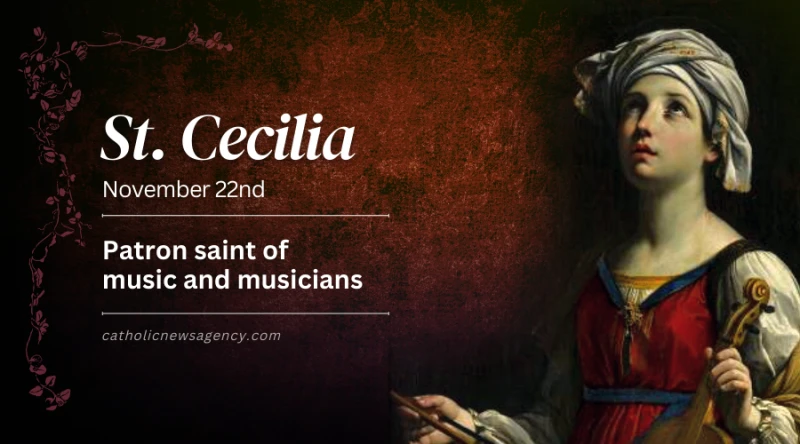
St. Cecilia’s family was one of the principle families of Rome. According to the cultural custom of the time, Cecilia’s family betrothed her to a pagan nobleman named Valerian despite St. Cecelia’s consecration to God. On their wedding night, Cecilia told Valerian that she had sworn to remain a virgin before God and that an angel guarded her body, protecting her virginity from violation. She told Valerian that he would be able to see this angel if he went to the third milestone along the Via Appia and was baptized by Pope Urban I. Valerian went to the milestone as Cecilia had instructed, and there was baptized. She later converted his brother as well.

During that era, it was forbidden for anyone to bury the bodies of Christians, so newly-baptized Valerian and his brother dedicated themselves to burying the bodies of all the Christians they found. For this, they were arrested and brought before a judge who ordered them to worship the Roman god Jupiter, and were martyred when they refused to deny their Christian faith. The police then came for Cecilia and strongly advised her to renounce her faith. In reply, she told them that she would prefer to die than to denounce the true faith. According to legend, upon hearing her response, they brought her to a large oven with the intention of suffocating her with the hot and toxic gasses it emitted. However, instead of choking, Cecilia began to sing. Infuriated, her persecutors attempted to behead her, but after three strokes of the sword, Cecilia was still alive and her head was not severed. The soldiers then left her covered in blood in her own home, where she remained for three days before she died.

The church Santa Cecilia in Trastevere was built on the site of the house where she lived. St. Cecelia is known for “singing in her heart to the Lord” upon her wedding day, despite her consecration to God. She is the patron Saint of musicians and poets because of this sentiment and her alleged singing within the oven during her martyrdom. Her fortitude may inspire the modern Catholic in the trials of life and inspire one to find God within music.

St. Cecilia Read More »

Memorial of The Presentation of the Blessed Virgin Mary


Reading 1 Rv 14:1-3, 4b-5

I, John, looked and there was the Lamb standing on Mount Zion,
and with him a hundred and forty-four thousand
who had his name and his Father’s name written on their foreheads.
I heard a sound from heaven
like the sound of rushing water or a loud peal of thunder.
The sound I heard was like that of harpists playing their harps.
They were singing what seemed to be a new hymn before the throne,
before the four living creatures and the elders.
No one could learn this hymn except the hundred and forty-four thousand
who had been ransomed from the earth.
These are the ones who follow the Lamb wherever he goes.
They have been ransomed as the first fruits
of the human race for God and the Lamb.
On their lips no deceit has been found; they are unblemished.

Responsorial Psalm Ps 24:1bc-2, 3-4ab, 5-6

R.        (see 6) Lord, this is the people that longs to see your face.

The LORD’s are the earth and its fullness;
the world and those who dwell in it.
For he founded it upon the seas
and established it upon the rivers.

R.        Lord, this is the people that longs to see your face.

Who can ascend the mountain of the LORD?
or who may stand in his holy place?
He whose hands are sinless, whose heart is clean,
who desires not what is vain.

R.        Lord, this is the people that longs to see your face.

He shall receive a blessing from the LORD,
a reward from God his savior.
Such is the race that seeks for him,
that seeks the face of the God of Jacob.

R.        Lord, this is the people that longs to see your face.

Alleluia Mt 24:42a, 44

R. Alleluia, alleluia.

Stay awake!
For you do not know when the Son of Man will come.

R. Alleluia, alleluia.

Gospel LK 21:1-4

When Jesus looked up he saw some wealthy people
putting their offerings into the treasury
and he noticed a poor widow putting in two small coins.
He said, “I tell you truly,
this poor widow put in more than all the rest;
for those others have all made offerings from their surplus wealth,
but she, from her poverty, has offered her whole livelihood.”

– – –

Lectionary for Mass for Use in the Dioceses of the United States, second typical edition, Copyright © 2001, 1998, 1997, 1986, 1970 Confraternity of Christian Doctrine; Psalm refrain © 1968, 1981, 1997, International Committee on English in the Liturgy, Inc. All rights reserved. Neither this work nor any part of it may be reproduced, distributed, performed or displayed in any medium, including electronic or digital, without permission in writing from the copyright owner.

Memorial of The Presentation of the Blessed Virgin Mary Read More »

Feast of the Presentation of the Blessed Virgin Mary


Feast of the Presentation of the Blessed Virgin Mary

Feast date: Nov 21

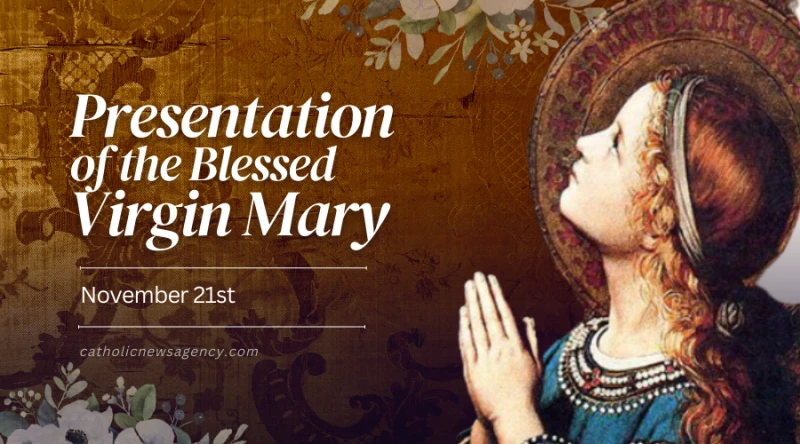
The Feast of the Presentation of the Blessed Virgin Mary, celebrated annually on November 21st, commemorates the presentation of the Blessed Virgin as a child by her parents in the Temple in Jerusalem. Before Mary’s birth, her parents received a heavenly message that they would bear a child. In thanksgiving for the God’s gift of Mary’s birth, they brought her to the Temple to consecrate their only daughter to The Lord.The celebration of the Feast is first documented in the 11th century within the Byzantine Catholic Church. It was introduced into the Roman Catholic Church in the 15th century by Pope Gregory XI, then removed from the calendar by Pope Pius V in the mid 16th century. Pope Sixtus V later reestablished the feast in 1585, and it is still celebrated today, commemorating the faith of her parents, Joachim and Anne, and the purity of Mary.

Feast of the Presentation of the Blessed Virgin Mary Read More »