Please mind our dust!

We are currently working on revamping our website!
Thank you for your patience!

CRD Solutions

The Solemnity of Our Lord Jesus Christ, King of the Universe

Reading 1 2 Sm 5:1-3

In those days, all the tribes of Israel came to David in Hebron and said:
“Here we are, your bone and your flesh.
In days past, when Saul was our king,
it was you who led the Israelites out and brought them back.
And the LORD said to you,
‘You shall shepherd my people Israel
and shall be commander of Israel.'”
When all the elders of Israel came to David in Hebron,
King David made an agreement with them there before the LORD,
and they anointed him king of Israel.

Responsorial Psalm Ps 122:1-2, 3-4, 4-5

R. (cf. 1) Let us go rejoicing to the house of the Lord.
I rejoiced because they said to me,
“We will go up to the house of the LORD.”
And now we have set foot
within your gates, O Jerusalem.
R. Let us go rejoicing to the house of the Lord.
Jerusalem, built as a city
with compact unity.
To it the tribes go up,
the tribes of the LORD.
R. Let us go rejoicing to the house of the Lord.
According to the decree for Israel,
to give thanks to the name of the LORD.
In it are set up judgment seats,
seats for the house of David.
R. Let us go rejoicing to the house of the Lord.

Reading 2 Col 1:12-20

Brothers and sisters:
Let us give thanks to the Father,
who has made you fit to share
in the inheritance of the holy ones in light.
He delivered us from the power of darkness
and transferred us to the kingdom of his beloved Son,
in whom we have redemption, the forgiveness of sins.

He is the image of the invisible God,
the firstborn of all creation.
For in him were created all things in heaven and on earth,
the visible and the invisible,
whether thrones or dominions or principalities or powers;
all things were created through him and for him.
He is before all things,
and in him all things hold together.
He is the head of the body, the church.
He is the beginning, the firstborn from the dead,
that in all things he himself might be preeminent.
For in him all the fullness was pleased to dwell,
and through him to reconcile all things for him,
making peace by the blood of his cross
through him, whether those on earth or those in heaven.

Alleluia Mk 11:9, 10

R. Alleluia, alleluia.
Blessed is he who comes in the name of the Lord!
Blessed is the kingdom of our father David that is to come!
R. Alleluia, alleluia.

Gospel Lk 23:35-43

The rulers sneered at Jesus and said,
“He saved others, let him save himself
if he is the chosen one, the Christ of God.”
Even the soldiers jeered at him.
As they approached to offer him wine they called out,
“If you are King of the Jews, save yourself.”
Above him there was an inscription that read,
“This is the King of the Jews.”

Now one of the criminals hanging there reviled Jesus, saying,
“Are you not the Christ?
Save yourself and us.”
The other, however, rebuking him, said in reply,
“Have you no fear of God,
for you are subject to the same condemnation?
And indeed, we have been condemned justly,
for the sentence we received corresponds to our crimes,
but this man has done nothing criminal.”
Then he said,
“Jesus, remember me when you come into your kingdom.”
He replied to him,
“Amen, I say to you,
today you will be with me in Paradise.”

– – –

Lectionary for Mass for Use in the Dioceses of the United States, second typical edition, Copyright © 2001, 1998, 1997, 1986, 1970 Confraternity of Christian Doctrine; Psalm refrain © 1968, 1981, 1997, International Committee on English in the Liturgy, Inc. All rights reserved. Neither this work nor any part of it may be reproduced, distributed, performed or displayed in any medium, including electronic or digital, without permission in writing from the copyright owner.

The Solemnity of Our Lord Jesus Christ, King of the Universe Read More »
St. Bernward


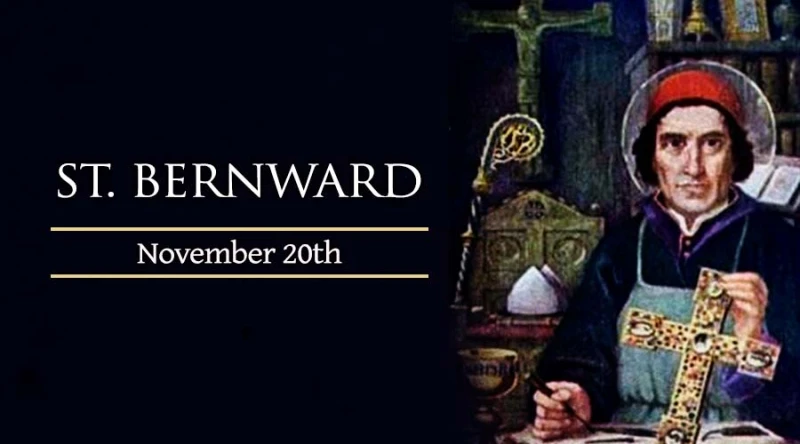
St. Bernward

Feast date: Nov 20

Saint Bernward served as the thirteenth Bishop of Hildesheim, Germany during the middle of the tenth century. His grandfather was Athelbero, Count Palatine of Saxony. After having lost his parents, Bernward was sent to live with his uncle Volkmar, who was the Bishop of Utrecht. His uncle enlisted the assistance of Thangmar, the pious and well-educated director of the cathedral school at Heidelberg, the help with Bernward’s education.

Under the instruction of Thangmar, Bernward made rapid progress in Christian piety as well as in the sciences. He became very proficient in mathematics, painting, architecture, and particularly in the manufacture of ecclesiastical vessels and ornaments made of silver and gold.

Saint Bernward completed his studies at Mainz, where he was then ordained a priest. In lieu of being placed in the diocese of his uncle, Bishop Volkmar, he chose to remain near his grandfather, Athelbero, to comfort him in his old age. Upon his grandfather’s death in 987, he became chaplain in the imperial court, and the Empress-Regent Theophano quickly appointed him to be tutor of her son Otto III, who was only six years old at the time. Bernward remained at the imperial court until 993, when he was elected Bishop of Hildesheim.

A man of extraordinary piety, he was deeply devoted to prayer as well as the practice of mortification, and his knowledge and practice of the arts were employed generously in the service of the Church.

Shortly before his death in 1022, he was vested in the Benedictine habit. He was canonized by Pope Celestine III in 1193.

St. Bernward Read More »

Saturday of the Thirty-third Week in Ordinary Time

Reading Rv 11:4-12

I, John, heard a voice from heaven speak to me:
Here are my two witnesses:
These are the two olive trees and the two lampstands
that stand before the Lord of the earth.
If anyone wants to harm them, fire comes out of their mouths
and devours their enemies.
In this way, anyone wanting to harm them is sure to be slain.
They have the power to close up the sky
so that no rain can fall during the time of their prophesying.
They also have power to turn water into blood
and to afflict the earth with any plague as often as they wish.

When they have finished their testimony,
the beast that comes up from the abyss
will wage war against them and conquer them and kill them.
Their corpses will lie in the main street of the great city,
which has the symbolic names “Sodom” and “Egypt,”
where indeed their Lord was crucified.
Those from every people, tribe, tongue, and nation
will gaze on their corpses for three and a half days,
and they will not allow their corpses to be buried.
The inhabitants of the earth will gloat over them
and be glad and exchange gifts
because these two prophets tormented the inhabitants of the earth.
But after the three and a half days,
a breath of life from God entered them.
When they stood on their feet, great fear fell on those who saw them.
Then they heard a loud voice from heaven say to them, “Come up here.”
So they went up to heaven in a cloud as their enemies looked on.

Responsorial Psalm Psalm 144:1, 2, 9-10

R.    (1b) Blessed be the Lord, my Rock!
Blessed be the LORD, my rock,
who trains my hands for battle, my fingers for war.
R.    Blessed be the Lord, my Rock!
My mercy and my fortress,
my stronghold, my deliverer,
My shield, in whom I trust,
who subdues my people under me.
R.    Blessed be the Lord, my Rock!
O God, I will sing a new song to you;
with a ten stringed lyre I will chant your praise,
You who give victory to kings,
and deliver David, your servant from the evil sword.
R.    Blessed be the Lord, my Rock!


Alleluia See 2 Tm 1:10

R. Alleluia, alleluia.
Our Savior Jesus Christ has destroyed death
and brought life to light through the Gospel.
R. Alleluia, alleluia.

Gospel Lk 20:27-40

Some Sadducees, those who deny that there is a resurrection,
came forward and put this question to Jesus, saying,
“Teacher, Moses wrote for us,
If someone’s brother dies leaving a wife but no child,
his brother must take the wife
and raise up descendants for his brother.

Now there were seven brothers;
the first married a woman but died childless.
Then the second and the third married her,
and likewise all the seven died childless.
Finally the woman also died.
Now at the resurrection whose wife will that woman be?
For all seven had been married to her.”
Jesus said to them,
“The children of this age marry and remarry;
but those who are deemed worthy to attain to the coming age
and to the resurrection of the dead
neither marry nor are given in marriage.
They can no longer die,
for they are like angels;
and they are the children of God
because they are the ones who will rise.
That the dead will rise
even Moses made known in the passage about the bush,
when he called  ‘Lord’
the God of Abraham, the God of Isaac, and the God of Jacob;
and he is not God of the dead, but of the living,
for to him all are alive.”
Some of the scribes said in reply,
“Teacher, you have answered well.”
And they no longer dared to ask him anything.

– – –

Lectionary for Mass for Use in the Dioceses of the United States, second typical edition, Copyright © 2001, 1998, 1997, 1986, 1970 Confraternity of Christian Doctrine; Psalm refrain © 1968, 1981, 1997, International Committee on English in the Liturgy, Inc. All rights reserved. Neither this work nor any part of it may be reproduced, distributed, performed or displayed in any medium, including electronic or digital, without permission in writing from the copyright owner.

Saturday of the Thirty-third Week in Ordinary Time Read More »

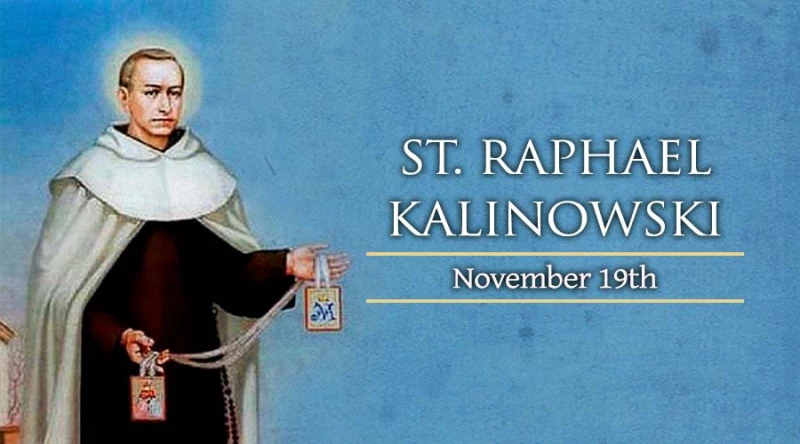
St. Raphael Kalinowski


St. Raphael Kalinowski

Feast date: Nov 19

Saint Raphael was born  in 1835 as Joseph, son of Andrew and Josepha Kalinowski in present day Lithuania. Saint Raphael felt a call to the priesthood early in his life, but decided to complete his education. He studied zoology, chemistry, agriculture, and apiculture at the Institute of Agronomy in Hory Horki, Russia, and at the Academy of Military Engineering in Saint Petersburg, Russia.

Saint Raphael became a Lieutenant in the Russian Military Engineering Corps in 1857. During his post he was responsible for the planning and supervised construction of the railway between Kursk and Odessa. He was promoted to captain in 1862 and stationed in Brest-Litovsk. In Bret-Litovsk he started, taught, and covered all the costs of a Sunday school, accepting anyone interested.

In 1863 he supported the Polish insurrection. He resigned from the Russian army and became the rebellion’s minister of war for the Vilna region. He only took the commission with the understanding that he would never hand out a death sentence nor execute a prisoner. He was soon arrested by Russian authorities, and in June of 1864 he was condemned to death for his part in the revolt. Fearing they would be creating a political martyr, they commuted his sentence to ten years of forced labour in the Siberian salt mines. Part of his sentence was spent in Irkutsk, where his relics have been moved to sanctify the new cathedral.

Upon his release in 1873, he was exiled from his home region in Lithuania. He moved to Paris, France, and worked there as a tutor for three years. In 1877 he finally answered the long-heard call to the religious life, and joined the Carmelite Order at Graz, Austria, taking the name Raphael. He studied theology in Hungary and then joined the Carmelite house in Czama, Poland. He was ordained on January 15, 1882.

Saint Raphael worked to restore the Discalced Carmelites to Poland, and for church unity. He founded a convent at Wadowice, Poland in 1889, and worked alongside Blessed Alphonsus Mary Marurek. He was a noted spiritual director for both Catholics and Orthodox. He was considered  an enthusiastic parish priest and spent countless hours with his parishioners in the confessional. Saint Raphael died in 1907 and was canonized by Pope John Paul II in 1991.

Source: Catholic-forum.com

St. Raphael Kalinowski Read More »

Friday of the Thirty-third Week in Ordinary Time

Reading 1 RV 10:8-11

I, John, heard a voice from heaven speak to me.
Then the voice spoke to me and said:
“Go, take the scroll that lies open in the hand of the angel
who is standing on the sea and on the land.”
So I went up to the angel and told him to give me the small scroll.
He said to me, “Take and swallow it.
It will turn your stomach sour,
but in your mouth it will taste as sweet as honey.”
I took the small scroll from the angel’s hand and swallowed it.
In my mouth it was like sweet honey,
but when I had eaten it, my stomach turned sour.
Then someone said to me, “You must prophesy again
about many peoples, nations, tongues, and kings.”

Responsorial Psalm PS 119:14, 24, 72, 103, 111, 131

R. (103a) How sweet to my taste is your promise!
In the way of your decrees I rejoice,
as much as in all riches.
R. How sweet to my taste is your promise!
Yes, your decrees are my delight;
 they are my counselors.
R. How sweet to my taste is your promise!
The law of your mouth is to me more precious
than thousands of gold and silver pieces.
R. How sweet to my taste is your promise!
How sweet to my palate are your promises,
sweeter than honey to my mouth!
R. How sweet to my taste is your promise!
Your decrees are my inheritance forever;
the joy of my heart they are.
R. How sweet to my taste is your promise!
I gasp with open mouth
in my yearning for your commands.
R. How sweet to my taste is your promise!


Alleluia JN 10:27

R. Alleluia, alleluia.
My sheep hear my voice, says the Lord;
I know them, and they follow me.
R. Alleluia, alleluia.

Gospel LK 19:45-48

Jesus entered the temple area and proceeded to drive out
those who were selling things, saying to them,
“It is written,
My house shall be a house of prayer,
but you have made it a den of thieves.”

And every day he was teaching in the temple area.
The chief priests, the scribes, and the leaders of the people, meanwhile,
were seeking to put him to death,
but they could find no way to accomplish their purpose
because all the people were hanging on his words.

– – –

Lectionary for Mass for Use in the Dioceses of the United States, second typical edition, Copyright © 2001, 1998, 1997, 1986, 1970 Confraternity of Christian Doctrine; Psalm refrain © 1968, 1981, 1997, International Committee on English in the Liturgy, Inc. All rights reserved. Neither this work nor any part of it may be reproduced, distributed, performed or displayed in any medium, including electronic or digital, without permission in writing from the copyright owner.

Friday of the Thirty-third Week in Ordinary Time Read More »