Please mind our dust!

We are currently working on revamping our website!
Thank you for your patience!

CRD Solutions

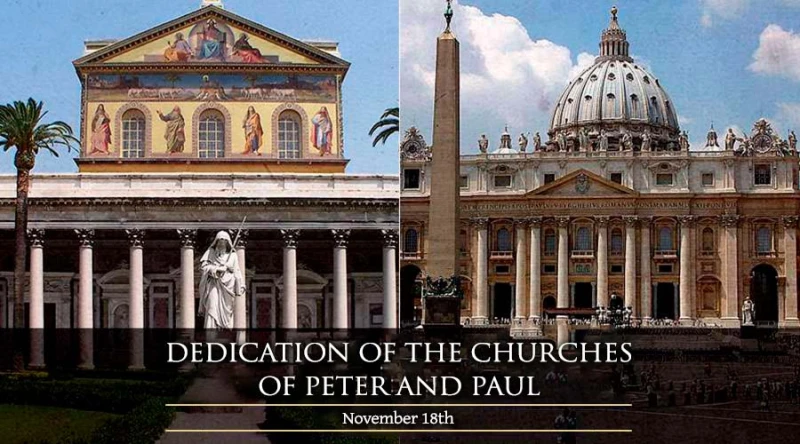
Dedication of the Churches of Peter and Paul


Dedication of the Churches of Peter and Paul

Feast date: Nov 18

This feast celebrates the dedications of two of the four major basilicas of Rome.

Saint Peter’s Basilica was originally built in 323 by the emperor Constantine.  The basilica was constructed over the tomb of Peter the Apostle, the Church’s first Pope.  After standing for more than a thousand years, Pope Julius II ordered the building to be torn down due to structural concerns.  The construction of the new church spanned over 200 years before its completion. It was dedicated on Nov. 18, 1626.  It is considered the most famous church in Christendom.

Saint Paul´s Basilica is located outside the original walls of Rome. It was also originally built by the emperor Constantine though it was destroyed by fire in 1823. Donations from around the world made the reconstruction possible. Before the completion of Saint Peter´s Basilica, St Paul’s was the largest church in Rome.  The Basilica was built over St. Paul´s grave.  Pope Pius IX consecrated the Basilica in 1854.

These two churches continue to draw millions of faithful pilgrims each year as well as many visitors from other faiths .

Dedication of the Churches of Peter and Paul Read More »

St. Rose Philippine Duchesne


St. Rose Philippine Duchesne

Feast date: Nov 18

St. Rose was born into a family with wealth and political connections August 29, 1769 in Grenoble, France. Her father, Pierre Francois Duchesne, was a lawyer, businessman, and prominent civic leader in Grenoble, while her mother, Rose Perier, was a member of a leading family from the Dauphine region. From the young age of eight, St. Rose had a desire to evangelize in the Americas, sparked by hearing a Jesuit missionary speak of his work there. She received a basic education at home from tutors, and religious education from her mother.

Educated from age 12 at the convent of the Visitation nuns in Grenoble, Rose joined them in 1788 at age 19 without the permission or knowledge of her family. Initially they were violently opposed to her choice, but finally gave in.  

In 1804 she joined the Society of the Sacred Heart, which sent her to the United States in 1818. From the convent and school she founded at St. Charles, Mo. — later moved to Florissant, Mo. — she traveled over a wide area, founding schools for girls, doing charitable work, and finally ministering to Native Americans.

St. Rose Duchesne was a valiant missionary and a well-known benefactress. She spent her last ten years in retirement in a tiny shack at the convent in Saint Charles, Missouri where she lived austerely and in constant prayer. She died on November 18, 1852 at Saint Charles, Missouri.

She was beatified on May 12, 1940 by Pope Pius XII, and canonized July 3, 1988 by Pope John Paul II. She is often referred to as “The Lady of Mercy,” or ” Woman Who Prays Always.”

Patronage: Opposition of Church authorities, diocese of Springfield-Cape Girardeau Missouri.

St. Rose Philippine Duchesne Read More »

St. Gregory Thaumaturgus

Feast date: Nov 17

St. Gregory was born to a distinguished pagan family at Neocaesarea, Pontus in 213, and studied law there. In about 233, he and his brother, Athenodorus, accompanied his sister, who was joining her husband in Caesarea, Palestine, while they continued on to Beirut to continue their law studies. They met Origen along the way, and instead of going to Beirut, entered his school at Caesarea, where they studied theology, were converted to Christianity by Origen, and became his disciples.

Gregory returned to Neocaesarea around 238, intending to practice law, but was instead elected bishop by the seventeen Christians of the city. It soon became apparent that he was gifted with remarkable powers. He preached eloquently, and converted so many that he was able to build a church, and soon was so reknowned for his miracles that he was surnamed “Thaumaturgus” (the wonder-worker).

He was a much-sought-after arbiter for his wisdom and legal knowledge and ability, and he advised his flock to go into hiding when Decius’ persecution of the Christians broke out in 250, and fled to the desert with his deacon. On his return, he ministered faithfully to his flock when the plague struck his See and when the Goths devastated Pontus, 252-254, which he described in his “Canonical Letter.”

He participated in the synod of Antioch, 264-265, against Samosata, and fought Sabellianism and Tritheism. It is reported that at his death in 270 at Neocaesarea, only seventeen unbelievers were left in the city.

He is invoked against floods and earthquakes (at one time he reportedly stopped the flooding of Lycus, and at another, he moved a mountain).

According to St. Gregory of Nyssa, Gregory Thaumaturgus experienced a vision of Our Lady, the first such recorded vision. He wrote a panegyric to Origen, a treatise on the Creed, and a dissertation addressed to Theopompus; St. Gregory of Nyssa wrote a panegyric to Gregory Thaumaturgus.

His feast day is Feast day is November 17.

Printed with permission from Catholic-Defense.

St. Gregory Thaumaturgus Read More »

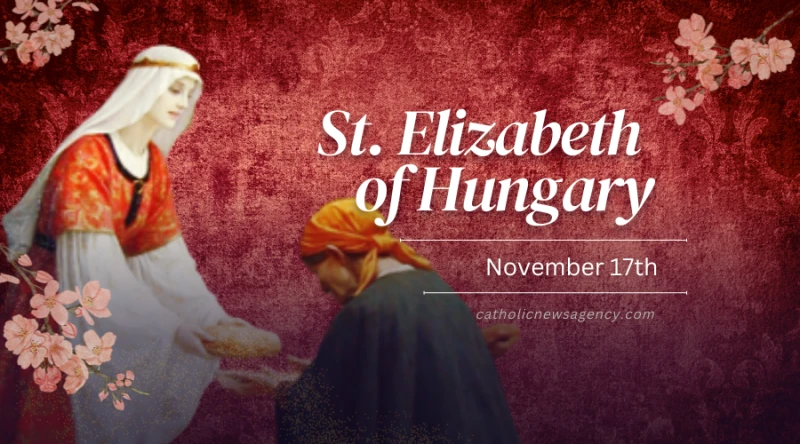
St. Elizabeth of Hungary


St. Elizabeth of Hungary

Feast date: Nov 17

On Nov. 17, the Catholic Church celebrates the life and example of St. Elizabeth of Hungary, a medieval noblewoman who responded to personal tragedy by embracing St. Francis’ ideals of poverty and service. A patron of secular Franciscans, she is especially beloved to Germans, as well as the faithful of her native Hungary.

As the daughter of the Hungarian King Andrew II, Elizabeth had the responsibilities of royalty thrust upon her almost as soon as her short life began in 1207. While she was still very young, Elizabeth’s father arranged for her to be married to a German nobleman, Ludwig of Thuringia.

The plan forced Elizabeth to separate from her parents while still a child. Adding to this sorrow was the murder of Elizabeth’s mother Gertrude in 1213, which history ascribes to a conflict between her own German people and the Hungarian nobles. Elizabeth took a solemn view of life and death from that point on, and found consolation in prayer. Both tendencies drew some ire from her royal peers.

For a time, beginning in 1221, she was happily married. Ludwig, who had advanced to become one of the rulers of Thuringia, supported Elizabeth’s efforts to live out the principles of the Gospel even within the royal court. She met with friars of the nascent Franciscan order during its founder’s own lifetime, resolving to use her position as queen to advance their mission of charity.

Remarkably, Ludwig agreed with his wife’s resolution, and the politically powerful couple embraced a life of remarkable generosity toward the poor. They had three children, two of whom went on to live as as members of the nobility, although one of them –her only son– died relatively young. The third eventually entered religious life and became abbess of a German convent.

In 1226, while Ludwig was attending to political affairs in Italy, Elizabeth took charge of distributing aid to victims of disease and flooding that struck Thuringia. She took charge of caring for the afflicted, even when this required giving up the royal family’s own clothes and goods. Elizabeth arranged for a hospital to be built, and is said to have provided for the needs of nearly a thousand desperately poor people on a daily basis.

The next year, however, would put Elizabeth’s faith to the test. Her husband had promised to assist the Holy Roman Emperor Frederick II in the Sixth Crusade, but he died of illness en route to Jerusalem. Devastated by Ludwig’s death, Elizabeth vowed never to remarry. Her children were sent away, and relatives heavily pressured her to break the vow.

Undeterred, Elizabeth used her remaining money to build another hospital, where she personally attended to the sick almost constantly. Sending away her servants, she joined the Third Order of St. Francis, seeking to emulate the example of its founder as closely as her responsibilities would allow. Near the end of her life, she lived in a small hut and spun her own clothes.

Working continually with the severely ill, Elizabeth became sick herself, dying of illness in November of 1231. After she died, miraculous healings soon began to occur at her grave near the hospital, and she was declared a saint only four years later.

Pope Benedict XVI has praised her as a “model for those in authority,” noting the continuity between her personal love for God, and her public work on behalf of the poor and sick.

Patronage: Bakers; beggars; brides; charitable societies; charitable workers; charities; countesses; death of children; exiles; falsely accused people; hoboes; homeless people; hospitals; in-law problems; lacemakers; lace workers; nursing homes; nursing services; people in exile; people ridiculed for their piety; Sisters of Mercy; tertiaries; Teutonic Knights; toothache; tramps; widows.

Representation: A queen distributing alms; woman wearing a crown and tending to beggars; woman wearing a crown, carrying a load of roses in her apron or mantle.

 

St. Elizabeth of Hungary Read More »

Memorial of Saint Elizabeth of Hungary, Religious

Reading 1 RV 5:1-10

I, John, saw a scroll in the right hand of the one who sat on the throne.
It had writing on both sides and was sealed with seven seals.
Then I saw a mighty angel who proclaimed in a loud voice,
“Who is worthy to open the scroll and break its seals?”
But no one in heaven or on earth or under the earth
was able to open the scroll or to examine it.
I shed many tears because no one was found worthy
to open the scroll or to examine it.
One of the elders said to me, “Do not weep.
The lion of the tribe of Judah, the root of David, has triumphed,
enabling him to open the scroll with its seven seals.”

Then I saw standing in the midst of the throne
and the four living creatures and the elders
a Lamb that seemed to have been slain.
He had seven horns and seven eyes;
these are the seven spirits of God sent out into the whole world.
He came and received the scroll from the right hand
of the one who sat on the throne.
When he took it,
the four living creatures and the twenty-four elders
fell down before the Lamb.
Each of the elders held a harp and gold bowls filled with incense,
which are the prayers of the holy ones.
They sang a new hymn:

“Worthy are you to receive the scroll
and break open its seals,
for you were slain and with your Blood you purchased for God
those from every tribe and tongue, people and nation.
You made them a kingdom and priests for our God,
and they will reign on earth.”
 

Responsorial Psalm PS 149:1B-2, 3-4, 5-6A AND 9B

R. (Rev. 5:10) The Lamb has made us a kingdom of priests to serve our God.
or:
R. Alleluia.
Sing to the LORD a new song
of praise in the assembly of the faithful.
Let Israel be glad in their maker,
let the children of Zion rejoice in their king.
R. The Lamb has made us a kingdom of priests to serve our God.
or:
R. Alleluia.
Let them praise his name in the festive dance,
let them sing praise to him with timbrel and harp.
For the LORD loves his people,
and he adorns the lowly with victory.
R. The Lamb has made us a kingdom of priests to serve our God.
or:
R. Alleluia.
Let the faithful exult in glory;
let them sing for joy upon their couches;
Let the high praises of God be in their throats.
This is the glory of all his faithful. Alleluia.
R. The Lamb has made us a kingdom of priests to serve our God.
or:
R. Alleluia.


Alleluia PS 95:8

R. Alleluia, alleluia.
If today you hear his voice,
harden not your hearts.
R. Alleluia, alleluia.

Gospel LK 19:41-44

As Jesus drew near Jerusalem,
he saw the city and wept over it, saying,
“If this day you only knew what makes for peace–
but now it is hidden from your eyes.
For the days are coming upon you
when your enemies will raise a palisade against you;
they will encircle you and hem you in on all sides.
They will smash you to the ground and your children within you,
and they will not leave one stone upon another within you
because you did not recognize the time of your visitation.”

– – –

Lectionary for Mass for Use in the Dioceses of the United States, second typical edition, Copyright © 2001, 1998, 1997, 1986, 1970 Confraternity of Christian Doctrine; Psalm refrain © 1968, 1981, 1997, International Committee on English in the Liturgy, Inc. All rights reserved. Neither this work nor any part of it may be reproduced, distributed, performed or displayed in any medium, including electronic or digital, without permission in writing from the copyright owner.

Memorial of Saint Elizabeth of Hungary, Religious Read More »