Please mind our dust!

We are currently working on revamping our website!
Thank you for your patience!

CRD Solutions

Wednesday of the Thirty-third Week in Ordinary Time

Reading 1 Rv 4:1-11

I, John, had a vision of an open door to heaven,
and I heard the trumpetlike voice
that had spoken to me before, saying,
“Come up here and I will show you what must happen afterwards.”
At once I was caught up in spirit.
A throne was there in heaven, and on the throne sat one
whose appearance sparkled like jasper and carnelian.
Around the throne was a halo as brilliant as an emerald.
Surrounding the throne I saw twenty-four other thrones
on which twenty-four elders sat,
dressed in white garments and with gold crowns on their heads.
From the throne came flashes of lightning,
rumblings, and peals of thunder.
Seven flaming torches burned in front of the throne,
which are the seven spirits of God.
In front of the throne was something that resembled
a sea of glass like crystal.

In the center and around the throne,
there were four living creatures
covered with eyes in front and in back.
The first creature resembled a lion, the second was like a calf,
the third had a face like that of a man,
and the fourth looked like an eagle in flight.
The four living creatures, each of them with six wings,
were covered with eyes inside and out.
Day and night they do not stop exclaiming:
“Holy, holy, holy is the Lord God almighty,
who was, and who is, and who is to come.”
Whenever the living creatures give glory and honor and thanks
to the one who sits on the throne, who lives forever and ever,
the twenty-four elders fall down
before the one who sits on the throne
and worship him, who lives forever and ever.
They throw down their crowns before the throne, exclaiming:

“Worthy are you, Lord our God,
to receive glory and honor and power,
for you created all things;
because of your will they came to be and were created.”

Responsorial Psalm 150:1b-2, 3-4, 5-6

R.    (1b) Holy, holy, holy Lord, mighty God!
Praise the LORD in his sanctuary,
praise him in the firmament of his strength.
Praise him for his mighty deeds,
praise him for his sovereign majesty.
R.    Holy, holy, holy Lord, mighty God!
Praise him with the blast of the trumpet,
praise him with lyre and harp,
Praise him with timbrel and dance,
praise him with strings and pipe.
R.    Holy, holy, holy Lord, mighty God!
Praise him with sounding cymbals,
praise him with clanging cymbals.
Let everything that has breath
praise the LORD! Alleluia.
R.    Holy, holy, holy Lord, mighty God!


Alleluia See Jn 15:16

R. Alleluia, alleluia.
I chose you from the world,
to go and bear fruit that will last, says the Lord.
R. Alleluia, alleluia.

Gospel Lk 19:11-28

While people were listening to Jesus speak,
he proceeded to tell a parable because he was near Jerusalem
and they thought that the Kingdom of God
would appear there immediately.
So he said,
“A nobleman went off to a distant country
to obtain the kingship for himself and then to return.
He called ten of his servants and gave them ten gold coins
and told them, ‘Engage in trade with these until I return.’
His fellow citizens, however, despised him
and sent a delegation after him to announce,
‘We do not want this man to be our king.’
But when he returned after obtaining the kingship,
he had the servants called, to whom he had given the money,
to learn what they had gained by trading.
The first came forward and said,
‘Sir, your gold coin has earned ten additional ones.’
He replied, ‘Well done, good servant!
You have been faithful in this very small matter;
take charge of ten cities.’
Then the second came and reported,
‘Your gold coin, sir, has earned five more.’
And to this servant too he said,
‘You, take charge of five cities.’
Then the other servant came and said,
‘Sir, here is your gold coin;
I kept it stored away in a handkerchief,
for I was afraid of you, because you are a demanding man;
you take up what you did not lay down
and you harvest what you did not plant.’
He said to him,
‘With your own words I shall condemn you,
you wicked servant.
You knew I was a demanding man,
taking up what I did not lay down
and harvesting what I did not plant;
why did you not put my money in a bank?
Then on my return I would have collected it with interest.’
And to those standing by he said,
‘Take the gold coin from him
and give it to the servant who has ten.’
But they said to him,
‘Sir, he has ten gold coins.’
He replied, ‘I tell you,
to everyone who has, more will be given,
but from the one who has not,
even what he has will be taken away.
Now as for those enemies of mine who did not want me as their king,
bring them here and slay them before me.’”

After he had said this,
he proceeded on his journey up to Jerusalem.

– – –

Lectionary for Mass for Use in the Dioceses of the United States, second typical edition, Copyright © 2001, 1998, 1997, 1986, 1970 Confraternity of Christian Doctrine; Psalm refrain © 1968, 1981, 1997, International Committee on English in the Liturgy, Inc. All rights reserved. Neither this work nor any part of it may be reproduced, distributed, performed or displayed in any medium, including electronic or digital, without permission in writing from the copyright owner.

Wednesday of the Thirty-third Week in Ordinary Time Read More »
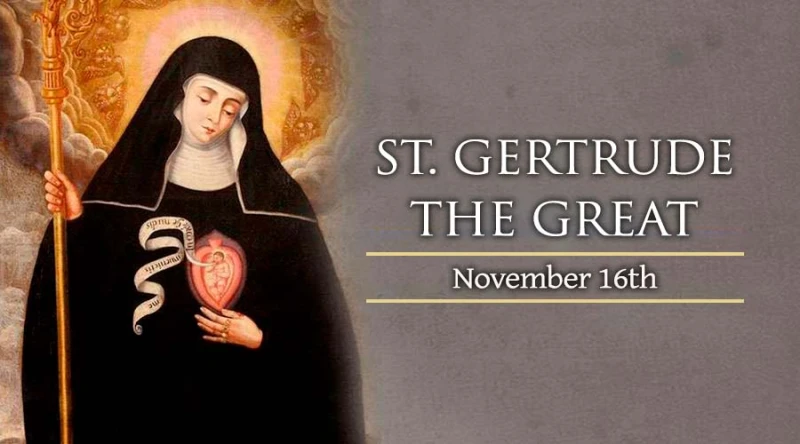
St. Gertrude the Great


St. Gertrude the Great

Feast date: Nov 16

On Nov. 16, the Catholic Church celebrates the memory of a distinguished medieval nun and writer in the Benedictine monastic tradition, Saint Gertrude of Helfta, better known as “St. Gertrude the Great.”

One of the most esteemed woman saints of the Christian West, she was a notable early devotee of the Sacred Heart of Jesus.

“She was an exceptional woman, endowed with special natural talents and extraordinary gifts of grace, the most profound humility and ardent zeal for her neighbor’s salvation,” Pope Benedict XVI said of St. Gertrude in an October 2010 general audience.

“She was in close communion with God both in contemplation and in her readiness to go to the help of those in need.”

Born in Germany on Jan. 6, 1256, Gertrude was sent at age 5 to a monastery in Helfta, to receive her education and religious formation. Under the leadership of the abbess Gertrude of Hackeborn, the monastery was highly regarded for its spiritual and intellectual vitality. The young Gertrude’s teacher, later canonized in her own right, was the abbess’ sister Saint Matilda of Hackeborn.

A gifted student with a great thirst for knowledge, Gertrude excelled in her study of the arts and sciences of her day, while living according to her community’s strict practice of the Rule of Saint Benedict. By her own account, however, something seems to have been lacking in Gertrude’s personal devotion, which suffered due to her overemphasis of intellectual and cultural pursuits.

A change in her priorities began near the end of the year 1280, in the season of Advent. Gertrude was 24 and had greatly distinguished herself in many fields of study. But her accomplishments began to seem meaningless, as she considered the true meaning and goal of her monastic vocation. Anxious and depressed, Gertrude felt she had built a “tower of vanity and curiosity” rather than seeking to love God above all things and live in union with him.

In January of the following year, she experienced a vision of Christ, hearing him declare: “I have come to comfort you and bring you salvation.” During 1281, her priorities shifted dramatically, away from secular knowledge and toward the study of Scripture and theology. Gertrude devoted herself strongly to personal prayer and meditation, and began writing spiritual treatises for the benefit of her monastic sisters.

Understanding the love of Christ as the supreme and fundamental reality, Gertrude communicated this truth in her writings and strove to live in accordance with it. Though acutely aware of her own persistent faults, she also came to understand the depths of God’s mercy. She accepted the illness and pain of her final years in a spirit of personal sacrifice, while recalling the goodness of God that had transformed her life.

St. Gertrude the Great died on Nov. 16, though it is not known whether this was in the year 1301 or 1302. While some of her written works were lost, others survive: “The Herald of Divine Love,” “The Life and Revelations,” and St. Gertrude’s “Spiritual Exercises.”

St. Gertrude the Great Read More »

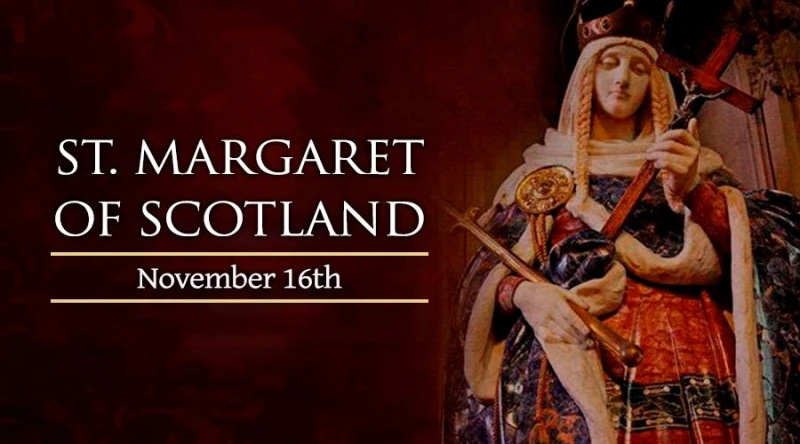
St. Margaret of Scotland


St. Margaret of Scotland

Feast date: Nov 16

On November 16, the Church celebrates the feast day of St. Margaret, Queen of Scotland. Her feast day was originally June 10, but was moved to November 16, the day of her death, upon the renewal of the Church’s Lirutgical calendar. Some continue to celebrate her feast on June 10, but many, including all of Scotland, celebrate her feast today.

Margaret was born into royalty in Hungary around 1045. Her father was Edward Atheling, heir to the English throne, and her mother was Princess Agatha of Hungary. Her family returned to England when she was 10 years old, but the Norman Conquest forced them into exile. By this time, her father had died, and her mother fled with the children. They boarded a ship which crashed onto the coast of Scotland, where they remained.

In 1070, at the age of 25, Margaret married the king of Scotland, Malcolm Canmore. As queen, Margaret’s faith had a strong influence on her husband’s reign. She softened his temper and led him to practice virtue. She dignified the court, providing an example of purity and reverence that led others to follow in her path. She and the king prayed together and fed the hungry, offering a powerful witness of faith to the people they served.

In addition to being a model wife and mother, Margaret worked tirelessly to bring justice and relief to the poor of Scotland. She also built churches and encouraged practices of religious devotion. In her private life, she exhibited great prayerfulness and piety. Her influence was seen not only in her husband’s life, but throughout all of Scotland.

Margaret died in 1093, just four days after her husband and one of her sons were killed in battle. She was canonized in 1250 by Pope Innocent IV and named patron of Scotland in 1673.

St. Margaret of Scotland Read More »

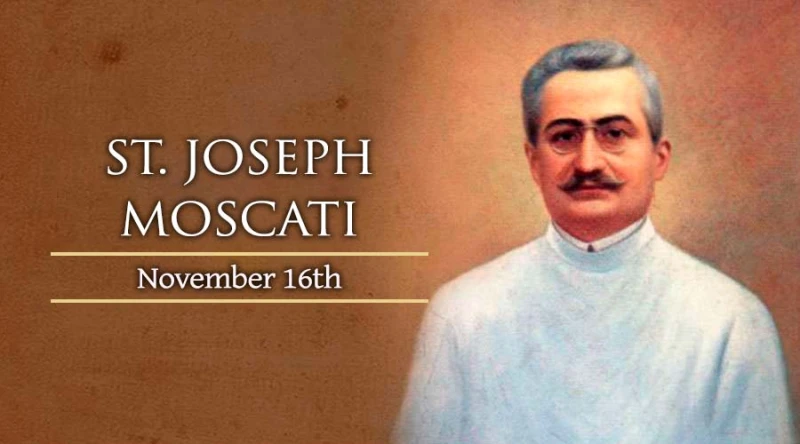
St. Joseph Moscati


St. Joseph Moscati

Feast date: Nov 16

On November 16, the Church celebrates the feast of St. Joseph Moscati, the first modern medical doctor to be canonized. Born on July 25, 1880 in Benevento, Italy, he lived out the Gospel through his position as a teacher and physician. There are a number of stories of Dr. Moscati paying close attention to the state of his patient’s soul as well as the body, sometimes even bringing the patient back to the sacraments. The Catholic understanding of body and soul clearly informed his understanding of illness and medicine. He saw Confession and Communion as the “first medicine.”

He is quoted as once having said, “Remember that you have to deal not only with the bodies but also with the moaning souls coming to you.”

Dr. Moscati’s holiness and devotion wasn’t just limited to his practice. To help the poor, he often donated his medical services or paid for his patients’ prescriptions.

St. Joseph Moscati also felt it was important to support priests and those in religious life with his prayers because, as he said: “They are easily forgotten by the living, since Christians often think that they do not need prayers.”

He carried a Rosary in his pocket as a reminder throughout his day and as a way to draw him to Our Lady — and through her, to Jesus — when he needed to make important decisions.

St. Joseph Moscati died on April 12, 1927 of natural causes in his office between patient appointments. He was beatified on November 16, 1975 by Pope Paul VI and canonized on October 25, 1987 by Pope John Paul II. His body rests in Naples, Italy, in the Church of Gesu Nuovo.

St. Joseph Moscati Read More »

Tuesday of the Thirty-third Week in Ordinary Time

Reading 1 RV 3:1-6, 14-22

I, John, heard the Lord saying to me:
“To the angel of the Church in Sardis, write this:

“‘The one who has the seven spirits of God
and the seven stars says this: “I know your works,
that you have the reputation of being alive, but you are dead.
Be watchful and strengthen what is left, which is going to die,
for I have not found your works complete in the sight of my God.
Remember then how you accepted and heard; keep it, and repent.
If you are not watchful, I will come like a thief,
and you will never know at what hour I will come upon you.
However, you have a few people in Sardis
who have not soiled their garments;
they will walk with me dressed in white,
because they are worthy.“‘

The victor will thus be dressed in white,
and I will never erase his name from the book of life
but will acknowledge his name in the presence of my Father
and of his angels.

“‘Whoever has ears ought to hear what the Spirit says to the churches.’”“

“To the angel of the Church in Laodicea, write this:

“‘The Amen, the faithful and true witness,
the source of God’s creation, says this:
“I know your works;
I know that you are neither cold nor hot.
I wish you were either cold or hot.
So, because you are lukewarm, neither hot nor cold,
I will spit you out of my mouth.
For you say, ‘I am rich and affluent and have no need of anything,’
and yet do not realize that you are wretched,
pitiable, poor, blind, and naked.
I advise you to buy from me gold refined by fire so that you may be rich,
and white garments to put on
so that your shameful nakedness may not be exposed,
and buy ointment to smear on your eyes so that you may see.
Those whom I love, I reprove and chastise.
Be earnest, therefore, and repent.

“‘Behold, I stand at the door and knock.
If anyone hears my voice and opens the door,
then I will enter his house and dine with him,
and he with me.
I will give the victor the right to sit with me on my throne,
as I myself first won the victory
and sit with my Father on his throne.

“‘Whoever has ears ought to hear
what the Spirit says to the churches.’”
 

Responsorial Psalm PS 15:2-3A, 3BC-4AB, 5

R. (Rev. 3: 21) I will seat the victor beside me on my throne.
He who walks blamelessly and does justice;
who thinks the truth in his heart
and slanders not with his tongue.
R. I will seat the victor beside me on my throne.
Who harms not his fellow man,
nor takes up a reproach against his neighbor;
By whom the reprobate is despised,
while he honors those who fear the LORD.
R. I will seat the victor beside me on my throne.
Who lends not his money at usury
and accepts no bribe against the innocent.
He who does these things
shall never be disturbed.
R. I will seat the victor beside me on my throne.


Alleluia 1 JN 4:10B

R. Alleluia, alleluia.
God loved us, and sent his Son
as expiation for our sins.
R. Alleluia, alleluia.

Gospel LK 19:1-10

At that time Jesus came to Jericho and intended to pass through the town.
Now a man there named Zacchaeus,
who was a chief tax collector and also a wealthy man, 
was seeking to see who Jesus was;
but he could not see him because of the crowd,
for he was short in stature. 
So he ran ahead and climbed a sycamore tree in order to see Jesus,
who was about to pass that way.
When he reached the place, Jesus looked up and said, 
“Zacchaeus, come down quickly,
for today I must stay at your house.” 
And he came down quickly and received him with joy. 
When they saw this, they began to grumble, saying, 
“He has gone to stay at the house of a sinner.” 
But Zacchaeus stood there and said to the Lord,
“Behold, half of my possessions, Lord, I shall give to the poor,
and if I have extorted anything from anyone
I shall repay it four times over.”
And Jesus said to him,
“Today salvation has come to this house
because this man too is a descendant of Abraham. 
For the Son of Man has come to seek
and to save what was lost.”

– – –

Lectionary for Mass for Use in the Dioceses of the United States, second typical edition, Copyright © 2001, 1998, 1997, 1986, 1970 Confraternity of Christian Doctrine; Psalm refrain © 1968, 1981, 1997, International Committee on English in the Liturgy, Inc. All rights reserved. Neither this work nor any part of it may be reproduced, distributed, performed or displayed in any medium, including electronic or digital, without permission in writing from the copyright owner.

Tuesday of the Thirty-third Week in Ordinary Time Read More »