Please mind our dust!

We are currently working on revamping our website!
Thank you for your patience!

CRD Solutions

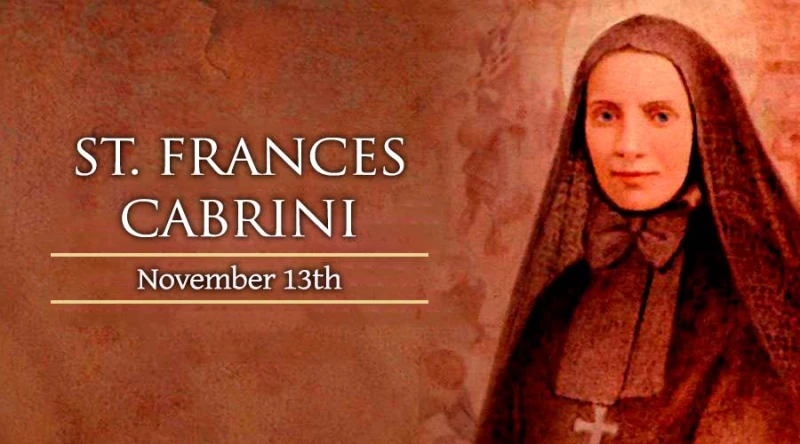
St. Frances Cabrini


St. Frances Cabrini

Feast date: Nov 13

On November 13, the universal Church honors St. Frances Xavier Cabrini, an Italian missionary who spent much of her life working with Italian immigrants in the United States. Mother Cabrini, who had a deathly fear of water and drowning, crossed the Atlantic Ocean more than 30 times in service of the Church and the people she was serving.

St. Frances Cabrini, from a young age, longed to be a missionary in China, but God had other plans for her. Orphaned in Italy before she was 18, she joined the Sisters of the Sacred Heart and took on the name “Xavier” in honor of St. Francis Xavier, the great missionary to the Orient.

At the advice of Pope Leo XIII, who told her “Not to the East, but to the West,” she focused her missionary efforts on the United States. Accepting Archbishop Corrigan of New York’s invitation, she came to America and spent nearly 30 years traveling back and forth across the Atlantic Ocean as well as around the United States setting up orphanages, hospitals, convents, and schools for the often marginalized Italian immigrants.

Eventually, St. Frances became a naturalized U.S. citizen. She died in 1917 and was canonized in 1946, just before a new wave of immigrants began to arrive in the U.S.

St. Frances Cabrini is the patron of immigrants.

St. Frances Cabrini Read More »

Memorial of Saint Josaphat, Bishop and Martyr

Reading 1 3 JN 5-8

Beloved, you are faithful in all you do for the brothers and sisters,
especially for strangers;
they have testified to your love before the Church.
Please help them in a way worthy of God to continue their journey.
For they have set out for the sake of the Name
and are accepting nothing from the pagans.
Therefore, we ought to support such persons,
so that we may be co-workers in the truth.

Responsorial Psalm PS 112:1-2, 3-4, 5-6

R. Blessed the man who fears the Lord.
or:
R. Alleluia.
Blessed the man who fears the LORD,
who greatly delights in his commands.
His posterity shall be mighty upon the earth;
the upright generation shall be blessed.
R. Blessed the man who fears the Lord.
or:
R. Alleluia.
Wealth and riches shall be in his house;
his generosity shall endure forever.
Light shines through the darkness for the upright;
he is gracious and merciful and just.
R. Blessed the man who fears the Lord.
or:
R. Alleluia.
Well for the man who is gracious and lends,
who conducts his affairs with justice;
He shall never be moved;
the just one shall be in everlasting remembrance.
R. Blessed the man who fears the Lord.
or:
R. Alleluia.


Alleluia See 2 THES 2:14

R. Alleluia, alleluia.
God has called us through the Gospel,
to possess the glory of our Lord Jesus Christ.
R. Alleluia, alleluia.

Gospel LK 18:1-8

Jesus told his disciples a parable
about the necessity for them to pray always without becoming weary. 
He said, “There was a judge in a certain town
who neither feared God nor respected any human being. 
And a widow in that town used to come to him and say,
‘Render a just decision for me against my adversary.’
For a long time the judge was unwilling, but eventually he thought,
‘While it is true that I neither fear God nor respect any human being, 
because this widow keeps bothering me
I shall deliver a just decision for her
lest she finally come and strike me.’” 
The Lord said, “Pay attention to what the dishonest judge says. 
Will not God then secure the rights of his chosen ones
who call out to him day and night? 
Will he be slow to answer them? 
I tell you, he will see to it that justice is done for them speedily. 
But when the Son of Man comes, will he find faith on earth?”

– – –

Lectionary for Mass for Use in the Dioceses of the United States, second typical edition, Copyright © 2001, 1998, 1997, 1986, 1970 Confraternity of Christian Doctrine; Psalm refrain © 1968, 1981, 1997, International Committee on English in the Liturgy, Inc. All rights reserved. Neither this work nor any part of it may be reproduced, distributed, performed or displayed in any medium, including electronic or digital, without permission in writing from the copyright owner.

Memorial of Saint Josaphat, Bishop and Martyr Read More »

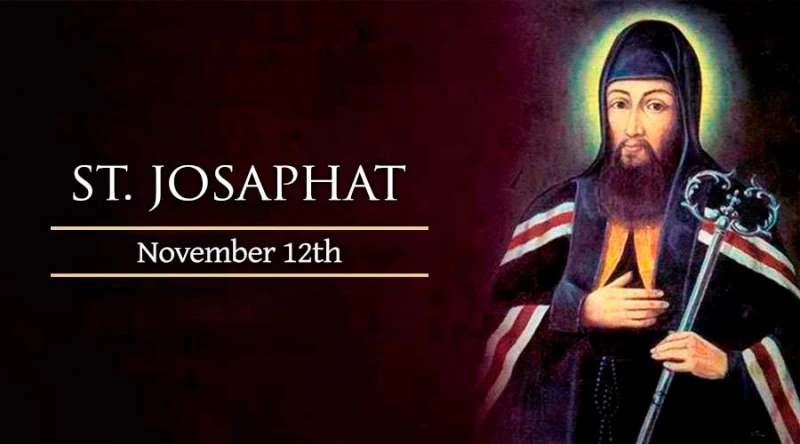
St. Josaphat


St. Josaphat

Feast date: Nov 12

Today, on the day of his martyrdom, Nov. 12, Roman Catholics and some Eastern Catholics remember St. Josaphat Kuntsevych, a bishop and monk whose example of faith inspired many Eastern Orthodox Christians to return to full communion with the Holy See.

Other Eastern Catholics, including the Ukrainian Catholic Church, celebrate St. Josaphat’s feast day on Nov. 25.

Born in 1580 in the western Ukrainian region of Volhynia, John Kuntsevych did not become “Josaphat” until his later life as a monk. He also was not initially a full member of the Catholic Church, born to Orthodox Christian parents whose church had fallen out of communion with the Pope.

Although the Eastern churches began to separate from the Holy See in 1054, a union had existed for a period of time after the 15th century Ecumenical Council of Florence. But social, political and theological disputes caused the union to begin dissolving even before the Turkish conquest of Byzantium in 1453. By John’s time, many Slavic Orthodox Christians had become strongly anti-Catholic.

During this time, Latin missionaries attempted to achieve reunion with the individual eastern patriarchs. The approach was risky, sometimes politicizing the faith and leading to further divisions. But it did yield some notable successes, including the reunion of John’s own Ruthenian Church in the 1596 Union of Brest.

John was trained as a merchant’s apprentice and could have opted for marriage. But he felt drawn to the rigors and spiritual depth of traditional Byzantine monasticism. Taking the monastic name of Josaphat, he entered a Ukrainian monastery in 1604.

The young monk was taking on an ambitious task, striving to re-incorporate the Eastern Orthodox tradition with the authority of the Catholic Church in the era of its “Counter-reformation.” Soon, as a priest, subsequently an archbishop, and ultimately a martyr, he would live and die for the union of the churches.

While rejecting the anti-Western sentiments of many of his countrymen, Josaphat also resisted any attempt to compromise the Eastern Catholic churches’ own traditions. Recognizing the urgent pastoral needs of the people, he produced catechisms and works of apologetics, while implementing long overdue reforms of the clergy and attending to the needs of the poor.

Josaphat’s exemplary life and zeal for the care of souls won the trust of many Orthodox Christians, who saw the value of the churches’ union reflected in the archbishop‘s life and works. Nevertheless, his mission was essentially controversial, and others were led to believe lurid stories and malicious suggestions made about him. In 1620, opponents arranged for the consecration of a rival archbishop.

As tensions between supporters and opponents began to escalate, Josaphat lamented the onset of attacks that would lead to his death. “You people of Vitebsk want to put me to death,” he protested. “You make ambushes for me everywhere, in the streets, on the bridges, on the highways, and in the marketplace. I am here among you as a shepherd, and you ought to know that I would be happy to give my life for you.”

He finally did so, on a fall day in 1623. An Orthodox priest had been shouting insults outside the archbishop’s residence, and trying to force his way inside. Josaphat had him removed, but the man assembled a mob in the town. They arrived and demanded the archbishop’s life, threatening his companions and servants. Unable to escape, Josaphat died praying for the men who shot and then beheaded him before dumping his body in a river.

St. Josaphat’s body was discovered incorrupt, five years later. Remarkably, the saint’s onetime rival – the Orthodox Archbishop Meletius – was reconciled with the Catholic Church in later years. St. Josaphat was canonized in 1867.

St. Josaphat Read More »

Memorial of Saint Martin of Tours, Bishop

Reading 1 2 JN 4-9

[Chosen Lady:]
I rejoiced greatly to find some of your children walking in the truth
just as we were commanded by the Father.
But now, Lady, I ask you,
not as though I were writing a new commandment
but the one we have had from the beginning:
let us love one another.
For this is love, that we walk according to his commandments;
this is the commandment, as you heard from the beginning,
in which you should walk.

Many deceivers have gone out into the world,
those who do not acknowledge Jesus Christ as coming in the flesh;
such is the deceitful one and the antichrist.
Look to yourselves that you do not lose what we worked for
but may receive a full recompense.
Anyone who is so “progressive”
as not to remain in the teaching of the Christ does not have God;
whoever remains in the teaching has the Father and the Son.

Responsorial Psalm PS 119:1, 2, 10, 11, 17, 18

R. (1b) Blessed are they who follow the law of the Lord!
Blessed are they whose way is blameless,
who walk in the law of the LORD.
R. Blessed are they who follow the law of the Lord!
Blessed are they who observe his decrees,
who seek him with all their heart.
R. Blessed are they who follow the law of the Lord!
 With all my heart I seek you;
let me not stray from your commands.
R. Blessed are they who follow the law of the Lord!
Within my heart I treasure your promise,
that I may not sin against you.
R. Blessed are they who follow the law of the Lord!
Be good to your servant, that I may live
and keep your words.
R. Blessed are they who follow the law of the Lord!
Open my eyes, that I may consider
the wonders of your law.
R. Blessed are they who follow the law of the Lord!


Alleluia LK 21:28

R. Alleluia, alleluia.
Stand erect and raise your heads
because your redemption is at hand.
R. Alleluia, alleluia.

Gospel LK 17:26-37

Jesus said to his disciples:
“As it was in the days of Noah,
so it will be in the days of the Son of Man;
they were eating and drinking,
marrying and giving in marriage up to the day
that Noah entered the ark,
and the flood came and destroyed them all.
Similarly, as it was in the days of Lot:
they were eating, drinking, buying,
selling, planting, building;
on the day when Lot left Sodom,
fire and brimstone rained from the sky to destroy them all.
So it will be on the day the Son of Man is revealed.
On that day, someone who is on the housetop
and whose belongings are in the house
must not go down to get them,
and likewise one in the field
must not return to what was left behind.
Remember the wife of Lot.
Whoever seeks to preserve his life will lose it,
but whoever loses it will save it.
I tell you, on that night there will be two people in one bed;
one will be taken, the other left.
And there will be two women grinding meal together;
one will be taken, the other left.” 
They said to him in reply, “Where, Lord?”
He said to them, “Where the body is,
there also the vultures will gather.”

– – –

Lectionary for Mass for Use in the Dioceses of the United States, second typical edition, Copyright © 2001, 1998, 1997, 1986, 1970 Confraternity of Christian Doctrine; Psalm refrain © 1968, 1981, 1997, International Committee on English in the Liturgy, Inc. All rights reserved. Neither this work nor any part of it may be reproduced, distributed, performed or displayed in any medium, including electronic or digital, without permission in writing from the copyright owner.

Memorial of Saint Martin of Tours, Bishop Read More »

St. Martin of Tours


St. Martin of Tours

Feast date: Nov 11

On Nov. 11, the Catholic Church honors St. Martin of Tours, who left his post in the Roman army to become a “soldier of Christ” as a monk and later bishop.

Martin was born around the year 316 in modern-day Hungary. His family left that region for Italy when his father, a military official of the Roman Empire, had to transfer there. Martin’s parents were pagans, but he felt an attraction to the Catholic faith which had become legal throughout the empire in 313. He received religious instruction at age 10, and even considered becoming a hermit in the desert.

Circumstances, however, forced him to join the Roman army at age 15, when he had not even received baptism. Martin strove to live a humble and upright life in the military, giving away much of his pay to the poor. His generosity led to a life-changing incident, when he encountered a man freezing without warm clothing near a gate at the city of Amiens in Gaul.

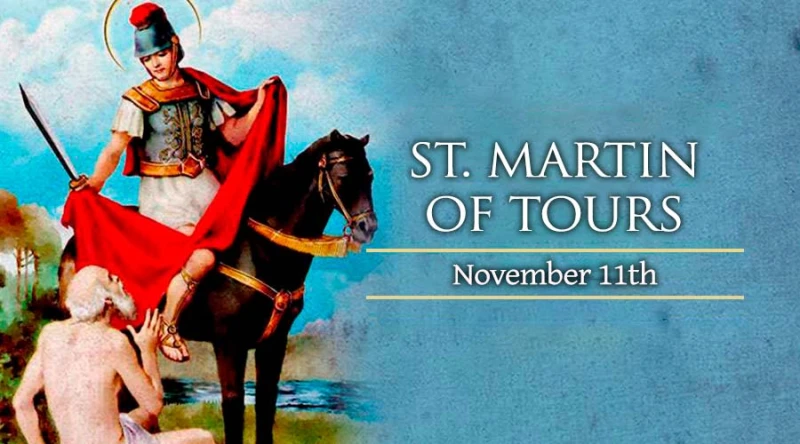
As his fellow soldiers passed by the man, Martin stopped and cut his own cloak into two halves with his sword, giving one half to the freezing beggar. That night, the unbaptized soldier saw Christ in a dream, wearing the half-cloak he had given to the poor man. Jesus declared: “Martin, a catechumen, has clothed me with this garment.”

Martin knew that the time for him to join the Church had arrived. He remained in the army for two years after his baptism, but desired to give his life to God more fully that the profession would allow. But when he finally asked for permission to leave the Roman army, during an invasion by the Germans, Martin was accused of cowardice.

He responded by offering to stand before the enemy forces unarmed. “In the name of the Lord Jesus, and protected not by a helmet and buckler, but by the sign of the cross, I will thrust myself into the thickest squadrons of the enemy without fear.” But this display of faith became unnecessary when the Germans sought peace instead, and Martin received his discharge.

After living as a Catholic for some time, Martin traveled to meet Bishop Hilary of Poitiers, a skilled theologian and later canonized saint. Martin’s dedication to the faith impressed the bishop, who asked the former soldier to return to his diocese after he had undertaken a journey back to Hungary to visit his parents. While there, Martin persuaded his mother, though not his father, to join the Church.

In the meantime, however, Hilary had provoked the anger of the Arians, a group that denied Jesus was God. This resulted in the bishop’s banishment, so that Martin could not return to his diocese as intended. Instead Martin spent some time living a life of severe asceticism, which almost resulted in his death. The two met up again in 360, when Hilary’s banishment from Poitiers ended.

After their reunion Hilary granted Martin a piece of land to build what may have been the first monastery in the region of Gaul. During the resulting decade as a monk, Martin became renowned for raising two people from the dead through his prayers. This evidence of his holiness led to his appointment as the third Bishop of Tours in the middle of present-day France.

Martin had not wanted to become a bishop, and had actually been tricked into leaving his monastery in the first place by those who wanted him the lead the local church. Once appointed, he continued to live as a monk, dressing plainly and owning no personal possessions. In this same spirit of sacrifice, he traveled throughout his diocese, from which he is said to have driven out pagan practices.

Both the Church and the Roman Empire passed through a time of upheaval during Martin’s time as bishop. Priscillianism, a heresy involving salvation through a system of secret knowledge, caused such serious problems in Spain and Gaul that civil authorities sentenced the heretics to death. But Martin, along with the Pope and St. Ambrose of Milan, opposed this death sentence for the Priscillianists.

Even in old age, Martin continued to live an austere life focused on the care of souls. His disciple and biographer, St. Sulpicius Severus, noted that the bishop helped all people with their moral, intellectual and spiritual problems. He also helped many laypersons discover their calling to the consecrated life of poverty, chastity and obedience.

Martin foresaw his own death and told his disciples of it. But when his last illness came upon him during a pastoral journey, the bishop felt uncertain about leaving his people.

“Lord, if I am still necessary to thy people, I refuse no labour. Thy holy will be done,” he prayed. He developed a fever, but did not sleep, passing his last several nights in the presence of God in prayer.

“Allow me, my brethren, to look rather towards heaven than upon the earth, that my soul may be directed to take its flight to the Lord to whom it is going,” he told his followers, shortly before he died in November of 397.

St. Martin of Tours has historically been among the most beloved saints in the history of Europe. In a 2007 Angelus address, Pope Benedict XVI expressed his hope “that all Christians may be like St Martin, generous witnesses of the Gospel of love and tireless builders of jointly responsible sharing.”
St. Martin of Tours Read More »