Please mind our dust!

We are currently working on revamping our website!
Thank you for your patience!

CRD Solutions

Pope St. Leo the Great
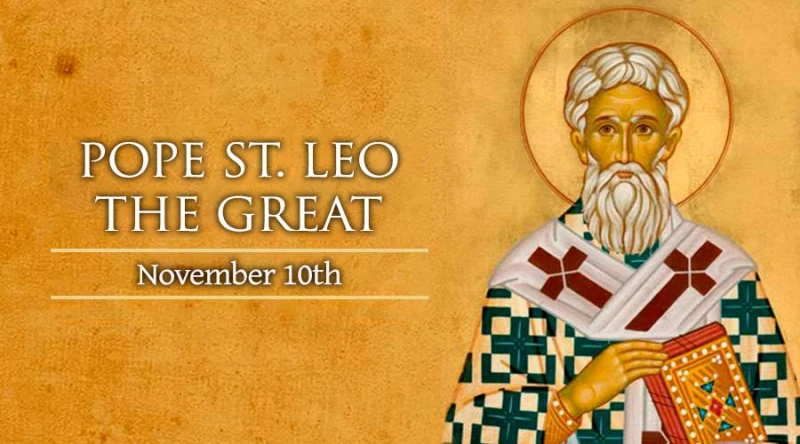

Pope St. Leo the Great

Feast date: Nov 10

Nov. 10 is the Roman Catholic Church’s liturgical memorial of the fifth-century Pope Saint Leo I, known as “St. Leo the Great,” whose involvement in the fourth ecumenical council helped prevent the spread of error on Christ’s divine and human natures.

St. Leo intervened for the safety of the Church in the West as well, persuading Attila the Hun to turn back from Rome.

Eastern Catholics and Eastern Orthodox Christians also maintain a devotion to the memory of Pope St. Leo the Great. Churches of the Byzantine tradition celebrate his feast day on Feb. 18.

“As the nickname soon attributed to him by tradition suggests,” Pope Benedict XVI said in a 2008 general audience on the saint, “he was truly one of the greatest pontiffs to have honoured the Roman See and made a very important contribution to strengthening its authority and prestige.”

Leo’s origins are obscure and his date of birth unknown. His ancestors are said to have come from Tuscany, though the future pope may have been born in that region or in Rome itself. He became a deacon in Rome in approximately 430, during the pontificate of Pope Celestine I.

During this time, central authority was beginning to decline in the Western portion of the Roman Empire. At some point between 432 and 440, during the reign of Pope St. Celestine’s successor Pope Sixtus III, the Roman Emperor Valentinian III commissioned Leo to travel to the region of Gaul and settle a dispute between military and civil officials.

Pope Sixtus III died in 440 and, like his predecessor Celestine, was canonized as a saint. Leo, away on his diplomatic mission at the time of the Pope’s death, was chosen to be the next Bishop of Rome. Reigning for over two decades, he sought to preserve the unity of the Church in its profession of faith, and to ensure the safety of his people against frequent barbarian invasions.

Leo used his authority, in both doctrinal and disciplinary matters, against a number of heresies troubling the Western church – including Pelagianism (involving the denial of Original Sin) and Manichaeanism (a gnostic system that saw matter as evil). In this same period, many Eastern Christians had begun arguing about the relationship between Jesus’ humanity and divinity.

As early as 445, Leo had intervened in this dispute in the East, which threatened to split the churches of Alexandria and Constantinople. Its eventual resolution was, in fact, rejected in some quarters – leading to the present-day split between Eastern Orthodoxy and the so-called “non-Chalcedonian churches” which accept only three ecumenical councils.

As the fifth-century Christological controversy continued, the Pope urged the gathering of an ecumenical council to resolve the matter. At the Council of Chalcedon in 451, the Pope’s teaching was received as authoritative by the Eastern bishops, who proclaimed: “Peter has spoken through the mouth of Leo.”

Leo’s teaching confirmed that Christ’s eternal divine personhood and nature did not absorb or negate the human nature that he assumed in time through the Incarnation. Instead, “the proper character of both natures was maintained and came together in a single person.”

“So without leaving his Father’s glory behind, the Son of God comes down from his heavenly throne and enters the depths of our world,” the Pope taught. “Whilst remaining pre-existent, he begins to exist in time. The Lord of the universe veiled his measureless majesty and took on a servant’s form. The God who knew no suffering did not despise becoming a suffering man, and, deathless as he is, to be subject to the laws of death.”

In 452, one year after the Council of Chalcedon, Pope Leo led a delegation which successfully negotiated with the barbarian king Attila to prevent an invasion of Rome. When the Vandal leader Genseric occupied Rome in 455, the Pope confronted him, unarmed, and obtained a guarantee of safety for many of the city’s inhabitants and the churches to which they had fled.

Pope St. Leo the Great died on Nov. 10, 461. He was proclaimed a Doctor of the Church by Pope Benedict XIV in 1754. A large collection of his writings and sermons survives, and can be read in translation today.

Pope St. Leo the Great Read More »

Memorial of Saint Leo the Great, Pope and Doctor of the Church

Reading 1 PHMN 7-20

Beloved:
I have experienced much joy and encouragement from your love,
because the hearts of the holy ones
have been refreshed by you, brother.
Therefore, although I have the full right in Christ
to order you to do what is proper,
I rather urge you out of love,
being as I am, Paul, an old man,
and now also a prisoner for Christ Jesus.
I urge you on behalf of my child Onesimus,
whose father I have become in my imprisonment,
who was once useless to you but is now useful to both you and me.
I am sending him, that is, my own heart, back to you.
I should have liked to retain him for myself,
so that he might serve me on your behalf
in my imprisonment for the Gospel,
but I did not want to do anything without your consent,
so that the good you do might not be forced but voluntary.
Perhaps this is why he was away from you for a while,
that you might have him back forever,
no longer as a slave but more than a slave, a brother,
beloved especially to me, but even more so to you,
as a man and in the Lord.
So if you regard me as a partner, welcome him as you would me.
And if he has done you any injustice
or owes you anything, charge it to me.
I, Paul, write this in my own hand: I will pay.
May I not tell you that you owe me your very self.
Yes, brother, may I profit from you in the Lord.
Refresh my heart in Christ.

Responsorial Psalm PS 146:7, 8-9A, 9BC-10

R. (5a) Blessed is he whose help is the God of Jacob.
or:
R. Alleluia.
The LORD secures justice for the oppressed,
gives food to the hungry.
The LORD sets captives free.
R. Blessed is he whose help is the God of Jacob.
or:
R. Alleluia.
The LORD gives sight to the blind.
The LORD raises up those who were bowed down;
the LORD loves the just.
The LORD protects strangers.
R. Blessed is he whose help is the God of Jacob.
or:
R. Alleluia.
The fatherless and the widow he sustains,
but the way of the wicked he thwarts.
The LORD shall reign forever;
your God, O Zion, through all generations. Alleluia.
R. Blessed is he whose help is the God of Jacob.
or:
R. Alleluia.


Alleluia JN 15:5

R. Alleluia, alleluia.
I am the vine, you are the branches, says the Lord:
whoever remains in me and I in him will bear much fruit.
R. Alleluia, alleluia.

Gospel LK 17:20-25

Asked by the Pharisees when the Kingdom of God would come,
Jesus said in reply,
“The coming of the Kingdom of God cannot be observed,
and no one will announce, ‘Look, here it is,’ or, ‘There it is.’
For behold, the Kingdom of God is among you.”

Then he said to his disciples,
“The days will come when you will long to see
one of the days of the Son of Man, but you will not see it.
There will be those who will say to you,
‘Look, there he is,’ or ‘Look, here he is.’
Do not go off, do not run in pursuit.
For just as lightning flashes
and lights up the sky from one side to the other,
so will the Son of Man be in his day.
But first he must suffer greatly and be rejected by this generation.”
 

– – –

Lectionary for Mass for Use in the Dioceses of the United States, second typical edition, Copyright © 2001, 1998, 1997, 1986, 1970 Confraternity of Christian Doctrine; Psalm refrain © 1968, 1981, 1997, International Committee on English in the Liturgy, Inc. All rights reserved. Neither this work nor any part of it may be reproduced, distributed, performed or displayed in any medium, including electronic or digital, without permission in writing from the copyright owner.

Memorial of Saint Leo the Great, Pope and Doctor of the Church Read More »

Feast of the Dedication of the Lateran Basilica in Rome

Reading I Ez 47:1-2, 8-9, 12

The angel brought me
back to the entrance of the temple,
and I saw water flowing out
from beneath the threshold of the temple toward the east,
for the façade of the temple was toward the east;
the water flowed down from the southern side of the temple,
south of the altar.
He led me outside by the north gate,
and around to the outer gate facing the east,
where I saw water trickling from the southern side.
He said to me,
“This water flows into the eastern district down upon the Arabah,
and empties into the sea, the salt waters, which it makes fresh.
Wherever the river flows,
every sort of living creature that can multiply shall live,
and there shall be abundant fish,
for wherever this water comes the sea shall be made fresh.
Along both banks of the river, fruit trees of every kind shall grow;
their leaves shall not fade, nor their fruit fail.
Every month they shall bear fresh fruit,
for they shall be watered by the flow from the sanctuary.
Their fruit shall serve for food, and their leaves for medicine.”

Responsorial Psalm 46:2-3, 5-6, 8-9

R.    (5) The waters of the river gladden the city of God, the holy dwelling of the Most High!
God is our refuge and our strength,
    an ever-present help in distress.
Therefore, we fear not, though the earth be shaken
    and mountains plunge into the depths of the sea.
R.    The waters of the river gladden the city of God, the holy dwelling of the Most High!
There is a stream whose runlets gladden the city of God,
    the holy dwelling of the Most High.
God is in its midst; it shall not be disturbed;
    God will help it at the break of dawn.
R.    The waters of the river gladden the city of God, the holy dwelling of the Most High!
The LORD of hosts is with us;
    our stronghold is the God of Jacob.
Come! behold the deeds of the LORD,
    the astounding things he has wrought on earth. 
R.    The waters of the river gladden the city of God, the holy dwelling of the Most High!

Reading II 1 Cor 3:9c-11, 16-17

Brothers and sisters:
You are God’s building.
According to the grace of God given to me,
like a wise master builder I laid a foundation,
and another is building upon it.
But each one must be careful how he builds upon it,
for no one can lay a foundation other than the one that is there,
namely, Jesus Christ.

Do you not know that you are the temple of God,
and that the Spirit of God dwells in you?
If anyone destroys God’s temple,
God will destroy that person;
for the temple of God, which you are, is holy.

Alleluia 2 Chr 7:16

R. Alleluia, alleluia.
I have chosen and consecrated this house, says the Lord,
that my name may be there forever.
R. Alleluia, alleluia.

Gospel Jn 2:13-22

Since the Passover of the Jews was near,
Jesus went up to Jerusalem.
He found in the temple area those who sold oxen, sheep, and doves,
as well as the money-changers seated there.
He made a whip out of cords
and drove them all out of the temple area, with the sheep and oxen,
and spilled the coins of the money-changers
and overturned their tables,
and to those who sold doves he said,
“Take these out of here,
and stop making my Father’s house a marketplace.”
His disciples recalled the words of Scripture,
    Zeal for your house will consume me.
At this the Jews answered and said to him,
“What sign can you show us for doing this?”
Jesus answered and said to them,
“Destroy this temple and in three days I will raise it up.”
The Jews said,
“This temple has been under construction for forty-six years,
and you will raise it up in three days?”
But he was speaking about the temple of his Body.
Therefore, when he was raised from the dead,
his disciples remembered that he had said this,
and they came to believe the Scripture
and the word Jesus had spoken.

– – –

Lectionary for Mass for Use in the Dioceses of the United States, second typical edition, Copyright © 2001, 1998, 1997, 1986, 1970 Confraternity of Christian Doctrine; Psalm refrain © 1968, 1981, 1997, International Committee on English in the Liturgy, Inc. All rights reserved. Neither this work nor any part of it may be reproduced, distributed, performed or displayed in any medium, including electronic or digital, without permission in writing from the copyright owner.

Feast of the Dedication of the Lateran Basilica in Rome Read More »

Dedication of St. John Lateran


Dedication of St. John Lateran

Feast date: Nov 09

The feast of the Dedication of the Basilica of St. John Lateran is celebrated by the entire Church. It marks the dedication of the cathedral church of Rome by Pope Sylvester I in 324. This church is the cathedra (or chair) of the bishop of Rome, who is the Pope. A Latin inscription in the Church reads: “omnium ecclesiarum Urbis et Orbis mater et caput.” Translated, this means, “The mother and head of all churches of the city and of the world.”

The basilica was originally named the Archbasilica of the Most Holy Savior. However, it is called St. John Lateran because it was built on property donated to the Church by the Laterani family, and because the monks from the monastery of St. John the Baptist and St. John the Divine served it.

Dedication of St. John Lateran Read More »

St. Benignus of Kilbannon

Feast date: Nov 09

Benignus of Kilbannon was the son of Sesenen, an Irish chieftain in the part of Ireland which is now County Meath. He was baptized by St. Patrick, and became his favorite disciple and coadjutor in the See of Armagh.

His gentle and lovable disposition suggested the name Benen, which has been Latinized as Benignus. He followed his master in all of his travels and assisted him in his missionary labors, giving most valuable assistance in the formation of choral services. Because of his musical attributes, he was known as “Patrick’s psalm-singer,” and he drew thousands of souls to Christ through his sweet voice.

St. Benignus is said not only to have assisted in compiling the great Irish code of Laws and the Senchus Mor, but also to have contributed materials for the “Psalter of Cashel,” and the “Book of Rights.” He was present at the famous synod which passed the canon recognizing “the See Of the Apostle Peter” as the final court of appeal in difficult cases, which canon is to be found in the Book of Armagh.

St. Benignus resigned his coadjutorship in 467 and died at the close of the same year. His feast is celebrated on the 9th of November.

Most authorities have identified St. Patrick’s psalm-singer with the St. Benignus who founded Kilbannon, near Tuam, though there is another Irish St. Benignus who comes from Armagh. Though the two saints are often confused, they were contemporaries.

St. Benignus of Kilbannon Read More »