Please mind our dust!

We are currently working on revamping our website!
Thank you for your patience!

CRD Solutions

St. Engelbert of Cologne
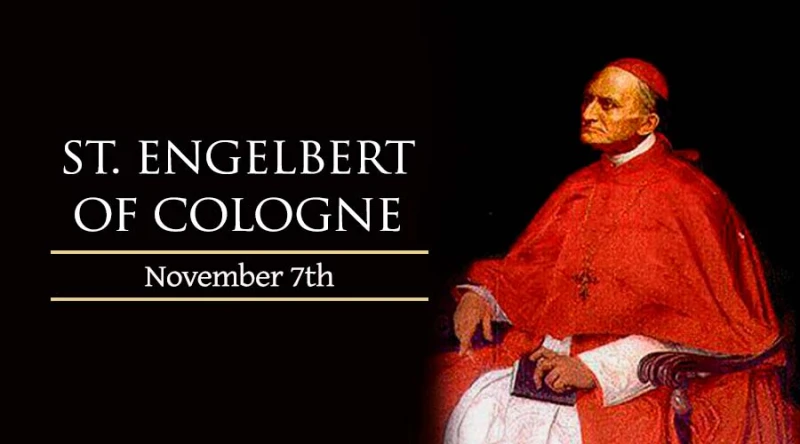

St. Engelbert of Cologne

Feast date: Nov 07

St. Engelbert, was born in Berg around the year 1185 to Engelbert, Count of Berg and Margaret, daughter of the Count of Gelderland. He studied at the cathedral school of Cologne and, while still a boy, was made provost of the churches of St. George and St. Severin at Cologne and of St. Mary’s at Aachen, as it was a common abuse in the Church at the time to appoint the children of nobles to such positions.

In 1199 he was elected provost of the cathedral at Cologne. He led a worldly life, and in the conflict between  two Archbishops, Adolf and Bruno, he sided with his cousin Adolf, and waged war for him. Consequently, he was excommunicated by the pope along with his cousin. After his submission he was reinstated in 1208 and, to atone for his sin, joined the crusade against the Albigenses in 1212. On Feb. 29, 1216, the chapter of the cathedral elected him archbishop by a unanimous vote.

The mendicant orders of the Franciscans and the Dominicans settled in his realm while he was Archbishop. He was well disposed towards the monasteries and insisted on strict religious observance in them. Ecclesiastical affairs were regulated in provincial synods. He was considered a friend of the clergy and a helper of the poor.

Engelbert exerted a strong influence in the affairs of the empire. Emperor Frederick II, who had taken up his residence permanently in Sicily, gave Germany to his son, Henry VII, then still a minor, and in 1221 appointed Engelbert guardian of the king and administrator of the empire. When the young king reached the age of twelve he was crowned at Aachen by Engelbert, who loved him as his own son and honoured him as his sovereign. Engelbert watched over the young king’s education and governed the empire in his name, careful to secure peace both within and without of the realm.

Engelbert’s devotion to duty, and his obedience to the pope and to the emperor, were eventually the cause of his ruin. Many of the nobility feared rather than loved him, and he was obliged to surround himself with bodyguards. The greatest danger came from his relatives.

His cousin, count Frederick of Isenberg, the secular administrator for the nuns of Essen, had grievously oppressed that abbey. Honorius III and the emperor urged Engelbert to protect the nuns and their rights. Frederick wished to forestall the archbishop, and his wife incited him to murder. On November 7, 1225, as he was journeying from Soest to Schwelm to consecrate a church, Engelbert was attacked on a dark evening by Frederick and his associates, was wounded in the thigh, torn from his horse and killed. His body was covered with forty-seven wounds. It was placed on a dung-cart and brought to Cologne four days later. King Henry wept bitterly over the remains, put Frederick under the ban of the empire, and saw him broken on the wheel a year later at Cologne. Frederick died contrite, having acknowledged and confessed his guilt.

Engelbert’s body was placed in the old cathedral of Cologne on February 24, 1226, by Cardinal Conrad von Urach. The latter also declared him a martyr, though a formal canonization did not take place. In the martyrology, Engelbert is commemorated on November 7 as a martyr. A convent for nuns was erected at the place of his death.

St. Engelbert of Cologne Read More »
Thirty-second Sunday in Ordinary Time

Reading 1 2 Mc 7:1-2, 9-14

It happened that seven brothers with their mother were arrested
and tortured with whips and scourges by the king,
to force them to eat pork in violation of God’s law.
One of the brothers, speaking for the others, said:
“What do you expect to achieve by questioning us?
We are ready to die rather than transgress the laws of our ancestors.”

At the point of death he said:
“You accursed fiend, you are depriving us of this present life,
but the King of the world will raise us up to live again forever.
It is for his laws that we are dying.”

After him the third suffered their cruel sport.
He put out his tongue at once when told to do so,
and bravely held out his hands, as he spoke these noble words:
“It was from Heaven that I received these;
for the sake of his laws I disdain them;
from him I hope to receive them again.”
Even the king and his attendants marveled at the young man’s courage,
because he regarded his sufferings as nothing.

After he had died,
they tortured and maltreated the fourth brother in the same way.
When he was near death, he said,
“It is my choice to die at the hands of men
with the hope God gives of being raised up by him;
but for you, there will be no resurrection to life.”

Responsorial Psalm Ps 17:1, 5-6, 8, 15

R. (15b)  Lord, when your glory appears, my joy will be full.
Hear, O LORD, a just suit;
attend to my outcry;
hearken to my prayer from lips without deceit.
R. Lord, when your glory appears, my joy will be full.
My steps have been steadfast in your paths,
my feet have not faltered.
I call upon you, for you will answer me, O God;
incline your ear to me; hear my word.
R. Lord, when your glory appears, my joy will be full.
Keep me as the apple of your eye,
hide me in the shadow of your wings.
But I in justice shall behold your face;
on waking I shall be content in your presence.
R. Lord, when your glory appears, my joy will be full.

Reading 2 2 Thes 2:16-3:5

Brothers and sisters:
May our Lord Jesus Christ himself and God our Father,
who has loved us and given us everlasting encouragement
and good hope through his grace,
encourage your hearts and strengthen them in every good deed
and word.

Finally, brothers and sisters, pray for us,
so that the word of the Lord may speed forward and be glorified,
as it did among you,
and that we may be delivered from perverse and wicked people,
for not all have faith.
But the Lord is faithful;
he will strengthen you and guard you from the evil one.
We are confident of you in the Lord that what we instruct you,
you are doing and will continue to do.
May the Lord direct your hearts to the love of God
and to the endurance of Christ.

Alleluia Rv 1:5a, 6b

R. Alleluia, alleluia.
Jesus Christ is the firstborn of the dead;
to him be glory and power, forever and ever.
R. Alleluia, alleluia.

Gospel Lk 20:27-38

Some Sadducees, those who deny that there is a resurrection,
came forward and put this question to Jesus, saying,
“Teacher, Moses wrote for us,
If someone’s brother dies leaving a wife but no child,
his brother must take the wife
and raise up descendants for his brother.

Now there were seven brothers;
the first married a woman but died childless.
Then the second and the third married her,
and likewise all the seven died childless.
Finally the woman also died.
Now at the resurrection whose wife will that woman be?
For all seven had been married to her.”
Jesus said to them,
“The children of this age marry and remarry;
but those who are deemed worthy to attain to the coming age
and to the resurrection of the dead
neither marry nor are given in marriage.
They can no longer die,
for they are like angels;
and they are the children of God
because they are the ones who will rise.
That the dead will rise
even Moses made known in the passage about the bush,
when he called out ‘Lord, ‘
the God of Abraham, the God of Isaac, and the God of Jacob;
and he is not God of the dead, but of the living,
for to him all are alive.”

Or Lk 20:27, 34-38

Some Sadducees, those who deny that there is a resurrection,
came forward.

Jesus said to them,
“The children of this age marry and remarry;
but those who are deemed worthy to attain to the coming age
and to the resurrection of the dead
neither marry nor are given in marriage.
They can no longer die,
for they are like angels;
and they are the children of God
because they are the ones who will rise.
That the dead will rise
even Moses made known in the passage about the bush,
when he called out ‘Lord, ‘
the God of Abraham, the God of Isaac, and the God of Jacob;
and he is not God of the dead, but of the living,
for to him all are alive.”

– – –

Lectionary for Mass for Use in the Dioceses of the United States, second typical edition, Copyright © 2001, 1998, 1997, 1986, 1970 Confraternity of Christian Doctrine; Psalm refrain © 1968, 1981, 1997, International Committee on English in the Liturgy, Inc. All rights reserved. Neither this work nor any part of it may be reproduced, distributed, performed or displayed in any medium, including electronic or digital, without permission in writing from the copyright owner.

Thirty-second Sunday in Ordinary Time Read More »

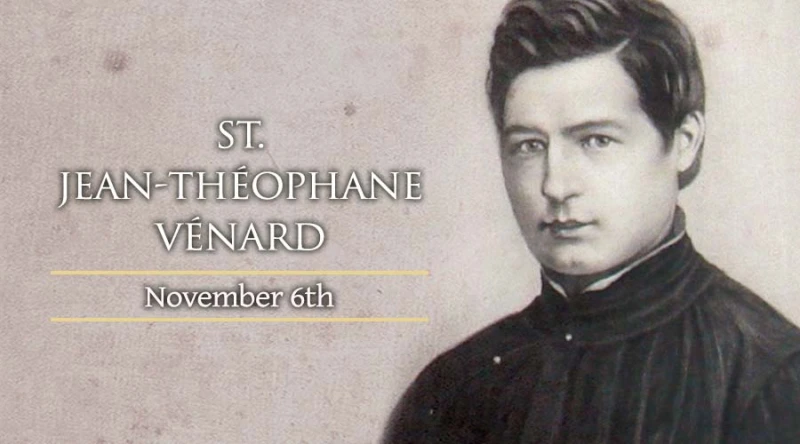
Saint Jean-Theophane Venard


Saint Jean-Theophane Venard

Feast date: Nov 06

On November 6, the Church celebrates the feast of St. Jean-Théophane Vénard, a French missionary to Vietnam who was martyred for the faith.

Famous for having inspired St. Therese of Lisieux, who said of St. Jean-Théophane that he was someone who had lived her own image of a martyr and missionary, St. Jean was born in France, became a priest in the Society of Foreign Missions, and was sent to Vietnam.

Due to the persecutions of the anti-Christian emperor Minh-Menh, priests were forced to hide in the forest and live in caves. They were able to sneak out at night and minster to the people. Eventually someone betrayed St. Jean, and he was arrested. During his trail, he refused to renounce his faith in order to save his life. He was condemned to death, and spent the last few weeks of his life locked in a cage.

It was during his incarceration that he wrote many letters, some to his family. His most famous line is from a letter to his father in which he said, “We are all flowers planted on this earth, which God plucks in His own good time: some a little sooner, some a little later . . . Father and son may we meet in Paradise. I, poor little moth, go first. Adieu.”

In reading these letters, St. Therese the Little Flower came to understand and use the image of being a little flower, whom God nevertheless cared for and cultivated, despite her minute size.

St. Jean-Théophane Vénard was beheaded Feb. 2, 1861. 

His severed head was later recovered and is preserved as a relic in Vietnam. The rest of his body rests in the crypt of the Missions Etrangères in Paris.

Saint Jean-Theophane Venard Read More »

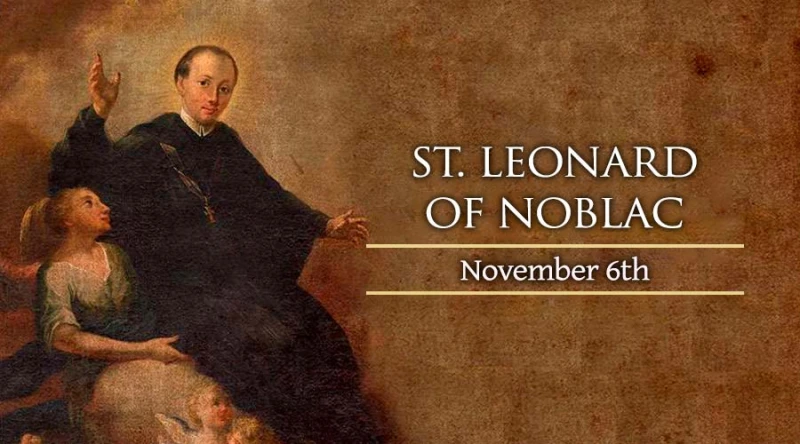
St. Leonard of Noblac


St. Leonard of Noblac

Feast date: Nov 06

St Leonard of Noblac was a Frank courtier, and during a certian invasion which they were losing, the Queen suggested to Leonard that he invoke the help of God to repel the invading army. He did, and the tide of battle turned, naming Clovis victorious. Saint Remigius, bishop of Rheims then used this miracle to convert the King, Leonard, and a thousand of thier followers to Christianity. Following his conversion, St. Leonard refused the offer of a See from his grandfather, King Clovis I.

He then began a life of austerity, sanctification, and preaching. His desire to know God grew so strong that he decided to enter the monastery at Orleans. His brother, Saint Lifiard, followed his example and, leaving the King’s court, built a monastery at Meun, and lived there.

However, Leonard desired further seclusion, so he withdrew into the forest of Limousin, converting many on the way, and living on herbs, wild fruits, and spring water. He built himself an oratory, leaving it only for journeys to churches. Others, recognizing his holiness, begged to live with him, and a monastery was formed. Leonard had a great compassion for prisoners, and converted many and obtaining their release.

He died of natural causes around 559. After his death, churches were dedicated to him in France, England, Belgium, Spain, Italy, Switzerland, Germany, Bohemia, Poland and other countries. Pilgrims flocked to his tomb, and in one small town in Bavaria there are records of 4,000 favors granted through Saint Leonard’s intercession.

St. Leonard of Noblac Read More »

Saturday of the Thirty-first Week in Ordinary Time

Reading 1 PHIL 4:10-19

Brothers and sisters:
I rejoice greatly in the Lord
that now at last you revived your concern for me.
You were, of course, concerned about me but lacked an opportunity.
Not that I say this because of need,
for I have learned, in whatever situation I find myself,
to be self-sufficient.
I know indeed how to live in humble circumstances;
I know also how to live with abundance.
In every circumstance and in all things
I have learned the secret of being well fed and of going hungry,
of living in abundance and of being in need.
I have the strength for everything through him who empowers me.
Still, it was kind of you to share in my distress.

You Philippians indeed know that at the beginning of the Gospel,
when I left Macedonia,
not a single church shared with me
in an account of giving and receiving, except you alone.
For even when I was at Thessalonica
you sent me something for my needs,
not only once but more than once.
It is not that I am eager for the gift;
rather, I am eager for the profit that accrues to your account.
I have received full payment and I abound.
I am very well supplied because of what I received from you
through Epaphroditus,
“a fragrant aroma,” an acceptable sacrifice, pleasing to God.
My God will fully supply whatever you need,
in accord with his glorious riches in Christ Jesus.

Responsorial Psalm PS 112:1B-2, 5-6, 8A AND 9

R. Blessed the man who fears the Lord.
or:
R. Alleluia.
Blessed the man who fears the LORD,
who greatly delights in his commands.
His posterity shall be mighty upon the earth;
the upright generation shall be blessed.
R. Blessed the man who fears the Lord.
or:
R. Alleluia.
Well for the man who is gracious and lends,
who conducts his affairs with justice;
He shall never be moved;
the just one shall be in everlasting remembrance.
R. Blessed the man who fears the Lord.
or:
R. Alleluia.
His heart is steadfast; he shall not fear.
Lavishly he gives to the poor;
his generosity shall endure forever;
his horn shall be exalted in glory.
R. Blessed the man who fears the Lord.
or:
R. Alleluia.


Alleluia 2 COR 8:9

R. Alleluia, alleluia.
Jesus Christ became poor although he was rich,
So that by his poverty you might become rich.
R. Alleluia, alleluia.

Gospel LK 16:9-15

Jesus said to his disciples:
“I tell you, make friends for yourselves with dishonest wealth,
so that when it fails, you will be welcomed into eternal dwellings.
The person who is trustworthy in very small matters
is also trustworthy in great ones;
and the person who is dishonest in very small matters
is also dishonest in great ones.
If, therefore, you are not trustworthy with dishonest wealth,
who will trust you with true wealth?
If you are not trustworthy with what belongs to another,
who will give you what is yours?
No servant can serve two masters.
He will either hate one and love the other,
or be devoted to one and despise the other.
You cannot serve God and mammon.”

The Pharisees, who loved money,
heard all these things and sneered at him.
And he said to them,
“You justify yourselves in the sight of others,
but God knows your hearts;
for what is of human esteem is an abomination in the sight of God.”

– – –

Lectionary for Mass for Use in the Dioceses of the United States, second typical edition, Copyright © 2001, 1998, 1997, 1986, 1970 Confraternity of Christian Doctrine; Psalm refrain © 1968, 1981, 1997, International Committee on English in the Liturgy, Inc. All rights reserved. Neither this work nor any part of it may be reproduced, distributed, performed or displayed in any medium, including electronic or digital, without permission in writing from the copyright owner.

Saturday of the Thirty-first Week in Ordinary Time Read More »