Please mind our dust!

We are currently working on revamping our website!
Thank you for your patience!

CRD Solutions

Blessed Bernhard Lichtenberg

Feast date: Nov 05

Blessed Bernhard Lichtenberg was a martyr during the Second World War. Born in 1875, he was ordained a priest for the Diocese of Berlin, Germany. He served in the Cathedral of Berlin and was an outspoken critic of the Nazis and their anti-Semitic campaign.

He organized protests outside concentration camps, led public prayers for the Jews, and filed complaints against the Nazi party. Bernhard was eventually arrested for these actions and imprisoned for two years, but this did not deter him.

After his release, he resumed his actions and criticisms against the Nazis. He was arrested again and sentenced to the Dachau concentration camp. He never arrived at the camp. He was killed Nov. 5, 1943 on the way to Dachau at the age of 67.

He was beatified by Pope John Paul II in 1996.

Blessed Bernhard Lichtenberg Read More »

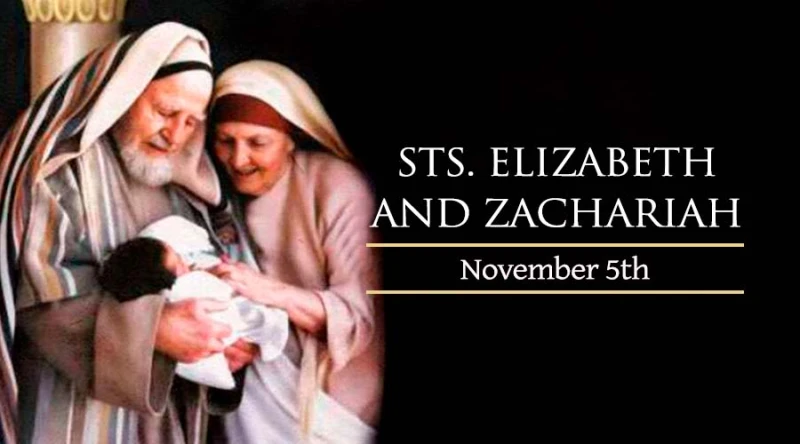
Sts. Elizabeth and Zachariah


Sts. Elizabeth and Zachariah

Feast date: Nov 05

Sts. Elizabeth and Zachariah were the parents of John the Baptist.

She was a relative of Mary the Mother of God; no one knows the exact biological relationship between them, but tradition often says that they were cousins.

The Gospel of Luke states that though Elizabeth had committed no evil in the eyes of God, she was barren for most of her life. She was advanced in age when the Angel Gabriel appeared to her husband Zachariah in the temple to promise them a son.

St. Elizabeth is most famous for the words of the “Hail Mary,” which she uttered at feeling her child leap in her womb as Mary, then pregnant with Jesus, came to visit cousin. However, there is no further mention of her in the bible after the birth and circumcision of her son John the Baptist.

Zachariah was in the Temple when the angel Gabriel appeared announcing that Elizabeth would bear a son who would “bring back many of the people of Israel to the Lord their God.” When Zachariah expressed doubt at this because of her age, he was struck mute, and upon exiting the Temple it was clear to the people there that he had seen a vision. He remained mute until John’s birth, when he wrote out the newborn’s name.

Sts. Elizabeth and Zachariah Read More »

Memorial of Saint Charles Borromeo, Bishop

Reading 1 PHIL 3:17—4:1

Join with others in being imitators of me, brothers and sisters, 
and observe those who thus conduct themselves 
according to the model you have in us.
For many, as I have often told you 
and now tell you even in tears, 
conduct themselves as enemies of the cross of Christ.
Their end is destruction.
Their God is their stomach; 
their glory is in their “shame.”
Their minds are occupied with earthly things.
But our citizenship is in heaven, 
and from it we also await a savior, the Lord Jesus Christ.
He will change our lowly body
to conform with his glorified Body 
by the power that enables him also 
to bring all things into subjection to himself.

Therefore, my brothers and sisters,
whom I love and long for, my joy and crown, 
in this way stand firm in the Lord, beloved.  
 

Responsorial Psalm PS 122:1-2, 3-4AB, 4CD-5

R. (1) Let us go rejoicing to the house of the Lord.
I rejoiced because they said to me,
“We will go up to the house of the LORD.”
And now we have set foot
within your gates, O Jerusalem.
R. Let us go rejoicing to the house of the Lord.
Jerusalem, built as a city
with compact unity.
To it the tribes go up,
the tribes of the LORD.
R. Let us go rejoicing to the house of the Lord.
According to the decree for Israel,
to give thanks to the name of the LORD.
In it are set up judgment seats,
seats for the house of David.
R. Let us go rejoicing to the house of the Lord.


Alleluia 1 JOHN 2:5

R. Alleluia, alleluia.
Whoever keeps the word of Christ,
the love of God is truly perfected in him.
R. Alleluia, alleluia.

Gospel LK 16:1-8

Jesus said to his disciples, “A rich man had a steward
who was reported to him for squandering his property.
He summoned him and said,
‘What is this I hear about you?
Prepare a full account of your stewardship,
because you can no longer be my steward.’
The steward said to himself, ‘What shall I do,
now that my master is taking the position of steward away from me?
I am not strong enough to dig and I am ashamed to beg.
I know what I shall do so that,
when I am removed from the stewardship,
they may welcome me into their homes.’
He called in his master’s debtors one by one.
To the first he said, ‘How much do you owe my master?’
He replied, ‘One hundred measures of olive oil.’
He said to him, ‘Here is your promissory note.
Sit down and quickly write one for fifty.’
Then to another he said, ‘And you, how much do you owe?’
He replied, ‘One hundred measures of wheat.’  
He said to him, ‘Here is your promissory note;
write one for eighty.’
And the master commended that dishonest steward for acting prudently.
For the children of this world
are more prudent in dealing with their own generation
than the children of light.”

– – –

Lectionary for Mass for Use in the Dioceses of the United States, second typical edition, Copyright © 2001, 1998, 1997, 1986, 1970 Confraternity of Christian Doctrine; Psalm refrain © 1968, 1981, 1997, International Committee on English in the Liturgy, Inc. All rights reserved. Neither this work nor any part of it may be reproduced, distributed, performed or displayed in any medium, including electronic or digital, without permission in writing from the copyright owner.

Memorial of Saint Charles Borromeo, Bishop Read More »

St. Charles Borromeo


St. Charles Borromeo

Feast date: Nov 04

No age of the Catholic Church’s history is without its share of confusion and corruption. Still, even in moments when disorder may seem overwhelming, individuals and movements eventually arise to propose the faith with clarity and demonstrate it in action. St. Charles Borromeo, a central figure in the Council of Trent, is remembered on November 4, as a model of such leadership in difficult times.

The circumstances of Charles’ birth, in 1538, could have easily allowed him to join the ranks of corrupt Renaissance-era clergy. He was born into luxury, the son of noble parents, with a guaranteed income comparable to modern “trust funds.” Early on, however, the young man signaled his intention to go against the cultural grain. He announced his desire to serve the Church with sincerity, asking his father to give away the majority of the fund’s money to the poor.

Charles could not escape a certain degree of wealth and prestige, which were expected due to his social class, but he insisted on using these forms of leverage to benefit the Church, rather than himself. When he was 22, his opportunity came: the young lawyer and canonist’s uncle was elected as Pope Pius IV. Charles soon assumed staggering responsibilities, serving as a papal diplomat and supervisor of major religious orders.

The young man relaxed from these tasks through literature and music, taking no interest in the temptations abounding in Rome during the late Renaissance. He considered renouncing even this temperate lifestyle, for the strict observance of a monastery– but found himself more urgently needed in the work of concluding the Council of Trent.

The Church’s nineteenth Ecumenical Council had begun in late 1545, but experienced many delays. Its twofold mission was to clarify Catholic doctrine against Protestant objections, and reform the Church internally against many longstanding problems. As a papal representative, Charles participated in the council’s conclusion in 1563, when he was only 25. He also played a leading role in assembling its comprehensive summary, the Roman Catechism (or Catechism of the Council of Trent).

In reward for his labors, Charles received even greater responsibilities. Ordained a priest during the Council, he was named as archbishop and cardinal only months later. He found his diocese of Milan in a state of disintegration, after two generations of virtually no local administration or leadership. The new bishop got straight to work establishing schools, seminaries, and centers for religious life.

His reforms of the diocese, in accordance with the decrees of the council, were dramatic and effective, so much so that a group of disgruntled monks attempted to kill him. His survival was called miraculous.

The new archbishop’s efforts for catechesis and the instruction of youth were especially fruitful, initiating the work of the Confraternity for Christian Doctrine and the first “Sunday School” classes. He also gave important pastoral attention to English Catholics who fled to Italy to escape new laws against the Catholic faith.

St. Charles Borromeo’s amazing diligence, frequent travel and ascetic living eventually took their toll. The once young prodigy of the Papal Court also died young at the age of 46 on November 3, 1584. He was canonized 26 years later, in 1610.

He is the patron of catechists and catechumens.

St. Charles Borromeo Read More »

Thursday of the Thirty-first Week in Ordinary Time

Reading 1 PHIL 3:3-8A

Brothers and sisters:
We are the circumcision, 
we who worship through the Spirit of God,
who boast in Christ Jesus and do not put our confidence in flesh,
although I myself have grounds for confidence even in the flesh.

If anyone else thinks he can be confident in flesh, all the more can I.  
Circumcised on the eighth day,
of the race of Israel, of the tribe of Benjamin,
a Hebrew of Hebrew parentage,
in observance of the law a Pharisee,
in zeal I persecuted the Church,
in righteousness based on the law I was blameless.

But whatever gains I had,
these I have come to consider a loss because of Christ.
More than that, I even consider everything as a loss
because of the supreme good of knowing Christ Jesus my Lord.

Responsorial Psalm PS 105:2-3, 4-5, 6-7

R. (3b) Let hearts rejoice who search for the Lord.
or:
R. Alleluia.
Sing to him, sing his praise,
proclaim all his wondrous deeds.
Glory in his holy name;
rejoice, O hearts that seek the LORD!
R. Let hearts rejoice who search for the Lord.
or:
R. Alleluia.
Look to the LORD in his strength;
seek to serve him constantly.
Recall the wondrous deeds that he has wrought,
his portents, and the judgments he has uttered.
R. Let hearts rejoice who search for the Lord.
or:
R. Alleluia.
You descendants of Abraham, his servants,
sons of Jacob, his chosen ones!
He, the LORD, is our God;
throughout the earth his judgments prevail.
R. Let hearts rejoice who search for the Lord.
or:
R. Alleluia.


Alleluia MT 11:28

R. Alleluia, alleluia.
Come to me, all you who labor and are burdened,
and I will give you rest, says the Lord.
R. Alleluia, alleluia.

Gospel LK 15:1-10

The tax collectors and sinners were all drawing near to listen to Jesus,
but the Pharisees and scribes began to complain, saying,
“This man welcomes sinners and eats with them.” 
So Jesus addressed this parable to them.
“What man among you having a hundred sheep and losing one of them
would not leave the ninety-nine in the desert
and go after the lost one until he finds it?
And when he does find it,
he sets it on his shoulders with great joy
and, upon his arrival home,
he calls together his friends and neighbors and says to them,
‘Rejoice with me because I have found my lost sheep.’ 
I tell you, in just the same way
there will be more joy in heaven over one sinner who repents
than over ninety-nine righteous people
who have no need of repentance.

“Or what woman having ten coins and losing one
would not light a lamp and sweep the house,
searching carefully until she finds it?
And when she does find it,
she calls together her friends and neighbors
and says to them,
‘Rejoice with me because I have found the coin that I lost.’ 
In just the same way, I tell you,
there will be rejoicing among the angels of God
over one sinner who repents.”

– – –

Lectionary for Mass for Use in the Dioceses of the United States, second typical edition, Copyright © 2001, 1998, 1997, 1986, 1970 Confraternity of Christian Doctrine; Psalm refrain © 1968, 1981, 1997, International Committee on English in the Liturgy, Inc. All rights reserved. Neither this work nor any part of it may be reproduced, distributed, performed or displayed in any medium, including electronic or digital, without permission in writing from the copyright owner.

Thursday of the Thirty-first Week in Ordinary Time Read More »