
Please mind our dust!

We are currently working on revamping our website!
Thank you for your patience!

CRD Solutions

St. Wolfgang, Bishop
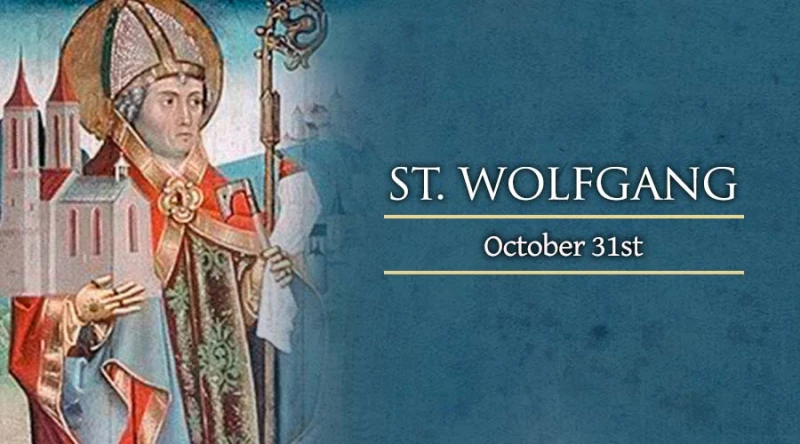

St. Wolfgang, Bishop

Feast date: Oct 31

Oct. 31, though best known as the Vigil of the Solemnity of All Saints (All Hallows’ Eve) in the Western church, is also the liturgical feast day of St. Wolfgang of Ratisbon, who was regarded as one of the greatest German saints of his time

The Benedictine monk and bishop, who served as a missionary to pagans and a reformer of the Church in southeastern Germany, was born around 934 in the historic southwestern German region of Swabia.

Wolfgang came from a family of nobility and was privately tutored as a child. Later on, the future monk was educated at the renowned Monastery of Reichenau, and at Wurtzburg. Wolfgang showed intellectual prowess and found companionship during his years of study, but was also dismayed by the petty jealousies and moral lapses he observed in Wurtzburg’s academic environment.

In 956, his school companion Henry was chosen to lead the Archdiocese of Trier. Though Wolfgang had become interested in monastic life, he chose to go with Henry to Trier, where his service to the Church included a teaching position in the cathedral school.

After Archbishop Henry’s death in 964, Wolfgang left Trier, became a monk of the Order of Saint Benedict, and settled at a monastery in the diocese of Augsburg. Its school prospered under his direction, and the local bishop – the future St. Ulrich – ordained him to the priesthood in 968. In his youth, Wolfgang had envisioned a secluded life of contemplation; but things turned out differently, as he was sent east to evangelize the Magyars in 972.

By Christmas of that year, Wolfgang had been chosen as the new Bishop of Ratisbon (present-day Regensburg in Bavaria). But he continued to live out his monastic vocation, retaining his distinctive Benedictine habit and dedicating himself to the same ascetic lifestyle. Amid the work of preaching and reform, Wolfgang remained a man of prayer, silence, and contemplative solitude.

Not surprisingly, the Bishop of Ratisbon made monasticism a focus of his church reforms, reviving religious life in places where it had fallen into disorder. Wolfgang also showed extraordinary care for the poor in his diocese, to such an extent that he was called “the Great Almoner.” On the other hand, he was also involved in affairs of state at a high level, and tutored the children of the Duke of Bavaria, including the future Holy Roman Emperor St. Henry II.

Wolfgang, despite being one of the great bishops and saints of his time, still encountered serious difficulties in his leadership of the Diocese of Ratisbon. On one occasion, a political conflict caused him to withdraw from his diocese to a hermitage for a period of time. Wolfgang is also said to have struggled with the great geographical extent of the diocese, parts of which were eventually entrusted to the Bishop of Prague.

In 994, while traveling in Austria, Wolfgang became sick and died in the village of Pupping. Miracles associated with his tomb, including many healings, led to his canonization of 1052. Several of St. Wolfgang’s devotees experienced relief from stomach ailments, and he remains a patron saint of such troubles today. His intercession is also sought by victims of strokes and paralysis, and by carpenters.

St. Wolfgang, Bishop Read More »
Thirty-first Sunday in Ordinary Time

Reading 1 Wis 11:22-12:2

Before the LORD the whole universe is as a grain from a balance
 or a drop of morning dew come down upon the earth.
 But you have mercy on all, because you can do all things;
 and you overlook people’s sins that they may repent.
 For you love all things that are
 and loathe nothing that you have made;
 for what you hated, you would not have fashioned.
 And how could a thing remain, unless you willed it;
 or be preserved, had it not been called forth by you?
 But you spare all things, because they are yours,
 O LORD and lover of souls,
 for your imperishable spirit is in all things!
 Therefore you rebuke offenders little by little,
 warn them and remind them of the sins they are committing,
 that they may abandon their wickedness and believe in you, O LORD!

Responsorial Psalm Ps 145:1-2, 8-9, 10-11, 13, 14

R. (cf. 1)  I will praise your name for ever, my king and my God.
I will extol you, O my God and King,
and I will bless your name forever and ever.
Every day will I bless you,
and I will praise your name forever and ever.
R. I will praise your name for ever, my king and my God.
The LORD is gracious and merciful,
slow to anger and of great kindness.
The LORD is good to all
and compassionate toward all his works.
R. I will praise your name for ever, my king and my God.
Let all your works give you thanks, O LORD,
and let your faithful ones bless you.
Let them discourse of the glory of your kingdom
and speak of your might.
R. I will praise your name for ever, my king and my God.
The LORD is faithful in all his words
and holy in all his works.
The LORD lifts up all who are falling
and raises up all who are bowed down.
R. I will praise your name for ever, my king and my God.

Reading 2 2 Thes 1:11-2:2

Brothers and sisters:
We always pray for you,
that our God may make you worthy of his calling
and powerfully bring to fulfillment every good purpose
and every effort of faith,
that the name of our Lord Jesus may be glorified in you,
and you in him,
in accord with the grace of our God and Lord Jesus Christ.

We ask you, brothers and sisters,
with regard to the coming of our Lord Jesus Christ
and our assembling with him,
not to be shaken out of your minds suddenly, or to be alarmed
either by a “spirit,” or by an oral statement,
or by a letter allegedly from us
to the effect that the day of the Lord is at hand.

Alleluia Jn 3:16

R. Alleluia, alleluia.
God so loved the world that he gave his only Son,
so that everyone who believes in him might have eternal life.
R. Alleluia, alleluia.

Gospel Lk 19:1-10

At that time, Jesus came to Jericho and intended to pass through the town.
Now a man there named Zacchaeus,
who was a chief tax collector and also a wealthy man,
was seeking to see who Jesus was;
but he could not see him because of the crowd,
for he was short in stature.
So he ran ahead and climbed a sycamore tree in order to see Jesus,
who was about to pass that way.
When he reached the place, Jesus looked up and said,
“Zacchaeus, come down quickly,
for today I must stay at your house.”
And he came down quickly and received him with joy.
When they all saw this, they began to grumble, saying,
“He has gone to stay at the house of a sinner.”
But Zacchaeus stood there and said to the Lord,
“Behold, half of my possessions, Lord, I shall give to the poor,
and if I have extorted anything from anyone
I shall repay it four times over.”
And Jesus said to him,
“Today salvation has come to this house
because this man too is a descendant of Abraham.
For the Son of Man has come to seek
and to save what was lost.”

– – –

Lectionary for Mass for Use in the Dioceses of the United States, second typical edition, Copyright © 2001, 1998, 1997, 1986, 1970 Confraternity of Christian Doctrine; Psalm refrain © 1968, 1981, 1997, International Committee on English in the Liturgy, Inc. All rights reserved. Neither this work nor any part of it may be reproduced, distributed, performed or displayed in any medium, including electronic or digital, without permission in writing from the copyright owner.

Thirty-first Sunday in Ordinary Time Read More »

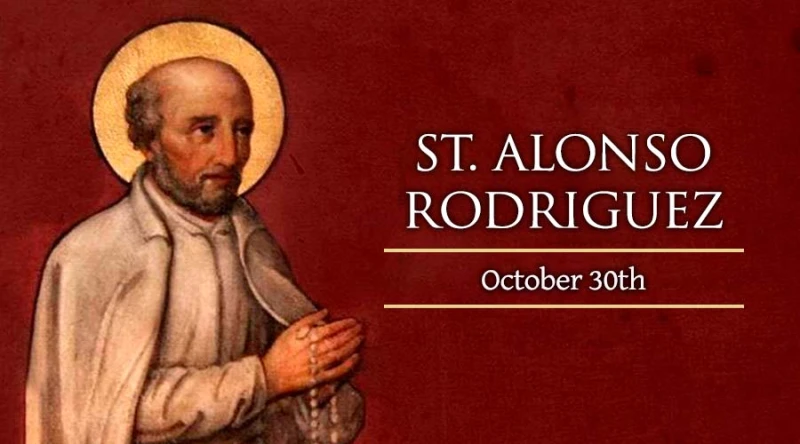
St. Alonso Rodriguez


St. Alonso Rodriguez

Feast date: Oct 30

On October 30, the Catholic Church honors a man whose humble occupation gave the world only glimpses of his extraordinary holiness. During his lifetime, Brother Alonso Rodriguez never became a priest, published a book, or advanced professionally. But writings discovered after his death revealed a true mystic, who attended to a rich spiritual life while he worked as a doorkeeper and porter.

Born in Spain during 1532, Alonso married at 26 and worked as a cloth merchant, coming to religious life only through a string of crushing tragedies. His wife and two of their children died by the time he was 31, and his turn toward a life of prayer and penance could not prevent the subsequent death of his third and last remaining child — nor the discouraging failure of his business.

Without his wife and children, and having few prospects due to his lack of a higher education, the Spanish layman turned his thoughts to religious life. Even there, however, he faced difficulties. In his early years, Alonso had met one of the first Jesuits, Bl. Peter Faber, and with his old life in ruins, he developed an interest in joining the recently established Society of Jesus.

Alonso’s lack of education prevented him from pursuing their course of priestly ordination, and he failed to acquire a diploma from the College of Barcelona despite attending for two years. The Jesuit Fathers in Valencia said he was unfit to join. But Alonso’s years of prayer had not been in vain: they were answered when a provincial of the society, sensing his dedication, admitted him as a lay-brother.

In modern times, Jesuit Brothers work in a wide range of fields, with few limitations apart from their lack of priestly ordination. During the 16th and 17th centuries, however, the lay-brothers of the Society of Jesus were known as “temporal coadjutors,” and assisted the priests of the order by performing its more routine duties such as cooking, construction and farming.

The Jesuits sent Rodriguez to the college of Montesión on the island of Majorca, to work as a porter and door-keeper. He assumed the responsibilities of receiving visitors and guests and carrying their luggage, tracking down students or priests when they were needed, delivering messages, and distributing alms to the poor. While other Jesuits traveled the globe evangelizing whole nations, and undertook a vast reform of the Catholic Church throughout Europe, Alonso carried bags and ran errands for 46 years.

But students began to seek him out, realizing that their doorkeeper was a man of unusual wisdom and faith. His Jesuit superiors started to take notice as well, and asked him to begin a private record of his life and thoughts.  Rodriguez struck up a notable friendship with one young man, Peter Claver, and advised him to volunteer for the South American missions. Following his advice, St. Peter Claver eventually catechized, baptized and spoke out for the rights of 300,000 slaves in South America.

When Brother Alonso died in 1617, his superiors examined the written records he had left behind describing his spiritual life. What they found was the life of a saint and mystic. His approach was simple: Christ was appearing in every person who appeared at the door; the task was to encounter God in any task. From this awareness, he proceeded to a life of contemplation akin to the renowned saints of his era (such as St. Ignatius or St. Teresa of Avila), whose grand achievements are better known.

Brother Alonso Rodriguez was declared a saint in 1887. He is buried on the same island of Majorca where he answered the door and carried bags for five decades.

St. Alonso Rodriguez Read More »

Saturday of the Thirtieth Week in Ordinary Time

Reading 1 PHIL 1:18B-26

Brothers and sisters:
As long as in every way, whether in pretense or in truth,
Christ is being proclaimed, and in that I rejoice.

Indeed I shall continue to rejoice,
for I know that this will result in deliverance for me
through your prayers and support from the Spirit of Jesus Christ.
My eager expectation and hope
is that I shall not be put to shame in any way,
but that with all boldness, now as always,
Christ will be magnified in my body,
whether by life or by death.
For to me life is Christ, and death is gain.
If I go on living in the flesh, that means fruitful labor for me.
And I do not know which I shall choose.
I am caught between the two.
I long to depart this life and be with Christ,
for that is far better.
Yet that I remain in the flesh is more necessary for your benefit.
And this I know with confidence,
that I shall remain and continue in the service of all of you
for your progress and joy in the faith,
so that your boasting in Christ Jesus may abound on account of me
when I come to you again.
 

Responsorial Psalm PS 42:2, 3, 5CDEF

R. My soul is thirsting for the living God.
As the hind longs for the running waters,
so my soul longs for you, O God.
R. My soul is thirsting for the living God.
Athirst is my soul for God, the living God.
When shall I go and behold the face of God?
R. My soul is thirsting for the living God.
I went with the throng
and led them in procession to the house of God.
Amid loud cries of joy and thanksgiving,
with the multitude keeping festival.
R. My soul is thirsting for the living God.


Alleluia MT 11:29AB

R. Alleluia, alleluia.
Take my yoke upon you and learn from me,
for I am meek and humble of heart. 
R. Alleluia, alleluia.

Gospel LK 14:1, 7-11

On a sabbath Jesus went to dine
at the home of one of the leading Pharisees,
and the people there were observing him carefully.

He told a parable to those who had been invited,
noticing how they were choosing the places of honor at the table.
“When you are invited by someone to a wedding banquet,
do not recline at table in the place of honor.
A more distinguished guest than you may have been invited by him,
and the host who invited both of you may approach you and say,
‘Give your place to this man,’
and then you would proceed with embarrassment
to take the lowest place.
Rather, when you are invited, 
go and take the lowest place
so that when the host comes to you he may say,
‘My friend, move up to a higher position.’
Then you will enjoy the esteem of your companions at the table.
For everyone who exalts himself will be humbled,
but the one who humbles himself will be exalted.”

– – –

Lectionary for Mass for Use in the Dioceses of the United States, second typical edition, Copyright © 2001, 1998, 1997, 1986, 1970 Confraternity of Christian Doctrine; Psalm refrain © 1968, 1981, 1997, International Committee on English in the Liturgy, Inc. All rights reserved. Neither this work nor any part of it may be reproduced, distributed, performed or displayed in any medium, including electronic or digital, without permission in writing from the copyright owner.

Saturday of the Thirtieth Week in Ordinary Time Read More »

Blessed Maria Restituta Kafka

Feast date: Oct 29

Helen Kafka was born in 1894 to a shoemaker and grew up in Vienna, Austria. At the age of 20, she decided to join the Franciscan Sisters of Christian Charity and took the name Restituta after an early Church martyr.

In 1919, she began working as a surgical nurse in Austria. When the Germans took over the country, she became a local opponent of the Nazi regime. Her conflict with them escalated after they ordered her to remove all the crucifixes she had hung up in each room of a new hospital wing.

Sister Maria Restitua refused, and was arrested by the Gestapo in 1942. She was sentenced to death for “aiding and abetting the enemy in the betrayal of the fatherland and for plotting high treason.”

She spent the rest of her days in prison caring for other prisoners, who loved  her. The Nazis offered her freedom if she would abandon the Franciscan sisters, but she refused. She was beheaded March 30, 1943 in Vienna, and was beatified by Pope John Paul II on June 21, 1998.

Blessed Maria Restituta Kafka Read More »