Please mind our dust!

We are currently working on revamping our website!
Thank you for your patience!

CRD Solutions

St. Abraham Kidunaia
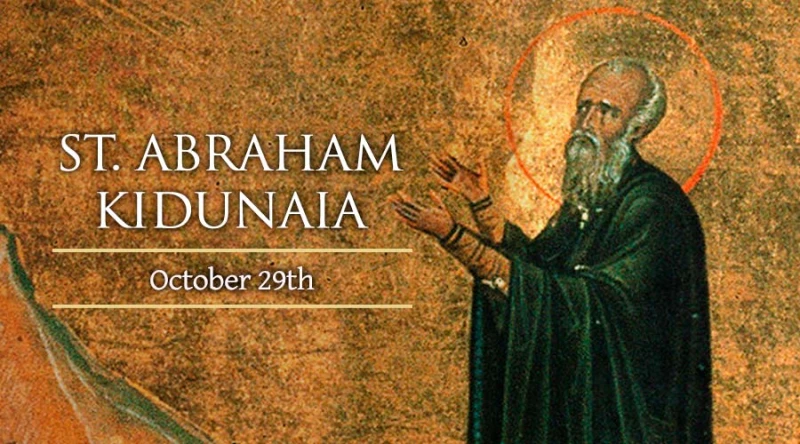

St. Abraham Kidunaia

Feast date: Oct 29

St. Abraham Kidunaia was born to a wealthy family during the third century. After receiving an excellent education, Abraham was encouraged to get married. He followed the wishes of his parents, but after the wedding ceremony, he told his bride his desire to remain a virgin and dedicate his life to God. His bride accepted this resolution and Abraham retired to a hermitage near Edessa, a city near Mesopotamia.

Ten years after he retreated from the world, his parents died and left a great amount of wealth to Abraham. As soon as he was aware of this, he asked a friend to distribute the sum to charitable causes. Through actions like this and his deep prayer life, Abraham became known throughout the region as a holy man and many came to him for guidance.

His reputation even came to the ears of the bishop, and when Edessa became poisoned with sin and idolatry, Abraham was ordained and asked to go to the city preaching reform. Abraham was greatly distressed by this, but obeyed the wishes of the bishop.

When Abraham arrived in Edessa, none of the residents would listen to his words. Eventually, through constant prayer, Abraham converted them. Once the conversions took place, Abraham returned to his hermitage to continue his life of solitary prayer.

Around the year 360 Abraham died after a life of faithful service to God.

St. Abraham Kidunaia Read More »
St. Narcissus


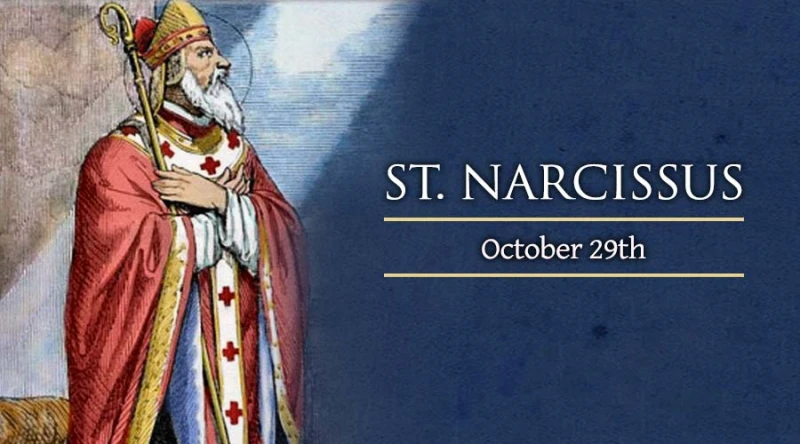
St. Narcissus

Feast date: Oct 29

St. Narcissus was born towards the end of the first century, and he was nearly 80 years old when he was named as the 30th bishop of Jerusalem.

In 195, he and Theophilus, bishop of Caesarea in Palestine, presided together over a council of the bishops of Palestine held at Caesarea around Easter. There it was decreed that the feast be kept always on a Sunday, and not continually with the Jewish Passover.

The bishop and historian Eusebius says the following miracle can be attributed to him: One year on Easter-eve the deacons did not have any oil for the lamps in the church, which was necessary at the solemn divine office on that day. Narcissus ordered those who had care of the lamps to bring him some water from the neighboring wells. This being done, he pronounced a devout prayer over the water. Then he bade them pour it into the lamps; which they did. The water was immediately converted into oil, to the great surprise of all the faithful. Some of this miraculous oil was kept there as a memorial at the time when Eusebius wrote his history.

The veneration of all good men for this holy bishop, however, could not shelter him from the malice of the wicked. Three incorrigible sinners, fearing his severity in the observance of ecclesiastical discipline, accused him of a terrible act. The sinners swore that they were right, adding the following to their testimony: One wished that he might perish by fire, another, that he might be struck with a leprosy, and the third, that he might lose his sight, if what they alleged was not the truth. Their accusations were false, however, and soon Divine Retribution called upon them. The first was burnt in his house along with his whole family by an accidental fire in the night, the second was struck with a universal leprosy and the third, terrified by these examples, confessed the conspiracy and slander, and by the abundance of tears which he continually shed for his sins, lost his sight before his death.

Narcissus either could not stand the shock of the bold calumny, or perhaps he made it an excuse for leaving Jerusalem in order to spend some time in solitude, which had long been his wish. He spent several years undiscovered in his retreat, where he enjoyed all the happiness and advantage which a close conversation with God can bestow.

The neighboring bishops appointed a new pastor for his church until Narcissus returned. Upon his return, the faithful rejoiced and convinced him to once again undertake the administration of the diocese, which he did.

As he reached extreme old age, he made St. Alexander his coadjutor. St. Narcissus continued to serve his flock, and even other churches, by his assiduous prayers and his earnest exhortations to unity and concord, as St. Alexander testifies in his letter to the Arsinoites in Egypt, where he says that Narcisus was at that time about one hundred and sixteen years old. The Roman Martyrology honors his memory on October 29th.

St. Narcissus Read More »

Feast of Saints Simon and Jude, Apostles

Reading I Eph 2:19-22

Brothers and sisters:
You are no longer strangers and sojourners,
but you are fellow citizens with the holy ones
and members of the household of God, 
built upon the foundation of the Apostles and prophets,
with Christ Jesus himself as the capstone.
Through him the whole structure is held together
and grows into a temple sacred in the Lord;
in him you also are being built together
into a dwelling place of God in the Spirit.

Responsorial Psalm 19:2-3, 4-5

R.    (5a) Their message goes out through all the earth.
The heavens declare the glory of God,
    and the firmament proclaims his handiwork.
Day pours out the word to day,
    and night to night imparts knowledge.
R.    Their message goes out through all the earth.
Not a word nor a discourse
    whose voice is not heard;
Through all the earth their voice resounds,
    and to the ends of the world, their message.
R.    Their message goes out through all the earth.

Alleluia See Te Deum

R. Alleluia, alleluia.
We praise you, O God,
we acclaim you as Lord;
the glorious company of Apostles praise you.
R. Alleluia, alleluia.

Gospel Lk 6:12-16

Jesus went up to the mountain to pray,
and he spent the night in prayer to God.

When day came, he called his disciples to himself,
and from them he chose Twelve, whom he also named Apostles:
Simon, whom he named Peter, and his brother Andrew,
James, John, Philip, Bartholomew, Matthew,
Thomas, James the son of Alphaeus,
Simon who was called a Zealot,
and Judas the son of James,
and Judas Iscariot, who became a traitor.

– – –

Lectionary for Mass for Use in the Dioceses of the United States, second typical edition, Copyright © 2001, 1998, 1997, 1986, 1970 Confraternity of Christian Doctrine; Psalm refrain © 1968, 1981, 1997, International Committee on English in the Liturgy, Inc. All rights reserved. Neither this work nor any part of it may be reproduced, distributed, performed or displayed in any medium, including electronic or digital, without permission in writing from the copyright owner.

Feast of Saints Simon and Jude, Apostles Read More »

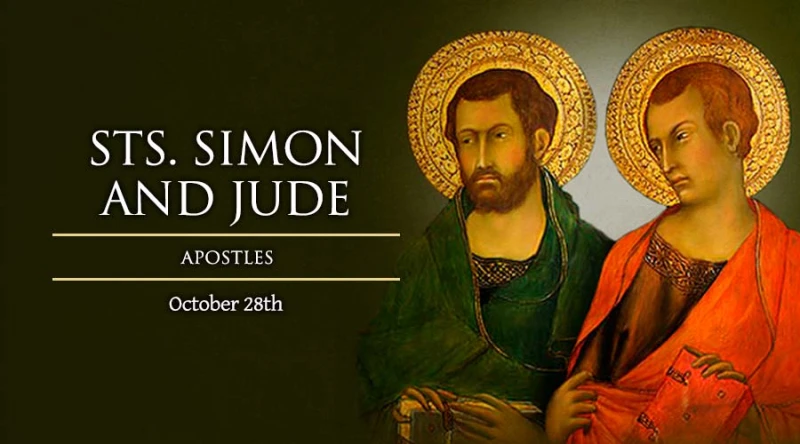
St. Jude Thaddeus and St. Simon the Zealot, Apostles


St. Jude Thaddeus and St. Simon the Zealot, Apostles

Feast date: Oct 28

St. Jude Thaddaeus

St. Jude, known as Thaddaeus, was a brother of St. James the Lesser, and a relative of Jesus. Ancient writers tell us that he preached the Gospel in Judea, Samaria, Idumaea, Syria, Mesopotamia, and Lybia. According to Eusebius, he returned to Jerusalem in the year 62 and assisted at the election of his brother, St. Simeon, as Bishop of Jerusalem.

He is an author of an epistle (letter) to the Churches of the East, in particular the Jewish converts, directed against the heresies of the Simonians, Nicolaites, and Gnostics. This Apostle is said to have suffered martyrdom in Armenia, which was then subject to Persia. The final conversion of the Armenian nation to Christianity did not take place until the third century A.D.

St. Jude was the one who asked Jesus at the Last Supper why He would not manifest Himself to the whole world after His resurrection. Little else is known of his life, but legend claims that he visited Beirut and Edessa.

He was beaten to death with a club, then beheaded post-mortem in 1st century Persia. His relics reside at Saint Peter’s in Rome, at Rheims, and at Toulouse, France.

Saint Jude Thaddeus is not the same person as Judas Iscariot, who betrayed Our Lord and despaired because of his great sin and lack of trust in God’s mercy.

St. Jude Thaddeus is invoked in desperate situations because his New Testament letter stresses that the faithful should persevere in the environment of harsh, difficult circumstances, just as their forefathers had done before them.

Therefore, he is the patron of desperate situations, forgotten causes, hospital workers, hospitals, impossible causes, lost causes, and the diocese of Saint Petersburg, Florida. He is represented as bearded man holding an oar, a boat, boat hook, a club, an axe or a book. Nearly every image of him depicts him wearing a medallion with a profile of Jesus. He usually has a small flame above his head and he often carries a pen.

We remember him October 28 in Roman Church, and June 19 in Eastern Church.

St. Simon the Zealot

Little is known about the post-Pentecost life of St. Simon, who had been called a Zealot. He is thought to have preached in Egypt and then to have joined St. Jude in Persia. Here, he was supposedly martyred by being cut in half with a saw, a tool he is often depicted with. However, the 4th-century St. Basil the Great says he died in Edessa, peacefully.

St. Jude Thaddeus and St. Simon the Zealot, Apostles Read More »

Thursday of the Thirtieth Week in Ordinary Time

Reading 1 EPH 6:10-20

Brothers and sisters:
Draw your strength from the Lord and from his mighty power.
Put on the armor of God so that you may be able to stand firm
against the tactics of the Devil.
For our struggle is not with flesh and blood
but with the principalities, with the powers,
with the world rulers of this present darkness,
with the evil spirits in the heavens.
Therefore, put on the armor of God,
that you may be able to resist on the evil day
and, having done everything, to hold your ground.
So stand fast with your loins girded in truth,
clothed with righteousness as a breastplate,
and your feet shod in readiness for the Gospel of peace.
In all circumstances, hold faith as a shield,
to quench all the flaming arrows of the Evil One.
And take the helmet of salvation and the sword of the Spirit,
which is the word of God.

With all prayer and supplication,
pray at every opportunity in the Spirit.
To that end, be watchful with all perseverance and supplication
for all the holy ones and also for me,
that speech may be given me to open my mouth,
to make known with boldness the mystery of the Gospel
for which I am an ambassador in chains,
so that I may have the courage to speak as I must.

Responsorial Psalm 144:1B, 2, 9-10

R. (1b) Blessed be the Lord, my Rock!
Blessed be the LORD, my rock,
who trains my hands for battle, my fingers for war.
R. Blessed be the Lord, my Rock!
My mercy and my fortress,
my stronghold, my deliverer,
My shield, in whom I trust,
who subdues my people under me.
R. Blessed be the Lord, my Rock!
O God, I will sing a new song to you;
with a ten-stringed lyre I will chant your praise,
You who give victory to kings,
and deliver David, your servant from the evil sword.
R. Blessed be the Lord, my Rock!


Alleluia See LK 19:38; 2:14

R. Alleluia, alleluia.
Blessed is the king who comes in the name of the Lord.
Glory to God in the highest and on earth peace to those on whom his favor rests.
R. Alleluia, alleluia.

Gospel LK 13:31-35

Some Pharisees came to Jesus and said,
“Go away, leave this area because Herod wants to kill you.”
He replied, “Go and tell that fox,
‘Behold, I cast out demons and I perform healings today and tomorrow,
and on the third day I accomplish my purpose.
Yet I must continue on my way today, tomorrow, and the following day,
for it is impossible that a prophet should die
outside of Jerusalem.’

“Jerusalem, Jerusalem,
you who kill the prophets and stone those sent to you,
how many times I yearned to gather your children together
as a hen gathers her brood under her wings,
but you were unwilling!
Behold, your house will be abandoned.
But I tell you, you will not see me until the time comes when you say,
Blessed is he who comes in the name of the Lord.”
 

– – –

Lectionary for Mass for Use in the Dioceses of the United States, second typical edition, Copyright © 2001, 1998, 1997, 1986, 1970 Confraternity of Christian Doctrine; Psalm refrain © 1968, 1981, 1997, International Committee on English in the Liturgy, Inc. All rights reserved. Neither this work nor any part of it may be reproduced, distributed, performed or displayed in any medium, including electronic or digital, without permission in writing from the copyright owner.

Thursday of the Thirtieth Week in Ordinary Time Read More »