
Please mind our dust!

We are currently working on revamping our website!
Thank you for your patience!

CRD Solutions

Memorial of Saints John de Brébeuf and Isaac Jogues, Priests, and Companions, Martyrs

Reading 1 EPH 3:2-12

Brothers and sisters:
You have heard of the stewardship of God’s grace
that was given to me for your benefit,
namely, that the mystery was made known to me by revelation,
as I have written briefly earlier.
When you read this
you can understand my insight into the mystery of Christ,
which was not made known to human beings in other generations
as it has now been revealed
to his holy Apostles and prophets by the Spirit,
that the Gentiles are coheirs, members of the same Body,
and copartners in the promise in Christ Jesus through the Gospel.

Of this I became a minister by the gift of God’s grace
that was granted me in accord with the exercise of his power.
To me, the very least of all the holy ones, this grace was given,
to preach to the Gentiles the inscrutable riches of Christ,
and to bring to light for all what is the plan of the mystery
hidden from ages past in God who created all things,
so that the manifold wisdom of God
might now be made known through the Church
to the principalities and authorities in the heavens.
This was according to the eternal purpose
that he accomplished in Christ Jesus our Lord,
in whom we have boldness of speech
and confidence of access through faith in him.
 

Responsorial Psalm IS 12:2-3, 4BCD, 5-6

R. (see 3)  You will draw water joyfully from the springs of salvation.
God indeed is my savior;
I am confident and unafraid.
My strength and my courage is the LORD,
and he has been my savior.
With joy you will draw water
at the fountain of salvation.
R. You will draw water joyfully from the springs of salvation.
Give thanks to the LORD, acclaim his name;
among the nations make known his deeds,
proclaim how exalted is his name.
R. You will draw water joyfully from the springs of salvation.
Sing praise to the LORD for his glorious achievement;
let this be known throughout all the earth.
Shout with exultation, O city of Zion,
for great in your midst
is the Holy One of Israel!
R. You will draw water joyfully from the springs of salvation.


Alleluia MT 24:42A, 44

R. Alleluia, alleluia.
Stay awake!
For you do not know when the Son of Man will come.
R. Alleluia, alleluia.

Gospel LK 12:39-48

Jesus said to his disciples: 
“Be sure of this:
if the master of the house had known the hour
when the thief was coming,
he would not have let his house be broken into.
You also must be prepared,
for at an hour you do not expect, the Son of Man will come.”

Then Peter said,
“Lord, is this parable meant for us or for everyone?”
And the Lord replied,
“Who, then, is the faithful and prudent steward
whom the master will put in charge of his servants
to distribute the food allowance at the proper time?
Blessed is that servant whom his master on arrival finds doing so.
Truly, I say to you, he will put him
in charge of all his property.
But if that servant says to himself,
‘My master is delayed in coming,’
and begins to beat the menservants and the maidservants,
to eat and drink and get drunk,
then that servant’s master will come
on an unexpected day and at an unknown hour
and will punish the servant severely
and assign him a place with the unfaithful.
That servant who knew his master’s will
but did not make preparations nor act in accord with his will
shall be beaten severely;
and the servant who was ignorant of his master’s will
but acted in a way deserving of a severe beating
shall be beaten only lightly. 
Much will be required of the person entrusted with much,
and still more will be demanded of the person entrusted with more.”

– – –

Lectionary for Mass for Use in the Dioceses of the United States, second typical edition, Copyright © 2001, 1998, 1997, 1986, 1970 Confraternity of Christian Doctrine; Psalm refrain © 1968, 1981, 1997, International Committee on English in the Liturgy, Inc. All rights reserved. Neither this work nor any part of it may be reproduced, distributed, performed or displayed in any medium, including electronic or digital, without permission in writing from the copyright owner.

Memorial of Saints John de Brébeuf and Isaac Jogues, Priests, and Companions, Martyrs Read More »
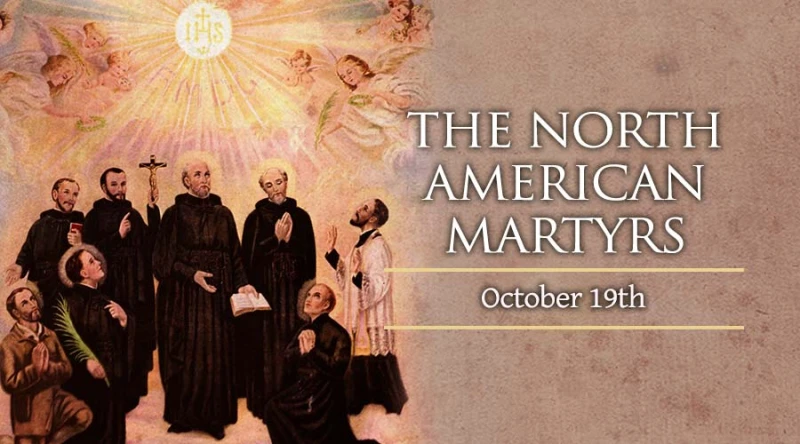
The North American Martyrs


The North American Martyrs

Feast date: Oct 19

Also known as Canadian Martyrs; Isaac Jogues and Companions; Jesuit Martyrs of North America; Martyrs of New France.
Memorial: 19 October; 26 September (Canada)

The eight North American martyrs, also known as the Candian Martyrs, the Jesuit Martyrs of North America or the Martyrs of France, included six priests and two lay brothers. They were heroic members of the Society of Jesus who were martyred in North America in order to bring the Faith that is necessary for salvation to the Huron, the Iroquois and the Mohawk Indians. Five of the eight North American martyrs were put to death in what is now Canada, and three of them in New York State. There is a shrine to the United States’ martyrs at Auriesville in New York, and there is a shrine to the Canadian martyrs at Fort Saint Mary near Midland, Ontario. The names of the eight North American martyrs are:

Saint Rene Goupil, a lay brother martyred in 1642 in New York State,
Saint Isaac Jogues, a priest,
Saint John de Lalande, a lay brother, martyred in 1646 in New York State,
Saint Anthony Daniel, a priest, martyred in Canada in 1648,
Saint John de Brebeuf,
Saint Charles Garnier,
Saint Noel Chabanel and
Saint Gabriel Lalemant, all priests, and all martyred in Canada in 1649.

Saint Isaac Jogues, after thirteen months’ imprisonment by the Mohawks, had several fingers cut off of his hand. He went back to Europe, but returned again to North America and was killed by tomahawk blows at Ossernenon, now called Auriesville, in New York State. Saint John de Brebeuf declared before he died, “I have a strong desire to suffer for Jesus Christ.” He was tortured terribly, and a burning torch was put into his mouth, which strangled him.

Saint Rene Goupil, thirty-five, was the youngest of the martyrs, and cried “Jesus, Jesus, Jesus!” as he died. Saint Noel Chabanel was thirty-six, and Saint Isaac Jogues and Saint Gabriel Lalemant were thirty-nine. The oldest of the eight North American martyrs, Saint John de Brebeuf, was fifty-six when the Indians killed him.

They were canonized June 29 of 1930 by Pope Pius XI. Their memorial is October 19, and Spetember 26 in Canada.

The North American Martyrs Read More »

St. Paul of the Cross

Feast date: Oct 19

Paul Francis Daneii was born at Ovada, Piedmont in northern Italy on January 3 of 1694. After receiving a vision, and while still a layman, he founded the Barefoot Clerks of the Cross and the Passion (Passionists) in 1721 to preach about Jesus Crucified. He became a preacher of such power that even hardened soldiers and bandits were seen to weep. At one point all the brothers in the order deserted him, but in 1741 his rule was approved by Pope Benedict XIV, and the community began to grow again.

His parents, Luke Danei and Anna Maria Massari, were exemplary Catholics, and from his earliest years the crucifix was his book, and the Crucified his model. Paul received his early education from a priest who kept a school for boys in Cremolino, Lombardy. He made great progress in study and virtue and spent much time in prayer and daily Mass. He frequently received the Sacraments, faithfully attended to his school duties, and gave his spare time to reading good books and visiting the churches, where he spent much time before the Blessed Sacrament, to which he had an ardent devotion. At the age of fifteen he left school and returned to his home at Castellazzo, and from this point on his life was full of trials.

In early manhood he renounced the offer of an honorable marriage, and also a good inheritance left him by an uncle who was a priest. He kept for himself only the priest’s Breviary.

Inflamed with a desire for God’s glory, he formed the idea of instituting a religious order with an emphasis on the Passion. Vested in a black tunic by the Bishop of Alessandria, his director, bearing the emblem of our Lord’s Passion, barefooted, and bareheaded, he retired to a narrow cell where he drew up the Rules of the new congregation according to the plan made known to him in a vision, which he relates in the introduction to the original copy of the Rules.

After the approbation of the Rules and the institute, the first general chapter was held at the Retreat of the Presentation on Mount Argentaro on April 10, 1747. At this chapter, St. Paul, against his wishes, was unanimously elected first superior general, an office which he held until the day of his death. In all virtues and in the observance of regular discipline, he became a model to his companions. “Although continually occupied with the cares of governing his religious society, and of founding everywhere new houses for it, he never ceased preaching the word of God, burning as he did with a wondrous desire for the salvation of souls” (Brief of Pius IX for St. Paul’s Beatification, Oct. 1, 1852).

Sacred missions were instituted and numerous conversions were made. He was untiring in his Apostolic labours and never, even to his last hour, remitted anything of his austere manner of life, finally succumbing to a severe illness, worn out as much by his austerities as by old age.

Among the distinguished associates of St. Paul in the formation and extension of the congregation were: John Baptist, his younger brother and constant companion from childhood, who shared all his labours and sufferings and equaled him in the practice of virtue, Father Mark Aurelius (Pastorelli), Father Thomas Struzzieri (subsequently Bishop of Amelia and afterwards of Todi), and Father Fulgentius of Jesus, all remarkable for learning, piety, and missionary zeal. Venerable Strambi, Bishop of Macerata and Tolentino, was his biographer.

Constant personal union with the Passion and Cross of our Lord was the prominent feature of St. Paul’s sanctity, but devotion to the Passion did not stand alone, for he carried to a heroic degree all the other virtues of a Christian life. Numerous miracles, in addition those special ones brought forward at his beatification and canonization, attested the favour he enjoyed with God.

Miracles of grace abounded, as witnessed in the conversion of sinners seemingly hardened and hopeless. For fifty years he prayed for the conversion of England, and left the devotion as a legacy to his sons. The body of St. Paul lies in the Basilica of Saints John and Paul in Rome.

He died on October 18, 1775, was beatified on October 1, 1852, and canonized on June 29, 1867. His feast is celebrated on April 28. The fame of his sanctity, which had spread far and wide in Italy during his life, increased after his death and spread into all countries. Great devotion to him is practiced by the faithful wherever Passionists are established.

St. Paul of the Cross Read More »

Feast of Saint Luke, evangelist

Reading I 2 Tm 4:10-17b

Beloved:
Demas, enamored of the present world,
deserted me and went to Thessalonica,
Crescens to Galatia, and Titus to Dalmatia.
Luke is the only one with me.
Get Mark and bring him with you,
for he is helpful to me in the ministry.
I have sent Tychicus to Ephesus.
When you come, bring the cloak I left with Carpus in Troas,
the papyrus rolls, and especially the parchments.

Alexander the coppersmith did me a great deal of harm;
the Lord will repay him according to his deeds.
You too be on guard against him,
for he has strongly resisted our preaching.

At my first defense no one appeared on my behalf,
but everyone deserted me.
May it not be held against them!
But the Lord stood by me and gave me strength,
so that through me the proclamation might be completed
and all the Gentiles might hear it.

Responsorial Psalm 145:10-11, 12-13, 17-18

R.    (12)  Your friends make known, O Lord, the glorious splendor of your Kingdom.
Let all your works give you thanks, O LORD,
    and let your faithful ones bless you.
Let them discourse of the glory of your Kingdom
    and speak of your might.
R.    Your friends make known, O Lord, the glorious splendor of your Kingdom.
Making known to men your might
    and the glorious splendor of your Kingdom.
Your Kingdom is a Kingdom for all ages,
    and your dominion endures through all generations.
R.    Your friends make known, O Lord, the glorious splendor of your Kingdom.
The LORD is just in all his ways
    and holy in all his works.
The LORD is near to all who call upon him,
    to all who call upon him in truth.
R.    Your friends make known, O Lord, the glorious splendor of your Kingdom.

Alleluia See Jn 15:16

R. Alleluia, alleluia.
I chose you from the world,
to go and bear fruit that will last, says the Lord.
R. Alleluia, alleluia.

Gospel Lk 10:1-9

The Lord Jesus appointed seventy-two disciples
whom he sent ahead of him in pairs
to every town and place he intended to visit.
He said to them,
“The harvest is abundant but the laborers are few;
so ask the master of the harvest
to send out laborers for his harvest.
Go on your way;
behold, I am sending you like lambs among wolves.
Carry no money bag, no sack, no sandals;
and greet no one along the way.
Into whatever house you enter,
first say, ‘Peace to this household.’
If a peaceful person lives there,
your peace will rest on him;
but if not, it will return to you.
Stay in the same house and eat and drink what is offered to you,
for the laborer deserves payment.
Do not move about from one house to another.
Whatever town you enter and they welcome you,
eat what is set before you,
cure the sick in it and say to them,
‘The Kingdom of God is at hand for you.’”

– – –

Lectionary for Mass for Use in the Dioceses of the United States, second typical edition, Copyright © 2001, 1998, 1997, 1986, 1970 Confraternity of Christian Doctrine; Psalm refrain © 1968, 1981, 1997, International Committee on English in the Liturgy, Inc. All rights reserved. Neither this work nor any part of it may be reproduced, distributed, performed or displayed in any medium, including electronic or digital, without permission in writing from the copyright owner.

Feast of Saint Luke, evangelist Read More »

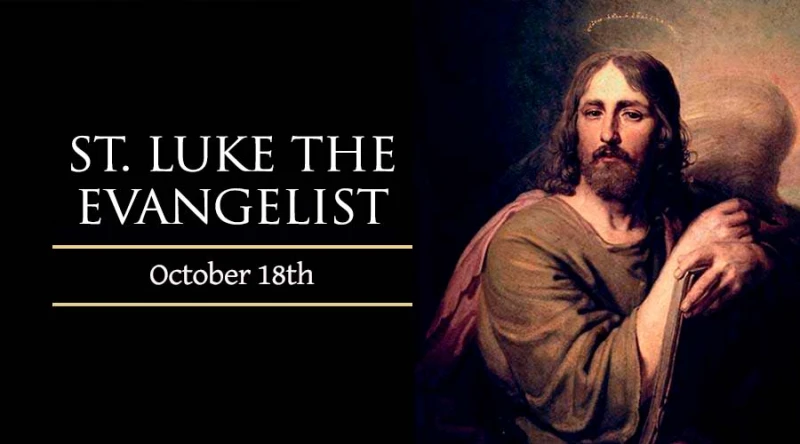
St. Luke the Evangelist


St. Luke the Evangelist

Feast date: Oct 18

On October 18, Catholics and other Christians around the world will celebrate the feast of St. Luke, the physician and companion of St. Paul whose gospel preserved the most extensive biography of Jesus Christ.

St. Luke wrote a greater volume of the New Testament than any other single author, including the earliest history of the Church. Ancient traditions also acknowledge Luke as the founder of Christian iconography, making him a patron of artists as well as doctors and other medical caregivers.

Luke came from the large metropolitan city of Antioch, a part of modern-day Turkey. In Luke’s lifetime, his native city emerged as an important center of early Christianity. During the future saint’s early years, the city’s port had already become a cultural center, renowned for arts and sciences. Historians do not know whether Luke came to Christianity from Judaism or paganism, although there are strong suggestions that Luke was a gentile convert.

Educated as a physician in the Greek-speaking city, Luke was among the most cultured and cosmopolitan members of the early Church. Scholars of archeology and ancient literature have ranked him among the top historians of his time period, besides noting the outstanding Greek prose style and technical accuracy of his accounts of Christ’s life and the apostles’ missionary journeys.

Other students of biblical history adduce from Luke’s writings that he was the only evangelist to incorporate the personal testimony of the Blessed Virgin Mary, whose role in Christ’s life emerges most clearly in his gospel. Tradition credits him with painting several icons of Christ’s mother, and one of the sacred portraits ascribed to him – known by the title “Salvation of the Roman People”– survives to this day in the Basilica of St. Mary Major.

Some traditions hold that Luke became a direct disciple of Jesus before his ascension, while others hold that he became a believer only afterward. After St. Paul’s conversion, Luke accompanied him as his personal physician– and, in effect, as a kind of biographer, since the journeys of Paul on which Luke accompanied him occupy a large portion of the Acts of the Apostles. Luke probably wrote this text, the final narrative portion of the New Testament, in the city of Rome where the account ends.

Luke was also among the only companions of Paul who did not abandon him during his final imprisonment and death in Rome. After the martyrdom of St. Paul in the year 67, St. Luke is said to have preached elsewhere throughout the Mediterranean, and possibly died as a martyr. However, even tradition is unclear on this point. Fittingly, the evangelist whose travels and erudition could have filled volumes, wrote just enough to proclaim the gospel and apostolic preaching to the world.

Patronage: artists, bachelors, bookbinders, brewers, butchers, doctors, glass makers, glassworkers, gold workers, goldsmiths, lacemakers, lace workers, notaries, painters, physicians, sculptors, stained glass workers, surgeons.

St. Luke the Evangelist Read More »