Please mind our dust!

We are currently working on revamping our website!
Thank you for your patience!

CRD Solutions

Memorial of Saint Ignatius of Antioch, Bishop and Martyr

Reading 1 EPH 2:1-10

Brothers and sisters:
You were dead in your transgressions and sins
in which you once lived following the age of this world,
following the ruler of the power of the air,
the spirit that is now at work in the disobedient.
All of us once lived among them in the desires of our flesh,
following the wishes of the flesh and the impulses,
and we were by nature children of wrath, like the rest.
But God, who is rich in mercy,
because of the great love he had for us,
even when we were dead in our transgressions,
brought us to life with Christ (by grace you have been saved),
raised us up with him,
and seated us with him in the heavens in Christ Jesus,
that in the ages to come
he might show the immeasurable riches of his grace
in his kindness to us in Christ Jesus.
For by grace you have been saved through faith,
and this is not from you; it is the gift of God;
it is not from works, so no one may boast.
For we are his handiwork, created in Christ Jesus for good works
that God has prepared in advance,
that we should live in them.

Responsorial Psalm PS 100:1B-2, 3, 4AB, 4C-5

R. (3b) The Lord made us, we belong to him.
Sing joyfully to the LORD all you lands;
serve the LORD with gladness;
come before him with joyful song.
R. The Lord made us, we belong to him.
Know that the LORD is God;
he made us, his we are;
his people, the flock he tends.
R. The Lord made us, we belong to him.
Enter his gates with thanksgiving,
his courts with praise.
R. The Lord made us, we belong to him.
Give thanks to him; bless his name, for he is good:
the LORD, whose kindness endures forever,
and his faithfulness, to all generations.
R. The Lord made us, we belong to him.


Alleluia MT 5:3

R. Alleluia, alleluia.
Blessed are the poor in spirit;
for theirs is the Kingdom of heaven.
R. Alleluia, alleluia.

Gospel LK 12:13-21

Someone in the crowd said to Jesus,
“Teacher, tell my brother to share the inheritance with me.”
He replied to him,
“Friend, who appointed me as your judge and arbitrator?”
Then he said to the crowd,
“Take care to guard against all greed,
for though one may be rich,
one’s life does not consist of possessions.”

Then he told them a parable.
“There was a rich man whose land produced a bountiful harvest.
He asked himself, ‘What shall I do,
for I do not have space to store my harvest?’
And he said, ‘This is what I shall do:
I shall tear down my barns and build larger ones.
There I shall store all my grain and other goods
and I shall say to myself, “Now as for you,
you have so many good things stored up for many years,
rest, eat, drink, be merry!”’
But God said to him,
‘You fool, this night your life will be demanded of you;
and the things you have prepared, to whom will they belong?’
Thus will it be for the one who stores up treasure for himself
but is not rich in what matters to God.”

– – –

Lectionary for Mass for Use in the Dioceses of the United States, second typical edition, Copyright © 2001, 1998, 1997, 1986, 1970 Confraternity of Christian Doctrine; Psalm refrain © 1968, 1981, 1997, International Committee on English in the Liturgy, Inc. All rights reserved. Neither this work nor any part of it may be reproduced, distributed, performed or displayed in any medium, including electronic or digital, without permission in writing from the copyright owner.

Memorial of Saint Ignatius of Antioch, Bishop and Martyr Read More »
St. Ignatius of Antioch


St. Ignatius of Antioch

Feast date: Oct 17

On Oct. 17, the Roman Catholic Church remembers the early Church Father, bishop, and martyr Saint Ignatius of Antioch, whose writings attest to the sacramental and hierarchical nature of the Church from its earliest days. Eastern Catholics and Eastern Orthodox Christians celebrate his memory on Dec. 20.

In a 2007 general audience on St. Ignatius of Antioch, Pope Benedict XVI observed that “no Church Father has expressed the longing for union with Christ and for life in him with the intensity of Ignatius.” In his letters, the Pope said, “one feels the freshness of the faith of the generation which had still known the Apostles. In these letters, the ardent love of a saint can also be felt.”

Born in Syria in the middle of the first century A.D., Ignatius is said to have been personally instructed – along with another future martyr, Saint Polycarp – by the Apostle Saint John. When Ignatius became the Bishop of Antioch around the year 70, he assumed leadership of a local church that was, according to tradition, first led by Saint Peter before his move to Rome.

Although St. Peter transmitted his Papal primacy to the bishops of Rome rather than Antioch, the city played an important role in the life of the early Church. Located in present-day Turkey, it was a chief city of the Roman Empire, and was also the location where the believers in Jesus’ teachings and his resurrection were first called “Christians.”

Ignatius led the Christians of Antioch during the reign of the Roman Emperor Domitian, the first of the emperors to proclaim his divinity by adopting the title “Lord and God.” Subjects who would not give worship to the emperor under this title could be punished with death. As the leader of a major Catholic diocese during this period, Ignatius showed courage and worked to inspire it in others.

After Domitian’s murder in the year 96, his successor Nerva reigned only briefly, and was soon followed by the Emperor Trajan. Under his rule, Christians were once again liable to death for denying the pagan state religion and refusing to participate in its rites. It was during his reign that Ignatius was convicted for his Christian testimony and sent from Syria to Rome to be put to death.

Escorted by a team of military guards, Ignatius nonetheless managed to compose seven letters: six to various local churches throughout the empire (including the Church of Rome), and one to his fellow bishop Polycarp who would give his own life for Christ several decades later.

Ignatius’ letters passionately stressed the importance of Church unity, the dangers of heresy, and the surpassing importance of the Eucharist as the “medicine of immortality.” These writings contain the first surviving written description of the Church as “Catholic,” from the Greek word indicating both universality and fullness.

One of the most striking features of Ignatius’ letters, is his enthusiastic embrace of martyrdom as a means to union with God and eternal life. “All the pleasures of the world, and all the kingdoms of this earth, shall profit me nothing,” he wrote to the Church of Rome. “It is better for me to die in behalf of Jesus Christ, than to reign over all the ends of the earth.”

“Now I begin to be a disciple,” the bishop declared. “Let fire and the cross; let the crowds of wild beasts; let tearings, breakings, and dislocations of bones; let cutting off of members; let shatterings of the whole body; and let all the dreadful torments of the devil come upon me: only let me attain to Jesus Christ.”

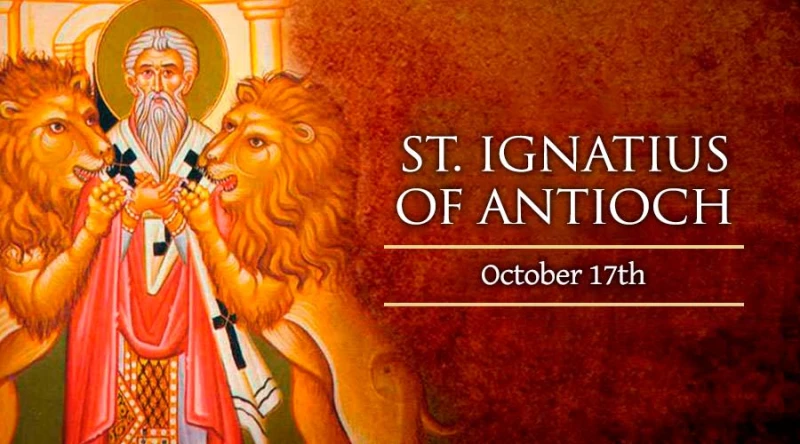
St. Ignatius of Antioch bore witness to Christ publicly for the last time in Rome’s Flavian Amphitheater, where he was mauled to death by lions. “I am the wheat of the Lord,” he had declared, before facing them. “I must be ground by the teeth of these beasts to be made the pure bread of Christ.” His memory was honored, and his bones venerated, soon after his death around the year 107.

St. Ignatius of Antioch Read More »

Twenty-ninth Sunday in Ordinary Time

Reading 1 Ex 17:8-13

In those days, Amalek came and waged war against Israel.
Moses, therefore, said to Joshua,
“Pick out certain men,
and tomorrow go out and engage Amalek in battle.
I will be standing on top of the hill
with the staff of God in my hand.”
So Joshua did as Moses told him:
he engaged Amalek in battle
after Moses had climbed to the top of the hill with Aaron and Hur.
As long as Moses kept his hands raised up,
Israel had the better of the fight,
but when he let his hands rest,
Amalek had the better of the fight.
Moses’hands, however, grew tired;
so they put a rock in place for him to sit on.
Meanwhile Aaron and Hur supported his hands,
one on one side and one on the other,
so that his hands remained steady till sunset.
And Joshua mowed down Amalek and his people
with the edge of the sword.

Responsorial Psalm Ps 121:1-2, 3-4, 5-6, 7-8

R.(cf. 2)  Our help is from the Lord, who made heaven and earth.
I lift up my eyes toward the mountains;
whence shall help come to me?
My help is from the LORD,
who made heaven and earth.
R. Our help is from the Lord, who made heaven and earth.
May he not suffer your foot to slip;
may he slumber not who guards you:
indeed he neither slumbers nor sleeps,
the guardian of Israel.
R. Our help is from the Lord, who made heaven and earth.
The LORD is your guardian; the LORD is your shade;
he is beside you at your right hand.
The sun shall not harm you by day,
nor the moon by night.
R. Our help is from the Lord, who made heaven and earth.
The LORD will guard you from all evil;
he will guard your life.
The LORD will guard your coming and your going,
both now and forever.
R. Our help is from the Lord, who made heaven and earth.

Reading 2 2 Tm 3:14-4:2

Beloved:
Remain faithful to what you have learned and believed,
because you know from whom you learned it,
and that from infancy you have known the sacred Scriptures,
which are capable of giving you wisdom for salvation
through faith in Christ Jesus.
All Scripture is inspired by God
and is useful for teaching, for refutation, for correction,
and for training in righteousness,
so that one who belongs to God may be competent,
equipped for every good work.

I charge you in the presence of God and of Christ Jesus,
who will judge the living and the dead,
and by his appearing and his kingly power:
proclaim the word;
be persistent whether it is convenient or inconvenient;
convince, reprimand, encourage through all patience and teaching.

Alleluia Heb 4:12

R. Alleluia, alleluia.
The word of God is living and effective,
discerning reflections and thoughts of the heart.
R. Alleluia, alleluia.

Gospel Lk 18:1-8

Jesus told his disciples a parable
about the necessity for them to pray always without becoming weary.
He said, “There was a judge in a certain town
who neither feared God nor respected any human being.
And a widow in that town used to come to him and say,
‘Render a just decision for me against my adversary.’
For a long time the judge was unwilling, but eventually he thought,
‘While it is true that I neither fear God nor respect any human being,
because this widow keeps bothering me
I shall deliver a just decision for her
lest she finally come and strike me.'”
The Lord said, “Pay attention to what the dishonest judge says.
Will not God then secure the rights of his chosen ones
who call out to him day and night?
Will he be slow to answer them?
I tell you, he will see to it that justice is done for them speedily.
But when the Son of Man comes, will he find faith on earth?”

– – –

Lectionary for Mass for Use in the Dioceses of the United States, second typical edition, Copyright © 2001, 1998, 1997, 1986, 1970 Confraternity of Christian Doctrine; Psalm refrain © 1968, 1981, 1997, International Committee on English in the Liturgy, Inc. All rights reserved. Neither this work nor any part of it may be reproduced, distributed, performed or displayed in any medium, including electronic or digital, without permission in writing from the copyright owner.

Twenty-ninth Sunday in Ordinary Time Read More »

St. Margaret Mary Alacoque


St. Margaret Mary Alacoque

Feast date: Oct 16

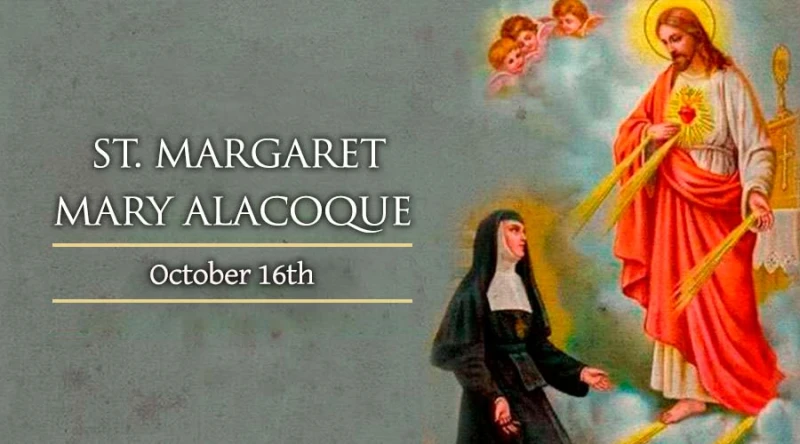
On Oct. 16, Roman Catholics celebrate the life of St. Margaret Mary Alacoque, the French nun whose visions of Christ helped to spread devotion to the Sacred Heart throughout the Western Church.

Margaret Mary Alacoque was born in July of 1647. Her parents Claude and Philiberte lived modest but virtuous lives, while Margaret proved to be a serious child with a great focus on God. Claude died when Margaret was eight, and from age 9-13 she suffered a paralyzing illness. In addition to her father’s death as well as her illenss, a struggle over her family’s property made life difficult for Margaret and her mother for several years.

During her illness, Margaret made a vow to enter religious life. During adolescence, however, she changed her mind. For a period of time she lived a relatively ordinary life, enjoying the ordinary social functions of her day and considering the possibility of marriage.

However, her life changed in response to a vision she saw one night while returning from a dance, in which she saw Christ being scourged. Margaret believed she had betrayed Jesus, by pursuing the pleasures of the world rather than her religious vocation, and a the at the age of 22, she decided to enter a convent.

Two days after Christmas of 1673, Margaret experienced Christ’s presence in an extraordinary way while in prayer. She heard Christ explain that he desired to show his love for the human race in a special way, by encouraging devotion to “the heart that so loved mankind.”

She experienced a subsequent series of private revelations regarding the gratitude due to Jesus on the part of humanity, and the means of responding through public and private devotion, but the superior of the convent dismissed this as a delusion.

This dismissal was a crushing disappointment, affecting the nun’s health so seriously that she nearly died. In 1674, however, the Jesuit priest Father Claude de la Colombiere became Margaret’s spiritual director. He believed her testimony, and chronicled it in writing.

Fr. de la Colombiere – later canonized as a saint – left the monastery to serve as a missionary in England. By the time he returned and died in 1681, Margaret had made peace with the apparent rejection of her experiences. Through St. Claude’s direction, she had reached a point of inner peace, no longer concerned with the hostility of others in her community.

In time, however, many who doubted her would become convinced as they pondered what St. Claude had written about the Sacred Heart. Eventually, her own writings and the accounts of her would face a rigorous examination by Church officials.

By the time that occurred, however, St. Margaret Mary Alacoque had already gained what she desired: “To lose myself in the heart of Jesus.” She faced her last illness with courage, frequently praying the words of Psalm 73: “What have I in heaven, and what do I desire on earth, but Thee alone, O my God?”

She died on October 17, 1690, and was canonized by Pope Benedict XV in 1920.

St. Margaret Mary Alacoque Read More »

St. Gerard Majella


St. Gerard Majella

Feast date: Oct 16

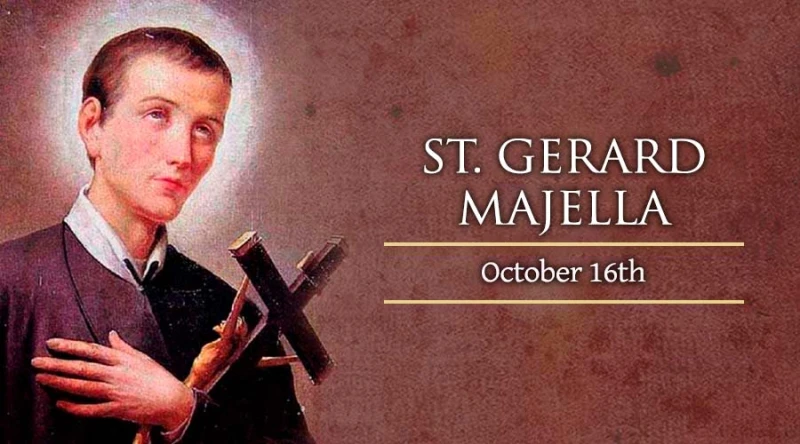
On October 16, we celebrate the feast of St. Gerard Majella. St. Gerard was born the son of a tailor on April 6, 1726. He grew up about fifty miles south of Naples in Muro Lucano, Italy in a large, poor family. When St. Gerard was only 12, his father Dominic Majella entered eternal rest. Upon the death of his father, his mother, beholden to poverty, sent St. Gerard away to live with his uncle. St. Gerard thereafter became an apprentice to a tailor. This tailor treated him well; however, the foreman treated him poorly. After serving as a sewing apprentice for a couple years, he instead became a servant in the household of the bishop of Lacedonia, who was a cantankerous master. Upon the death of the bishop in 1745, he returned home. At the age of 21, he became a journeyman. He split his earnings for his mother and the poor, and made offerings for the holy souls in purgatory. Afterwards, he opened his own tailor shop.

At a young age, St. Gerard tried to join the local Capuchins, but he was turned down twice due to his youth and poor health. He also tried to become a hermit, but that too was not God’s will for him. He then entered the Congregation of the Most Holy Redeemer in 1749 and professed of perpetual vows under the Redemptorist’s founder, Saint Alphonsus Liguori, in 1751.

He served as tailor and infirmarian and became known for his extraordinary supernatural gifts of bilocation, prophecy, ecstasies, visions, and infused knowledge. Though not ordained to the holy order of priest, his spiritual direction and advice were sought by many among the clergy and communities of nuns, to which he also gave conferences. He was most successful in converting sinners, and was widely known for his sanctity and charity.

In 1754, he was calumniated and accused of lechery by a woman named Neria Caggiano. Caggiano later admitted her charge was a lie. Even before she admitted to her falsehood, St. Gerard did not deny her charges. As these charges were still up in the air, his superiors became suspicious, so they put him under surveillance and excluded him from communion for months until the girl admitted that she had lied. When asked by Saint Alphonsus why he had kept silent in such circumstances, St. Gerard replied that he thought such patience was required in the face of unjust accusations. As St. Gerard bore this calumny with such humility and patience, Saint Alphonsus said, “Brother Gerard is a saint.”

St. Gerard was sent to Naples soon after, but when the house was inundated by visitors wanting to see him, he was sent to Caposele a few months later. He served as the porter there and ministered to the poor of the town. St. Gerard spent the last few months of his life raising funds for new buildings at Caposele.

Just prior to his death, St. Gerard visited his friends, the Pirofalo family. One of the daughters ran and called after him as he left the home, as he dropped his handkerchief. Speaking through the gift of prophecy, he replied, “Keep it. It will be useful to you someday.” Years down the road, when this young women was in danger of childbirth, she recalled these words of St. Gerard, and requested the handkerchief. The handkerchief was applied to her, thus a miracle: her pain immediately ceased and she gave birth to a healthy child.

St. Gerard died of tuberculosis on October 16, 1755 at the age of 29 in Caposele. He was beatified by Pope Leo XIII on January 29, 1893, and was canonized on December 11, 1904 by Pope Saint Pius X. He is the patron saint of mothers, motherhood, expectant mothers, childbirth, children, pregnant women, unborn children, the pro-life movement, the falsely accused, good confessions, and lay brothers.

St. Gerard Majella Read More »