Please mind our dust!

We are currently working on revamping our website!
Thank you for your patience!

CRD Solutions

Memorial of Saint Teresa of Jesus, Virgin and Doctor of the Church

Reading 1 EPH 1:15-23

Brothers and sisters:
Hearing of your faith in the Lord Jesus
and of your love for all the holy ones,
I do not cease giving thanks for you,
remembering you in my prayers,
that the God of our Lord Jesus Christ, the Father of glory,
may give you a spirit of wisdom and revelation
resulting in knowledge of him.
May the eyes of your hearts be enlightened,
that you may know what is the hope that belongs to his call,
what are the riches of glory
in his inheritance among the holy ones,
and what is the surpassing greatness of his power
for us who believe,
in accord with the exercise of his great might,
which he worked in Christ,
raising him from the dead
and seating him at his right hand in the heavens,
far above every principality, authority, power, and dominion,
and every name that is named
not only in this age but also in the one to come.
And he put all things beneath his feet
and gave him as head over all things to the Church,
which is his Body,
the fullness of the one who fills all things in every way.

Responsorial Psalm PS 8:2-3AB, 4-5, 6-7

R. (7) You have given your Son rule over the works of your hands.
O LORD, our LORD,
how glorious is your name over all the earth!
You have exalted your majesty above the heavens.
Out of the mouths of babes and sucklings
you have fashioned praise because of your foes.
R. You have given your Son rule over the works of your hands.
When I behold your heavens, the work of your fingers,
the moon and the stars which you set in place—
What is man that you should be mindful of him,
or the son of man that you should care for him?
R. You have given your Son rule over the works of your hands.
You have made him little less than the angels,
and crowned him with glory and honor.
You have given him rule over the works of your hands,
 putting all things under his feet.
R. You have given your Son rule over the works of your hands.


Alleluia JN 15:26B, 27A

R. Alleluia, alleluia.
The Spirit of truth will testify to me, says the Lord,
and you also will testify.
R. Alleluia, alleluia.

Gospel LK 12:8-12

Jesus said to his disciples: 
 “I tell you,
everyone who acknowledges me before others
the Son of Man will acknowledge before the angels of God.
But whoever denies me before others
will be denied before the angels of God.

“Everyone who speaks a word against the Son of Man will be forgiven,
but the one who blasphemes against the Holy Spirit
will not be forgiven.
When they take you before synagogues and before rulers and authorities,
do not worry about how or what your defense will be
or about what you are to say. 
For the Holy Spirit will teach you at that moment what you should say.”

– – –

Lectionary for Mass for Use in the Dioceses of the United States, second typical edition, Copyright © 2001, 1998, 1997, 1986, 1970 Confraternity of Christian Doctrine; Psalm refrain © 1968, 1981, 1997, International Committee on English in the Liturgy, Inc. All rights reserved. Neither this work nor any part of it may be reproduced, distributed, performed or displayed in any medium, including electronic or digital, without permission in writing from the copyright owner.

Memorial of Saint Teresa of Jesus, Virgin and Doctor of the Church Read More »
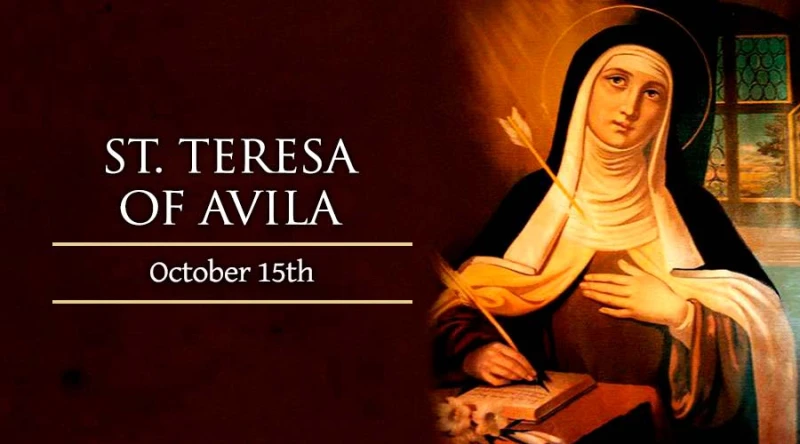
St. Teresa of Avila


St. Teresa of Avila

Feast date: Oct 15

On Oct. 15, Roman Catholics celebrate the Spanish Carmelite reformer and mystic St. Teresa of Avila, whose life of prayer enriched the Church during the 16th century counter-reformation.

Teresa Sanchez Cepeda Davila y Ahumada was born in the Castilian city of Avila during the year 1515,  the third child in a family descended from Jewish merchants who had converted to Christianity during the reign of King Ferdinand and Queen Isabella. Her father Alphonsus had become an ardent Catholic, with a collection of spiritual books of the type his daughter would later compose herself.

As a child, Teresa felt captivated by the thought of eternity and the vision of God granted to the saints in heaven. She and her younger brother Rodrigo once attempted to run away from home for the sake of dying as martyrs in a Muslim country, though they soon ran into a relative who sent them back to their mother Beatrice.

When Teresa was 14, her mother died, causing the girl a profound grief that prompted her to embrace a deeper devotion to the Virgin Mary as her spiritual mother. Along with this good resolution, however, she also developed immoderate interests in reading popular fiction (consisting, at that time, mostly of medieval tales of knighthood) and caring for her own appearance.

Though Teresa’s spiritual directors in later life would judge these faults to be relatively minor, they still represented a noticeable loss of her childhood zeal for God. Alphonsus decided his teenage daughter needed a change of environment, and sent her to be educated in a convent of Augustinian nuns. Teresa found their life dull at first, but soon came to some understanding of its spiritual advantages.

Illness forced her to leave the convent during her second year. But the influence of her devout uncle Peter, along with her reading of the letters of the monk and Church Father St. Jerome, convinced Teresa that the surest road to salvation lay in forsaking marriage, property, and worldly pleasures completely. Against the will of her father, who wanted her to postpone the decision, she joined the Carmelite Order.

Teresa became a professed member of the order at age 20, but soon developed a serious illness that forced her to return home. She experienced severe pain and physical paralysis for two years, and was expected to die when she went into a coma for four days. But she insisted on returning to the Carmelite monastery as soon as she was able, even though she remained in a painful and debilitated state.

For the next three years the young nun made remarkable progress in her spiritual life, developing the practice of recalling herself into the presence of God through quiet contemplation. As her health returned, however, Teresa lapsed into a more routine prayer life. While she remained an obedient Carmelite, she would not re-establish this close personal connection to God for almost twenty years.

When she was nearly 40, however, Teresa found herself dramatically called back to the practice of contemplative mental prayer. She experienced profound changes within her own soul, and remarkable visions that seemed to come from God. Under the direction of her confessors, Teresa wrote about some of these experiences in an autobiography that she completed in 1565.

Teresa had always been accustomed to contemplate Christ’s presence within her after receiving him in the sacrament of Holy Communion. Now, however, she understood that the presence she received did not simply fade: God was, in fact, with her always, and had been all along. It was simply a matter of putting herself in his presence, with love and attention – as one could do at any moment.

This revolution in her spiritual life enabled Teresa to play a significant role in the renewal of the Church that followed the Council of Trent. She proposed a return of the Carmelites to their original rule of life, a simple and austere form of monasticism – founded on silence and solitude – that had received papal approval in the 12th century and was believed to date back to the Old Testament prophet Elijah.

Together with her close collaborator, the priest and writer later canonized as Saint John of the Cross, she founded what is known today as the Order of Discalced Carmelites – “discalced,” meaning barefoot, symbolizing the simplicity to which they chose to return the order after a period of corruption. The reform met with fierce opposition, but resulted in the founding of 30 monasteries during her life.

Teresa’s health failed her for the last time while she was traveling through Salamanca in 1582. She accepted her dramatic final illness as God’s chosen means of calling her into his presence forever.

“O my Lord, and my spouse, the desired hour is now come,” she stated. “The hour is at last come, wherein I shall pass out of this exile, and my soul shall enjoy in thy company what it hath so earnestly longed for.”

St. Teresa of Avila died on Oct. 15, 1582. She was canonized on March 22, 1622, along with three of her greatest contemporaries: St. Ignatius Loyola, St. Francis Xavier, and St. Philip Neri.

In 1970, Pope St. Paul VI proclaimed St. Teresa as one of the first two woman Doctors of the Church, along with 14th century Dominican St. Catherine of Siena.

St. Teresa of Avila Read More »

Friday of the Twenty-eighth Week in Ordinary Time

Reading 1 EPH 1:11-14

Brothers and sisters:
In Christ we were also chosen,
destined in accord with the purpose of the One
who accomplishes all things according to the intention of his will,
so that we might exist for the praise of his glory,
we who first hoped in Christ.
In him you also, who have heard the word of truth,
the Gospel of your salvation, and have believed in him,
were sealed with the promised Holy Spirit,
which is the first installment of our inheritance
toward redemption as God’s possession, to the praise of his glory.

Responsorial Psalm PS 33:1-2, 4-5, 12-13

R.  (12) Blessed the people the Lord has chosen to be his own.
Exult, you just, in the LORD;
praise from the upright is fitting.
Give thanks to the LORD on the harp;
with the ten-stringed lyre chant his praises.
R. Blessed the people the Lord has chosen to be his own.
For upright is the word of the LORD,
and all his works are trustworthy.
He loves justice and right;
of the kindness of the LORD the earth is full.
R. Blessed the people the Lord has chosen to be his own.
Blessed the nation whose God is the LORD,
the people he has chosen for his own inheritance.
From heaven the LORD looks down;
he sees all mankind.
R. Blessed the people the Lord has chosen to be his own.


Alleluia PS 33:22

R. Alleluia, alleluia.
May your kindness, LORD, be upon us;
who have put our hope in you.
R. Alleluia, alleluia.

Gospel LK 12:1-7

At that time:
So many people were crowding together 
that they were trampling one another underfoot.
Jesus began to speak, first to his disciples,
“Beware of the leaven–that is, the hypocrisy–of the Pharisees.

“There is nothing concealed that will not be revealed,
nor secret that will not be known.
Therefore whatever you have said in the darkness
will be heard in the light,
and what you have whispered behind closed doors
will be proclaimed on the housetops.
I tell you, my friends,
do not be afraid of those who kill the body
but after that can do no more.
I shall show you whom to fear.
Be afraid of the one who after killing
has the power to cast into Gehenna;
yes, I tell you, be afraid of that one.
Are not five sparrows sold for two small coins?
Yet not one of them has escaped the notice of God.
Even the hairs of your head have all been counted.
Do not be afraid.
You are worth more than many sparrows.”

– – –

Lectionary for Mass for Use in the Dioceses of the United States, second typical edition, Copyright © 2001, 1998, 1997, 1986, 1970 Confraternity of Christian Doctrine; Psalm refrain © 1968, 1981, 1997, International Committee on English in the Liturgy, Inc. All rights reserved. Neither this work nor any part of it may be reproduced, distributed, performed or displayed in any medium, including electronic or digital, without permission in writing from the copyright owner.

Friday of the Twenty-eighth Week in Ordinary Time Read More »

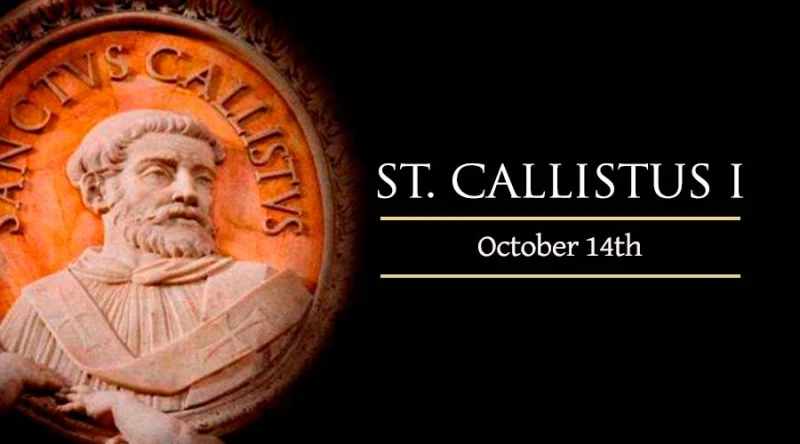
St. Callistus I


St. Callistus I

Feast date: Oct 14

Pope Callistus I is celebrated in churches throughout the world as a saint and martyr on October 14. The saint caused a major controversy, including a schism that lasted almost two decades, by choosing to emphasize God’s mercy in his ministry. However, the early Pope’s model of leadership has endured, and his martyrdom in the year 222 confirmed his example of holiness.

Because no completely trustworthy biography of Pope Callistus I exists, historians have been forced to rely on an account by his contemporary Hippolytus of Rome. Although Hippolytus himself was eventually reconciled to the Church and canonized as a martyr, he vocally opposed the pontificate of Callistus and three of his successors, to the point of usurping papal prerogatives for himself (as the first “antipope”). Nevertheless, his account of Callistus’ life and papacy provides important details.

According to Hippolytus’ account, Callistus – whose year of birth is not known – began his career as a highly-placed domestic servant, eventually taking responsibility for his master’s banking business. When the bank failed, Callistus received the blame, and attempted to flee from his master. Being discovered, he was demoted to serve as a manual laborer in Rome. Thus, under inauspicious circumstances, Callistus came as a slave to the city where he would later serve as Pope.

Matters went from bad to worse when he was sent to work in the mines, possibly for causing a public disturbance, if Hippolytus’ account is to be trusted. However, Callistus may also simply have been sentenced due to a persecution of Christians, as he was among the many believers eventually freed on the initiative of Pope St. Victor I.

During the subsequent reign of Pope Zephyrinus, Callistus became a deacon and the caretaker of a major Roman Christian cemetery (which still bears his name as the “Cemetery of St. Callistus”), in addition to advising the Pope on theological controversies of the day. He was a natural candidate to follow Zephyrinus, when the latter died in 219.

Hippolytus, an erudite Roman theologian, accused Pope Callistus of sympathizing with heretics, and resented the new Pope’s clarification that even the most serious sins could be absolved after sincere confession. The Pope’s assertion of divine mercy also scandalized the North African Christian polemicist Tertullian, already in schism from the Church in Carthage, who also erroneously held that certain sins were too serious to be forgiven through confession.

Considered in light of this error, Hippolytus’ catalogue of sins allegedly “permitted” by Callistus – including extramarital sex and early forms of contraception – may in fact represent offenses which the Pope never allowed, but which he was willing to absolve in the case of penitents seeking reconciliation with the Church.

Even so, Callistus could not persuade Hippolytus’ followers of his rightful authority as Pope during his own lifetime. The Catholic Church, however, has always acknowledged the orthodoxy and holiness of Pope St. Callistus I, particularly since the time of his martyrdom – traditionally ascribed to an anti-Christian mob – in 222. 

St. Callistus’ own intercession after death may also have made possible the historic reconciliation between his opponent Hippolytus, and the later Pope Pontian. The Pope and former antipope were martyred together in 236, and both subsequently canonized.

St. Callistus I Read More »

Thursday of the Twenty-eighth Week in Ordinary Time

Reading 1 EPH 1:1-10

Paul, an Apostle of Christ Jesus by the will of God,
to the holy ones who are in Ephesus
and faithful in Christ Jesus:
grace to you and peace from God our Father and the Lord Jesus Christ.

Blessed be the God and Father of our Lord Jesus Christ,
who has blessed us in Christ
with every spiritual blessing in the heavens,
as he chose us in him, before the foundation of the world,
to be holy and without blemish before him.
In love he destined us for adoption to himself through Jesus Christ,
in accord with the favor of his will,
for the praise of the glory of his grace
that he granted us in the beloved.

In Christ we have redemption by his Blood,
the forgiveness of transgressions,
in accord with the riches of his grace that he lavished upon us.
In all wisdom and insight, he has made known to us
the mystery of his will in accord with his favor
that he set forth in him as a plan for the fullness of times,
to sum up all things in Christ, in heaven and on earth.

Responsorial Psalm PS 98:1, 2-3AB, 3CD-4, 5-6

R. (2a) The Lord has made known his salvation.
Sing to the LORD a new song,
for he has done wondrous deeds;
His right hand has won victory for him,
his holy arm.
R. The Lord has made known his salvation.
The LORD has made his salvation known:
in the sight of the nations he has revealed his justice.
He has remembered his kindness and his faithfulness
toward the house of Israel.
R. The Lord has made known his salvation.
All the ends of the earth have seen
the salvation by our God.
Sing joyfully to the LORD, all you lands;
break into song; sing praise.
R. The Lord has made known his salvation.
Sing praise to the LORD with the harp,
with the harp and melodious song.
With trumpets and the sound of the horn
sing joyfully before the King, the LORD.
R. The Lord has made known his salvation.


Alleluia  JN 14:16

R. Alleluia, alleluia.
I am the way and the truth and the life, says the Lord;
no one comes to the Father except through me.
R. Alleluia, alleluia.

Gospel LK 11:47-54

The Lord said:
“Woe to you who build the memorials of the prophets 
whom your fathers killed.
Consequently, you bear witness and give consent
to the deeds of your ancestors,
for they killed them and you do the building.
Therefore, the wisdom of God said,
‘I will send to them prophets and Apostles;
some of them they will kill and persecute’
in order that this generation might be charged
with the blood of all the prophets
shed since the foundation of the world,
from the blood of Abel to the blood of Zechariah
who died between the altar and the temple building.
Yes, I tell you, this generation will be charged with their blood!
Woe to you, scholars of the law!
You have taken away the key of knowledge.
You yourselves did not enter and you stopped those trying to enter.”
When Jesus left, the scribes and Pharisees
began to act with hostility toward him
and to interrogate him about many things,
for they were plotting to catch him at something he might say.

– – –

Lectionary for Mass for Use in the Dioceses of the United States, second typical edition, Copyright © 2001, 1998, 1997, 1986, 1970 Confraternity of Christian Doctrine; Psalm refrain © 1968, 1981, 1997, International Committee on English in the Liturgy, Inc. All rights reserved. Neither this work nor any part of it may be reproduced, distributed, performed or displayed in any medium, including electronic or digital, without permission in writing from the copyright owner.

Thursday of the Twenty-eighth Week in Ordinary Time Read More »