Please mind our dust!

We are currently working on revamping our website!
Thank you for your patience!

CRD Solutions

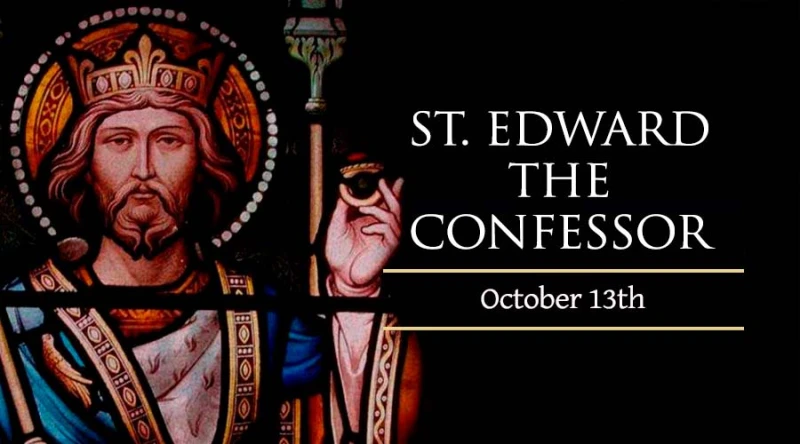
St. Edward the Confessor


St. Edward the Confessor

Feast date: Oct 13

St. Edward was born in 1003 as the son of the Duke of Normandy and nephew of King Edmund Ironside of England. He grew up in exile in Normandy from the age of 10 when the Danes gained control of England, and the early experience of loss, coupled with his earnest religious piety, caused him to renounce worldly ambition and devote himself to the love of God.

On the death of the Danish king, Canute, in 1042, he was called to the throne of England, which he accepted dutifully and held until 1066. His saintly bearing made him a popular sovereign, and his actions even more so. He abolished an unjust tax and was known to cure people with his touch.

Having made a vow of chastity, he accepted marriage for the sake of his kingdom, but lived with his queen in celibacy, as brother and sister.

Unable to fulfill a vow to embark on a pilgrimage to Saint Peter’s tomb without leaving his subjects vulnerable to attack, his vow was commuted by the pope to the rebuilding of Saint Peter’s Abbey in Westminister, where he was buried upon his death a week after it’s dedication.

Edward died on January 5, 1066, and was canonized by Pope Alexander III in 1161.

St. Edward the Confessor Read More »

Wednesday of the Twenty-eighth Week in Ordinary Time

Reading 1 GAL 5:18-25

Brothers and sisters:
If you are guided by the Spirit, you are not under the law.
Now the works of the flesh are obvious:
immorality, impurity, licentiousness, idolatry,
sorcery, hatreds, rivalry, jealousy,
outbursts of fury, acts of selfishness,
dissensions, factions, occasions of envy,
drinking bouts, orgies, and the like.
I warn you, as I warned you before,
that those who do such things will not inherit the Kingdom of God.
In contrast, the fruit of the Spirit is love, joy, peace,
patience, kindness, generosity,
faithfulness, gentleness, self-control.
Against such there is no law.
Now those who belong to Christ Jesus have crucified their flesh
with its passions and desires.
If we live in the Spirit, let us also follow the Spirit. 

Responsorial Psalm PS 1:1-2, 3, 4 AND 6

R. (see Jn 8:12) Those who follow you, Lord, will have the light of life.
Blessed the man who follows not
the counsel of the wicked
Nor walks in the way of sinners,
nor sits in the company of the insolent,
But delights in the law of the LORD
and meditates on his law day and night.
R. Those who follow you, Lord, will have the light of life.
He is like a tree
planted near running water,
That yields its fruit in due season,
and whose leaves never fade.
Whatever he does, prospers.
R. Those who follow you, Lord, will have the light of life.
Not so the wicked, not so;
they are like chaff which the wind drives away.
For the LORD watches over the way of the just,
but the way of the wicked vanishes.
R. Those who follow you, Lord, will have the light of life.


Alleluia  JN 10:27

R. Alleluia, alleluia.
My sheep hear my voice, says the Lord;
I know them, and they follow me.
R. Alleluia, alleluia.

Gospel LK 11:42-46

The Lord said:
“Woe to you Pharisees!
You pay tithes of mint and of rue and of every garden herb,
but you pay no attention to judgment and to love for God.
These you should have done, without overlooking the others.
Woe to you Pharisees!
You love the seat of honor in synagogues
and greetings in marketplaces.  
Woe to you!
You are like unseen graves over which people unknowingly walk.”

Then one of the scholars of the law said to him in reply,
“Teacher, by saying this you are insulting us too.”
And he said, “Woe also to you scholars of the law!
You impose on people burdens hard to carry,
but you yourselves do not lift one finger to touch them.”

– – –

Lectionary for Mass for Use in the Dioceses of the United States, second typical edition, Copyright © 2001, 1998, 1997, 1986, 1970 Confraternity of Christian Doctrine; Psalm refrain © 1968, 1981, 1997, International Committee on English in the Liturgy, Inc. All rights reserved. Neither this work nor any part of it may be reproduced, distributed, performed or displayed in any medium, including electronic or digital, without permission in writing from the copyright owner.

Wednesday of the Twenty-eighth Week in Ordinary Time Read More »

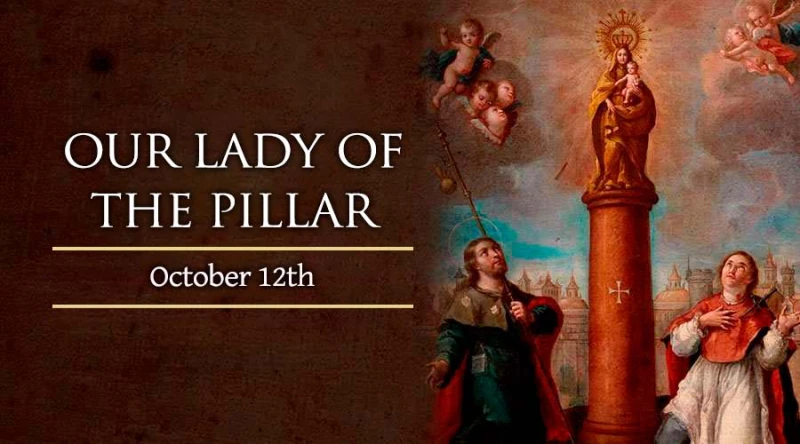
Nuestra Senora del Pilar (Our Lady of the Pillar)


Nuestra Senora del Pilar (Our Lady of the Pillar)

Feast date: Oct 12

The first Marian apparition in history appeared to Saint James the Apostle, the brother of Saint John the Evangelist, on the bank of the river Ebro in Saragossa, Spain. Unlike every other recorded apparition, this one took place during the earthly life of the Mother of God.


According to tradition, she had promised Saint James that when he needed it most in his difficult mission to the pagans in today’s Spain, she would appear to him to encourage him.


In the year 40 A.D., while praying one night on the tobrt bank, the Virgin appeared with the Child Jesus standing on a pillar and asked Saint James and his eight disciples to build a church on the site, promising that “it will stand from that moment until the end of time in order that God may work miracles and wonders through my intercession for all those who place themselves under my patronage.”


The church of Our Lady of the Pilar in Zaragoza, is the first church dedicated to Mary in history and it remains standing to this day, having survived invasions and wars – in the Spanish Civil War of 1936-1939 three bombs were dropped on the church and none of them exploded.


Our Lady is also said to have given the small wooden statue of the apparition to Saint James which now stands on a pillar in the church.


Nuestra Señora del Pilar is the patron of Spain and all Hispanic peoples. October 12, 1492, the feast of the Virgin of the Pillar, is the day Christopher Colombus first sighted American land, and when the first Mass in the Americas was celebrated.

Nuestra Senora del Pilar (Our Lady of the Pillar) Read More »

St. Wilfrid of York

Feast date: Oct 12

St. Wilfrid the son of a Northumbrian thegn in 634 in Northumbria, England. His mother died when he was a boy, and he never got along with his step-mother. At age 14, partly to escape the miserable family life, he was sent to the court of King Oswy, King of Northumbria. In this court, Queen Eanfleda took notice of St. Wilfrid, and with her help, he was able to study at the monastery of Lindisfarne for three years. The Queen, through her benevolence, again assisted St. Wilfred and sent him to Rome in the company of St. Benedict Biscop. Here, he studied under the papal consiliarus and archdeacon, Boniface.

On his way back to his homeland, the Kingdom of Northumbria, he stayed in Lyons for three years to study the monastic life. He became a monk and received the tonsure from Annemundas (St. Annemund), the bishop of Lyons. Archbishop Annemundas wanted St. Wilfrid to stay in Lyons, marry his niece, and become his heir, but St. Wilfrid was intent on becoming a priest.

He left during persecutions of the local Christians. He was appointed abbot of the monastery at Ripon for five years, and placed it under the Benedictine Rule. Priest.

He was instrumental in bringing Roman liturgical practice and rules to the region, working influentially at the Synod of Whitby in 664. Bishop Colman and several of his monks, opposing the new practice, withdrew to the north. Wilfrid was chosen as the new bishop and travelled to France for ordination, considering the dissenting northern bishops to be schismatics. He returned to England in 666, nearly dying at the hands of hostile pagans when his ship wrecked on the coast of Sussex. However, he had taken so long to come back that Saint Chad had been chosen to replace him. Wilfrid retired to the monastery at Ripon and evangelized in Mercia and Kent. In 669 Archbishop Theodore of Canterbury explained to Saint Chad that Wilfrid should have the see; Chad withdrew, and Wilfrid resumed the bishopric.

During his tenure Wilfrid worked to enforce Roman ritual, founded Benedictine monasteries, and rebuilt the minster of York, all while living a simply and holy life himself. He became embroiled in political discord when he encouraged Queen Etheldrida to move to a convent when she no longer wished to live with her husband, King Ecgfrid. When Archbishop Theodore subdivided Wilfrid’s diocese to reduce his influence, Wilfrid appealed to Rome. Pope Agatho ruled in Wilfrid’s favour, and the three intruding bishops were removed. However, when Wilfrid returned to England King Ecgfrid accused him of buying the decision, and imprisoned him at Bambrough then exiled him to Sussex.

He worked as a missionary in heathen Sussex. He reconciled with Archbishop Theodore, who had also been working in Sussex, in 686, and when Aldfrid became king of Northumbria, Theodore insured Wilfrid’s return from exile. He served as bishop of Hexham, and then of York again. However, when he tried to consolidate the dioceses again, the king and Theodore opposed him, and he Wilfrid was forced to appeal again to Rome in 704. Through a series of meetings, synods and rulings, Wilfrid became bishop of Hexham and Ripon, but not York. In the end Wilfrid accepted, deciding that the result of this turmoil was that everyone involved had agreed to the authority and primacy of the Pope and the Vatican, the principle he had fought for all along.

He died in 709 at Oundle, Northhamptonshire, England and is the patron of Ripon, England .

St. Wilfrid of York Read More »

Tuesday of the Twenty-eighth Week in Ordinary Time

Reading 1 GAL 5:1-6

Brothers and sisters:
For freedom Christ set us free;
so stand firm and do not submit again to the yoke of slavery.

It is I, Paul, who am telling you
that if you have yourselves circumcised,
Christ will be of no benefit to you.
Once again I declare to every man who has himself circumcised
that he is bound to observe the entire law.
You are separated from Christ,
you who are trying to be justified by law;
you have fallen from grace.
For through the Spirit, by faith, we await the hope of righteousness.
For in Christ Jesus,
neither circumcision nor uncircumcision counts for anything,
but only faith working through love.
 

Responsorial Psalm PS 119:41, 43, 44, 45, 47, 48

R. (41a) Let your mercy come to me, O Lord.
Let your mercy come to me, O LORD,
your salvation according to your promise.
R. Let your mercy come to me, O Lord.
Take not the word of truth from my mouth,
for in your ordinances is my hope.
R. Let your mercy come to me, O Lord.
And I will keep your law continually,
forever and ever.
R. Let your mercy come to me, O Lord.
And I will walk at liberty,
because I seek your precepts.
R. Let your mercy come to me, O Lord.
And I will delight in your commands, 
which I love.
R. Let your mercy come to me, O Lord.
And I will lift up my hands to your commands
and meditate on your statutes.
R. Let your mercy come to me, O Lord.


Alleluia HEB 4:12

R. Alleluia, alleluia.
The word of God is living and effective,
able to discern reflections and thoughts of the heart.
R. Alleluia, alleluia.

Gospel LK 11:37-41

After Jesus had spoken,
a Pharisee invited him to dine at his home.
He entered and reclined at table to eat.
The Pharisee was amazed to see
that he did not observe the prescribed washing before the meal.
The Lord said to him, “Oh you Pharisees!
Although you cleanse the outside of the cup and the dish,
inside you are filled with plunder and evil.
You fools!
Did not the maker of the outside also make the inside?
But as to what is within, give alms,
and behold, everything will be clean for you.”

– – –

Lectionary for Mass for Use in the Dioceses of the United States, second typical edition, Copyright © 2001, 1998, 1997, 1986, 1970 Confraternity of Christian Doctrine; Psalm refrain © 1968, 1981, 1997, International Committee on English in the Liturgy, Inc. All rights reserved. Neither this work nor any part of it may be reproduced, distributed, performed or displayed in any medium, including electronic or digital, without permission in writing from the copyright owner.
Tuesday of the Twenty-eighth Week in Ordinary Time Read More »