
Please mind our dust!

We are currently working on revamping our website!
Thank you for your patience!

CRD Solutions

Pope Saint John XXIII
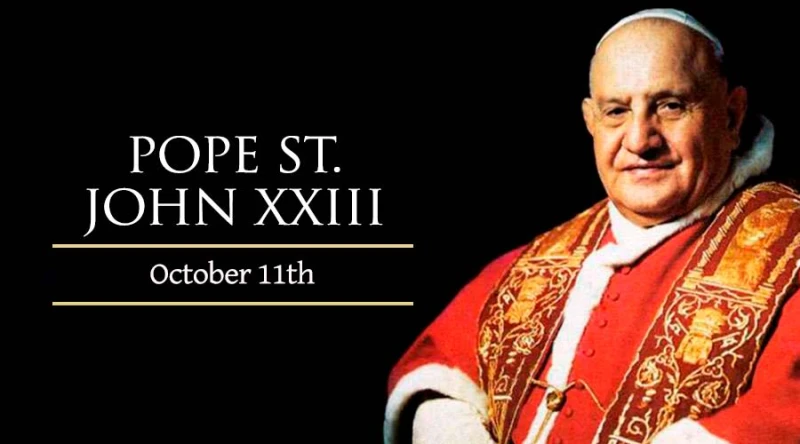

Pope Saint John XXIII

Feast date: Oct 11

Born Angelo Giuseppe Roncalli at Sotto il Monte, Italy on 25 November 1881, Pope John XXIII was elected Pope on October 28, 1958. He died June 3, 1963 in Rome and was beatified by Pope John Paul II on September 3, 2000.

Angelo was the fourth child of 14, born to pious parents. His religious education was entrusted to his godfather, who instilled in him a deep love and admiration of the mystery of God.

He entered the minor seminary in 1892 at the age of 11, became a Secular Francsican in 1896 and in 1901 he entered the Pontifical Roman Seminary. On being ordained in 1904, he was appointed secretary to the bishop of Bergamo and taught in the seminary.

His great friends among the saints during this formative period were St. Charles Borromeo and St. Francis de Sales, two outstanding intellectuals and also formidable pastors.

He served as a military chaplain during the First World War, served as spiritual director of a seminary, and in 1921 served as the Italian president of the Society for the Propagation of the Faith.

In 1925 Pius XI made him a bishop and sent him to Bulgaria as the Apostolic Visitator. For his Episcopal motto he chose Oboedientia et Pax.  In 1935 he was assigned to Turkey and Greece where he ministered to the Catholic population and engaged in dialogue with Orthodox Christianity and with Islam.

During the Second World War he used his diplomatic means to save as many Jews as he could by obtaining safe passage for them. 
 
He was created cardinal and Patriarch of Venice in 1953 and was a much loved pastor, dedicating himself completely to the well being of his flock.

Elected Pope on the death of Pope Pius XII, he was an example of a ‘pastoral’ Pope, a good shepherd who cared deeply for his sheep. He manifested this concern in his social enyclicals, especially Pacem in Terris, “On peace in the World.”

His greatest act as Pope however was undoubtedly the inspiration to convoke the Second Vatican Council, which he opened on October 11, 1962.

Pope John’s spirit of humble simplicity, profound goodness, and deep life of prayer radiated in all that he did, and inspired people to affectionately call him “Good Pope John.”

He was canonized by Pope Francis in St. Peter’s Square on April 27, 2014, alongside the man who beatified him, Pope St. John Paul II.

Pope Saint John XXIII Read More »
St. Firminus of Uzès

Feast date: Oct 11

St. Firminus was born circa 480 in Narbonne, France on October 11. He was born to the senator and aristocrat Tonnatius Ferreolus, otherwise known as Tonance Ferréol the Second, and his wife Industria.

St. Firminus was well-educated by his 80-year-old uncle, Roricius (Ruricius or Rorice), who was a patrician. His uncle served as the third bishop of Uzès from 533 to 538. St. Firminus thereafter succeeded his uncle as bishop of Uzès.

In 538, he signed the fourth and fifth Councils of Orléans in 541 and 549, respectively. In 551, he assisted at the second council of Paris. At the time, the bishop of Uzès was under the metropolitan Archdiocese of Arles. St. Firminus was a spiritual student of Saint Cæsarius of Arles.

He died 15 years after he became bishop, in 553.

Saint Firminus is locally venerated as Saint Firmin and his relics are located in the Uzès Cathedral. 

St. Firminus of Uzès Read More »

Monday of the Twenty-eighth Week in Ordinary Time

Reading 1 GAL 4:22-24, 26-27, 31–5:1

Brothers and sisters:
It is written that Abraham had two sons,
one by the slave woman and the other by the freeborn woman.
The son of the slave woman was born naturally,
the son of the freeborn through a promise.
Now this is an allegory.
These women represent two covenants.
One was from Mount Sinai, bearing children for slavery;
this is Hagar.
But the Jerusalem above is freeborn, and she is our mother.
For it is written:
Rejoice, you barren one who bore no children;
break forth and shout, you who were not in labor;
for more numerous are the children of the deserted one
than of her who has a husband.

Therefore, brothers and sisters,
we are children not of the slave woman
but of the freeborn woman.

For freedom Christ set us free; so stand firm
and do not submit again to the yoke of slavery.
 

Responsorial Psalm PS 113:1B-2, 3-4, 5A AND 6-7

R. (see 2) Blessed be the name of the Lord forever.
or:
R. Alleluia, alleluia.
Praise, you servants of the LORD,
praise the name of the LORD.
Blessed be the name of the LORD
both now and forever.
R. Blessed be the name of the Lord forever.
or:
R. Alleluia, alleluia.
From the rising to the setting of the sun
is the name of the LORD to be praised.
High above all nations is the LORD;
above the heavens is his glory.
R. Blessed be the name of the Lord forever.
or:
R. Alleluia, alleluia.
Who is like the LORD, our God,
who looks upon the heavens and the earth below?    
He raises up the lowly from the dust;
from the dunghill he lifts up the poor.
R. Blessed be the name of the Lord forever.
or:
R. Alleluia, alleluia.


Alleluia PS 95:8

R. Alleluia, alleluia.
If today you hear his voice,
harden not your hearts.
R. Alleluia, alleluia.

Gospel LK 11:29-32

While still more people gathered in the crowd, Jesus said to them,
“This generation is an evil generation;
it seeks a sign, but no sign will be given it,
except the sign of Jonah.
Just as Jonah became a sign to the Ninevites,
so will the Son of Man be to this generation.
At the judgment 
the queen of the south will rise with the men of this generation
and she will condemn them,
because she came from the ends of the earth
to hear the wisdom of Solomon,
and there is something greater than Solomon here.
At the judgment the men of Nineveh will arise with this generation 
and condemn it,
because at the preaching of Jonah they repented,
and there is something greater than Jonah here.”

– – –

Lectionary for Mass for Use in the Dioceses of the United States, second typical edition, Copyright © 2001, 1998, 1997, 1986, 1970 Confraternity of Christian Doctrine; Psalm refrain © 1968, 1981, 1997, International Committee on English in the Liturgy, Inc. All rights reserved. Neither this work nor any part of it may be reproduced, distributed, performed or displayed in any medium, including electronic or digital, without permission in writing from the copyright owner.

Monday of the Twenty-eighth Week in Ordinary Time Read More »

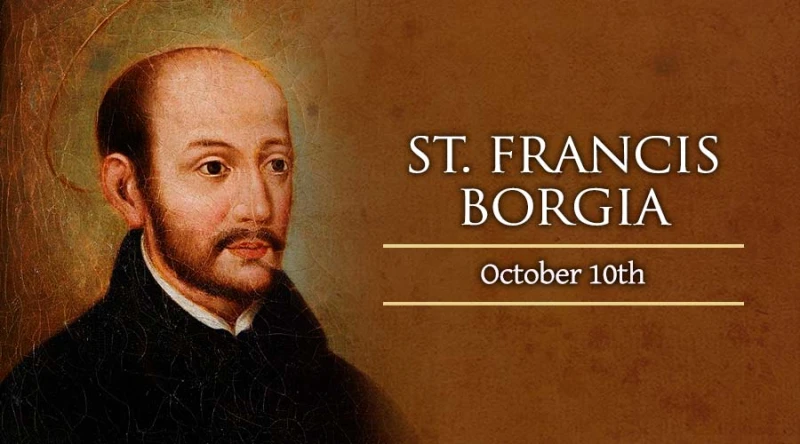
St. Francis Borgia


St. Francis Borgia

Feast date: Oct 10

Francis Borgia was born October 28, 1510 in Gandia, Valencia, Spain as the son of the Duke of Gandia, the great grandson, from his father’s side, of Pope Alexander VI, the notorious Borgia pope, and from his mother’s side, the great grandson of King Ferdinand of Aragon.

Francis’ grandmother joined her daughther in a convent of Poor Clares after the death of her husband and held a pious influence in the court of the Borgia, to which Francis is indebted. It was with these two women that holiness penetrated into the scandalous lineage of the Borgia family.

Francis grew to be a pious young man, posessed of many natural gifts and a favorite at the court of Charles V.  It is recounted that one day Francis passed through Alcalá, followed by his escort, and exchanged an emotional glance with a poor man being escorted to prison by the Inquisition. This man was Ignatius of Loyola, and at this moment Francis could not have had any idea what an important role this man would play in his destiny.

In 1539 Francis was appointed Viceroy of Catalonia, and four years later, upon the death of his father, the Duke of Gandia. He built a university there, received the degree of Doctor in Theology, and invited the Jesuits to his duchy.

His wife died in 1546, and Francis entered the Society of Jesus in 1548, but was ordered by the Pope to remain in the world until he had fulfilled his obligations to his ten children and his duchy.

Two years later he left Gandia, never to return, and joined the Jesuits in Rome. He immediately set about initiating grand projects – he convinced Ignatius to found the Roman College, and a year later he left for Spain, where his preaching and example sparked a renewal of religious fervour in the country, drawing pilgrims from far and wide to hear him preach.

In 1556 he was placed in charge of all the missions of the Society, and his energetic work transformed them. He also initiated the missions to Peru, New Spain and Brazil.

He was elected as general on July 2, 1565, and although in poor health for his last years, he executed the governance and initiated projects of the Society with great energy. He introduced so many reforms to the society of Jesus that he was considered in some ways to be its second founder. Francis was a man of contemplation and action in the fullest sense, and clearly drew much strength from the silence of his prayer.

He died in Rome on September 30, 1572, in Ferrara, Spain, two days after returning from an apostolic journey to Spain.

Saint Francis Borgia is one of the great saints of the Catholic Reformation, and was cannonized by Pope Clement X in 1670.

St. Francis Borgia Read More »

Twenty-eighth Sunday in Ordinary Time

Reading I 2 Kgs 5:14-17

Naaman went down and plunged into the Jordan seven times
at the word of Elisha, the man of God.
His flesh became again like the flesh of a little child,
and he was clean of his leprosy.

Naaman returned with his whole retinue to the man of God.
On his arrival he stood before Elisha and said,
“Now I know that there is no God in all the earth,
except in Israel.
Please accept a gift from your servant.”

Elisha replied, “As the LORD lives whom I serve, I will not take it;”
and despite Naaman’s urging, he still refused.
Naaman said: “If you will not accept,
please let me, your servant, have two mule-loads of earth,
for I will no longer offer holocaust or sacrifice
to any other god except to the LORD.”
 

Responsorial Psalm Ps 98:1, 2-3, 3-4

R. (cf. 2b) The Lord has revealed to the nations his saving power.
Sing to the LORD a new song,
for he has done wondrous deeds;
his right hand has won victory for him,
his holy arm.
R. The Lord has revealed to the nations his saving power.
The LORD has made his salvation known:
in the sight of the nations he has revealed his justice.
He has remembered his kindness and his faithfulness
toward the house of Israel.
R. The Lord has revealed to the nations his saving power.
All the ends of the earth have seen
the salvation by our God.
Sing joyfully to the LORD, all you lands:
break into song; sing praise.
R. The Lord has revealed to the nations his saving power.

Reading II 2 Tm 2:8-13

Beloved:
Remember Jesus Christ, raised from the dead, a descendant of David:
such is my gospel, for which I am suffering,
even to the point of chains, like a criminal.
But the word of God is not chained.
Therefore, I bear with everything for the sake of those who are chosen,
so that they too may obtain the salvation that is in Christ Jesus,
together with eternal glory.
This saying is trustworthy:
If we have died with him
we shall also live with him;
if we persevere
we shall also reign with him.
But if we deny him
he will deny us.
If we are unfaithful
he remains faithful,
for he cannot deny himself.

Alleluia 1 Thes 5:18

R. Alleluia, alleluia.
In all circumstances, give thanks,
for this is the will of God for you in Christ Jesus.
R. Alleluia, alleluia.


Gospel Lk 17:11-19

As Jesus continued his journey to Jerusalem,
he traveled through Samaria and Galilee.
As he was entering a village, ten lepers met him.
They stood at a distance from him and raised their voices, saying,
“Jesus, Master! Have pity on us!”
And when he saw them, he said,
“Go show yourselves to the priests.”
As they were going they were cleansed.
And one of them, realizing he had been healed,
returned, glorifying God in a loud voice;
and he fell at the feet of Jesus and thanked him.
He was a Samaritan.
Jesus said in reply,
“Ten were cleansed, were they not?
Where are the other nine?
Has none but this foreigner returned to give thanks to God?”
Then he said to him, “Stand up and go;
your faith has saved you.”

– – –

Lectionary for Mass for Use in the Dioceses of the United States, second typical edition, Copyright © 2001, 1998, 1997, 1986, 1970 Confraternity of Christian Doctrine; Psalm refrain © 1968, 1981, 1997, International Committee on English in the Liturgy, Inc. All rights reserved. Neither this work nor any part of it may be reproduced, distributed, performed or displayed in any medium, including electronic or digital, without permission in writing from the copyright owner.

Twenty-eighth Sunday in Ordinary Time Read More »