
Please mind our dust!

We are currently working on revamping our website!
Thank you for your patience!

CRD Solutions

Memorial of Our Lady of the Rosary

Reading 1 GAL 3:7-14

Brothers and sisters:
Realize that it is those who have faith
who are children of Abraham.
Scripture, which saw in advance that God
would justify the Gentiles by faith,
foretold the good news to Abraham, saying,
Through you shall all the nations be blessed.
Consequently, those who have faith are blessed
along with Abraham who had faith.
For all who depend on works of the law are under a curse;
for it is written, Cursed be everyone
who does not persevere in doing all the things
written in the book of the law.

And that no one is justified before God by the law is clear,
for the one who is righteous by faith will live.
But the law does not depend on faith;
rather, the one who does these things will live by them.
Christ ransomed us from the curse of the law by becoming a curse for us,
for it is written, Cursed be everyone who hangs on a tree,
that the blessing of Abraham might be extended
to the Gentiles through Christ Jesus,
so that we might receive the promise of the Spirit through faith.

Responsorial Psalm PS 111:1B-2, 3-4, 5-6

R. (5) The Lord will remember his covenant for ever.
I will give thanks to the LORD with all my heart
in the company and assembly of the just.
Great are the works of the LORD,
exquisite in all their delights.
R. The Lord will remember his covenant for ever.
Majesty and glory are his work,
and his justice endures forever.
He has won renown for his wondrous deeds;
gracious and merciful is the LORD.
R. The Lord will remember his covenant for ever.
He has given food to those who fear him;
he will forever be mindful of his covenant.
He has made known to his people the power of his works,
giving them the inheritance of the nations.
R. The Lord will remember his covenant for ever.


Alleluia JN 12:31B-32

R. Alleluia, alleluia.
The prince of this world will now be cast out,
and when I am lifted up from the earth
I will draw all to myself, says the Lord.
R. Alleluia, alleluia.

Gospel LK 11:15-26

When Jesus had driven out a demon, some of the crowd said:
“By the power of Beelzebul, the prince of demons,
he drives out demons.”
Others, to test him, asked him for a sign from heaven.
But he knew their thoughts and said to them,
“Every kingdom divided against itself will be laid waste
and house will fall against house.
And if Satan is divided against himself, how will his kingdom stand?
For you say that it is by Beelzebul that I drive out demons.
If I, then, drive out demons by Beelzebul,
by whom do your own people drive them out?
Therefore they will be your judges.
But if it is by the finger of God that I drive out demons,
then the Kingdom of God has come upon you.
When a strong man fully armed guards his palace,
his possessions are safe.
But when one stronger than he attacks and overcomes him,
he takes away the armor on which he relied
and distributes the spoils.
Whoever is not with me is against me,
and whoever does not gather with me scatters.

“When an unclean spirit goes out of someone,
it roams through arid regions searching for rest
but, finding none, it says,
‘I shall return to my home from which I came.’
But upon returning, it finds it swept clean and put in order.
Then it goes and brings back seven other spirits
more wicked than itself who move in and dwell there,
and the last condition of that man is worse than the first.”

– – –

Lectionary for Mass for Use in the Dioceses of the United States, second typical edition, Copyright © 2001, 1998, 1997, 1986, 1970 Confraternity of Christian Doctrine; Psalm refrain © 1968, 1981, 1997, International Committee on English in the Liturgy, Inc. All rights reserved. Neither this work nor any part of it may be reproduced, distributed, performed or displayed in any medium, including electronic or digital, without permission in writing from the copyright owner.

Memorial of Our Lady of the Rosary Read More »
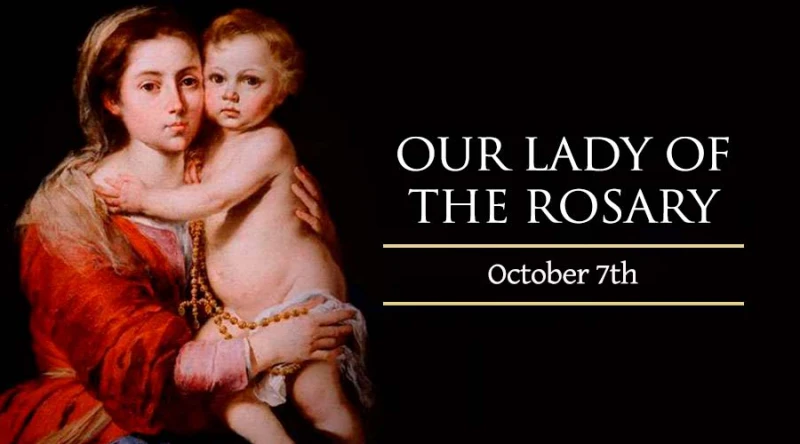
Feast of Our Lady of the Rosary


Feast of Our Lady of the Rosary

Feast date: Oct 07

On October 7, the Roman Catholic Church celebrates the yearly feast of Our Lady of the Rosary. Known for several centuries by the alternate title of “Our Lady of Victory,” the feast day takes place in honor of a 16th century naval victory which secured Europe against Turkish invasion. Pope St. Pius V attributed the victory to the intercession of the Blessed Virgin Mary, who was invoked on the day of the battle through a campaign to pray the Rosary throughout Europe.

The feast always occurs one week after the similar Byzantine celebration of the Protection of the Mother of God, which most Eastern Orthodox Christians and Eastern Catholics celebrate on October 1 in memory of a 10th-century military victory which protected Constantinople against invasion after a reported Marian apparition.

Pope Leo XIII was particularly devoted to Our Lady of the Rosary, producing 11 encyclicals on the subject of this feast and its importance in the course of his long pontificate.

In the first of them, 1883’s “Supremi Apostolatus Officio,” he echoed the words of the oldest known Marian prayer (known in the Latin tradition as the “Sub Tuum Praesidium”), when he wrote, “It has always been the habit of Catholics in danger and in troublous times to fly for refuge to Mary.”

“This devotion, so great and so confident, to the august Queen of Heaven,” Pope Leo continued, “has never shone forth with such brilliancy as when the militant Church of God has seemed to be endangered by the violence of heresy … or by an intolerable moral corruption, or by the attacks of powerful enemies.” Foremost among such “attacks” was the battle of Lepanto, a perilous and decisive moment in European and world history.

Troops of the Turkish Ottoman Empire had invaded and occupied the Byzantine empire by 1453, bringing a large portion of the increasingly divided Christian world under a version of Islamic law. For the next hundred years, the Turks expanded their empire westward on land, and asserted their naval power in the Mediterranean. In 1565 they attacked Malta, envisioning an eventual invasion of Rome. Though repelled at Malta, the Turks captured Cyprus in the fall of 1570.

The next year, three Catholic powers on the continent – Genoa, Spain, and the Papal States – formed an alliance called the Holy League, to defend their Christian civilization against Turkish invasion. Its fleets sailed to confront the Turks near the west coast of Greece on October 7, 1571.

Crew members on more than 200 ships prayed the Rosary in preparation for the battle – as did Christians throughout Europe, encouraged by the Pope to gather in their churches to invoke the Virgin Mary against the daunting Turkish forces.

Some accounts say that Pope Pius V was granted a miraculous vision of the Holy League’s stunning victory. Without a doubt, the Pope understood the significance of the day’s events, when he was eventually informed that all but 13 of the nearly 300 Turkish ships had been captured or sunk. He was moved to institute the feast now celebrated universally as Our Lady of the Rosary.

“Turkish victory at Lepanto would have been a catastrophe of the first magnitude for Christendom,” wrote military historian John F. Guilmartin, Jr., “and Europe would have followed a historical trajectory strikingly different from that which obtained.”

Feast of Our Lady of the Rosary Read More »
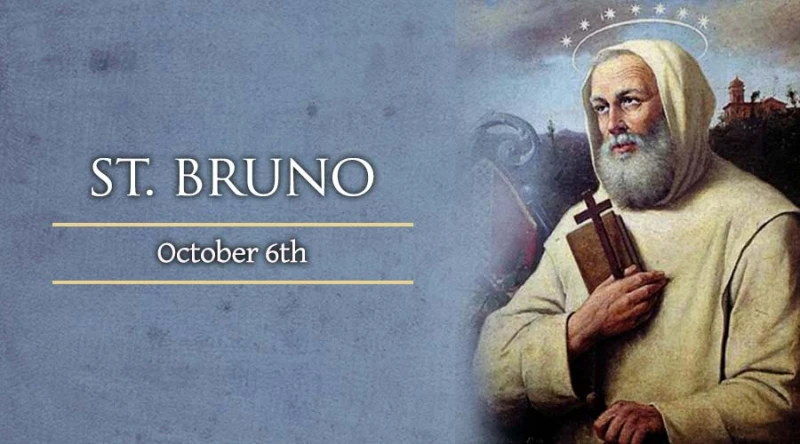
St. Bruno, founder


St. Bruno, founder

Feast date: Oct 06

On Oct. 6, the Catholic Church commemorates Saint Bruno of Cologne, founder of the Carthusian order of monks who remain notable for their strictly traditional and austere rule of contemplative life.

Born in 1030, Bruno is said to have belonged to a prominent family in the city of Cologne. Little is known of his early years, except that he studied theology in the present-day French city of Reims before returning to his native land, where he was most likely ordained a priest in approximately 1055.

Returning to Reims the following year, he soon became head of the school he had attended there, after its director Heriman left to enter consecrated religious life in 1057. Bruno led and taught at the school for nearly two decades, acquiring an excellent reputation as a philosopher and theologian, until he was named chancellor of the local diocese in 1075.

Bruno’s time as chancellor coincided with an uproar in Reims over the behavior of its new bishop Manasses de Gournai. Suspended by the decision of a local council, the bishop appealed to Rome while attacking and robbing the houses of his opponents. Bruno left the diocese during this period, though he was considered as a possible successor to Manasses after the bishop’s final deposition in 1080.

The chancellor, however, was not interested in leading the Church of Reims. Bruno and two of his friends had resolved to renounce their worldly goods and positions and enter religious life. Inspired by a dream to seek guidance from the bishop later canonized as Saint Hugh of Grenoble, Bruno settled in the Chartreuse Mountains in 1084, joined by a small group of scholars looking to become monks.

In 1088, one of Bruno’s former students was elected as Pope Urban II. Six years into his life as an alpine monk, Bruno was called to leave his remote monastery to assist the Pope in his struggle against a rival papal claimant as well as the hostile Holy Roman Emperor Henry IV.

Bruno served as a close adviser to the Pope during a critical period of reform. Around this time, he also rejected another chance to become a bishop, this time in the Italian region of Calabria. While he obtained the Pope’s permission to return to monastic life, Bruno was required to remain in Italy to help the Pope periodically, rather than returning to his monastery in France.

During the 1090s Bruno befriended Count Roger of Sicily and Calabria, who granted land to his group of monks and enabled the founding of a major monastery in 1095. The monks were known, then as now, for their strict practice of asceticism, poverty, and prayer; and for their unique organizational form, combining the solitary life of hermits with the collective life of more conventional monks.

St. Bruno died on October 6, 1101, after making a notable profession of faith which was preserved for posterity. In this final testimony, he gave particular emphasis to the doctrine of Christ’s Eucharistic presence, which had already begun to be questioned in parts of the Western Church.

“I believe,” he attested, “in the sacraments that the Church believes and holds in reverence, and especially that what has been consecrated on the altar is the true Flesh and the true Blood of our Lord Jesus Christ, which we receive for the forgiveness of our sins and in the hope of eternal salvation.”

Veneration of St. Bruno was given formal approval in 1514, and extended throughout the Latin Rite in 1623. More recently, his Carthusian Order was the subject of the 2006 documentary film “Into Great Silence,” chronicling the life of monks in the Grand Chartreuse monastery. 

St. Bruno, founder Read More »

Thursday of the Twenty-seventh Week in Ordinary Time

Reading 1 GAL 3:1-5

O stupid Galatians!
Who has bewitched you,
before whose eyes Jesus Christ was publicly portrayed as crucified?
I want to learn only this from you:
did you receive the Spirit from works of the law,
or from faith in what you heard?
Are you so stupid?
After beginning with the Spirit,
are you now ending with the flesh?
Did you experience so many things in vain?–
if indeed it was in vain.
Does, then, the one who supplies the Spirit to you
and works mighty deeds among you
do so from works of the law
or from faith in what you heard?

Responsorial Psalm LK 1:69-70, 71-72, 73-75

R. (68) Blessed be the Lord, the God of Israel; he has come to his people.
He has raised up for us a mighty savior,
born of the house of his servant David.
R. Blessed be the Lord, the God of Israel; he has come to his people.
Through his holy prophets he promised of old
that he would save us from our enemies,
from the hands of all who hate us.
R. Blessed be the Lord, the God of Israel; he has come to his people.
He promised to show mercy to our fathers
and to remember his holy covenant.
R. Blessed be the Lord, the God of Israel; he has come to his people.
This was the oath he swore to our father Abraham:
to set us free from the hands of our enemies,
free to worship him without fear,
holy and righteous in his sight
all the days of our life.
R. Blessed be the Lord, the God of Israel; He has come to his people.


Alleluia ACTS 16:14B

R. Alleluia, alleluia.
Open our hearts, O Lord,
to listen to the words of your Son.
R. Alleluia, alleluia.

Gospel LK 11:5-13

Jesus said to his disciples:
“Suppose one of you has a friend
to whom he goes at midnight and says,
‘Friend, lend me three loaves of bread,
for a friend of mine has arrived at my house from a journey
and I have nothing to offer him,’
and he says in reply from within,
‘Do not bother me; the door has already been locked
and my children and I are already in bed.
I cannot get up to give you anything.’
I tell you, if he does not get up to give him the loaves
because of their friendship,
he will get up to give him whatever he needs
because of his persistence.

“And I tell you, ask and you will receive;
seek and you will find;
knock and the door will be opened to you.
For everyone who asks, receives;
and the one who seeks, finds;
and to the one who knocks, the door will be opened.
What father  among you would hand his son a snake
when he asks for a fish?
Or hand him a scorpion when he asks for an egg?
If you then, who are wicked,
know how to give good gifts to your children,
how much more will the Father in heaven give the Holy Spirit
to those who ask him?”

– – –

Lectionary for Mass for Use in the Dioceses of the United States, second typical edition, Copyright © 2001, 1998, 1997, 1986, 1970 Confraternity of Christian Doctrine; Psalm refrain © 1968, 1981, 1997, International Committee on English in the Liturgy, Inc. All rights reserved. Neither this work nor any part of it may be reproduced, distributed, performed or displayed in any medium, including electronic or digital, without permission in writing from the copyright owner.

Thursday of the Twenty-seventh Week in Ordinary Time Read More »

Wednesday of the Twenty-seventh Week in Ordinary Time

Reading 1 Gal 2:1-2, 7-14

Brothers and sisters:
After fourteen years I again went up to Jerusalem with Barnabas,
taking Titus along also.
I went up in accord with a revelation,
and I presented to them the Gospel that I preach to the Gentiles–
but privately to those of repute–
so that I might not be running, or have run, in vain.
On the contrary,
when they saw that I had been entrusted with the Gospel to the uncircumcised,
just as Peter to the circumcised,
for the one who worked in Peter for an apostolate to the circumcised
worked also in me for the Gentiles,
and when they recognized the grace bestowed upon me,
James and Cephas and John,
who were reputed to be pillars,
gave me and Barnabas their right hands in partnership,
that we should go to the Gentiles
and they to the circumcised.
Only, we were to be mindful of the poor,
which is the very thing I was eager to do.

And when Cephas came to Antioch,
I opposed him to his face because he clearly was wrong.
For, until some people came from James,
he used to eat with the Gentiles;
but when they came, he began to draw back and separated himself,
because he was afraid of the circumcised.
And the rest of the Jews acted hypocritically along with him,
with the result that even Barnabas
was carried away by their hypocrisy.
But when I saw that they were not on the right road
in line with the truth of the Gospel,
I said to Cephas in front of all,
“If you, though a Jew,
are living like a Gentile and not like a Jew,
how can you compel the Gentiles to live like Jews?”

Responsorial Psalm Ps 117:1bc, 2

R. Go out to all the world, and tell the Good News.
Praise the LORD, all you nations,
glorify him, all you peoples!
R. Go out to all the world, and tell the Good News.
For steadfast is his kindness toward us,
and the fidelity of the LORD endures forever.
R. Go out to all the world, and tell the Good News.

Alleluia Rom 8:15bc

R. Alleluia, alleluia.
You have received a spirit of adoption as sons
through which we cry: Abba! Father!
R. Alleluia, alleluia.

Gospel Lk 11:1-4

Jesus was praying in a certain place, and when he had finished,
one of his disciples said to him,
“Lord, teach us to pray just as John taught his disciples.”
He said to them, “When you pray, say:

Father, hallowed be your name,
your Kingdom come.
Give us each day our daily bread
and forgive us our sins
for we ourselves forgive everyone in debt to us,
and do not subject us to the final test.”

– – –

Lectionary for Mass for Use in the Dioceses of the United States, second typical edition, Copyright © 2001, 1998, 1997, 1986, 1970 Confraternity of Christian Doctrine; Psalm refrain © 1968, 1981, 1997, International Committee on English in the Liturgy, Inc. All rights reserved. Neither this work nor any part of it may be reproduced, distributed, performed or displayed in any medium, including electronic or digital, without permission in writing from the copyright owner.

Wednesday of the Twenty-seventh Week in Ordinary Time Read More »