
Please mind our dust!

We are currently working on revamping our website!
Thank you for your patience!

CRD Solutions

St. Faustina, Virgin
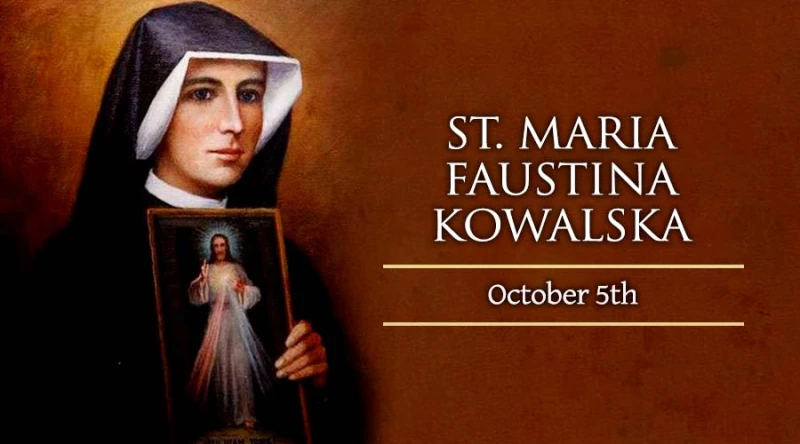

St. Faustina, Virgin

Feast date: Oct 05

On October 5, the church celebrates the Memorial of St. Mary Faustina Kowalska, virgin.

St. Faustina was born Helena Kowalska on August 25, 1905 to a poor but devout Polish family in 1905. At the age of 20, with very little education, and having been rejected from several other convents because of her poverty and lack of education, Helen entered the Congregation of the Sisters of Our Lady of Mercy. There, she took the name Sr. Faustina and spent time in convents in both Poland and Lithuania.

Throughout her life, Jesus appeared to Sr. Faustina. He asked her to become an apostle and secretary of his mercy, by writing down his messages of Divine Mercy for the world in her diary. Jesus also asked Sr. Faustina to have an image painted of his Divine Mercy, with red and white rays issuing from his heart, and to spread devotion to the Divine Mercy novena.

Even before her death on October 5, 1938, devotion to Divine Mercy began to spread throughout Poland.This little nun and Jesus’ message of Divine Mercy impacted Karol Wojtyla greatly, which became obvious to the world when he was elected Pope.

“It is truly marvelous how her devotion to the merciful Jesus is spreading in our contemporary world and gaining so many human hearts! This is doubtlessly a sign of the times — a sign of our twentieth century. The balance of this century, which is now ending, in addition to the advances which have often surpassed those of preceding eras, presents a deep restlessness and fear of the future. Where, if not in the Divine Mercy, can the world find refuge and the light of hope? Believers understand that perfectly,” Pope St. John Paul II wrote.

On April 30, 2000, Pope John Paul II canonized St. Faustina in what he was widely reported as saying was “the happiest day of my life.”

“Today my joy is truly great in presenting the life and witness of Sr. Faustina Kowalska to the whole Church as a gift of God for our time. By divine Providence, the life of this humble daughter of Poland was completely linked with the history of the 20th century, the century we have just left behind. In fact, it was between the First and Second World Wars that Christ entrusted his message of mercy to her. Those who remember, who were witnesses and participants in the events of those years and the horrible sufferings they caused for millions of people, know well how necessary was the message of mercy,” the Pope said in his homily that day.

It was also on this day, the Sunday after Easter, that Pope John Paul II instituted the Feast of Divine Mercy, which Jesus had asked for in his messages to Sr. Faustina.

St. Faustina, Virgin Read More »
Blessed Bartholomew Longo

Feast date: Oct 05

“My only desire is to see Mary who saved me and who will save me from the clutches of Satan.

– Blessed Bartholomew Longo’s last words


Perhaps one of the most remarkable conversions in the history of the Church was that of Bartholomew Longo, who went from being a Satanist priest to a beatified, through the extraordinary assistance of the Blessed Virgin Mary.


Born in 1841 to a practicing Catholic family, he was not an irreligious youth, but when he went to university in Naples to study law, all that changed.  He first went from being a practicing Catholic to being involved in anti-papal demonstrations and then an atheist, following that a Satanist, eventually being ordained to the Satanist priesthood.  He had become a complete apostate.


However, Bartholomew’s family and friends continued to ardently pray for him and his conversion back to the faith of his childhood. A university professor of his hometown in southern Italy began to have discussions with him and with much perseverance managed to persuade him of the irrationality of his position. This was the beginning of his road to sainthood. He then was referred to a Dominican priest named Father Albert who directed his deprogramming and finally guided him back into communion with the Church.


He had recovered his faith, but realizing the awful scandal and damage he had caused, he wished to make reparations. He learnt first-hand of the awful poverty of the tenant farmers near his hometown. It is said that at the sight of their destitution the words of Our Lady of the Rosary came to his mind: “One who propagates my Rosary shall be saved.”


He believed that from this point on he would devote his life to spreading devotion to the Rosary.  His first step was to organize Rosary groups around a shrine he established in his neighborhood church around a picture of Mary called Our Lady of the Rosary. The shrine grew and became a basilica in 1901, attracting thousands of pilgrims daily, and still does today.


Bartholomew was aided in his work by the Countess di Fusco, a devout widow. Pope Leo XIII suggested that they marry to quiet rumors that their work together was leading to an amorous relationship. In obedience to the Pope they did so but vowed to live in celibacy.


They opened an orphanage for children of prison inmates, which achieved unexpected results for children who were considered lost causes and hereditary criminals at the turn of the century.


Bartholomew lived his last 20 years of his life under constant ill health and attacks against his reputation by those envious of him and the success of his apostolate.


His reliance on and dedication to the Rosary was extremelly pronounced in his life, as he acknowledged how vital Mary had been in his rescue from Satanism and conversion to the truth. He was an active proponent of the definition of the dogma of the Assumption of Mary, which was proclaimed in 1950 by Pope Pius XII.


Bartholomew died on October 5, 1926 at the age of 85.  He was beatified by Pope John Paul II in 1980.


“Rosary in hand, Blessed Bartolo Longo says to each of us: “Awaken your confidence in the Most Blessed Virgin of the Rosary. Venerable Holy Mother, in You I rest all my troubles, all my trust and all my hope!”

Pope John Paul II at Blessed Bartholomew Longo’s beatification ceremony.

Blessed Bartholomew Longo Read More »

St. Luigi Scrosoppi

Feast date: Oct 05

St. Luigi Scrosoppi’s life bears witness to a great trust in Divine Providence. He was born in the year 1804 in Udine, Italy and entered the diocesan seminary at 12 years old. He was ordained at age 23.

The famine and poverty in Udine inspired Fr. Luigi to care for those most in need. With other priests and a group of young teachers, he dedicated himself to educating poor and abandoned girls in the practical skills of sewing and embroidery, as well as in reading, writing and arithmetic. Nine of these girls decided to take their vows as the first sisters of the Congregation of the Sisters of Providence, which Fr. Luigi founded in 1837. The congregation grew, and eventually he opened 12 houses of sisters.

Furthering his priestly vocation, Fr. Luigi entered the Congregation of the Oratorian Fathers, founded by St. Philip Neri, at the age of 42. He continued to guide the Sisters of Providence, dedicating his life to social justice and the poor, including the sick and the elderly. Through his deep union with God, Fr. Luigi was also gifted with the ability to read hearts.

The climate of anticlericalism, which accompanied the unification of Italy in the mid-19th century, suppressed the sisters’ “House of Orphans” and the Congregation of the Oratorian Fathers. However, Fr. Luigi was successful in save the work he and the Sisters were doing with the orphans. In late 1883, he fell ill and was forced to stop working. He died on April 3, 1884.

St. Luigi Scrosoppi Read More »

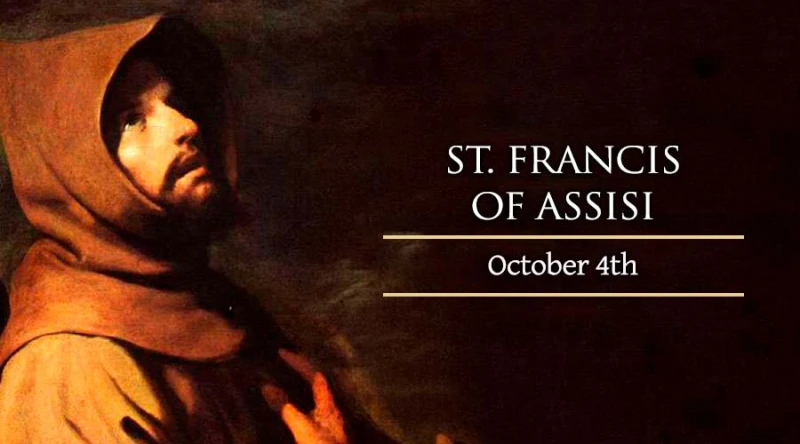
St. Francis of Assisi


St. Francis of Assisi

Feast date: Oct 04

On Oct. 4, Roman Catholics celebrate the feast of St. Francis of Assisi, the Italian deacon who brought renewal to the Church through his decision to follow Jesus’ words as literally as possible.

In a January 2010 general audience, Pope Benedict XVI recalled this “giant of holiness” as a “great saint and a joyful man,” who taught the Church that “the secret of true happiness” is “to become saints, close to God.”

The future Saint Francis was born on an uncertain date in the early 1180s, one of the several children born to the wealthy merchant Pietro Bernardone and his wife Pica. He originally received the name Giovanni (or John), but became known as Francesco (or Francis) by his father’s choice.

Unlike many medieval saints, St. Francis was neither studious nor pious in his youth. His father’s wealth gave him access to a lively social life among the upper classes, where he was known for his flashy clothes and his readiness to burst into song. Later a patron of peacemakers, he aspired to great military feats in his youth and fought in a war with a rival Italian city-state.

A period of imprisonment during that conflict turned his mind toward more serious thoughts, as did a recurring dream that suggested his true “army” was not of this world. He returned to Assisi due to illness in 1205, and there began consider a life of voluntary poverty.

Three major incidents confirmed Francis in this path. In Assisi, he overcame his fear of disease to kiss the hand of a leper. Afterward, he made a pilgrimage to Rome, where he deposited his money at Saint Peter’s tomb and exchanged clothes with a beggar. Soon after he returned home, Francis heard Christ tell him in a vision: “Go, Francis, and repair my house, which as you see is falling into ruin.”

Francis began to use his father’s wealth to restore churches. This led to a public quarrel in which the cloth-merchant’s son removed his clothing and declared that he had no father except God. He regarded himself as the husband of “Lady Poverty,” and resolved to serve Christ as “a herald of the Great King.”

During the year 1208, the “herald” received the inspiration that would give rise to the Franciscan movement. At Mass one morning, he heard the Gospel reading in which Christ instructed the apostles to go forth without money, shoes, or extra clothing. This way of life soon became a papally-approved rule, which would attract huge number of followers within Francis’ own lifetime.

Through his imitation of Christ, Francis also shared in the Lord’s sufferings. He miraculously received Christ’s wounds, the stigmata, in his own flesh during September of 1224. His health collapsed over the next two years, a “living sacrifice” made during two decades of missionary preaching and penance.

St. Francis of Assisi died on Oct. 3, 1226. Pope Gregory IX, his friend and devotee, canonized him in 1228.

St. Francis of Assisi Read More »

Memorial of Saint Francis of Assisi

Reading 1 GAL 1:13-24

Brothers and sisters:
You heard of my former way of life in Judaism,
how I persecuted the Church of God beyond measure
and tried to destroy it, 
and progressed in Judaism
beyond many of my contemporaries among my race,
since I was even more a zealot for my ancestral traditions.
But when he, who from my mother’s womb had set me apart
and called me through his grace,
was pleased to reveal his Son to me,
so that I might proclaim him to the Gentiles,
I did not immediately consult flesh and blood,
nor did I go up to Jerusalem
to those who were Apostles before me;
rather, I went into Arabia and then returned to Damascus.

Then after three years I went up to Jerusalem to confer with Cephas
and remained with him for fifteen days.
But I did not see any other of the Apostles,
only James the brother of the Lord.
(As to what I am writing to you, behold,
before God, I am not lying.)
Then I went into the regions of Syria and Cilicia.
And I was unknown personally to the churches of Judea
that are in Christ;
they only kept hearing that “the one who once was persecuting us
is now preaching the faith he once tried to destroy.”
So they glorified God because of me.

Responsorial Psalm PS 139:1B-3, 13-14AB, 14C-15

R. (24b) Guide me, Lord, along the everlasting way.
O LORD, you have probed me and you know me;
you know when I sit and when I stand;
you understand my thoughts from afar.
My journeys and my rest you scrutinize,
with all my ways you are familiar.
R. Guide me, Lord, along the everlasting way.
Truly you have formed my inmost being;
you knit me in my mother’s womb.
I give you thanks that I am fearfully, wonderfully made;
wonderful are your works.
R. Guide me, Lord, along the everlasting way.
My soul also you knew full well;
nor was my frame unknown to you
When I was made in secret,
when I was fashioned in the depths of the earth.
R. Guide me, Lord, along the everlasting way.


Alleluia LK 11:28

R. Alleluia, alleluia.
Blessed are those who hear the word of God
and observe it.
R. Alleluia, alleluia.

Gospel LK 10:38-42

Jesus entered a village 
where a woman whose name was Martha welcomed him.
She had a sister named Mary
who sat beside the Lord at his feet listening to him speak. 
Martha, burdened with much serving, came to him and said,
“Lord, do you not care
that my sister has left me by myself to do the serving? 
Tell her to help me.” 
The Lord said to her in reply,
“Martha, Martha, you are anxious and worried about many things. 
There is need of only one thing. 
Mary has chosen the better part
and it will not be taken from her.”

– – –

Lectionary for Mass for Use in the Dioceses of the United States, second typical edition, Copyright © 2001, 1998, 1997, 1986, 1970 Confraternity of Christian Doctrine; Psalm refrain © 1968, 1981, 1997, International Committee on English in the Liturgy, Inc. All rights reserved. Neither this work nor any part of it may be reproduced, distributed, performed or displayed in any medium, including electronic or digital, without permission in writing from the copyright owner.

Memorial of Saint Francis of Assisi Read More »