Please mind our dust!

We are currently working on revamping our website!
Thank you for your patience!

CRD Solutions

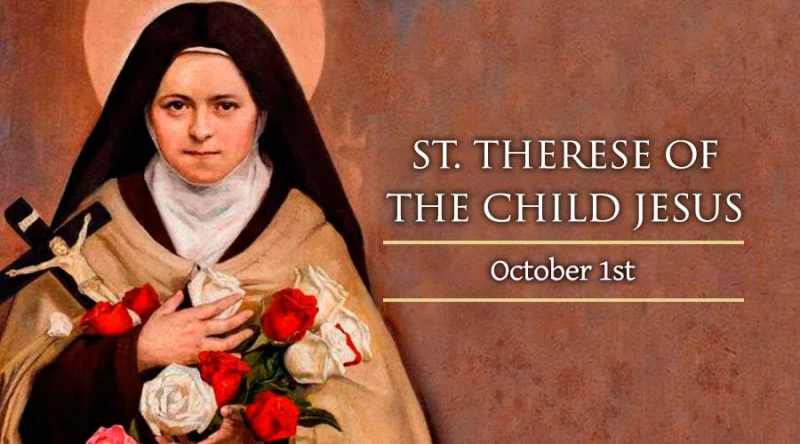
St. Therese of the Child Jesus

St. Therese of the Child Jesus

Feast date: Oct 01

On October 1, Catholics around the world honor the life of St. Thérèse of the Child Jesus, or St. Thérèse of Lisieux on her feast day.  St. Thérèse was born January 2, 1873 in Alençon, France to pious parents, both of whom are scheduled to be canonized in October 2016. Her mother died when she was four, leaving her father and elder sisters to raise her.

On Christmas Day 1886 St. Thérèse had a profound experience of intimate union with God, which she described as a “complete conversion.”  Almost a year later, in a papal audience during a pilgrimage to Rome, in 1887, she asked for and obtained permission from Pope Leo XIII to enter the Carmelite Monastery at the young age of 15.

On entering, she devoted herself to living a life of holiness, doing all things with love and childlike trust in God. She struggled with life in the convent, but decided to make an effort to be charitable to all, especially those she didn’t like. She performed little acts of charity always, and little sacrifices not caring how unimportant they seemed.  These acts helped her come to a deeper understanding of her vocation.

She wrote in her autobiography that she had always dreamed of being a missionary, an Apostle, a martyr – yet she was a nun in a quiet cloister in France. How could she fulfill these longings?

“Charity gave me the key to my vocation. I understood that the Church had a Heart and that this Heart was burning with love. I knew that one love drove the members of the Church to action, that if this love were extinguished, the apostles would have proclaimed the Gospel no longer, the martyrs would have shed their blood no more. I understood that Love comprised all vocations, that Love was everything, that it embraced all times and places…in a word, that it was eternal! Then in the excess of my delirious joy, I cried out: O Jesus, my Love…my vocation, at last I have found it…My vocation is Love!”

Thérèse offered herself as a sacrificial victim to the merciful Love of God on June 9, 1895, the feast of the Most Holy Trinity and the following year, on the night between Holy Thursday and Good Friday, she noticed the first symptoms of Tuberculosis, the illness which would lead to her death.

Thérèse recognized in her illness the mysterious visitation of the divine Spouse and welcomed the suffering as an answer to her offering the previous year.  She also began to undergo a terrible trial of faith which lasted until her death a year and a half later.  “Her last words, ‘My God, I love you,’ are the seal of her life,” said Pope John Paul II.

Since her death, millions have been inspired by her ‘little way’ of loving God and neighbor. Many miracles have been attributed to her intercession. She had predicted during her earthly life that “My Heaven will be spent doing good on Earth.”

Saint Thérèse was proclaimed a Doctor of the Church by Pope John Paul II in 1997 – 100 years after her death at the age of 24. She is only the third woman to be so proclaimed, after Saint Catherine of Siena and Saint Teresa of Avila.

St. Thérèse wrote once, ‘You know well enough that Our Lord does not look so much at the greatness of our actions, nor even at their difficulty, but at the love with which we do them.”

St. Therese of the Child Jesus Read More »
Memorial of Saint Jerome, Priest and Doctor of the Church

Reading 1 Jb 38:1, 12-21; 40:3-5

The LORD addressed Job out of the storm and said:

Have you ever in your lifetime commanded the morning
and shown the dawn its place
For taking hold of the ends of the earth,
till the wicked are shaken from its surface?
The earth is changed as is clay by the seal,
and dyed as though it were a garment;
But from the wicked the light is withheld,
and the arm of pride is shattered.

Have you entered into the sources of the sea,
or walked about in the depths of the abyss?
Have the gates of death been shown to you,
or have you seen the gates of darkness?
Have you comprehended the breadth of the earth?
Tell me, if you know all:
Which is the way to the dwelling place of light,
and where is the abode of darkness,
That you may take them to their boundaries
and set them on their homeward paths?
You know, because you were born before them,
and the number of your years is great!

Then Job answered the LORD and said:

Behold, I am of little account; what can I answer you?
I put my hand over my mouth.
Though I have spoken once, I will not do so again;
though twice, I will do so no more.

Responsorial Psalm Ps 139:1-3, 7-8, 9-10, 13-14ab

R. (24b) Guide me, Lord, along the everlasting way.
O LORD, you have probed me and you know me;
you know when I sit and when I stand;
you understand my thoughts from afar.
My journeys and my rest you scrutinize,
with all my ways you are familiar.
R. Guide me, Lord, along the everlasting way.
Where can I go from your spirit?
From your presence where can I flee?
If I go up to the heavens, you are there;
if I sink to the nether world, you are present there.
R. Guide me, Lord, along the everlasting way.
If I take the wings of the dawn,
if I settle at the farthest limits of the sea,
Even there your hand shall guide me,
and your right hand hold me fast.
R. Guide me, Lord, along the everlasting way.
Truly you have formed my inmost being;
you knit me in my mother’s womb.
I give you thanks that I am fearfully, wonderfully made;
wonderful are your works.
R. Guide me, Lord, along the everlasting way.

Alleluia Ps 95:8

R. Alleluia, alleluia.
If today you hear his voice,
harden not your hearts.
R. Alleluia, alleluia.

Gospel Lk 10:13-16

Jesus said to them,
“Woe to you, Chorazin! Woe to you, Bethsaida!
For if the mighty deeds done in your midst
had been done in Tyre and Sidon,
they would long ago have repented,
sitting in sackcloth and ashes.
But it will be more tolerable for Tyre and Sidon
at the judgment than for you.
And as for you, Capernaum, ‘Will you be exalted to heaven?
You will go down to the netherworld.’
Whoever listens to you listens to me.
Whoever rejects you rejects me.
And whoever rejects me rejects the one who sent me.”

– – –

Lectionary for Mass for Use in the Dioceses of the United States, second typical edition, Copyright © 2001, 1998, 1997, 1986, 1970 Confraternity of Christian Doctrine; Psalm refrain © 1968, 1981, 1997, International Committee on English in the Liturgy, Inc. All rights reserved. Neither this work nor any part of it may be reproduced, distributed, performed or displayed in any medium, including electronic or digital, without permission in writing from the copyright owner.

Memorial of Saint Jerome, Priest and Doctor of the Church Read More »

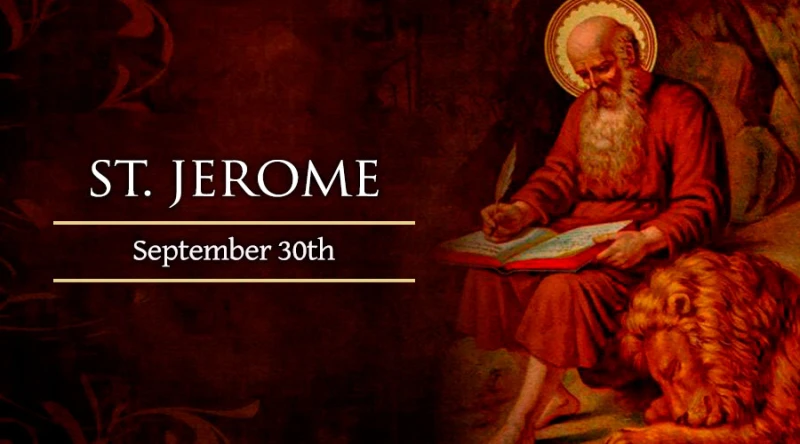
St. Jerome


St. Jerome

Feast date: Sep 30

Saint Jerome, the priest, monk and Doctor of the Church renowned for his extraordinary depth of learning and translations of the Bible into Latin in the Vulgate, is celebrated by the Church with his memorial today, September 30.

Besides his contributions as a Church Father and patronage of subsequent Catholic scholarship, Jerome is also regarded as a patron of people with difficult personalities—owing to the sometimes extreme approach which he took in articulating his scholarly opinions and the teaching of the Church. He is also notable for his devotion to the ascetic life, and for his insistence on the importance of Hebrew scholarship for Christians.

Born around 340 as Eusebius Hieronymous Sophronius in present-day Croatia, Jerome received Christian instruction from his father, who sent him to Rome for instruction in rhetoric and classical literature. His youth was thus dominated by a struggle between worldly pursuits –which brought him into many types of temptation– and the inclination to a life of faith, a feeling evoked by regular trips to the Roman catacombs with his friends in the city.

Baptized in 360 by Pope Liberius, Jerome traveled widely among the monastic and intellectual centers of the newly Christian empire. Upon returning to the city of his birth, following the end of a local crisis caused by the Arian heresy, he studied theology in the famous schools of Trier and worked closely with two other future saints, Chromatius and Heliodorus, who were outstanding teachers of orthodox theology.

Seeking a life more akin to the first generation of “desert fathers,” Jerome left the Adriatic and traveled east to Syria, visiting several Greek cities of civil and ecclesiastical importance on the way to his real destination: “a wild and stony desert … to which, through fear or hell, I had voluntarily condemned myself, with no other company but scorpions and wild beasts.”

Jerome’s letters vividly chronicle the temptations and trials he endured during several years as a desert hermit. Nevertheless, after his ordination by the bishop of Antioch, followed by periods of study in Constantinople and service at Rome to Pope Damasus I, Jerome opted permanently for a solitary and ascetic life in the city of Bethlehem from the mid-380s.

Jerome remained engaged both as an arbitrator and disputant of controversies in the Church, and served as a spiritual father to a group of nuns who had become his disciples in Rome. Monks and pilgrims from a wide array of nations and cultures also found their way to his monastery, where he commented that “as many different choirs chant the psalms as there are nations.”

Rejecting pagan literature as a distraction, Jerome undertook to learn Hebrew from a Christian monk who had converted from Judaism. Somewhat unusually for a fourth-century Christian priest, he also studied with Jewish rabbis, striving to maintain the connection between Hebrew language and culture, and the emerging world of Greek and Latin-speaking Christianity. He became a secretary of Pope Damasus, who commissioned the Vulgate from him. Prepared by these ventures, Jerome spent 15 years translating most of the Hebrew Bible into its authoritative Latin version. His harsh temperament and biting criticisms of his intellectual opponents made him many enemies in the Church and in Rome and he was forced to leave the city.

Jerome went to Bethlehem, established a monastery, and lived the rest of his years in study, prayer, and ascetcism.

St. Jerome once said, “I interpret as I should, following the command of Christ: ‘Search the Scriptures,’ and ‘Seek and you shall find.’ For if, as Paul says, Christ is the power of God and the wisdom of God, and if the man who does not know Scripture does not know the power and wisdom of God, then ignorance of Scriptures is ignorance of Christ.”

After living through both Barbarian invasions of the Roman empire, and a resurgence of riots sparked by doctrinal disputes in the Church, Jerome died in his Bethlehem monastery in 420.

St. Jerome Read More »

Feast of Saints Michael, Gabriel, and Raphael, archangels

Reading I Dn 7:9-10, 13-14

As I watched:

    Thrones were set up
        and the Ancient One took his throne.
    His clothing was bright as snow,
        and the hair on his head as white as wool;
    His throne was flames of fire,
        with wheels of burning fire.
    A surging stream of fire
        flowed out from where he sat;
    Thousands upon thousands were ministering to him,
        and myriads upon myriads attended him.

The court was convened, and the books were opened.
As the visions during the night continued, I saw

    One like a son of man coming,
        on the clouds of heaven;
    When he reached the Ancient One
        and was presented before him,
    He received dominion, glory, and kingship;
        nations and peoples of every language serve him.
    His dominion is an everlasting dominion
        that shall not be taken away,
        his kingship shall not be destroyed.

OR: 

Rv 12:7-12ab

War broke out in heaven;
Michael and his angels battled against the dragon.
The dragon and its angels fought back,
but they did not prevail
and there was no longer any place for them in heaven.
The huge dragon, the ancient serpent,
who is called the Devil and Satan,
who deceived the whole world,
was thrown down to earth,
and its angels were thrown down with it.

Then I heard a loud voice in heaven say:
“Now have salvation and power come,
and the Kingdom of our God
and the authority of his Anointed.
For the accuser of our brothers is cast out,
who accuses them before our God day and night.
They conquered him by the Blood of the Lamb
and by the word of their testimony;
love for life did not deter them from death.
Therefore, rejoice, you heavens,
and you who dwell in them.”

Responsorial Psalm 138:1-2ab, 2cde-3, 4-5

R.    (1)  In the sight of the angels I will sing your praises, Lord.
I will give thanks to you, O LORD, with all my heart,
    for you have heard the words of my mouth;
    in the presence of the angels I will sing your praise;
I will worship at your holy temple
    and give thanks to your name.
R.    In the sight of the angels I will sing your praises, Lord.
Because of your kindness and your truth;
    for you have made great above all things
    your name and your promise.
When I called, you answered me;
    you built up strength within me.
R.    In the sight of the angels I will sing your praises, Lord.
All the kings of the earth shall give thanks to you, O LORD
    when they hear the words of your mouth;
And they shall sing of the ways of the LORD
    “Great is the glory of the LORD
R.    In the sight of the angels I will sing your praises, Lord.

Alleluia Ps 103:21

R. Alleluia, alleluia.
Bless the LORD, all you angels,
you ministers, who do his will.
R. Alleluia, alleluia.

Gospel Jn 1:47-51

Jesus saw Nathanael coming toward him and said of him,
“Here is a true child of Israel.
There is no duplicity in him.”
Nathanael said to him, “How do you know me?”
Jesus answered and said to him,
“Before Philip called you, I saw you under the fig tree.”
Nathanael answered him,
“Rabbi, you are the Son of God; you are the King of Israel.”
Jesus answered and said to him,
“Do you believe
because I told you that I saw you under the fig tree?
You will see greater things than this.”
And he said to him, “Amen, amen, I say to you,
you will see heaven opened
and the angels of God ascending and descending on the Son of Man.”

– – –

Lectionary for Mass for Use in the Dioceses of the United States, second typical edition, Copyright © 2001, 1998, 1997, 1986, 1970 Confraternity of Christian Doctrine; Psalm refrain © 1968, 1981, 1997, International Committee on English in the Liturgy, Inc. All rights reserved. Neither this work nor any part of it may be reproduced, distributed, performed or displayed in any medium, including electronic or digital, without permission in writing from the copyright owner.

Feast of Saints Michael, Gabriel, and Raphael, archangels Read More »

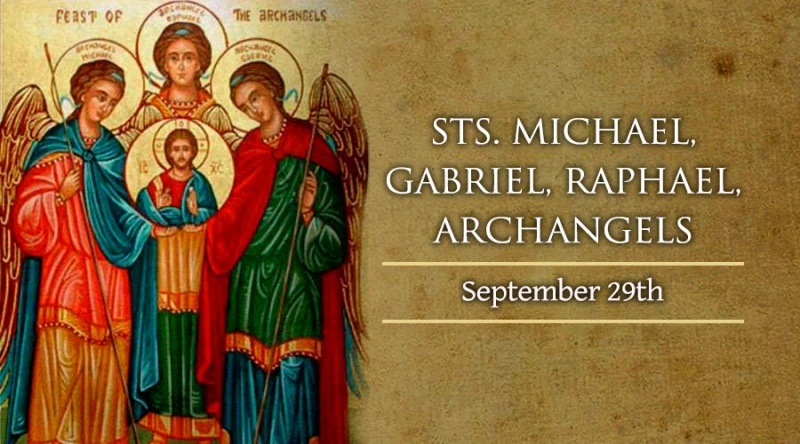
Sts. Michael, Gabriel, Raphael, Archangels


Sts. Michael, Gabriel, Raphael, Archangels

Feast date: Sep 29

The three Archangels Michael, Gabriel and Raphael are the only angels named in Sacred Scripture and all three have important roles in the history of salvation.

Saint Michael is the “Prince of the Heavenly Host,” the leader of all the angels. His name is Hebrew for “Who is like God?” and was the battle cry of the good angels against Lucifer and his followers when they rebelled against God. He is mentioned four times in the Bible, in Daniel 10 and 12, in the letter of Jude, and in Revelation.

Michael, whose forces cast down Lucifer and the evil spirits into Hell, is invoked for protection against Satan and all evil. Pope Leo XIII, in 1899, having had a prophetic vision of the evil that would be inflicted upon the Church and the world in the 20th century, instituted a prayer asking for Saint Michael’s protection to be said at the end of every Mass.

Christian tradition recognizes four offices of Saint Michael: (i) to fight against Satan (ii) to rescue the souls of the faithful from the power of the enemy, especially at the hour of death. (iii) to be the champion of God’s people, (iv) to call away from earth and bring men’s souls to judgment.

“I am Gabriel, who stand before God.” (Luke 1, 19)

Saint Gabriel, whose name means “God’s strength,” is mentioned four times in the Bible. Most significant are Gabriel’s two mentions in the New Testament: to announce the birth of John the Baptist to his father Zacharias, and the at Incarnation of the Word in the womb of Mary.

Christian tradition suggests that it is he who appeared to St. Joseph and to the shepherds, and also that it was he who “strengthened” Jesus during his agony in the garden of Gethsemane.

“I am the angel Raphael, one of the seven, who stand before the Lord” (Tob 12:15)

Saint Raphael, whose name means “God has healed” because of his healing of Tobias’ blindness in the Book of Tobit.  Tobit is the only book in which he is mentioned. His office is generally accepted by tradition to be that of healing and acts of mercy.

Raphael is also identified with the angel in John 5:1-4 who descended upon the pond and bestowed healing powers upon it so that the first to enter it after it moved would be healed of whatever infirmity he was suffering.

Sts. Michael, Gabriel, Raphael, Archangels Read More »