Please mind our dust!

We are currently working on revamping our website!
Thank you for your patience!

CRD Solutions

Wednesday of the Twenty-sixth Week in Ordinary Time

Reading 1 Jb 9:1-12, 14-16

Job answered his friends and said:

I know well that it is so;
but how can a man be justified before God?
Should one wish to contend with him,
he could not answer him once in a thousand times.
God is wise in heart and mighty in strength;
who has withstood him and remained unscathed?

He removes the mountains before they know it;
he overturns them in his anger.
He shakes the earth out of its place,
and the pillars beneath it tremble.
He commands the sun, and it rises not;
he seals up the stars.

He alone stretches out the heavens
and treads upon the crests of the sea.
He made the Bear and Orion,
the Pleiades and the constellations of the south;
He does great things past finding out,
marvelous things beyond reckoning.

Should he come near me, I see him not;
should he pass by, I am not aware of him;
Should he seize me forcibly, who can say him nay?
Who can say to him, “What are you doing?”

How much less shall I give him any answer,
or choose out arguments against him!
Even though I were right, I could not answer him,
but should rather beg for what was due me.
If I appealed to him and he answered my call,
I could not believe that he would hearken to my words.

Responsorial Psalm Ps 88:10bc-11, 12-13, 14-15

R. (3) Let my prayer come before you, Lord.
Daily I call upon you, O LORD;
to you I stretch out my hands.
Will you work wonders for the dead?
Will the shades arise to give you thanks?
R. Let my prayer come before you, Lord.
Do they declare your mercy in the grave,
your faithfulness among those who have perished?
Are your wonders made known in the darkness,
or your justice in the land of oblivion?
R. Let my prayer come before you, Lord.
But I, O LORD, cry out to you;
with my morning prayer I wait upon you.
Why, O LORD, do you reject me;
why hide from me your face?
R. Let my prayer come before you, Lord.

Alleluia Phil 3:8-9

R. Alleluia, alleluia.
I consider all things so much rubbish
that I may gain Christ and be found in him.
R. Alleluia, alleluia.

Gospel Lk 9:57-62

As Jesus and his disciples were proceeding
on their journey, someone said to him,
“I will follow you wherever you go.”
Jesus answered him,
“Foxes have dens and birds of the sky have nests,
but the Son of Man has nowhere to rest his head.”
And to another he said, “Follow me.”
But he replied, “Lord, let me go first and bury my father.”
But he answered him, “Let the dead bury their dead.
But you, go and proclaim the Kingdom of God.”
And another said, “I will follow you, Lord,
but first let me say farewell to my family at home.”
Jesus answered him, “No one who sets a hand to the plow
and looks to what was left behind is fit for the Kingdom of God.”

– – –

Lectionary for Mass for Use in the Dioceses of the United States, second typical edition, Copyright © 2001, 1998, 1997, 1986, 1970 Confraternity of Christian Doctrine; Psalm refrain © 1968, 1981, 1997, International Committee on English in the Liturgy, Inc. All rights reserved. Neither this work nor any part of it may be reproduced, distributed, performed or displayed in any medium, including electronic or digital, without permission in writing from the copyright owner.

Wednesday of the Twenty-sixth Week in Ordinary Time Read More »
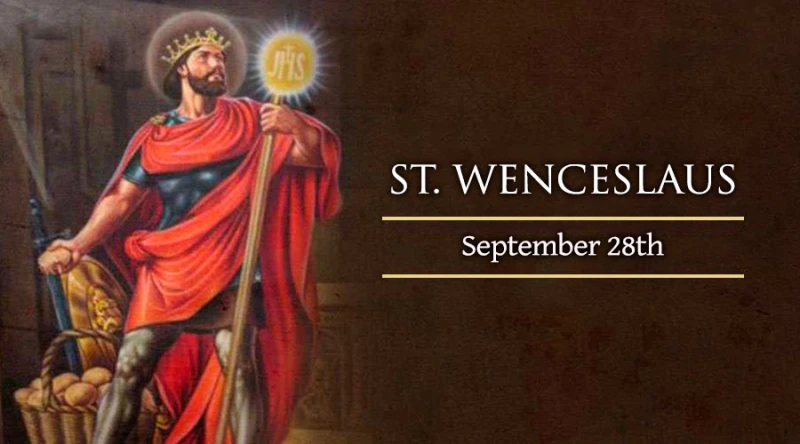
St. Wenceslaus


St. Wenceslaus

Feast date: Sep 28

On Sept. 28, the Catholic Church honors Saint Wenceslaus, a Central European ruler who died at the hands of his brother while seeking to strengthen the Catholic faith in his native Bohemia.

During his 2009 visit to the Czech Republic, Pope Benedict XVI called the country’s patron saint “a martyr for Christ” who “had the courage to prefer the kingdom of heaven to the enticement of worldly power.”

St. Wenceslaus was born around the year 903. His father Duke Wratislaw was a Catholic, but his mother Princess Dragomir practiced the native pagan religion. She would later arrange the murders of both Wenceslaus and his grandmother Ludmilla, who is also a canonized saint.

During his youth, Wenceslaus received a strong religious education from Ludmilla, in addition to the good example of his father. He maintained a virtuous manner of living while attending college near Prague, making significant progress both academically and spiritually. But with the death of his father Wratislaw, the devout young nobleman faced a spiritual and political crisis.

His mother Dragomir, who had never accepted the Catholic faith, turned against it entirely. She seized her husband’s death as a chance to destroy the religion his parents had received from Sts. Cyril and Methodius, through methods that included purging Catholics from public office, closing churches, and preventing all teaching of the faith.

Dragomir’s Catholic mother-in-law Ludmilla urged Wenceslaus to seize power from his mother and defend their faith. His attempt to do so resulted in the division of the country into two halves: one ruled by Wenceslaus, advised by Ludmilla; the other ruled by Wenceslaus’ younger brother Boleslaus, who had absorbed his mother’s hatred of the Church.

Wenceslaus, who would have preferred to become a monk and not a duke, fortified himself in this struggle through fervent prayer, extreme asceticism, charitable service, and a vow of chastity. Meanwhile, his mother carried out a plot to kill Ludmilla, having her strangled in her private chapel. St. Ludmilla’s liturgical feast day is Sept. 16.

The Bohemian duke also faced the threat of invasion from abroad, when Prince Radislaus of Gurima demanded that Bohemia submit to his rule. When Wenceslaus sought to avoid a war by challenging him in single combat, two angels are said to have appeared, deflecting the javelin thrown at Wenceslaus and immediately inspiring Radislaus to drop to his knees in surrender.

During his period of rule, Wenceslaus received the relics of several saints from the Holy Roman Emperor Otto I, who also conferred on him the title of “King Wenceslaus.” But some noblemen of his own country resented the saintly king’s strict morals, and allied themselves with Dragomir and Boleslaus.

Wenceslaus’ brother sought to appear as a peacemaker, inviting the king to his realm for a celebration. When Wenceslaus was praying in a chapel during the visit, Boleslaus’ henchmen attacked and wounded him. Boleslaus himself delivered the final blow, killing his brother by running him through with a lance. St. Wenceslaus died on Sept. 28, 935.

Emperor Otto responded to St. Wenceslaus’ death by invading Bohemia and making war against Boleslaus for several years. He succeeded in conquering the region, and forced Boleslaus to reverse the anti-Catholic measures he and his mother had taken.

There is no evidence that Dragomir, who died soon after the murder of St. Wenceslaus, ever repented of killing her family members. Boleslaus, however, came to regret his sin when he learned of the miracles that were taking place at his brother’s tomb. He moved St. Wenceslaus’ body to a cathedral for veneration by the faithful.

St. Wenceslaus Read More »

Memorial of Saint Vincent de Paul, Priest

Reading 1 Jb 3:1-3, 11-17, 20-23

Job opened his mouth and cursed his day.
Job spoke out and said:

Perish the day on which I was born,
the night when they said, “The child is a boy!”

Why did I not perish at birth,
come forth from the womb and expire?
Or why was I not buried away like an untimely birth,
like babes that have never seen the light?
Wherefore did the knees receive me?
or why did I suck at the breasts?

For then I should have lain down and been tranquil;
had I slept, I should then have been at rest
With kings and counselors of the earth
who built where now there are ruins
Or with princes who had gold
and filled their houses with silver.

There the wicked cease from troubling,
there the weary are at rest.

Why is light given to the toilers,
and life to the bitter in spirit?
They wait for death and it comes not;
they search for it rather than for hidden treasures,
Rejoice in it exultingly,
and are glad when they reach the grave:
Those whose path is hidden from them,
and whom God has hemmed in!

Responsorial Psalm Ps 88:2-3, 4-5, 6, 7-8

R. (3) Let my prayer come before you, Lord.
O LORD, my God, by day I cry out;
at night I clamor in your presence.
Let my prayer come before you;
incline your ear to my call for help.
R. Let my prayer come before you, Lord.
For my soul is surfeited with troubles
and my life draws near to the nether world.
I am numbered with those who go down into the pit;
I am a man without strength.
R. Let my prayer come before you, Lord.
My couch is among the dead,
like the slain who lie in the grave,
Whom you remember no longer
and who are cut off from your care.
R. Let my prayer come before you, Lord.
You have plunged me into the bottom of the pit,
into the dark abyss.
Upon me your wrath lies heavy,
and with all your billows you overwhelm me.
R. Let my prayer come before you, Lord.

Alleluia Mk 10:45

R. Alleluia, alleluia.
The Son of Man came to serve
and to give his life as a ransom for many.
R. Alleluia, alleluia.

Gospel Lk 9:51-56

When the days for Jesus to be taken up were fulfilled,
he resolutely determined to journey to Jerusalem,
and he sent messengers ahead of him.
On the way they entered a Samaritan village
to prepare for his reception there,
but they would not welcome him
because the destination of his journey was Jerusalem.
When the disciples James and John saw this they asked,
“Lord, do you want us to call down fire from heaven
to consume them?”
Jesus turned and rebuked them,
and they journeyed to another village.

– – –

Lectionary for Mass for Use in the Dioceses of the United States, second typical edition, Copyright © 2001, 1998, 1997, 1986, 1970 Confraternity of Christian Doctrine; Psalm refrain © 1968, 1981, 1997, International Committee on English in the Liturgy, Inc. All rights reserved. Neither this work nor any part of it may be reproduced, distributed, performed or displayed in any medium, including electronic or digital, without permission in writing from the copyright owner.

Memorial of Saint Vincent de Paul, Priest Read More »

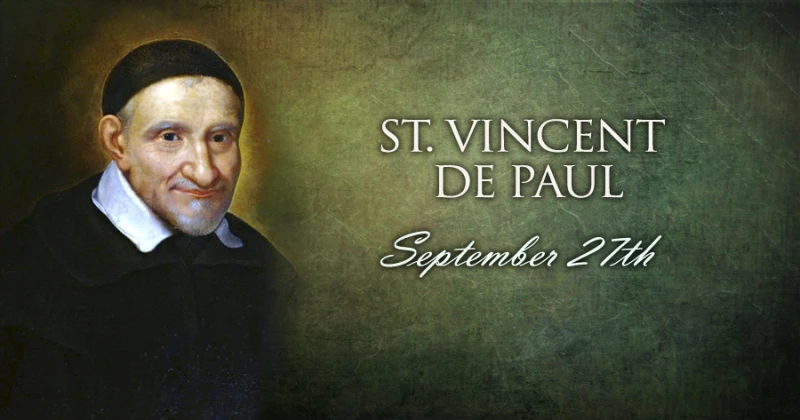
St. Vincent de Paul


St. Vincent de Paul

Feast date: Sep 27

On Sept. 27, the Catholic Church remembers Saint Vincent de Paul, the French, 17th century priest known as the patron of Catholic charities for his apostolic work among the poor and marginalized.
 
During a September 2010 Angelus address, Pope Benedict XVI noted that St. Vincent “keenly perceived the strong contrast between the richest and the poorest of people,” and was “encouraged by the love of Christ” to “organize permanent forms of service” to provide for those in need.
 
The exact year of Vincent’s birth is not definitively known, but it has been placed between 1576 and 1581. Born to a poor family in the southwest of France, he showed his intellectual gifts from a young age, studying theology from around age 15. He received ordination as a priest in the year 1600, and worked as a tutor to students in Toulouse.
 
During a sea voyage in 1605, Vincent was seized by Turkish pirates and sold into slavery. His ordeal of captivity lasted until 1607, during which time the priest converted his owner to the Christian faith and escaped with him from Tunisia. Afterward, he spent time studying in Rome, and – in a striking reversal of fortune – served as an educator and spiritual guide to members of an upper-class French family.
 
Although Vincent had initially begun his priesthood with the intention of securing a life of leisure for himself, he underwent a change of heart after hearing the confession of a dying peasant. Moved with compassion for the poor, he began undertaking missions and founding institutions to help them both materially and spiritually. The one-time slave also ministered to convicts forced to serve in squalid conditions as rowers aboard galley ships.
 
Vincent established the Congregation of Priests of the Mission in 1625, as part of an effort to evangelize rural populations and foster vocations to remedy a priest shortage. Not long after this, he worked with the future Saint Louise de Marillac to organize the Daughters of Charity, the first congregation of women religious whose consecrated life involved an extensive apostolate among the poor, the sick, and prisoners.
 
Under Louise’s direction, the order collected donations which Vincent distributed widely among the needy. These contributions went toward homes for abandoned children, a hospice for the elderly, and an immense complex where 40,000 poor people were given lodging and work. Vincent was involved in various ways with all of these works, as well as with efforts to help refugees and to free those sold into slavery in foreign lands.
 
Though admired for these accomplishments during his lifetime, the priest maintained great personal humility, using his reputation and connections to help the poor and strengthen the Church. Doctrinally, Vincent was a strong opponent of Jansenism, a theological heresy that denied the universality of God’s love and discouraged reception of the Eucharist. He was also involved in the reform of several religious orders within France.
 
St. Vincent de Paul died on Sept. 27, 1660, only months after the death of St. Louise de Marillac in March of the same year. Pope Clement XII canonized him in 1737. In 1835, the French scholar Blessed Frederic Ozanam took him as the inspiration and namesake for the Society of Saint Vincent de Paul, a lay Catholic organization working for the relief of the poor.

St. Vincent de Paul Read More »

Monday of the Twenty-sixth Week in Ordinary Time

Reading 1 JB 1:6-22

One day, when the angels of God came to present themselves before the LORD,
Satan also came among them.
And the LORD said to Satan, “Whence do you come?”
Then Satan answered the LORD and said,
“From roaming the earth and patrolling it.” 
And the LORD said to Satan, “Have you noticed my servant Job,
and that there is no one on earth like him,
blameless and upright, fearing God and avoiding evil?”
But Satan answered the LORD and said,
“Is it for nothing that Job is God-fearing?
Have you not surrounded him and his family
and all that he has with your protection?
You have blessed the work of his hands,
and his livestock are spread over the land.
But now put forth your hand and touch anything that he has,
and surely he will blaspheme you to your face.”
And the LORD said to Satan,
“Behold, all that he has is in your power;
only do not lay a hand upon his person.”
So Satan went forth from the presence of the LORD.

And so one day, while his sons and his daughters
were eating and drinking wine
in the house of their eldest brother,
a messenger came to Job and said,
“The oxen were ploughing and the asses grazing beside them,
and the Sabeans carried them off in a raid.
They put the herdsmen to the sword,
and I alone have escaped to tell you.”
While he was yet speaking, another came and said,
“Lightning has fallen from heaven
and struck the sheep and their shepherds and consumed them;
and I alone have escaped to tell you.”
While he was yet speaking, another messenger came and said,
“The Chaldeans formed three columns,
seized the camels, carried them off,
and put those tending them to the sword,
and I alone have escaped to tell you.”
While he was yet speaking, another came and said,
“Your sons and daughters were eating and drinking wine
in the house of their eldest brother,
when suddenly a great wind came across the desert
and smote the four corners of the house.
It fell upon the young people and they are dead;
and I alone have escaped to tell you.”
Then Job began to tear his cloak and cut off his hair.
He cast himself prostrate upon the ground, and said,

“Naked I came forth from my mother’s womb,
and naked shall I go back again.
The LORD gave and the LORD has taken away;
blessed be the name of the LORD!”

In all this Job did not sin,
nor did he say anything disrespectful of God.

Responsorial Psalm PS 17:1BCD, 2-3, 6-7

R. (6) Incline your ear to me and hear my word.
Hear, O LORD, a just suit;
attend to my outcry;
hearken to my prayer from lips without deceit.
R. Incline your ear to me and hear my word.
From you let my judgment come;
your eyes behold what is right.
Though you test my heart, searching it in the night,
though you try me with fire, you shall find no malice in me.
R. Incline your ear to me and hear my word.
I call upon you, for you will answer me, O God; 
incline your ear to me; hear my word.
Show your wondrous mercies,
O savior of those who flee
from their foes to refuge at your right hand.
R. Incline your ear to me and hear my word.


Alleluia MK 10:45

R. Alleluia, alleluia.
The Son of Man came to serve
and to give his life as a ransom for many.
R. Alleluia, alleluia.

Gospel LK 9:46-50

An argument arose among the disciples
about which of them was the greatest. 
Jesus realized the intention of their hearts and took a child
and placed it by his side and said to them,
“Whoever receives this child in my name receives me,
and whoever receives me receives the one who sent me.
For the one who is least among all of you
is the one who is the greatest.”Then John said in reply, 
“Master, we saw someone casting out demons in your name 
and we tried to prevent him
 because he does not follow in our company.”
Jesus said to him, 
“Do not prevent him, for whoever is not against you is for you.”

– – –

Lectionary for Mass for Use in the Dioceses of the United States, second typical edition, Copyright © 2001, 1998, 1997, 1986, 1970 Confraternity of Christian Doctrine; Psalm refrain © 1968, 1981, 1997, International Committee on English in the Liturgy, Inc. All rights reserved. Neither this work nor any part of it may be reproduced, distributed, performed or displayed in any medium, including electronic or digital, without permission in writing from the copyright owner.

Monday of the Twenty-sixth Week in Ordinary Time Read More »