Please mind our dust!

We are currently working on revamping our website!
Thank you for your patience!

CRD Solutions

Memorial of Saint Pius of Pietrelcina, Priest

Reading 1 ECCL 3:1-11

There is an appointed time for everything,
and a time for every thing under the heavens.
A time to be born, and a time to die;
a time to plant, and a time to uproot the plant.
A time to kill, and a time to heal;
a time to tear down, and a time to build.
A time to weep, and a time to laugh;
a time to mourn, and a time to dance.
A time to scatter stones, and a time to gather them;
a time to embrace, and a time to be far from embraces.
A time to seek, and a time to lose;
a time to keep, and a time to cast away.
A time to rend, and a time to sew;
a time to be silent, and a time to speak.
A time to love, and a time to hate;
a time of war, and a time of peace.

What advantage has the worker from his toil?
I have considered the task that God has appointed
for the sons of men to be busied about.
He has made everything appropriate to its time,
and has put the timeless into their hearts,
without man’s ever discovering,
from beginning to end, the work which God has done.

Responsorial Psalm PS 144:1B AND 2ABC, 3-4

R. (1) Blessed be the Lord, my Rock!
Blessed be the LORD, my rock,
my mercy and my fortress,
my stronghold, my deliverer,
My shield, in whom I trust.
R. Blessed be the Lord, my Rock!
LORD, what is man, that you notice him;
the son of man, that you take thought of him?
Man is like a breath;
his days, like a passing shadow.
R. Blessed be the Lord, my Rock!


Alleluia MK 10:45

R. Alleluia, alleluia.
The Son of Man came to serve
and to give his life as a ransom for many.
R. Alleluia, alleluia.

Gospel LK 9:18-22

Once when Jesus was praying in solitude,
and the disciples were with him,
he asked them, “Who do the crowds say that I am?”
They said in reply, “John the Baptist; others, Elijah;
still others, ‘One of the ancient prophets has arisen.’”
Then he said to them, “But who do you say that I am?”
Peter said in reply, “The Christ of God.”
He rebuked them and directed them not to tell this to anyone.

He said, “The Son of Man must suffer greatly
and be rejected by the elders, the chief priests, and the scribes,
and be killed and on the third day be raised.”
 

– – –

Lectionary for Mass for Use in the Dioceses of the United States, second typical edition, Copyright © 2001, 1998, 1997, 1986, 1970 Confraternity of Christian Doctrine; Psalm refrain © 1968, 1981, 1997, International Committee on English in the Liturgy, Inc. All rights reserved. Neither this work nor any part of it may be reproduced, distributed, performed or displayed in any medium, including electronic or digital, without permission in writing from the copyright owner.

Memorial of Saint Pius of Pietrelcina, Priest Read More »
St. Pio of Pietrelcina


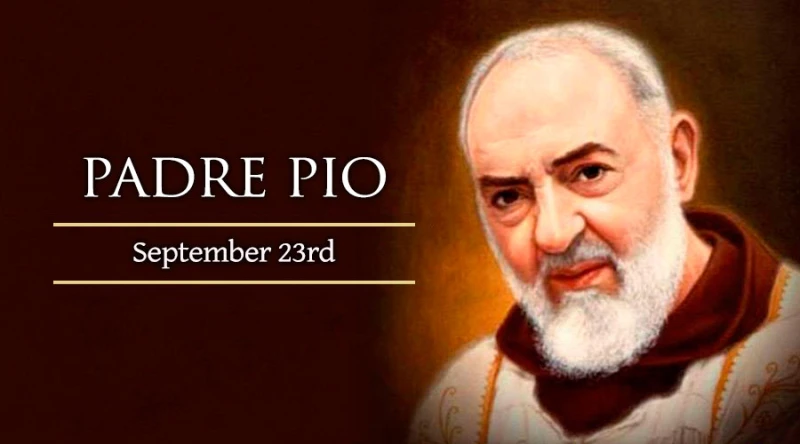
St. Pio of Pietrelcina

Feast date: Sep 23

On Sept. 23, the Catholic Church remembers the Italian Franciscan priest St. Pio of Petrelcina, better known as “Padre Pio” and known for his suffering, humility and miracles.

The man later known by these names was originally named Francesco Forgione, born to his parents Grazio and Maria in 1887. His parents had seven children, two of whom died in infancy. They taught the five surviving children to live their faith through daily Mass, family prayer of the rosary, and regular acts of penance.

Francesco had already decided at a young age to dedicate his entire life to God. At age 10, he felt inspired by the example of a young Capuchin Franciscan, and told his parents: “I want to be a friar – with a beard.” Francesco’s father spent time in America, working to finance his son’s education so he could enter the religious life.

On Jan. 22, 1903, Francesco donned the Franciscan habit for the first time. He took the new name Pio, a modernized Italian form of “Pius,” in honor of Pope St. Pius V. He made his solemn vows four years later, and received priestly ordination in the summer of 1910. Shortly after, he first received the Stigmata – Christ’s wounds, present in his own flesh.

Along with these mystical but real wounds, Padre Pio also suffered health problems that forced him to live apart from his Franciscan community for the first six years of his priesthood. By 1916 he managed to re-enter community life at the Friary of San Giovanni Rotondo, where he lived until his death. He handled many duties as a spiritual director and teacher, covering for brothers drafted into World War I.

During 1917 and 1918, Padre Pio himself briefly served in a medical unit of the Italian army. He later offered himself as a spiritual “victim” for an end to the war, accepting suffering as a form of prayer for peace. Once again, he received the wounds of Christ on his body. They would remain with him for 50 years, through a succession of global conflicts.

Against his own wishes, the friar’s reputation for holiness, and attending miracles, began to attract huge crowds. Some Church officials, however, denounced the priest and had him banned from public ministry in 1931. Pope Pius XI ended the ban two years later, and his successor Pius XII encouraged pilgrimages to Padre Pio’s friary.

Known for patient suffering, fervent prayer, and compassionate spiritual guidance, Padre Pio also lent his efforts to the establishment of a major hospital, the “Home to Relieve Suffering.”

Padre Pio died in 1968, and was declared a saint in 2002. Three years after his death, Pope Paul VI marveled at his simple and holy life in an address to the Capuchin Order.

“A worldwide following gathered around him … because he said Mass humbly, heard confessions from dawn to dusk and was – it is not easy to say it – one who bore the wounds of our Lord,” Pope Paul explained. “He was a man of prayer and suffering.”

St. Pio of Pietrelcina Read More »

Thursday of the Twenty-fifth Week in Ordinary Time

Reading 1 ECCL 1:2-11

Vanity of vanities, says Qoheleth,
vanity of vanities!  All things are vanity!
What profit has man from all the labor
which he toils at under the sun?
One generation passes and another comes,
but the world forever stays.
The sun rises and the sun goes down;
then it presses on to the place where it rises.
Blowing now toward the south, then toward the north,
the wind turns again and again, resuming its rounds.
All rivers go to the sea,
yet never does the sea become full.
To the place where they go,
the rivers keep on going.
All speech is labored;
there is nothing one can say.
The eye is not satisfied with seeing
nor is the ear satisfied with hearing.

What has been, that will be;
what has been done, that will be done.
Nothing is new under the sun.
Even the thing of which we say, “See, this is new!”
has already existed in the ages that preceded us.
There is no remembrance of the men of old;
nor of those to come will there be any remembrance
among those who come after them.
 

Responsorial Psalm PS 90:3-4, 5-6, 12-13, 14 AND 17BC

R. (1)  In every age, O Lord, you have been our refuge.
You turn man back to dust,
saying, “Return, O children of men.”
For a thousand years in your sight
are as yesterday, now that it is past,
or as a watch of the night.
R. In every age, O Lord, you have been our refuge.
You make an end of them in their sleep;
the next morning they are like the changing grass,
Which at dawn springs up anew,
but by evening wilts and fades.
R. In every age, O Lord, you have been our refuge.
Teach us to number our days aright,
that we may gain wisdom of heart.
Return, O LORD!  How long?
Have pity on your servants!
R. In every age, O Lord, you have been our refuge.
Fill us at daybreak with your kindness,
that we may shout for joy and gladness all our days.
Prosper the work of our hands for us!
Prosper the work of our hands!
R. In every age, O Lord, you have been our refuge.


Alleluia JN 14:6

R. Alleluia, alleluia.
I am the way and the truth and the life, says the Lord;
no one comes to the Father except through me.
R. Alleluia, alleluia.

Gospel LK 9:7-9

Herod the tetrarch heard about all that was happening,
and he was greatly perplexed because some were saying,
“John has been raised from the dead”;
others were saying, “Elijah has appeared”;
still others, “One of the ancient prophets has arisen.”
But Herod said, “John I beheaded.
Who then is this about whom I hear such things?”
And he kept trying to see him.

– – –

Lectionary for Mass for Use in the Dioceses of the United States, second typical edition, Copyright © 2001, 1998, 1997, 1986, 1970 Confraternity of Christian Doctrine; Psalm refrain © 1968, 1981, 1997, International Committee on English in the Liturgy, Inc. All rights reserved. Neither this work nor any part of it may be reproduced, distributed, performed or displayed in any medium, including electronic or digital, without permission in writing from the copyright owner.

Thursday of the Twenty-fifth Week in Ordinary Time Read More »

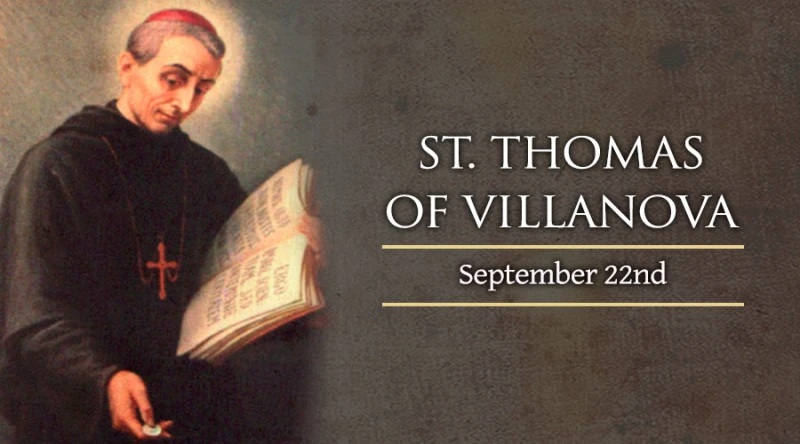
St. Thomas of Villanova


St. Thomas of Villanova

Feast date: Sep 22

On Sept. 22, the Catholic Church remembers Saint Thomas of Villanova, a 16th century Spanish Augustinian monk and archbishop who lived a life of austerity in order to provide for the spiritual and material needs of his people.

Born during 1488 in the Spanish region of Castile, in the town of Villanova de los Infantes, Thomas Garcia was raised to take after the faith and charitable works of his parents Alphonsus and Lucia. His father, a mill worker, regularly distributed food and provisions to the poor, as did his mother.

Generous and devout from an early age, their son was also intellectually gifted, beginning his studies at the University of Alcala at age 16. Within ten years he had become a professor of philosophy at that same university, where he taught for two years before being offered a more prestigious position at the University of Salamanca.

Thomas, however, chose not to continue his academic career. After his father’s death, he had determined to leave much of his inheritance to the poor and sick rather than retaining it himself. At age 28, after much deliberation, Thomas embraced a life of chastity, poverty, and religious obedience with his entry into the monastic Order of St. Augustine.

Thomas made his first vows as an Augustinian in 1517 and was ordained a priest in 1518. He taught theology within his order and became renowned for his eloquent and effective preaching in the churches of Salamanca. This led to his appointment as a court preacher and adviser to the Holy Roman Emperor Charles V.

Presented with the prospect of being named an archbishop, Thomas initially declined and instead continued his work within the Order of St. Augustine, during a period that saw its expansion across the sea to Mexico. In August of 1544, however, he was ordered by his religious superiors to accept his appointment as the Archbishop of Valencia.

Thomas arrived wearing the same well-worn monastic habit that he had worn for several years and would continue wearing for years to come. Given a donation to decorate his residence, he funnelled the money to a hospital in need of repair. After his installation, he visited local prisons and ordered changes to be made in response to their inhumane conditions.

While continuing his life of monastic asceticism, the archbishop worked to improve the spiritual lives and living conditions of the faithful. He gave special attention to the needs of the poor, feeding and sheltering them in his own residence. During the same period he worked to promote education, restore religious orthodoxy, and reform the lifestyles of clergy and laypersons.

After 11 years leading the Archdiocese of Valencia, St. Thomas of Villanova succumbed to a heart condition at the end of a Mass held in his home on Sept. 8, 1555. He is said to have died on the floor rather than in his bed, which he insisted on offering to a poor man who had come to his house. Pope Alexander VII canonized him in 1658.

St. Thomas of Villanova Read More »

St. Maurice and Companions

Feast date: Sep 22

Saint Maurice was a member of the Theban Legion, a Roman legion said to have been constituted by Christian soldiers from Africa, which was called to put down a revolt in Aaunum, located in modern day Switzerland, in the year 287.

Two legends exist about the martyrdom of St. Maurice and his companions. According to the legends, the legion’s soldiers were either ordered to take part in pagan sacrifices, or ordered to harass and kill some local Christians. In either event the 6,600 men of Maurice’s legion refused. In punishment for their disobedience, every tenth man in the legion was killed. When the remaining soldiers, fortified by St. Maurice, still refused other legions were called in to force them to follow their orders. Persisting in their refusal, they were all massacred.

St. Maurice and Companions Read More »