Please mind our dust!

We are currently working on revamping our website!
Thank you for your patience!

CRD Solutions

Feast of Saint Matthew, Apostle and evangelist

Reading I Eph 4:1-7, 11-13

Brothers and sisters:
I, a prisoner for the Lord,
urge you to live in a manner worthy of the call you have received,
with all humility and gentleness, with patience,
bearing with one another through love,
striving to preserve the unity of the Spirit
through the bond of peace:
one Body and one Spirit,
as you were also called to the one hope of your call;
one Lord, one faith, one baptism;
one God and Father of all,
who is over all and through all and in all.

But grace was given to each of us
according to the measure of Christ’s gift. 

And he gave some as Apostles, others as prophets,
others as evangelists, others as pastors and teachers,
to equip the holy ones for the work of ministry,
for building up the Body of Christ,
until we all attain to the unity of faith
and knowledge of the Son of God, to mature manhood,
to the extent of the full stature of Christ. 

Responsorial Psalm 19:2-3, 4-5

R.    (5)  Their message goes out through all the earth.
The heavens declare the glory of God;
    and the firmament proclaims his handiwork.
Day pours out the word to day,
    and night to night imparts knowledge.
R.    Their message goes out through all the earth.
Not a word nor a discourse
    whose voice is not heard;
Through all the earth their voice resounds,
    and to the ends of the world, their message.
R.    Their message goes out through all the earth.

Alleluia See Te Deum

R. Alleluia, alleluia.
We praise you, O God,
we acclaim you as Lord;
the glorious company of Apostles praise you.
R. Alleluia, alleluia.

Gospel Mt 9:9-13

As Jesus passed by,
he saw a man named Matthew sitting at the customs post.
He said to him, “Follow me.”
And he got up and followed him.
While he was at table in his house,
many tax collectors and sinners came
and sat with Jesus and his disciples.
The Pharisees saw this and said to his disciples,
“Why does your teacher eat with tax collectors and sinners?”
He heard this and said,
“Those who are well do not need a physician, but the sick do.
Go and learn the meaning of the words,
    I desire mercy, not sacrifice.
I did not come to call the righteous but sinners.”
 

– – –

Lectionary for Mass for Use in the Dioceses of the United States, second typical edition, Copyright © 2001, 1998, 1997, 1986, 1970 Confraternity of Christian Doctrine; Psalm refrain © 1968, 1981, 1997, International Committee on English in the Liturgy, Inc. All rights reserved. Neither this work nor any part of it may be reproduced, distributed, performed or displayed in any medium, including electronic or digital, without permission in writing from the copyright owner.

Feast of Saint Matthew, Apostle and evangelist Read More »
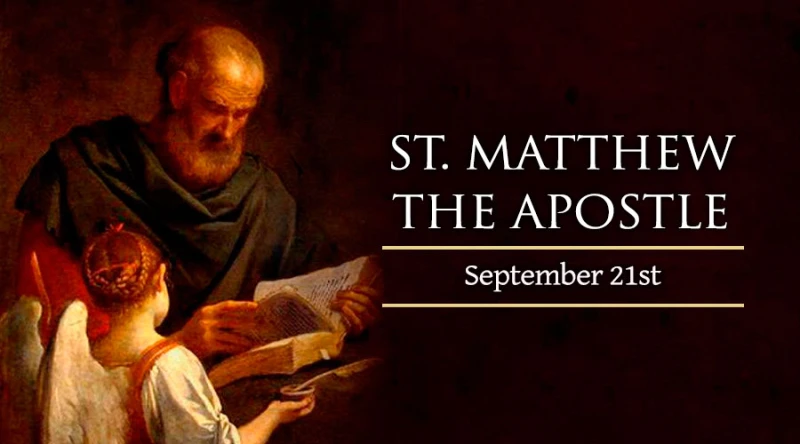
St. Matthew, Apostle


St. Matthew, Apostle

Feast date: Sep 21

Saint Matthew, the first-century tax collector turned apostle who chronicled the life and ministry of Christ in his Gospel, is celebrated by the Church today, September 21. Although relatively little is known about the life of St. Matthew, the account he wrote of Christ’s ministry – traditionally considered to be the first of the four Gospels – is of inestimable value to the Church, particularly in its verification of Jesus as the Messiah.

Eastern Catholics and the Orthodox churches celebrate St. Matthew on November 16, along with St. Fulvianus, a prince who is recorded in some traditions as converting from paganism after Matthew’s martyrdom.

The Gospel accounts of Mark and Luke, like Matthew’s own, describe the encounter between Jesus and Matthew under the surprising circumstances of Matthew’s tax-collecting duties. Jewish publicans, who collected taxes on behalf of the Roman rulers of first-century Judea, were objects of scorn and even hatred among their own communities, since they worked on behalf of the occupying power and often earned their living by collecting more than the state’s due.

Jesus most likely first encountered Matthew near the house of Peter, in Capernaum near the Sea of Galilee. The meeting of the two was dramatic, as Matthew’s third-person account in his Gospel captured: “As Jesus passed on,” the ninth chapter recounts, “he saw a man named Matthew sitting at the customs post. He said to him, ‘Follow me’. And he got up and followed him.”

Matthew’s calling into Jesus’ inner circle was a dramatic gesture of the Messiah’s universal message and mission, causing some religious authorities of the Jewish community to wonder: “Why does your teacher eat with tax collectors and sinners?” Jesus’ significant response indicated a central purpose of his ministry: “I did not come to call the righteous but sinners.”

A witness to Christ’s resurrection after death, as well as his ascension into heaven and the events of Pentecost, Matthew also recorded Jesus’ instruction for the apostles to “go, therefore, and make disciples of all nations, baptizing them in the name of the Father, and of the Son, and of the holy Spirit, teaching them to observe all that I have commanded you.”

Like 11 of the 12 apostles, St. Matthew is traditionally thought to have died as a martyr while preaching the Gospel. The Roman Martyrology describes his death as occurring in a territory near present-day Egypt.

Both the saint himself, and his Gospel narrative, have inspired important works of religious art, ranging from the ornate illuminated pages of the Book of Kells in the ninth century, to the Saint Matthew Passion of J.S. Bach. Three famous paintings of Caravaggio, depicting St. Matthew’s calling, inspiration and martyrdom, hang within the Contarelli Chapel in Rome’s Church of St. Louis of the French.

Reflecting on St. Matthew’s calling, from the pursuit of dishonest financial gain to the heights of holiness and divine inspiration, Pope Benedict said in 2006 that “in the figure of Matthew, the Gospels present to us a true and proper paradox: those who seem to be the farthest from holiness can even become a model of the acceptance of God’s mercy and offer a glimpse of its marvelous effects in their own lives.”

St. Matthew, Apostle Read More »

Memorial of Saints Andrew Kim Tae-gŏn, Priest, and Paul Chŏng Ha-sang, and Companions, Martyrs

Reading 1 PRV 21:1-6, 10-13

Like a stream is the king’s heart in the hand of the LORD;
wherever it pleases him, he directs it.

All the ways of a man may be right in his own eyes,
but it is the LORD who proves hearts.

To do what is right and just
is more acceptable to the LORD than sacrifice.

Haughty eyes and a proud heart–
the tillage of the wicked is sin.

The plans of the diligent are sure of profit,
but all rash haste leads certainly to poverty.

Whoever makes a fortune by a lying tongue
is chasing a bubble over deadly snares.

The soul of the wicked man desires evil;
his neighbor finds no pity in his eyes.

When the arrogant man is punished, the simple are the wiser;
when the wise man is instructed, he gains knowledge.

The just man appraises the house of the wicked:
there is one who brings down the wicked to ruin.

He who shuts his ear to the cry of the poor
will himself also call and not be heard.

Responsorial Psalm PS 119:1, 27, 30, 34, 35, 44

R. (35) Guide me, Lord, in the way of your commands.
Blessed are they whose way is blameless,
who walk in the law of the LORD.
R. Guide me, Lord, in the way of your commands.
Make me understand the way of your precepts,
and I will meditate on your wondrous deeds.
R. Guide me, Lord, in the way of your commands.
The way of truth I have chosen;
I have set your ordinances before me.
R. Guide me, Lord, in the way of your commands.
Give me discernment, that I may observe your law
and keep it with all my heart.
R. Guide me, Lord, in the way of your commands.
Lead me in the path of your commands,
for in it I delight.
R. Guide me, Lord, in the way of your commands.
And I will keep your law continually,
forever and ever.
R. Guide me, Lord, in the way of your commands.


Alleluia LK 11:28

R. Alleluia, alleluia.
Blessed are those who hear the word of God
and observe it.
R. Alleluia, alleluia.

Gospel LK 8:19-21

The mother of Jesus and his brothers came to him
but were unable to join him because of the crowd.
He was told, “Your mother and your brothers are standing outside
and they wish to see you.”
He said to them in reply, “My mother and my brothers 
are those who hear the word of God and act on it.”

– – –

Lectionary for Mass for Use in the Dioceses of the United States, second typical edition, Copyright © 2001, 1998, 1997, 1986, 1970 Confraternity of Christian Doctrine; Psalm refrain © 1968, 1981, 1997, International Committee on English in the Liturgy, Inc. All rights reserved. Neither this work nor any part of it may be reproduced, distributed, performed or displayed in any medium, including electronic or digital, without permission in writing from the copyright owner.

Memorial of Saints Andrew Kim Tae-gŏn, Priest, and Paul Chŏng Ha-sang, and Companions, Martyrs Read More »

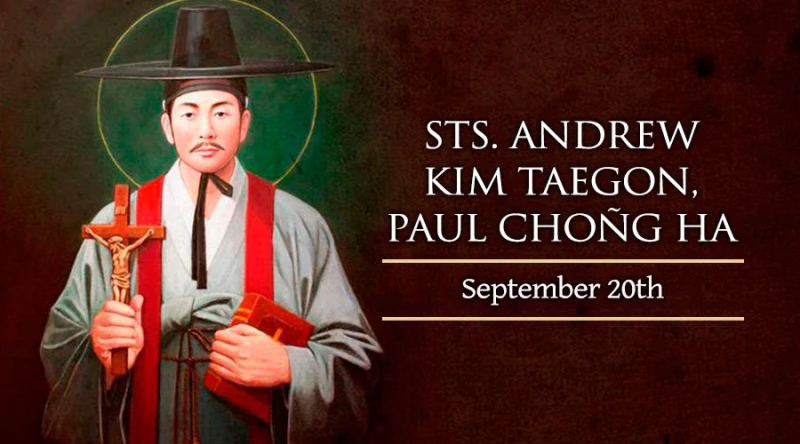
Sts. Andrew Kim Taegon, Paul Choñg Ha


Sts. Andrew Kim Taegon, Paul Choñg Ha

Feast date: Sep 20

Pope John Paul II said this of the Catholic Church in Korea: “The Korean Church is unique because it was founded entirely by laypeople. This fledgling Church, so young and yet so strong in faith, withstood wave after wave of fierce persecution. Thus, in less than a century, it could boast 10,000 martyrs. The years 1791, 1801, 1827, 1839, 1846, and 1866 are forever signed with the holy blood of your martyrs and engraved in your hearts. The death of these many martyrs became the leaven of the Church and led to today’s splendid flowering of the Church in Korea. Even today their undying spirit sustains the Christians of the Church of Silence in the north of this tragically divided land.”

Christianity came to Korea through Christian books which had been brought across the border from China. In 1784 the small community of Koreans who had been converted through what they read in the books sent one of their own to Beijing to receive baptism.

In the next half century, the rapidly growing Christian community of Korea was sustained in the Sacraments by only two priests from China, until 1836, when, after years of pleading, a group of French missionary priests were sent to Korea. These priests all numbered among the martyrs.

At the end of the 18th century and throughout the next, there were six great waves of persecution in which 10,000 martyrs shed their blood for the faith.

Saints Andrew Kim Taegon and Paul Chong Hasañg, were leaders of the Catholic Church in Korea.

Andrew Kim Taegon was born to Korean nobility, and his parents converted when he was 15-years old. He traveled over 1000 miles to study in a seminary and became the first native Korean priest. He was tortured and beheaded in 1846.

Paul Choñg Hasang was a Korean Catholic lay leader who defended the faith before the government of Korea, and reunited the Christians in the midst of the persecutions, encouraging them to stay strong in the faith. In response to his direct appeals, the Pope, Gregory X, confirmed the validity of the Korean Church and sent more priests to Korea. He was martyred in 1839.

Sts. Andrew Kim Taegon, Paul Choñg Ha Read More »

Monday of the Twenty-fifth Week in Ordinary Time

Reading 1 Prv 3:27-34

Refuse no one the good on which he has a claim
when it is in your power to do it for him.
Say not to your neighbor, “Go, and come again,
tomorrow I will give,” when you can give at once.

Plot no evil against your neighbor,
against one who lives at peace with you.
Quarrel not with a man without cause,
with one who has done you no harm.

Envy not the lawless man
and choose none of his ways:
To the LORD the perverse one is an abomination,
but with the upright is his friendship.

The curse of the LORD is on the house of the wicked,
but the dwelling of the just he blesses;
When dealing with the arrogant, he is stern,
but to the humble he shows kindness.

Responsorial Psalm ps 15:2-3a, 3bc-4ab, 5

R. (1) The just one shall live on your holy mountain, O Lord.
He who walks blamelessly and does justice;
who thinks the truth in his heart
and slanders not with his tongue.
R. The just one shall live on your holy mountain, O Lord.
Who harms not his fellow man,
nor takes up a reproach against his neighbor;
By whom the reprobate is despised,
while he honors those who fear the LORD.
R. The just one shall live on your holy mountain, O Lord.
Who lends not his money at usury
and accepts no bribe against the innocent.
He who does these things
shall never be disturbed.
R. The just one shall live on your holy mountain, O Lord.

Alleluia Mt 5:16

R. Alleluia, alleluia.
Let your light shine before others,
that they may see your good deeds and glorify your heavenly Father.
R. Alleluia, alleluia.

Gospel Lk 8:16-18

Jesus said to the crowd:
“No one who lights a lamp conceals it with a vessel
or sets it under a bed;
rather, he places it on a lampstand
so that those who enter may see the light.
For there is nothing hidden that will not become visible,
and nothing secret that will not be known and come to light.
Take care, then, how you hear.
To anyone who has, more will be given,
and from the one who has not,
even what he seems to have will be taken away.”

– – –

Lectionary for Mass for Use in the Dioceses of the United States, second typical edition, Copyright © 2001, 1998, 1997, 1986, 1970 Confraternity of Christian Doctrine; Psalm refrain © 1968, 1981, 1997, International Committee on English in the Liturgy, Inc. All rights reserved. Neither this work nor any part of it may be reproduced, distributed, performed or displayed in any medium, including electronic or digital, without permission in writing from the copyright owner.

Monday of the Twenty-fifth Week in Ordinary Time Read More »