Please mind our dust!

We are currently working on revamping our website!
Thank you for your patience!

CRD Solutions

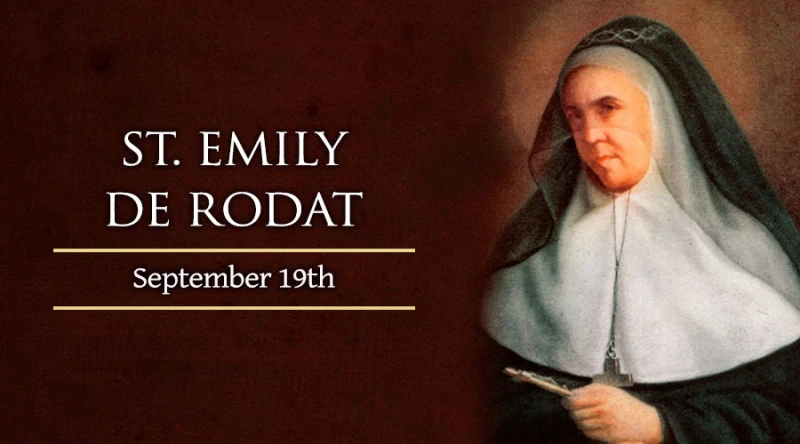
St. Emily de Rodat


St. Emily de Rodat

Feast date: Sep 19

Emily was born in 1787 at Rodez, France.  She was educated at Villefranche, became a teacher at the age of 18 and, realizing that many of the children of the poor were not going to school because they could not afford to, she opened a school for them and taught without charge.


She also began to consider religious life, but after entering three or four congregations for a short time, she realized that she was not called to any of the existing orders.


Emily devoted all of her life to teaching the poor and gathered other young women to help her cope with the rapidly growing numbers of children in her school. These women also gave all their lives to teaching the children and became the nucleus of the Religious Congregation of the Holy Family of Villefranche.


The congregation was devoted to caring for the elderly, prisoners, and orphans, in addition to the schools for the poor. Some of the nuns were also contemplative and spent their time in prayer and adoration.


She died of cancer at Villefranche on September 19, 1852.  At the time of her death Saint Emily de Rodat had opened 38 charitable institutions. 


Saint Emily was canonized in 1950 by Pope Pius XII.

St. Emily de Rodat Read More »

Twenty-fifth Sunday in Ordinary Time

Reading 1 Am 8:4-7

Hear this, you who trample upon the needy
 and destroy the poor of the land!
 “When will the new moon be over,” you ask,
 “that we may sell our grain,
 and the sabbath, that we may display the wheat?
 We will diminish the ephah,
 add to the shekel,
 and fix our scales for cheating!
 We will buy the lowly for silver,
 and the poor for a pair of sandals;
 even the refuse of the wheat we will sell!”
 The LORD has sworn by the pride of Jacob:
 Never will I forget a thing they have done!

Responsorial Psalm Ps 113:1-2, 4-6, 7-8

R. (cf. 1a, 7b) Praise the Lord who lifts up the poor.
or:
R. Alleluia.
Praise, you servants of the LORD,
 praise the name of the LORD.
Blessed be the name of the LORD
 both now and forever.
R. Praise the Lord who lifts up the poor.
or:
R. Alleluia.
High above all nations is the LORD;
 above the heavens is his glory.
Who is like the LORD, our God, who is enthroned on high
 and looks upon the heavens and the earth below?
R. Praise the Lord who lifts up the poor.
or:
R. Alleluia.
He raises up the lowly from the dust;
 from the dunghill he lifts up the poor
to seat them with princes,
 with the princes of his own people.
R. Praise the Lord who lifts up the poor.
or:
R. Alleluia.

Reading 2 1 Tm 2:1-8

Beloved:
First of all, I ask that supplications, prayers,
petitions, and thanksgivings be offered for everyone,
for kings and for all in authority,
that we may lead a quiet and tranquil life
in all devotion and dignity.
This is good and pleasing to God our savior,
who wills everyone to be saved
and to come to knowledge of the truth.
For there is one God.
There is also one mediator between God and men,
     the man Christ Jesus,
who gave himself as ransom for all.
This was the testimony at the proper time.
For this I was appointed preacher and apostle
— I am speaking the truth, I am not lying —,
teacher of the Gentiles in faith and truth.

It is my wish, then, that in every place the men should pray,
lifting up holy hands, without anger or argument.

Alleluia Cf. 2 Cor 8:9

R. Alleluia, alleluia.
Though our Lord Jesus Christ was rich, he became poor,
so that by his poverty you might become rich.
R. Alleluia, alleluia.

Gospel Lk 16:1-13

Jesus said to his disciples,
“A rich man had a steward
who was reported to him for squandering his property.
He summoned him and said,
‘What is this I hear about you?
Prepare a full account of your stewardship,
because you can no longer be my steward.’
The steward said to himself, ‘What shall I do,
now that my master is taking the position of steward away from me?
I am not strong enough to dig and I am ashamed to beg.
I know what I shall do so that,
when I am removed from the stewardship,
they may welcome me into their homes.’
He called in his master’s debtors one by one.
To the first he said,
‘How much do you owe my master?’
He replied, ‘One hundred measures of olive oil.’
He said to him, ‘Here is your promissory note.
Sit down and quickly write one for fifty.’
Then to another the steward said, ‘And you, how much do you owe?’
He replied, ‘One hundred kors of wheat.’
The steward said to him, ‘Here is your promissory note;
write one for eighty.’
And the master commended that dishonest steward for acting prudently.
“For the children of this world
are more prudent in dealing with their own generation
than are the children of light.
I tell you, make friends for yourselves with dishonest wealth,
so that when it fails, you will be welcomed into eternal dwellings.
The person who is trustworthy in very small matters
is also trustworthy in great ones;
and the person who is dishonest in very small matters
is also dishonest in great ones.
If, therefore, you are not trustworthy with dishonest wealth,
who will trust you with true wealth?
If you are not trustworthy with what belongs to another,
who will give you what is yours?
No servant can serve two masters.
He will either hate one and love the other,
or be devoted to one and despise the other.
You cannot serve both God and mammon.”

Or Lk 16:10-13

Jesus said to his disciples:
“The person who is trustworthy in very small matters
is also trustworthy in great ones;
and the person who is dishonest in very small matters
is also dishonest in great ones.
If, therefore, you are not trustworthy with dishonest wealth,
who will trust you with true wealth?
If you are not trustworthy with what belongs to another,
who will give you what is yours?
No servant can serve two masters.
He will either hate one and love the other,
or be devoted to one and despise the other.
You cannot serve both God and mammon.”

– – –

Lectionary for Mass for Use in the Dioceses of the United States, second typical edition, Copyright © 2001, 1998, 1997, 1986, 1970 Confraternity of Christian Doctrine; Psalm refrain © 1968, 1981, 1997, International Committee on English in the Liturgy, Inc. All rights reserved. Neither this work nor any part of it may be reproduced, distributed, performed or displayed in any medium, including electronic or digital, without permission in writing from the copyright owner.

Twenty-fifth Sunday in Ordinary Time Read More »

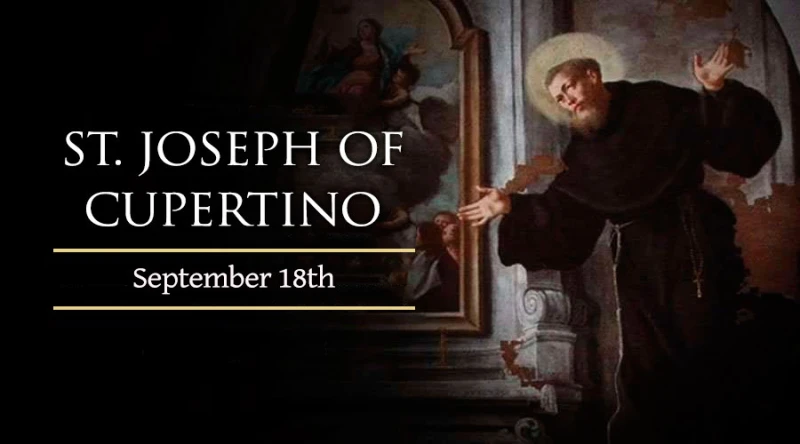
St. Joseph of Cupertino


St. Joseph of Cupertino

Feast date: Sep 18

On September 18, the Church celebrates the life of St. Joseph of Cupertino, a mystic who was perhaps most famous for his ability to fly.  His father, a poor carpenter, died before his birth and his mother, who was unable to pay the debts, lost her home and gave birth to Joseph in a stable at Cupertino, Italy on June 17, 1603.

Joseph began having mystical visions when he was seven, and was often so lost to the world around him that the other children made fun of him giving him the nickname, “open-mouthed” for his gaping manner.

He had an irascible temper and read very poorly, giving others the impression that he was dumb and good for nothing. Aside from that, he was so continually drawn into ecstasy that it was impossible for him to be attentive to the tasks at hand. Thus, when he secured a job, he lost it very quickly.

He finally managed to obtain a post taking care of a stable in a Franciscan convent near Cupertino. Upon realizing his holiness and aptitude for penance, humility, and obedience, it was decided that he could begin studying for the priesthood.

Joseph was a very poor student, however during his final examination, the examiner happened to ask him a question on the one topic he knew well.  He passed and was admitted into the priesthood

It was also soon recognized that though he knew little by way of worldly knowledge and had little capacity to learn, Joseph was infused with a divine knowledge that made him capable of solving some of the most intricate theological quandaries.

For the last 35 years of his life as a priest he was unable to celebrate Mass in public because he would often, without being able to help it, be lifted up into the air when he went into an ecstatic state, which happened at nearly every Mass.  It took only the slightest reference of anything having to do with God in order for this state to be induced in him.

Despite being moved from one friary to another, because of the disruption he caused by his ecstasies and the persecutions he endured from some of his brothers who were envious of his gifts, he remained profoundly inundated by the joy of abandoning himself to Divine Providence.

He died on September 18, 1663 and was canonized in 1767 by Pope Clement XIII.  He is the patron of air travelers and students preparing for exams.

St. Joseph of Cupertino Read More »

Saturday of the Twenty-fourth Week in Ordinary Time

Reading 1 1 COR 15:35-37, 42-49

Brothers and sisters:
Someone may say, “How are the dead raised? 
With what kind of body will they come back?”You fool!
What you sow is not brought to life unless it dies.
And what you sow is not the body that is to be
but a bare kernel of wheat, perhaps, or of some other kind.

So also is the resurrection of the dead.
It is sown corruptible; it is raised incorruptible.
It is sown dishonorable; it is raised glorious.
It is sown weak; it is raised powerful.
It is sown a natural body; it is raised a spiritual body.
If there is a natural body, there is also a spiritual one.

So, too, it is written,
“The first man, Adam, became a living being,”
the last Adam a life-giving spirit.
But the spiritual was not first;
rather the natural and then the spiritual.
The first man was from the earth, earthly;
the second man, from heaven.
As was the earthly one, so also are the earthly,
and as is the heavenly one, so also are the heavenly.
Just as we have borne the image of the earthly one,
we shall also bear the image of the heavenly one.

Responsorial Psalm PS 56:10C-12, 13-14

R. (14) I will walk in the presence of God, in the light of the living.
Now I know that God is with me.
In God, in whose promise I glory,
in God I trust without fear;
what can flesh do against me?
R. I will walk in the presence of God, in the light of the living.
I am bound, O God, by vows to you;
your thank offerings I will fulfill.
For you have rescued me from death,
my feet, too, from stumbling;
that I may walk before God in the light of the living.
R. I will walk in the presence of God, in the light of the living.


Alleluia LK 8:15

R. Alleluia, alleluia.
Blessed are they who have kept the word with a generous heart
and yield a harvest through perseverance.
R. Alleluia, alleluia.

Gospel LK 8:4-15

When a large crowd gathered, with people from one town after another
journeying to Jesus, he spoke in a parable. 
“A sower went out to sow his seed.
And as he sowed, some seed fell on the path and was trampled,
and the birds of the sky ate it up.
Some seed fell on rocky ground, and when it grew,
it withered for lack of moisture.
Some seed fell among thorns,
and the thorns grew with it and choked it.
And some seed fell on good soil, and when it grew,
it produced fruit a hundredfold.”
After saying this, he called out,
“Whoever has ears to hear ought to hear.”

Then his disciples asked him
what the meaning of this parable might be.
He answered,
“Knowledge of the mysteries of the Kingdom of God
has been granted to you;
but to the rest, they are made known through parables
so that they may look but not see, and hear but not understand.

“This is the meaning of the parable. 
The seed is the word of God.
Those on the path are the ones who have heard,
but the Devil comes and takes away the word from their hearts
that they may not believe and be saved.
Those on rocky ground are the ones who, when they hear,
receive the word with joy, but they have no root;
they believe only for a time and fall away in time of temptation.
As for the seed that fell among thorns,
they are the ones who have heard, but as they go along,
they are choked by the anxieties and riches and pleasures of life, 
and they fail to produce mature fruit.
But as for the seed that fell on rich soil,
they are the ones who, when they have heard the word,
embrace it with a generous and good heart,
and bear fruit through perseverance.”
 

– – –

Lectionary for Mass for Use in the Dioceses of the United States, second typical edition, Copyright © 2001, 1998, 1997, 1986, 1970 Confraternity of Christian Doctrine; Psalm refrain © 1968, 1981, 1997, International Committee on English in the Liturgy, Inc. All rights reserved. Neither this work nor any part of it may be reproduced, distributed, performed or displayed in any medium, including electronic or digital, without permission in writing from the copyright owner.
Saturday of the Twenty-fourth Week in Ordinary Time Read More »

St. Robert Bellarmine


St. Robert Bellarmine

Feast date: Sep 17

On Sept. 17, the Catholic Church celebrates the Italian cardinal and theologian St. Robert Bellarmine. One of the great saints of the Jesuit order, St. Robert has also been declared a Doctor of the Church and the patron of catechists.

Robert Bellarmine was born on October 4, 1542 in the Tuscan town of Montepulciano. His uncle was a cardinal who later became Pope Marcellus II. As a young man, Robert received his education from the Jesuit order, which had received written papal approval only two years before his birth.

In September of 1560, Robert entered the Jesuit order himself. He studied philosophy for three years in Rome, then taught humanities until 1567, when he began a study of theology that lasted until 1569. The final stage of his training emphasized the refutation of Protestant errors.

Robert received ordination to the priesthood in Belgium, where his sermons drew crowds of both Catholics and Protestants. In 1576, he returned to Italy and took up an academic position addressing theological controversies. The resulting work, his “Disputations,” became a classic of Catholic apologetics.

Near the end of the 1580s, the esteemed theologian became “Spiritual Father” to the Roman College. He served as a guide to St. Aloysius Gonzaga near the end of the young Jesuit’s life, and helped produce the authoritative Latin text of the Bible called for by the recent Council of Trent.

Around the century’s end Robert became an advisor to Pope Clement VIII. The Pope named him a cardinal in 1599, declaring him to be the most educated man in the Church. Robert played a part in a debate between Dominicans and Jesuits regarding grace, though the Pope later decided to appoint and consecrate him as the Archbishop of Capua.

The cardinal archbishop’s three years in Capua stood out as an example of fidelity to the reforming spirit and decrees of the Council of Trent. He was considered as a possible Pope in two successive elections, but the thought of becoming Pope disturbed him and in the end he was never chosen.

In the early years of the 17th century, the cardinal took a public stand for the Church’s freedom when it came under attack in Venice and England. He also attempted, though not successfully, to negotiate peace between the Vatican and his personal friend Galileo Galilei, over the scientist’s insistence that not only the earth, but the entire universe, revolved around the sun.

Cardinal Bellarmine retired due to health problems in the summer of 1621. Two years before, he had set out his thoughts on the end of earthly life in a book titled “The Art of Dying Well.” In that work, the cardinal explained that preparing for death was life’s most important business, since the state of one’s soul at death would determine the person’s eternal destiny.

St. Robert Bellarmine died on September 17, 1621. Pope Pius XI canonized him in 1931, and declared him to be a Doctor of the Church.

St. Robert Bellarmine Read More »