Please mind our dust!

We are currently working on revamping our website!
Thank you for your patience!

CRD Solutions

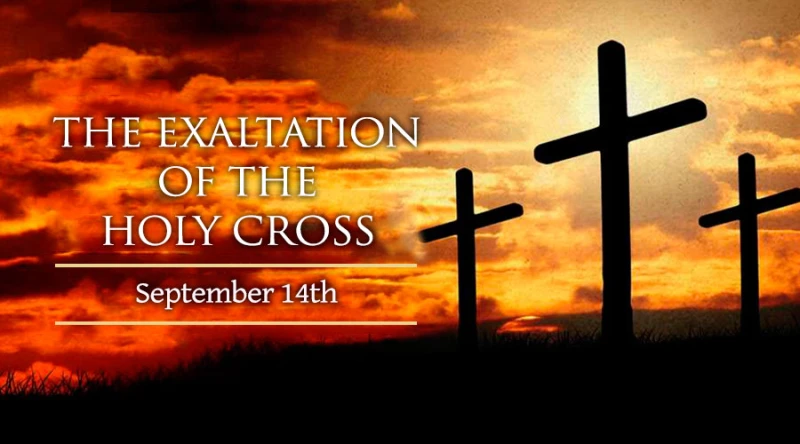
The Exaltation of the Holy Cross


The Exaltation of the Holy Cross

Feast date: Sep 14

The feast of the Exaltation of the Holy Cross celebrates two historical events: the discovery of the True Cross by Saint Helena, the mother of the Emperor Constantine, in 320 under the temple of Venus in Jerusalem, and the dedication in 335 of the basilica and shrine built on Calvary by Constantine, which mark the site of the Crucifixion.


The basilica, named the Martyrium, and the shrine, named the Calvarium, were destroyed by the Persians in 614. The Church of the Holy sepulcher which now stands on the site was built by the crusaders in 1149.


However the feast, more than anything else, is a celebration and commemoration of God’s greatest work: his salvific death on the Cross and His Resurrection, through which death was defeated and the doors to Heaven opened.


The entrance antiphon for the Feast of the Exaltation of the Holy Cross is: “We should glory in the cross of our Lord Jesus Christ, for he is our salvation, our life and our resurrection: through him we are saved and made free.”

The Exaltation of the Holy Cross Read More »

Memorial of Saint John Chrysostom, Bishop and Doctor of the Church

Reading 1 1 Cor 12:12-14, 27-31a

Brothers and sisters:
As a body is one though it has many parts,
and all the parts of the body, though many, are one body,
so also Christ.
For in one Spirit we were all baptized into one Body,
whether Jews or Greeks, slaves or free persons,
and we were all given to drink of one Spirit.

Now the body is not a single part, but many.

Now you are Christ’s Body, and individually parts of it.
Some people God has designated in the Church
to be, first, Apostles; second, prophets; third, teachers;
then, mighty deeds;
then gifts of healing, assistance, administration,
and varieties of tongues.
Are all Apostles? Are all prophets? Are all teachers?
Do all work mighty deeds? Do all have gifts of healing?
Do all speak in tongues? Do all interpret?
Strive eagerly for the greatest spiritual gifts.

Responsorial Psalm Ps 100:1b-2, 3, 4, 5

R. (3) We are his people: the sheep of his flock.
Sing joyfully to the LORD, all you lands;
serve the LORD with gladness;
come before him with joyful song.
R. We are his people: the sheep of his flock.
Know that the LORD is God;
he made us, his we are;
his people, the flock he tends.
R. We are his people: the sheep of his flock.
Enter his gates with thanksgiving,
his courts with praise;
Give thanks to him; bless his name.
R. We are his people: the sheep of his flock.
For he is good, the LORD,
whose kindness endures forever,
and his faithfulness, to all generations.
R. We are his people: the sheep of his flock.

Alleluia Lk 7:16

R. Alleluia, alleluia.
A great prophet has arisen in our midst
and God has visited his people.
R. Alleluia, alleluia.

Gospel Lk 7:11-17

Jesus journeyed to a city called Nain,
and his disciples and a large crowd accompanied him.
As he drew near to the gate of the city,
a man who had died was being carried out,
the only son of his mother, and she was a widow.
A large crowd from the city was with her.
When the Lord saw her,
he was moved with pity for her and said to her,
“Do not weep.”
He stepped forward and touched the coffin;
at this the bearers halted,
and he said, “Young man, I tell you, arise!”
The dead man sat up and began to speak,
and Jesus gave him to his mother.
Fear seized them all, and they glorified God, exclaiming,
“A great prophet has arisen in our midst,”
and “God has visited his people.”
This report about him spread through the whole of Judea
and in all the surrounding region.

– – –

Lectionary for Mass for Use in the Dioceses of the United States, second typical edition, Copyright © 2001, 1998, 1997, 1986, 1970 Confraternity of Christian Doctrine; Psalm refrain © 1968, 1981, 1997, International Committee on English in the Liturgy, Inc. All rights reserved. Neither this work nor any part of it may be reproduced, distributed, performed or displayed in any medium, including electronic or digital, without permission in writing from the copyright owner.

Memorial of Saint John Chrysostom, Bishop and Doctor of the Church Read More »

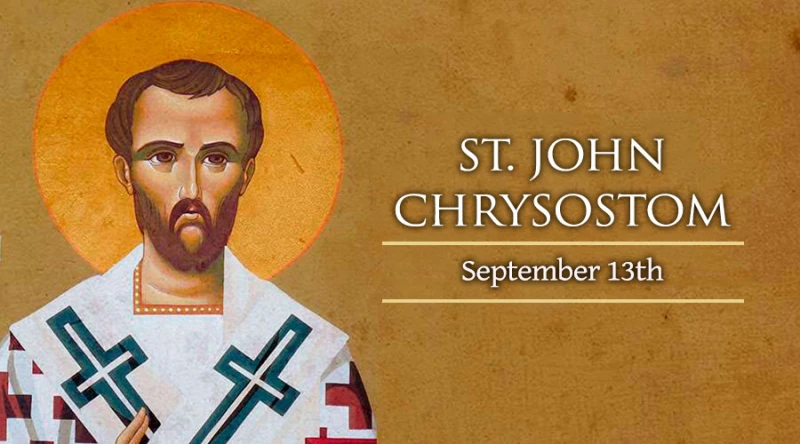
St. John Chrysostom


St. John Chrysostom

Feast date: Sep 13

“If the Lord should give you power to raise the dead, He would give much less than He does when he bestows suffering. By miracles you would make yourself debtor to Him, while by suffering He may become debtor to you. And even if sufferings had no other reward than being able to bear something for that God who loves you, is not this a great reward and a sufficient remuneration? Whoever loves, understands what I say.”
-St. John Chrysostom

Born in Antioch, c. 347, Saint John Chrysostom (Golden-mouthed) was perhaps the greatest preacher in the history of the Church, thus the name given him, and the most prominent Greek father of the Church.

He grew up in Antioch, received an excellent classical Greek education, and upon meeting the holy bishop Meletus, he decided to devote his time to the study of religious works and the Sacred Scriptures. He received Baptism after three years of study and set out for the desert to live the ascetic life of a hermit.

His extreme mortifications left him in fragile health, and he thus returned to Antioch after two years of recovery, and devoted himself to studying for the priesthood. He was ordained in 386 and served in the Cathedral of Antioch for 12 years, winning widespread fame for his sublime preaching.

In 398 he was forcefully appointed Patriarch of Constantinople, and fast became very popular with his flock through his example of preaching and courage in front of the imperial power, whose corruption and decadence he never shirked from criticizing in public.

This attitude naturally made an enemy of the empress, Eudoxia as well as Theophilus, bishop of Alexandria, who had him condemned on false charges in 403. He was exiled to Armenia where he continued to be a great presence in the Church of the East through his many letters. He was exiled from Armenia to an isolated place along the Black Sea. He died during the journey in 407 in Pontus, his ill health unable to endure its rigors.

In 438 the Emperor Theodosius II of Constantinople had John’s body returned to Constantinople, and did penance for the sins of his mother Eudoxia.

Chrysostom’s many writings, especially homilies and commentaries on the Gospels, are still extant and have exerted great influence over the centuries.

“When you are before the altar where Christ reposes, you ought no longer to think that you are amongst men; but believe that there are troops of angels and archangels standing by you, and trembling with respect before the sovereign Master of Heaven and earth. Therefore, when you are in church, be there in silence, fear, and veneration.”
St. John Chrysostom

St. John Chrysostom Read More »

Monday of the Twenty-fourth Week in Ordinary Time

Reading 1 1 Cor 11:17-26, 33

Brothers and sisters:
In giving this instruction, I do not praise the fact
that your meetings are doing more harm than good.
First of all, I hear that when you meet as a Church
there are divisions among you,
and to a degree I believe it;
there have to be factions among you
in order that also those who are approved among you
may become known.
When you meet in one place, then,
it is not to eat the Lord’s supper,
for in eating, each one goes ahead with his own supper,
and one goes hungry while another gets drunk.
Do you not have houses in which you can eat and drink?
Or do you show contempt for the Church of God
and make those who have nothing feel ashamed?
What can I say to you? Shall I praise you?
In this matter I do not praise you.

For I received from the Lord what I also handed on to you,
that the Lord Jesus, on the night he was handed over,
took bread and, after he had given thanks,
broke it and said, “This is my Body that is for you.
Do this in remembrance of me.”
In the same way also the cup, after supper, saying,
“This cup is the new covenant in my Blood.
Do this, as often as you drink it, in remembrance of me.”
For as often as you eat this bread and drink the cup,
you proclaim the death of the Lord until he comes.

Therefore, my brothers and sisters,
when you come together to eat, wait for one another.

Responsorial Psalm Ps 40:7-8a, 8b-9, 10, 17

R. (1 Cor 11:26b) Proclaim the death of the Lord until he comes again.
Sacrifice or oblation you wished not,
but ears open to obedience you gave me.
Burnt offerings or sin offerings you sought not;
then said I, “Behold I come.”
R. Proclaim the death of the Lord until he comes again.
“In the written scroll it is prescribed for me,
To do your will, O my God, is my delight,
and your law is within my heart!”
R. Proclaim the death of the Lord until he comes again.
I announced your justice in the vast assembly;
I did not restrain my lips, as you, O LORD, know.
R. Proclaim the death of the Lord until he comes again.
May all who seek you
exult and be glad in you
And may those who love your salvation
say ever, “The LORD be glorified.”
R. Proclaim the death of the Lord until he comes again.

Alleluia Jn 3:16

R. Alleluia, alleluia.
God so loved the world that he gave his only-begotten Son,
so that everyone who believes in him might have eternal life.
R. Alleluia, alleluia.

Gospel Lk 7:1-10

When Jesus had finished all his words to the people,
he entered Capernaum.
A centurion there had a slave who was ill and about to die,
and he was valuable to him.
When he heard about Jesus, he sent elders of the Jews to him,
asking him to come and save the life of his slave.
They approached Jesus and strongly urged him to come, saying,
“He deserves to have you do this for him,
for he loves our nation and he built the synagogue for us.”
And Jesus went with them,
but when he was only a short distance from the house,
the centurion sent friends to tell him,
“Lord, do not trouble yourself,
for I am not worthy to have you enter under my roof.
Therefore, I did not consider myself worthy to come to you;
but say the word and let my servant be healed.
For I too am a person subject to authority,
with soldiers subject to me.
And I say to one, ‘Go,’ and he goes;
and to another, ‘Come here,’ and he comes;
and to my slave, ‘Do this,’ and he does it.”
When Jesus heard this he was amazed at him
and, turning, said to the crowd following him,
“I tell you, not even in Israel have I found such faith.”
When the messengers returned to the house,
they found the slave in good health.

– – –

Lectionary for Mass for Use in the Dioceses of the United States, second typical edition, Copyright © 2001, 1998, 1997, 1986, 1970 Confraternity of Christian Doctrine; Psalm refrain © 1968, 1981, 1997, International Committee on English in the Liturgy, Inc. All rights reserved. Neither this work nor any part of it may be reproduced, distributed, performed or displayed in any medium, including electronic or digital, without permission in writing from the copyright owner.
Monday of the Twenty-fourth Week in Ordinary Time Read More »

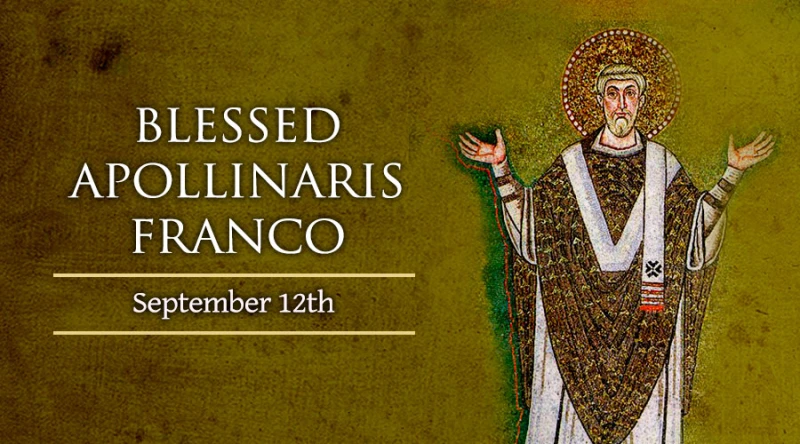
Blessed Apollinaris Franco


Blessed Apollinaris Franco

Feast date: Sep 12

Blessed Apollinaris was born in Old Castile, Spain where he joined the Franciscan order.  He was sent to Japan to head the Japanese Franciscan mission in 1614, the year that the new Japanese shogun had instituted a nationwide ban on Christianity and declared being a Christian a capital offense.

Friar Apollinaris Franco evangelized covertly until he was arrested in 1617 and thrown into prison in Nagasaki along with other priests and laymen, for five years to await his execution. The conditions in the prison were exceedingly harsh in an attempt to force the prisoners to reject the faith.

Apollinaris ministered to the other prisoners and converted some of the jailers through his example and teaching. On September 12, 1622, he was burned at the stake along with other Franciscans and Jesuits.

Blessed Apollinaris Franco Read More »