Please mind our dust!

We are currently working on revamping our website!
Thank you for your patience!

CRD Solutions

Twenty-fourth Sunday in Ordinary Time

Reading 1 Ex 32:7-11, 13-14

The LORD said to Moses,
“Go down at once to your people,
whom you brought out of the land of Egypt,
for they have become depraved.
They have soon turned aside from the way I pointed out to them,
making for themselves a molten calf and worshiping it,
sacrificing to it and crying out,
‘This is your God, O Israel,
who brought you out of the land of Egypt!’
“I see how stiff-necked this people is, ” continued the LORD to Moses.
Let me alone, then,
that my wrath may blaze up against them to consume them.
Then I will make of you a great nation.”

But Moses implored the LORD, his God, saying,
“Why, O LORD, should your wrath blaze up against your own people,
whom you brought out of the land of Egypt
with such great power and with so strong a hand?
Remember your servants Abraham, Isaac, and Israel,
and how you swore to them by your own self, saying,
‘I will make your descendants as numerous as the stars in the sky;
and all this land that I promised,
I will give your descendants as their perpetual heritage.'”
So the LORD relented in the punishment
he had threatened to inflict on his people.

Responsorial Psalm Ps 51:3-4, 12-13, 17, 19

R. (Lk 15:18)  I will rise and go to my father.
Have mercy on me, O God, in your goodness;
in the greatness of your compassion wipe out my offense.
Thoroughly wash me from my guilt
and of my sin cleanse me.
R. I will rise and go to my father.
A clean heart create for me, O God,
and a steadfast spirit renew within me.
Cast me not out from your presence,
and your Holy Spirit take not from me.
R. I will rise and go to my father.
O Lord, open my lips,
and my mouth shall proclaim your praise.
My sacrifice, O God, is a contrite spirit;
a heart contrite and humbled, O God, you will not spurn.
R. I will rise and go to my father.

Reading 2 1 Tm 1:12-17

Beloved:
I am grateful to him who has strengthened me, Christ Jesus our Lord,
because he considered me trustworthy
in appointing me to the ministry.
I was once a blasphemer and a persecutor and arrogant,
but I have been mercifully treated
because I acted out of ignorance in my unbelief.
Indeed, the grace of our Lord has been abundant,
along with the faith and love that are in Christ Jesus.
This saying is trustworthy and deserves full acceptance:
Christ Jesus came into the world to save sinners.
Of these I am the foremost.
But for that reason I was mercifully treated,
so that in me, as the foremost,
Christ Jesus might display all his patience as an example
for those who would come to believe in him for everlasting life.
To the king of ages, incorruptible, invisible, the only God,
honor and glory forever and ever.  Amen.

Alleluia 2 Cor 5:19

R. Alleluia, alleluia.
God was reconciling the world to himself in Christ
and entrusting to us the message of reconciliation.
R. Alleluia, alleluia.

Gospel Lk 15:1-32

Tax collectors and sinners were all drawing near to listen to Jesus,
but the Pharisees and scribes began to complain, saying,
“This man welcomes sinners and eats with them.”
So to them he addressed this parable.
“What man among you having a hundred sheep and losing one of them
would not leave the ninety-nine in the desert
and go after the lost one until he finds it?
And when he does find it,
he sets it on his shoulders with great joy
and, upon his arrival home,
he calls together his friends and neighbors and says to them,
‘Rejoice with me because I have found my lost sheep.’
I tell you, in just the same way
there will be more joy in heaven over one sinner who repents
than over ninety-nine righteous people
who have no need of repentance.

“Or what woman having ten coins and losing one
would not light a lamp and sweep the house,
searching carefully until she finds it?
And when she does find it,
she calls together her friends and neighbors
and says to them,
‘Rejoice with me because I have found the coin that I lost.’
In just the same way, I tell you,
there will be rejoicing among the angels of God
over one sinner who repents.”

Then he said,
“A man had two sons, and the younger son said to his father,
‘Father give me the share of your estate that should come to me.’
So the father divided the property between them.
After a few days, the younger son collected all his belongings
and set off to a distant country
where he squandered his inheritance on a life of dissipation.
When he had freely spent everything,
a severe famine struck that country,
and he found himself in dire need.
So he hired himself out to one of the local citizens
who sent him to his farm to tend the swine.
And he longed to eat his fill of the pods on which the swine fed,
but nobody gave him any.
Coming to his senses he thought,
‘How many of my father’s hired workers
have more than enough food to eat,
but here am I, dying from hunger.
I shall get up and go to my father and I shall say to him,
“Father, I have sinned against heaven and against you.
I no longer deserve to be called your son;
treat me as you would treat one of your hired workers.”’
So he got up and went back to his father.
While he was still a long way off,
his father caught sight of him,
and was filled with compassion.
He ran to his son, embraced him and kissed him.
His son said to him,
‘Father, I have sinned against heaven and against you;
I no longer deserve to be called your son.’
But his father ordered his servants,
‘Quickly bring the finest robe and put it on him;
put a ring on his finger and sandals on his feet.
Take the fattened calf and slaughter it.
Then let us celebrate with a feast,
because this son of mine was dead, and has come to life again;
he was lost, and has been found.’
Then the celebration began.
Now the older son had been out in the field
and, on his way back, as he neared the house,
he heard the sound of music and dancing.
He called one of the servants and asked what this might mean.
The servant said to him,
‘Your brother has returned
and your father has slaughtered the fattened calf
because he has him back safe and sound.’
He became angry,
and when he refused to enter the house,
his father came out and pleaded with him.
He said to his father in reply,
‘Look, all these years I served you
and not once did I disobey your orders;
yet you never gave me even a young goat to feast on with my friends. But when your son returns,
who swallowed up your property with prostitutes,
for him you slaughter the fattened calf.’
He said to him,
‘My son, you are here with me always;
everything I have is yours.
But now we must celebrate and rejoice,
because your brother was dead and has come to life again;
he was lost and has been found.’”

Or Lk 15:1-10

Tax collectors and sinners were all drawing near to listen to Jesus,
but the Pharisees and scribes began to complain, saying,
“This man welcomes sinners and eats with them.”
So to them he addressed this parable.
“What man among you having a hundred sheep and losing one of them
would not leave the ninety-nine in the desert
and go after the lost one until he finds it?
And when he does find it,
he sets it on his shoulders with great joy
and, upon his arrival home,
he calls together his friends and neighbors and says to them,
‘Rejoice with me because I have found my lost sheep.’
I tell you, in just the same way
there will be more joy in heaven over one sinner who repents
than over ninety-nine righteous people
who have no need of repentance.

“Or what woman having ten coins and losing one
would not light a lamp and sweep the house,
searching carefully until she finds it?
And when she does find it,
she calls together her friends and neighbors
and says to them,
‘Rejoice with me because I have found the coin that I lost.’
In just the same way, I tell you,
there will be rejoicing among the angels of God
over one sinner who repents.”

– – –

Lectionary for Mass for Use in the Dioceses of the United States, second typical edition, Copyright © 2001, 1998, 1997, 1986, 1970 Confraternity of Christian Doctrine; Psalm refrain © 1968, 1981, 1997, International Committee on English in the Liturgy, Inc. All rights reserved. Neither this work nor any part of it may be reproduced, distributed, performed or displayed in any medium, including electronic or digital, without permission in writing from the copyright owner.

Twenty-fourth Sunday in Ordinary Time Read More »
St. Paphnutius

Feast date: Sep 11

On Sept. 11, the Catholic Church honors Saint Paphnutius, an Egyptian monk who became a bishop, endured torture for the faith, and participated at the Ecumenical Council of Nicea in its confirmation of Christ’s divinity.

While there is no record of Paphnutius’ early life, it is known that he – like many other men of his day – became a disciple of the monk Saint Anthony of the Desert, whose direction of a community of fellow hermits marked the beginning of traditional Christian monasticism.

Having spent several years pursuing spiritual illumination in the austerity of the desert under Anthony’s direction, Paphnutius was eventually chosen to become a bishop for the Upper Thebaid region.

This placed him in direct conflict with Maximinus Daia, the Roman imperial ruler of Egypt and Syria from 305 to 313, who persecuted the Church in these regions and attempted to undermine it by strengthening the institutions of paganism.

Under Maximinus Daia’s rule, Paphnutius had his left leg partly mutilated and his right eye put out, in an unsuccessful effort to make him renounce the Catholic faith. Not yielding before torture, he was condemned to manual labor in the mines.

Imperial policy toward Christians shifted between 311 and 313, in the midst of a power struggle between the various co-emperors of the time. The Emperor Constantine began to embrace the faith in 312, and he proclaimed its legality the following year, during which Maximinus Daia also died.

Since he survived the ordeal of persecution, Paphnutius was regarded with reverence by the first Christian leader of the Roman Empire. Constantine is said to have met frequently with the bishop from the Upper Thebaid, showing his respect by kissing the wound left by the loss of his eye.

The Egyptian bishop is also reputed to have played a role at the First Ecumenical Council, which condemned Arianism and promulgated the Nicene Creed. While celibate himself, Paphnutius successfully resisted an effort by some council participants to change the Eastern Churches’ traditions regarding married members of the clergy.

During the years of doctrinal confusion that followed the Council of Nicea, Paphnutius stood in defense of Christian orthodoxy alongside Saint Athanasius of Alexandria and other Church leaders who upheld the doctrine of Jesus’ eternal preexistence as God.

In 335 Paphnutius joined a large group of Egyptian bishops in attending the regional Council of Tyre, where they found the majority of bishops adhering to the Arian heresy.

Paphnutius was especially distressed to see his fellow bishop Maximus of Jerusalem mingling with the Arian clergy, since Maximus, like himself, had once suffered torture rather than compromise his faith. The Egyptian bishop took his fellow confessor aside, and personally persuaded him to back St. Athanasius in the struggle against Arianism.

The year of St. Paphnutius’ death, like that of his birth, is unknown. He should not be confused with another prominent Egyptian monk of the same name (who appears in the “Conferences” of Saint John Cassian), nor is he the same Paphnutius whose martyrdom the Eastern churches commemorate on April 19.

St. Paphnutius Read More »

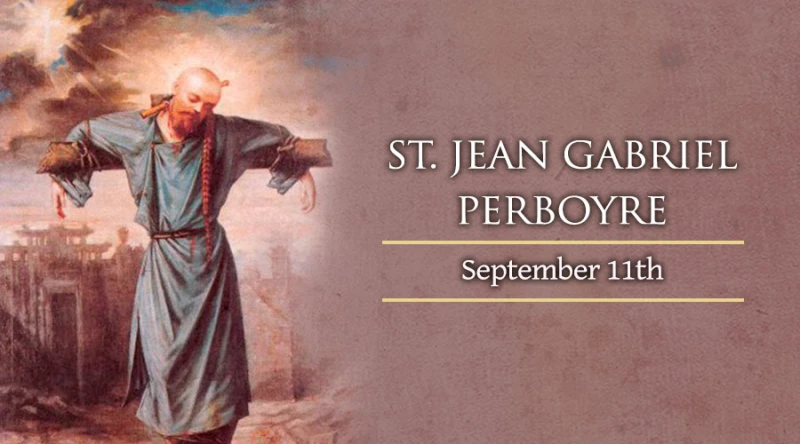
Saint Jean Gabriel Perboyre


Saint Jean Gabriel Perboyre

Feast date: Sep 11

St. Jean Gabriel was born in Puech, France, on January 6th, 1802, to a pious family of eight children. Including Jean Gabriel, five of the Perboyer children became consecrated religious – three priests and two nuns. Accompanying his younger brother Louis while he was entering the seminary, Jean-Gabriel discovered his calling and entered the Congregation of the Mission, founded by St. Vincent de Paul, at the age of 16.

He was ordained at age 23 and taught theology at the seminary before being appointed rector, and later master of novices in Paris – on account of the sanctity his superiors saw in him.

His younger brother, Louis, died on his way to preach in China at the age of 24 and Jean-Gabriel asked to carry out the mission that had been entrusted to his brother. He arrived on the island of Macao on August 29, 1835 and set out for the mainland later that year.

He carried out his evangelical labors in Ho-Nan for three years before being transferred to Hou-Pé. His missions bore much fruit in the short time he spent there.

On September 11, 1839 Jean-Gabriel became one of the first victims of the persecutions against Christians, dying in a manner which had a striking resemblance to the passion of our Lord. He was betrayed for a sum of silver, stripped of his garments and dragged from tribunal to tribunal, beaten and tortured continuously until he was sentenced to death with seven criminals. He was crucified and died on a cross.

Canonized on June 2, 1996 by Pope John Paul II, St. Jean Gabriel Perboyre is the first saint of China.

Before his death St. Jean Gabriel wrote this prayer:

“O my Divine Savior,
Transform me into Yourself.
Grant that I may live but in You, by You, and for You,
So that I may truly say, with Saint Paul,

“‘I live – now not I – But Christ lives in me.'”

Saint Jean Gabriel Perboyre Read More »

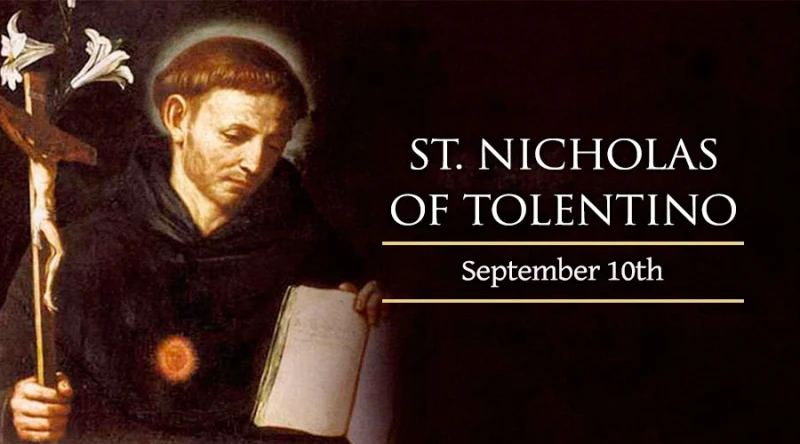
St. Nicholas of Tolentino


St. Nicholas of Tolentino

Feast date: Sep 10

Born in 1246 in Sant’ Angelo, Italy, Nicholas became an Augustinian friar at the age of 18 after hearing an Augustinian hermit preach. He was ordained seven years later and quickly gained a reputation as a great preacher and confessor.

He practiced severe mortifications and fasted strictly. He was known for obtaining healings for many of the sick who lived in Tolentino, where he spent the last 30 years of his life.

St. Nicholas’ bread, a roll of dough with a cross in the center, has its origin in the bread he used to give to the sick to eat after he had prayed for the Virgin Mary’s healing intercession.

St. Nicholas died September 10, 1306 and was canonized by Pope Eugene IV in 1446.

St. Nicholas of Tolentino Read More »

Saturday of the Twenty-Third Week in Ordinary Time

Reading 1 1 Cor 10:14-22

My beloved ones, avoid idolatry.
I am speaking as to sensible people;
judge for yourselves what I am saying.
The cup of blessing that we bless,
is it not a participation in the Blood of Christ?
The bread that we break,
is it not a participation in the Body of Christ?
Because the loaf of bread is one,
we, though many, are one Body,
for we all partake of the one loaf.

Look at Israel according to the flesh;
are not those who eat the sacrifices participants in the altar?
So what am I saying?
That meat sacrificed to idols is anything?
Or that an idol is anything?
No, I mean that what they sacrifice,
they sacrifice to demons, not to God,
and I do not want you to become participants with demons.
You cannot drink the cup of the Lord and also the cup of demons.
You cannot partake of the table of the Lord and of the table of demons.
Or are we provoking the Lord to jealous anger?
Are we stronger than him?

Responsorial Psalm Ps 116:12-13, 17-18

R.        (17) To you, Lord, I will offer a sacrifice of praise.

How shall I make a return to the LORD
for all the good he has done for me?
The cup of salvation I will take up,
and I will call upon the name of the LORD.

R.        To you, Lord, I will offer a sacrifice of praise.

To you will I offer sacrifice of thanksgiving,
and I will call upon the name of the LORD.
My vows to the LORD I will pay
in the presence of all his people.

R.        To you, Lord, I will offer a sacrifice of praise.

Alleluia JN 14:23

R. Alleluia, alleluia.

Whoever loves me will keep my word,
and my Father will love him,
and we will come to him.

R. Alleluia, alleluia.

Gospel LK 6:43-49

Jesus said to his disciples:
“A good tree does not bear rotten fruit,
nor does a rotten tree bear good fruit.
For every tree is known by its own fruit.
For people do not pick figs from thornbushes,
nor do they gather grapes from brambles.
A good person out of the store of goodness in his heart produces good,
but an evil person out of a store of evil produces evil;
for from the fullness of the heart the mouth speaks.

“Why do you call me, ‘Lord, Lord,’ but not do what I command?
I will show you what someone is like who comes to me,
listens to my words, and acts on them.
That one is like a man building a house,
who dug deeply and laid the foundation on rock;
when the flood came, the river burst against that house
but could not shake it because it had been well built.
But the one who listens and does not act
is like a person who built a house on the ground
without a foundation.
When the river burst against it,
it collapsed at once and was completely destroyed.”

– – –

Lectionary for Mass for Use in the Dioceses of the United States, second typical edition, Copyright © 2001, 1998, 1997, 1986, 1970 Confraternity of Christian Doctrine; Psalm refrain © 1968, 1981, 1997, International Committee on English in the Liturgy, Inc. All rights reserved. Neither this work nor any part of it may be reproduced, distributed, performed or displayed in any medium, including electronic or digital, without permission in writing from the copyright owner.

Saturday of the Twenty-Third Week in Ordinary Time Read More »