Please mind our dust!

We are currently working on revamping our website!
Thank you for your patience!

CRD Solutions

Memorial of Saint Peter Claver, Priest

Reading 1 1 COR 9:16-19, 22B-27

Brothers and sisters:
If I preach the Gospel, this is no reason for me to boast,
for an obligation has been imposed on me,
and woe to me if I do not preach it!
If I do so willingly, I have a recompense,
but if unwillingly, then I have been entrusted with a stewardship.
What then is my recompense?
That, when I preach, I offer the Gospel free of charge
so as not to make full use of my right in the Gospel.

Although I am free in regard to all,
I have made myself a slave to all
so as to win over as many as possible.
I have become all things to all, to save at least some.
All this I do for the sake of the Gospel,
so that I too may have a share in it.

Do you not know that the runners in the stadium all run in the race,
but only one wins the prize?
Run so as to win.
Every athlete exercises discipline in every way.
They do it to win a perishable crown,
but we an imperishable one.
Thus I do not run aimlessly;
I do not fight as if I were shadowboxing.
No, I drive my body and train it,
for fear that, after having preached to others,
I myself should be disqualified.

Responsorial Psalm PS 84:3, 4, 5-6, 12

R. (2) How lovely is your dwelling place, Lord, mighty God!
My soul yearns and pines 
for the courts of the LORD.
My heart and my flesh
cry out for the living God.
R. How lovely is your dwelling place, Lord, mighty God!
Even the sparrow finds a home,
and the swallow a nest
in which she puts her young—
Your altars, O LORD of hosts,
my king and my God!
R. How lovely is your dwelling place, Lord, mighty God!
Blessed they who dwell in your house!
continually they praise you.
Blessed the men whose strength you are!
their hearts are set upon the pilgrimage.
R. How lovely is your dwelling place, Lord, mighty God!
For a sun and a shield is the LORD God;
grace and glory he bestows;
The LORD withholds no good thing
from those who walk in sincerity. 
R. How lovely is your dwelling place, Lord, mighty God!


Alleluia JN 17:17B, 17A

R. Alleluia, alleluia.
Your word, O Lord, is truth;
consecrate us in the truth.
R. Alleluia, alleluia.

Gospel LK 6:39-42

Jesus told his disciples a parable:
“Can a blind person guide a blind person?
Will not both fall into a pit?
No disciple is superior to the teacher;
but when fully trained,
every disciple will be like his teacher.
Why do you notice the splinter in your brother’s eye,
but do not perceive the wooden beam in your own?
How can you say to your brother,
‘Brother, let me remove that splinter in your eye,’
when you do not even notice the wooden beam in your own eye?
You hypocrite!  Remove the wooden beam from your eye first;
then you will see clearly
to remove the splinter in your brother’s eye.”

– – –

Lectionary for Mass for Use in the Dioceses of the United States, second typical edition, Copyright © 2001, 1998, 1997, 1986, 1970 Confraternity of Christian Doctrine; Psalm refrain © 1968, 1981, 1997, International Committee on English in the Liturgy, Inc. All rights reserved. Neither this work nor any part of it may be reproduced, distributed, performed or displayed in any medium, including electronic or digital, without permission in writing from the copyright owner.

Memorial of Saint Peter Claver, Priest Read More »
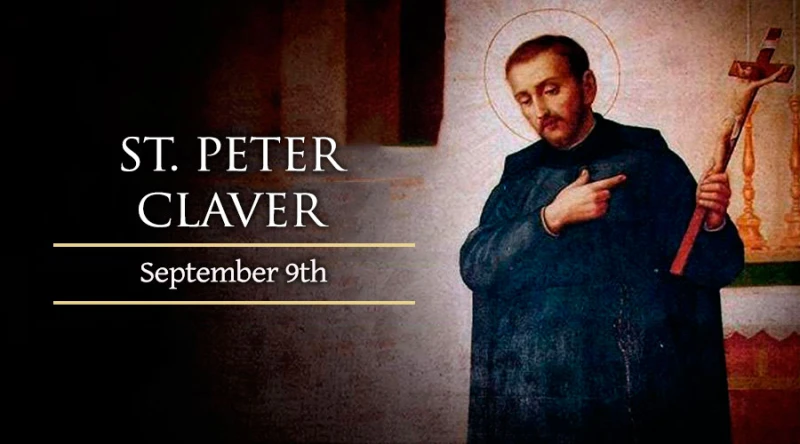
St. Peter Claver


St. Peter Claver

Feast date: Sep 09

On Sept. 9, the Catholic Church celebrates St. Peter Claver, a Jesuit missionary who spent his life in the service of African slaves brought against their will to South America during the 17th century.

Peter Claver was born into a farming family in the Spanish region of Catalonia during 1581. He studied at the University of Barcelona as a young man, and joined the Jesuits as a novice at the age of 20.

While studying philosophy in Tarragona, Peter developed a friendship with an older Jesuit lay brother, Alphonsus Rodriguez. Although Alphonsus spent his days doing menial work as a door-keeper, he had immense insight into spiritual matters and encouraged Peter to become a missionary in the Spanish colonies. Pope Leo XIII would later canonize both men on the same day, almost two centuries later.

In 1610, Peter Claver – now a priest – arrived in Cartagena, a port city in present-day Colombia. Despite Pope Paul III’s repeated condemnations of slavery during the previous century, European colonists continued importing African slaves, often sold by their own rulers, to work on plantations and in mines. Those who survived the ship journey could expect to be worked to death by their masters.

Peter was determined to sacrifice his own freedom to bring material aid and eternal salvation to the African slaves, in keeping with his vow to become “the slave of the blacks forever.” The young priest made and kept this resolution despite his own health problems (aggravated by Cartagena’s tropical climate) and the language barrier between himself and the population he served.

Many Spanish Royal officials in Cartagena appreciated Claver’s work, and made contributions toward the slaves’ relief and religious education. The slave traders, on the other hand, found the priest and his interpreters to be a nuisance. Meanwhile, some Spanish expatriates who sought out the priest because of his holy reputation, refused to enter the same church or confessional as the black slaves.

In order to minister to speakers of a foreign language, Claver often employed pictorial representations of Catholic truths. He also communicated by means of generosity and expressions of love, giving food and drink to the ailing workers and visiting them during bouts of sickness that often proved fatal.

“We must speak to them with our hands,” he reasoned, “before we try to speak to them with our lips.”

In keeping with his vow of “slavery,” Peter survived on minimal amounts of food and sleep. His life of humility and penance led to miraculous occurrences – as when he healed the sick with the touch of his cloak, or appeared surrounded by a supernatural light during his hospital visits.

St. Peter Claver’s work came to an end with his death on September 8, 1654. He had baptized and taught the faith to more than 300,000 slaves during his four decades in Cartagena.

During the Vatican’s Synod for Africa in 2009, Cartagena’s Archbishop Jorge Enrique Jiménez Carvajal lamented the fact that his city had been the center of an “awful commerce.”

But he spoke with gratitude for the fact that the same city had become the home of such a “great witness to sanctity,” the “apostle of the slaves, whose body rests in our cathedral, who lived to protect them and lead them towards the faith” in which they could experience God’s love.

St. Peter Claver Read More »

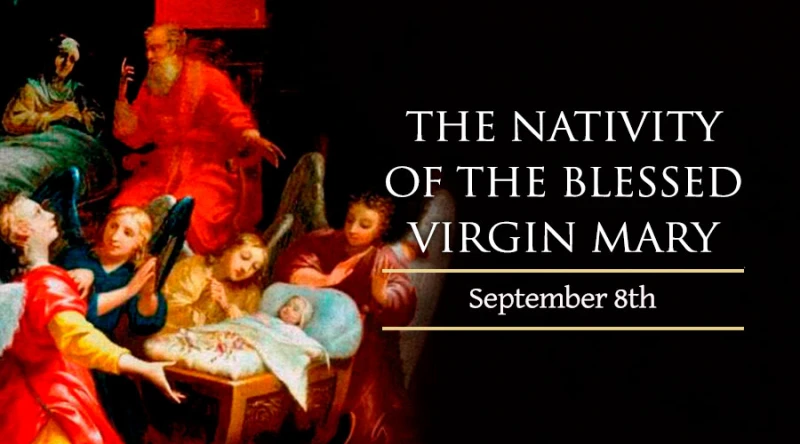
The Nativity of the Blessed Virgin Mary


The Nativity of the Blessed Virgin Mary

Feast date: Sep 08

The Catholic Church celebrates today the birth of the Blessed Virgin Mary on its traditional fixed date of September 8, nine months after the December 8 celebration of her Immaculate Conception as the child of Saints Joachim and Anne.

The circumstances of the Virgin Mary’s infancy and early life are not directly recorded in the Bible, but other documents and traditions describing the circumstances of her birth are cited by some of the earliest Christian writers from the first centuries of the Church.

These accounts, although not considered authoritative in the same manner as the Bible, outline some of the Church’s traditional beliefs about the birth of Mary.

The “Protoevangelium of James,” which was probably put into its final written form in the early second century, describes Mary’s father Joachim as a wealthy member of one of the Twelve Tribes of Israel. Joachim was deeply grieved, along with his wife Anne, by their childlessness. “He called to mind Abraham,” the early Christian writing says, “that in the last day God gave him a son Isaac.”

Joachim and Anne began to devote themselves extensively and rigorously to prayer and fasting, initially wondering whether their inability to conceive a child might signify God’s displeasure with them.

As it turned out, however, the couple were to be blessed even more abundantly than Abraham and Sarah, as an angel revealed to Anne when he appeared to her and prophesied that all generations would honor their future child: “The Lord has heard your prayer, and you shall conceive, and shall bring forth, and your seed shall be spoken of in all the world.”

After Mary’s birth, according to the Protoevangelium of James, Anne “made a sanctuary” in the infant girl’s room, and “allowed nothing common or unclean” on account of the special holiness of the child. The same writing records that when she was one year old, her father “made a great feast, and invited the priests, and the scribes, and the elders, and all the people of Israel.”

“And Joachim brought the child to the priests,” the account continues, “and they blessed her, saying: ‘O God of our fathers, bless this child, and give her an everlasting name to be named in all generations’ . . . And he brought her to the chief priests, and they blessed her, saying: ‘O God most high, look upon this child, and bless her with the utmost blessing, which shall be for ever.’”

The protoevangelium goes on to describe how Mary’s parents, along with the temple priests, subsequently decided that she would be offered to God as a consecrated Virgin for the rest of her life, and enter a chaste marriage with the carpenter Joseph.

Saint Augustine described the birth of the Blessed Virgin Mary as an event of cosmic and historic significance, and an appropriate prelude to the birth of Jesus Christ. “She is the flower of the field from whom bloomed the precious lily of the valley,” he said.

The fourth-century bishop, whose theology profoundly shaped the Western Church’s understanding of sin and human nature, affirmed that “through her birth, the nature inherited from our first parents is changed.”

The Nativity of the Blessed Virgin Mary Read More »

Feast of the Nativity of the Blessed Virgin Mary

Reading I Mi 5:1-4a

The LORD says:
    You, Bethlehem-Ephrathah,
        too small to be among the clans of Judah,
    From you shall come forth for me
        one who is to be ruler in Israel;
    Whose origin is from of old,
        from ancient times.
    (Therefore the Lord will give them up, until the time
        when she who is to give birth has borne,
    And the rest of his brethren shall return
        to the children of Israel.)
    He shall stand firm and shepherd his flock
        by the strength of the LORD,
        in the majestic name of the LORD, his God;
    And they shall remain, for now his greatness
        shall reach to the ends of the earth;
        he shall be peace.

OR:

Rom 8:28-30

Brothers and sisters:
We know that all things work for good for those who love God,
who are called according to his purpose. 
For those he foreknew he also predestined
to be conformed to the image of his Son,
so that he might be the firstborn
among many brothers.
And those he predestined he also called;
and those he called he also justified;
and those he justified he also glorified.

Responsorial Psalm 13:6ab, 6c

R.    (Isaiah 61:10)  With delight I rejoice in the Lord.
Though I trusted in your mercy,
    let my heart rejoice in your salvation.
R.    With delight I rejoice in the Lord.
Let me sing of the LORD, “He has been good to me.”
R.    With delight I rejoice in the Lord.

Alleluia

R. Alleluia, alleluia.
Blessed are you, holy Virgin Mary, deserving of all praise;
from you rose the sun of Justice, Christ our God.
R. Alleluia, alleluia.

Gospel Mt 1:1-16, 18-23 or 1:18-23

The Book of the genealogy of Jesus Christ,
the son of David, the son of Abraham.

Abraham became the father of Isaac,
Isaac the father of Jacob,
Jacob the father of Judah and his brothers.
Judah became the father of Perez and Zerah,
whose mother was Tamar.
Perez became the father of Hezron,
Hezron the father of Ram,
Ram the father of Amminadab.
Amminadab became the father of Nahshon,
Nahshon the father of Salmon,
Salmon the father of Boaz,
whose mother was Rahab.
Boaz became the father of Obed,
whose mother was Ruth.
Obed became the father of Jesse,
Jesse the father of David the king.

David became the father of Solomon,
whose mother had been the wife of Uriah.
Solomon became the father of Rehoboam,
Rehoboam the father of Abijah,
Abijah the father of Asaph.
Asaph became the father of Jehoshaphat,
Jehoshaphat the father of Joram,
Joram the father of Uzziah.
Uzziah became the father of Jotham,
Jotham the father of Ahaz,
Ahaz the father of Hezekiah.
Hezekiah became the father of Manasseh,
Manasseh the father of Amos,
Amos the father of Josiah.
Josiah became the father of Jechoniah and his brothers
at the time of the Babylonian exile.

After the Babylonian exile,
Jechoniah became the father of Shealtiel,
Shealtiel the father of Zerubbabel,
Zerubbabel the father of Abiud.
Abiud became the father of Eliakim,
Eliakim the father of Azor,
Azor the father of Zadok.
Zadok became the father of Achim,
Achim the father of Eliud,
Eliud the father of Eleazar.
Eleazar became the father of Matthan,
Matthan the father of Jacob,
Jacob the father of Joseph, the husband of Mary.
Of her was born Jesus who is called the Christ.

Now this is how the birth of Jesus Christ came about. 
When his mother Mary was betrothed to Joseph,
but before they lived together,
she was found with child through the Holy Spirit.
Joseph her husband, since he was a righteous man,
yet unwilling to expose her to shame,
decided to divorce her quietly.
Such was his intention when, behold,
the angel of the Lord appeared to him in a dream and said,
“Joseph, son of David,
do not be afraid to take Mary your wife into your home.
For it is through the Holy Spirit
that this child has been conceived in her.
She will bear a son and you are to name him Jesus,
because he will save his people from their sins.”
All this took place to fulfill
what the Lord had said through the prophet:

    Behold, the virgin shall be with child and bear a son,
        and they shall name him Emmanuel,

which means “God is with us.” 

OR:

This is how the birth of Jesus Christ came about.
When his mother Mary was betrothed to Joseph,
but before they lived together,
she was found with child through the Holy Spirit.
Joseph her husband, since he was a righteous man,
yet unwilling to expose her to shame,
decided to divorce her quietly.
Such was his intention when, behold,
the angel of the Lord appeared to him in a dream and said,
“Joseph, son of David,
do not be afraid to take Mary your wife into your home.
For it is through the Holy Spirit
that this child has been conceived in her.
She will bear a son and you are to name him Jesus,
because he will save his people from their sins.”
All this took place to fulfill
what the Lord had said through the prophet:

    Behold, the virgin shall be with child and bear a son,
        and they shall name him Emmanuel,

which means “God is with us.”

– – –

Lectionary for Mass for Use in the Dioceses of the United States, second typical edition, Copyright © 2001, 1998, 1997, 1986, 1970 Confraternity of Christian Doctrine; Psalm refrain © 1968, 1981, 1997, International Committee on English in the Liturgy, Inc. All rights reserved. Neither this work nor any part of it may be reproduced, distributed, performed or displayed in any medium, including electronic or digital, without permission in writing from the copyright owner.

Feast of the Nativity of the Blessed Virgin Mary Read More »

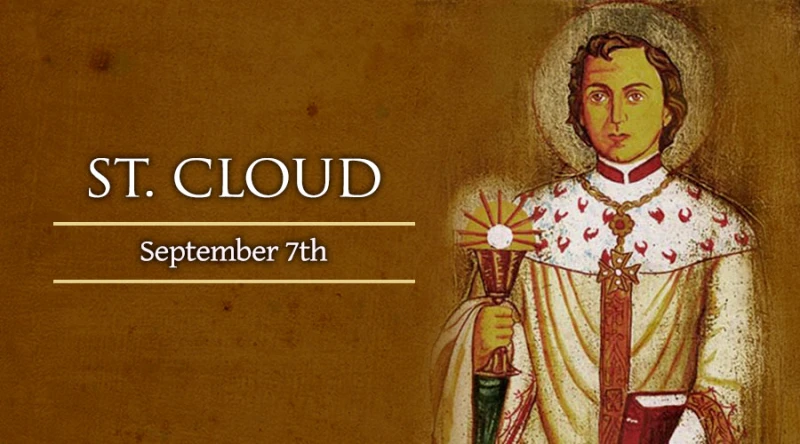
St. Cloud


St. Cloud

Feast date: Sep 07

On Sept. 7, the Catholic Church honors the memory of Saint Clodoald, popularly known as Saint Cloud, who escaped from violent political intrigue to pursue holiness as a monk and priest.

Born in 522, Clodoald was the grandson of the Frankish King Clovis I, whose conversion to orthodox Christianity – rather than the Arian heresy – made him the first Catholic ruler of present-day France.

After Clodoald’s father Clodomir was killed in 524, he and his brothers Theudovald and Gunthar were raised by their grandmother Queen Clothilde, whom the Church now honors as St. Clothilde.

Clovis’ kingdom had been divided equally among his four sons following his death in 511. In an effort to secure Clodomir’s share of the territory after his death, two of Clodoald’s uncles plotted to kill the three boys who were under the protection of the queen. While the uncles managed to kill Gunthar and Theudovald, Clodoald fled and was taken in by the archbishop Saint Remigius of Rheims,

Forced into seclusion by the plot against him, the young man became determined to renounce the power and wealth that had brought grief to his family. Placing himself in God’s service, Clodoald lived in a small monastic cell where he pursued a life of asceticism and contemplative prayer. He gave his inheritance to the poor, and eventually became a disciple of the hermit St. Severinus near Paris.

No longer pursued by his uncles, Clodoald appeared before the bishop of Paris in 542. He formally received the monastic habit from the bishop, who cut off the long hair that had signified his Frankish royal origins. Clodoald eventually left Paris to live as a hermit in the forest for several years, growing closer to God in his contemplative vocation and studying Sacred Scripture extensively.

During these years, pilgrims began making their way to the hermitage, seeking his prayers which were known to work miracles. Though he had left Paris to live in anonymity and solitude, the hermit now sensed a need to return to the city, where he was ordained a priest in 551. His two murderous uncles are said to have repented of their deeds during the time of his ministry.

In 554 Clodoald returned to the monastic life, founding and leading a community of monks in the village of Nogent near Paris. There, he was known for his generosity toward the poor, and his attention to the work of religious instruction among the people. He died on Sept. 7, 560, at the age of 38.

Under the name of “St. Cloud,” Clodoald became the namesake of several cities and towns. These include the Parisian suburb of Saint-Cloud, and later St. Cloud, Minnesota, whose Catholic diocese has been placed under his patronage.

St. Cloud Read More »