Please mind our dust!

We are currently working on revamping our website!
Thank you for your patience!

CRD Solutions

St. Teresa of Kolkata
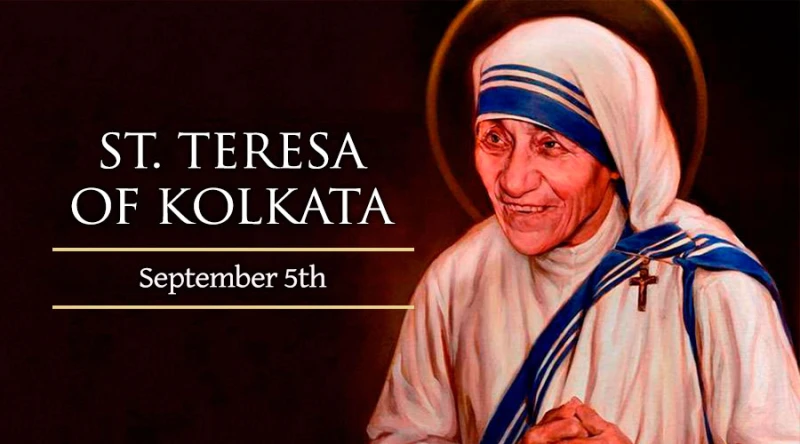

St. Teresa of Kolkata

Feast date: Sep 05

The Church celebrates on Septermber 5 the feast of Mother Teresa, a universal symbol of God’s merciful and preferential love for the poor and forgotten.

Mother Teresa was born Agnes Gonxha Bojaxhiu on August 26, 1910, in Skopje, Macedonia, the youngest of three children. She attended a youth group called Sodality, run by a Jesuit priest at her parish, and her involvement opened her to the call of service as a missionary nun.

She joined the Sisters of Loretto at age 17 and was sent to Calcutta where she taught at a high school. She contracted Tuberculosis and was sent to rest in Darjeeling. It was on the train to Darjeeling that she received her calling – what she called “an order” from God to leave the convent and work and live among the poor.  At this point she did not know that she was to found an order of nuns, or even exactly where she was to serve. “I knew where I belonged, but I did not know how to get there,” she said once, recalling the moment on the train.

Confirmation of the calling came when the Vatican granted her permission to leave the Sisters of Loretto and fulfill her calling under the Archbshop of Calcutta. She started working in the slums, teaching poor children, and treating the sick in their homes. She was joined a year later by some of her former students and together they took in men, women, and children who were dying in the gutters along the streets and cared for them.

In 1950 the Missionaries of Charity were born as a congregation of the Diocese of Calcutta and in 1952 the government granted them a house from which to continue their service among Calcutta’s forgotten.

The congregation very quickly grew from a single house for the dying and unwanted to nearly 500 around the world.  Mother Teresa set up homes for AIDS sufferers, for prostitutes, for battered women, and orphanages for poor children.

She often said that the poorest of the poor were those who had no one to care for them and no one who knew them. And she often remarked with sadness and desolation of milliions of souls in the developed world whose spiritual poverty and loneliness was such an immense cause of suffering.

She was a fierce defender of the unborn saying: “If you hear of some woman who does not want to keep her child and wants to have an abortion, try to persuade her to bring him to me. I will love that child, seeing in him the sign of God’s love.”

Mother Teresa died on September 5, 1997 and was beatified only six years later, on October 19, 2003.

Mother Teresa once said, “A sacrifice to be real must cost, must hurt, must empty ourselves. The fruit of silence is prayer, the fruit of prayer is faith, the fruit of faith is love, the fruit of love is service, the fruit of service is peace.” She also said, “give yourself fully to God. He will use you to accomplish great things on the condition that you believe much more in His love than in your own weakness.” 

St. Teresa of Kolkata Read More »
Twenty-third Sunday in Ordinary Time

Reading 1 Wis 9:13-18b

 Who can know God’s counsel,
 or who can conceive what the LORD intends?
 For the deliberations of mortals are timid,
 and unsure are our plans.
 For the corruptible body burdens the soul
 and the earthen shelter weighs down the mind that has many concerns.
 And scarce do we guess the things on earth,
 and what is within our grasp we find with difficulty;
 but when things are in heaven, who can search them out?
 Or who ever knew your counsel, except you had given wisdom
 and sent your holy spirit from on high?
 And thus were the paths of those on earth made straight.

Responsorial Psalm Ps 90:3-4, 5-6, 12-13, 14 and 17

R. (1) In every age, O Lord, you have been our refuge.
You turn man back to dust,
saying, “Return, O children of men.”
For a thousand years in your sight
 are as yesterday, now that it is past,
or as a watch of the night.
R. In every age, O Lord, you have been our refuge.
You make an end of them in their sleep;
 the next morning they are like the changing grass,
Which at dawn springs up anew,
 but by evening wilts and fades.
R. In every age, O Lord, you have been our refuge.
Teach us to number our days aright,
 that we may gain wisdom of heart.
Return, O LORD! How long?
Have pity on your servants!
R. In every age, O Lord, you have been our refuge.
Fill us at daybreak with your kindness,
 that we may shout for joy and gladness all our days.
And may the gracious care of the LORD our God be ours;
 prosper the work of our hands for us!
Prosper the work of our hands!
R. In every age, O Lord, you have been our refuge.

Reading 2 Phmn 9-10, 12-17

I, Paul, an old man,
and now also a prisoner for Christ Jesus,
urge you on behalf of my child Onesimus,
whose father I have become in my imprisonment;
I am sending him, that is, my own heart, back to you.
I should have liked to retain him for myself,
so that he might serve me on your behalf
in my imprisonment for the gospel,
but I did not want to do anything without your consent,
so that the good you do might not be forced but voluntary.
Perhaps this is why he was away from you for a while,
that you might have him back forever,
no longer as a slave
but more than a slave, a brother,
beloved especially to me, but even more so to you,
as a man and in the Lord.
So if you regard me as a partner, welcome him as you would me.

Alleluia Ps 119:135

R. Alleluia, alleluia.
Let your face shine upon your servant;
and teach me your laws.
R. Alleluia, alleluia.

Gospel Lk 14:25-33

Great crowds were traveling with Jesus,
and he turned and addressed them,
“If anyone comes to me without hating his father and mother,
wife and children, brothers and sisters,
and even his own life,
he cannot be my disciple.
Whoever does not carry his own cross and come after me
cannot be my disciple.
Which of you wishing to construct a tower
does not first sit down and calculate the cost
to see if there is enough for its completion?
Otherwise, after laying the foundation
and finding himself unable to finish the work
the onlookers should laugh at him and say,
‘This one began to build but did not have the resources to finish.’
Or what king marching into battle would not first sit down
and decide whether with ten thousand troops
he can successfully oppose another king
advancing upon him with twenty thousand troops?
But if not, while he is still far away,
he will send a delegation to ask for peace terms.
In the same way,
anyone of you who does not renounce all his possessions
cannot be my disciple.”

– – –

Lectionary for Mass for Use in the Dioceses of the United States, second typical edition, Copyright © 2001, 1998, 1997, 1986, 1970 Confraternity of Christian Doctrine; Psalm refrain © 1968, 1981, 1997, International Committee on English in the Liturgy, Inc. All rights reserved. Neither this work nor any part of it may be reproduced, distributed, performed or displayed in any medium, including electronic or digital, without permission in writing from the copyright owner.

Twenty-third Sunday in Ordinary Time Read More »

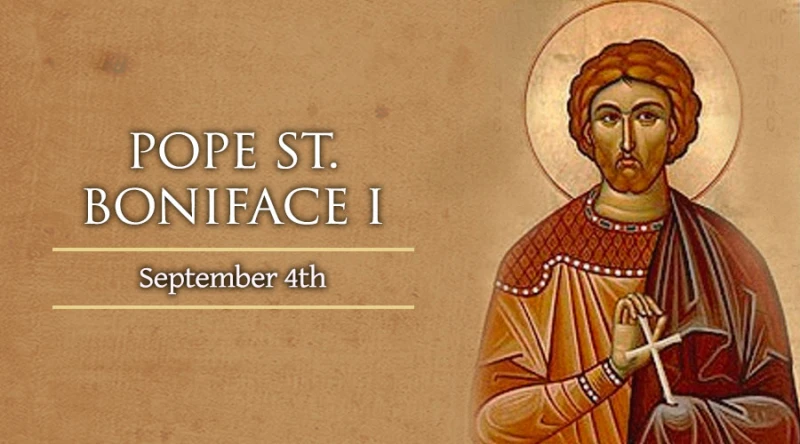
Saint Boniface I, Pope


Saint Boniface I, Pope

Feast date: Sep 04

Though few details are known of Boniface’s early life, he was elected Pope on December 28, 418. He is believed to have been ordained a priest by Pope Damasus I (366-384) and to have served as representative of Innocent I at Constantinople (c. 405).

Boniface was highly esteemed for his charitable and learned personality, which were clearly seen and lived through the service of his priestly duties.

At the death of Pope Zosimus in 418, two Popes were elected, Boniface and Eulalius. They were sent away from Rome by the emperor until the difficulty would be cleared. Eulalius failed to respect the Emperor’s decree and thus Boniface was recognized as the legitimate Pope.

Boniface’s reign was marked by great zeal and activity in disciplinary organization and control. He worked to reform certain corrupt practices and reduced the privileges granted to certain bishops.

He ardently supported St. Augustine in his fight against Pelagianism, and Augustine devoted several works to him.


Pope Saint Boniface died in Rome, September 4, 422.

Saint Boniface I, Pope Read More »

Memorial of Saint Gregory the Great, Pope and Doctor of the Church

Reading 1 1 COR 4:6b-15

Brothers and sisters:
Learn from myself and Apollos not to go beyond what is written,
so that none of you will be inflated with pride
in favor of one person over against another.
Who confers distinction upon you?
What do you possess that you have not received?
But if you have received it,
why are you boasting as if you did not receive it?
You are already satisfied; you have already grown rich;
you have become kings without us!
Indeed, I wish that you had become kings,
so that we also might become kings with you.

For as I see it, God has exhibited us Apostles as the last of all,
like people sentenced to death,
since we have become a spectacle to the world,
to angels and men alike.
We are fools on Christ’s account, but you are wise in Christ;
we are weak, but you are strong;
you are held in honor, but we in disrepute.
To this very hour we go hungry and thirsty,
we are poorly clad and roughly treated,
we wander about homeless and we toil, working with our own hands.
When ridiculed, we bless; when persecuted, we endure;
when slandered, we respond gently.
We have become like the world’s rubbish, the scum of all,
to this very moment.

I am writing you this not to shame you,
but to admonish you as my beloved children.
Even if you should have countless guides to Christ,
yet you do not have many fathers,
for I became your father in Christ Jesus through the Gospel.

Responsorial Psalm PS 145:17-18, 19-20, 21

R. (18) The Lord is near to all who call upon him.
The LORD is just in all his ways
and holy in all his works.
The LORD is near to all who call upon him,
to all who call upon him in truth.
R. The Lord is near to all who call upon him.
He fulfills the desire of those who fear him,
he hears their cry and saves them.
The LORD keeps all who love him,
but all the wicked he will destroy.
R. The Lord is near to all who call upon him.
May my mouth speak the praise of the LORD,
and may all flesh bless his holy name forever and ever.
R. The Lord is near to all who call upon him.


Alleluia JOHN 14:6

R. Alleluia, alleluia.
I am the way and the truth and the life, says the Lord;
no one comes to the Father except through me.
R. Alleluia, alleluia.

Gospel LK 6:1-5

While Jesus was going through a field of grain on a sabbath,
his disciples were picking the heads of grain,
rubbing them in their hands, and eating them.
Some Pharisees said,
“Why are you doing what is unlawful on the sabbath?”
Jesus said to them in reply,
“Have you not read what David did
when he and those who were with him were hungry?
How he went into the house of God, took the bread of offering,
which only the priests could lawfully eat,
ate of it, and shared it with his companions?”
Then he said to them, “The Son of Man is lord of the sabbath.”

– – –

Lectionary for Mass for Use in the Dioceses of the United States, second typical edition, Copyright © 2001, 1998, 1997, 1986, 1970 Confraternity of Christian Doctrine; Psalm refrain © 1968, 1981, 1997, International Committee on English in the Liturgy, Inc. All rights reserved. Neither this work nor any part of it may be reproduced, distributed, performed or displayed in any medium, including electronic or digital, without permission in writing from the copyright owner.

Memorial of Saint Gregory the Great, Pope and Doctor of the Church Read More »

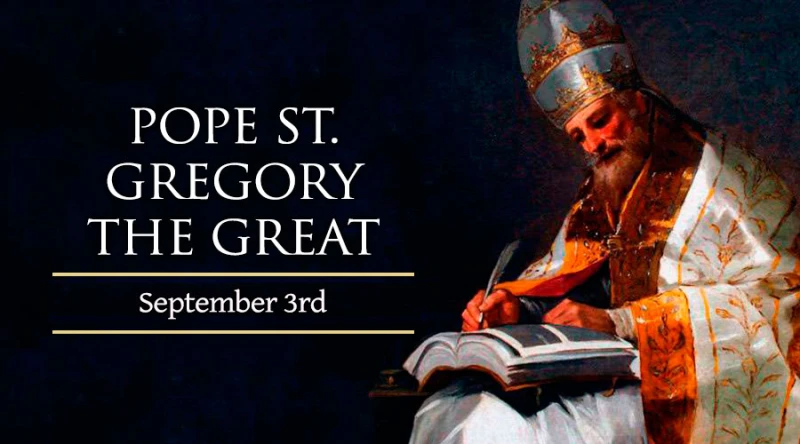
Saint Gregory the Great


Saint Gregory the Great

Feast date: Sep 03

St. Gregory the Great, a central figure of the medieval western Church and one of the most admired Popes in history, is commemorated in the Ordinary Form of the Roman Catholic liturgy today, September 3.

Born near the middle of the sixth century into a noble Roman family, Gregory received a classical education in liberal arts and the law. He also had strong religious formation from his devout family, particularly from his mother, Silvia, also a canonized saint. By around age 30, Gregory had
advanced to high political office in Rome, during what was nevertheless a period of marked decline for the city.

Some time after becoming the prefect of the former imperial capital, Gregory chose to leave the civil administration to become a monk during the rise of the Benedictine order. In reality, however, the new monk’s great career in public life was yet to come.

After three years of strict monastic life, he was called personally by the Pope to assume the office of a deacon in Rome. From Rome, he was dispatched to Constantinople, to seek aid from the emperor for Rome’s civic troubles, and to aid in resolving the Eastern church’s theological controversies. He returned to Rome in 586, after six years of service as the Papal representative to the eastern Church and empire.

Rome faced a series of disasters caused by flooding in 589, followed by the death of Pope Pelagius II the next year. Gregory, then serving as abbot in a monastery, reluctantly accepted his election to replace him as the Bishop of Rome.

Despite this initial reluctance, however, Pope Gregory began working tirelessly to reform and solidify the Roman liturgy, the disciplines of the Church, the military and economic security of Rome, and the Church’s spreading influence in western Europe.

As Pope, Gregory brought his political experience at Rome and Constantinople to bear, in the task of preventing the Catholic Church from becoming subservient to any of the various groups struggling for control of the former imperial capital. As the former abbot of a monastery, he strongly supported the Benedictine movement as a bedrock of the western Church. He sent missionaries to England, and is given much of the credit for the nation’s conversion.

In undertaking these works, Pope Gregory saw himself as the “servant of the servants of God.” He was the first of the Bishops of Rome to popularize the now-traditional Papal title, which referred to Christ’s command that those in the highest position of leadership should be “the last of all and the servant of all.”

Even as he undertook to consolidate Papal power and shore up the crumbling Roman west, St. Gregory the Great maintained a humble sense of his mission as a servant and pastor of souls, from the time of his election until his death in 604.

Saint Gregory the Great Read More »