Please mind our dust!

We are currently working on revamping our website!
Thank you for your patience!

CRD Solutions

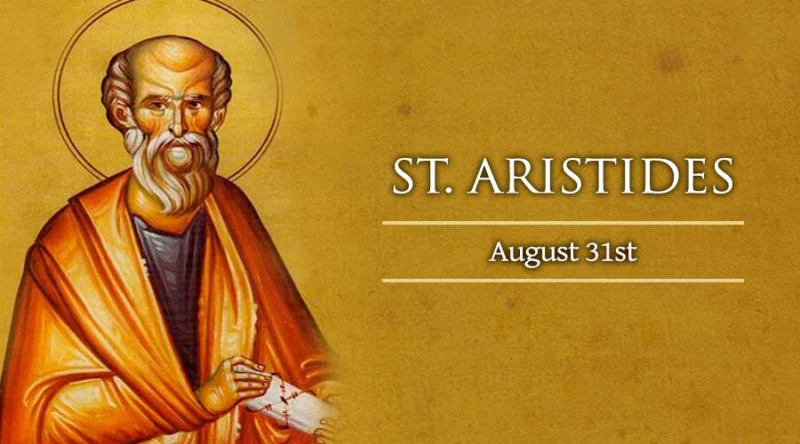
Saint Aristides


Saint Aristides

Feast date: Aug 31

Not much is known about the life of St. Aristides, excpet that he lived during the second century and was an avid confessor of the faith and Athenian philosopher. He wrote an Apologia for Christianity, which he presented to Emperor Hadrian in 125. His text was included in a work by Sts. Barlaam and Josaphat.

His feast day is August 31.

Printed with permission from Catholic-Defense.

Saint Aristides Read More »

St. Raymond Nonnatus

Feast date: Aug 31

Raymond became a priest due to his quiet persistence in prayer and study.


He was born to a noble Spanish family in 1204. His mother died during child birth and his father had high expectations for Raymond to serve in the country’s

Royal Court

.  However, the young Raymond felt drawn to religious life. In an attempt to dissuade him, his father ordered him to manage one of the family farms. However, Raymond spent his time with the workers, studying, and praying. His father finally gave up and allowed Raymond to enter the Mercederians.


Fr. Raymond spent his entire estate ransoming slaves. He even offered himself as a hostage to free another. He was sentenced to death but was spared because his ransom would bring in a large amount of money.


During his imprisonment, he succeeded at converting some of his guards. To keep him from continuing his preaching, his captors bored a hole through his lips with a hot iron, and attached a padlock. He was eventually ransomed, and he returned to Barcelona in 1239.


That year, he was named a cardinal by Pope Gregory IX.  The following year, in 1240, he was summoned to Rome, but barely made it out of Barcelona before he died at the age of 36.


St. Raymond is the patron saint of pregnant women, childbirth, and newborn infants.

St. Raymond Nonnatus Read More »

Tuesday of the Twenty-second Week in Ordinary Time

Reading 1 1 COR 2:10B-16

Brothers and sisters:
The Spirit scrutinizes everything, even the depths of God.
Among men, who knows what pertains to the man
except his spirit that is within?
Similarly, no one knows what pertains to God except the Spirit of God.
We have not received the spirit of the world
but the Spirit who is from God,
so that we may understand the things freely given us by God.
And we speak about them not with words taught by human wisdom,
but with words taught by the Spirit,
describing spiritual realities in spiritual terms.

Now the natural man does not accept what pertains to the Spirit of God,
for to him it is foolishness, and he cannot understand it,
because it is judged spiritually.
The one who is spiritual, however, can judge everything
but is not subject to judgment by anyone.

For “who has known the mind of the Lord, so as to counsel him?”
But we have the mind of Christ.

Responsorial Psalm PS 145:8-9, 10-11, 12-13AB, 13CD-14

R. (17) The Lord is just in all his ways.
The LORD is gracious and merciful,
slow to anger and of great kindness.
The LORD is good to all
and compassionate toward all his works.
R. The Lord is just in all his ways.
Let all your works give you thanks, O LORD,
and let your faithful ones bless you.
Let them discourse of the glory of your Kingdom
and speak of your might.
R. The Lord is just in all his ways.
Making known to men your might
and the glorious splendor of your Kingdom.
Your Kingdom is a Kingdom for all ages,
and your dominion endures through all generations.
R. The Lord is just in all his ways.
The LORD is faithful in all his words
and holy in all his works.
The LORD lifts up all who are falling
and raises up all who are bowed down.
R. The Lord is just in all his ways.


Alleluia LK 7:16

R. Alleluia, alleluia.
A great prophet has arisen in our midst
and God has visited his people.
R. Alleluia, alleluia.

Gospel LK 4:31-37

Jesus went down to Capernaum, a town of Galilee.
He taught them on the sabbath,
and they were astonished at his teaching
because he spoke with authority.
In the synagogue there was a man with the spirit of an unclean demon, 
and he cried out in a loud voice,
“What have you to do with us, Jesus of Nazareth?
Have you come to destroy us?
I know who you are–the Holy One of God!”
Jesus rebuked him and said, “Be quiet! Come out of him!”
Then the demon threw the man down in front of them
and came out of him without doing him any harm.
They were all amazed and said to one another,
“What is there about his word?
For with authority and power he commands the unclean spirits,
and they come out.”
And news of him spread everywhere in the surrounding region.

– – –

Lectionary for Mass for Use in the Dioceses of the United States, second typical edition, Copyright © 2001, 1998, 1997, 1986, 1970 Confraternity of Christian Doctrine; Psalm refrain © 1968, 1981, 1997, International Committee on English in the Liturgy, Inc. All rights reserved. Neither this work nor any part of it may be reproduced, distributed, performed or displayed in any medium, including electronic or digital, without permission in writing from the copyright owner.

Tuesday of the Twenty-second Week in Ordinary Time Read More »

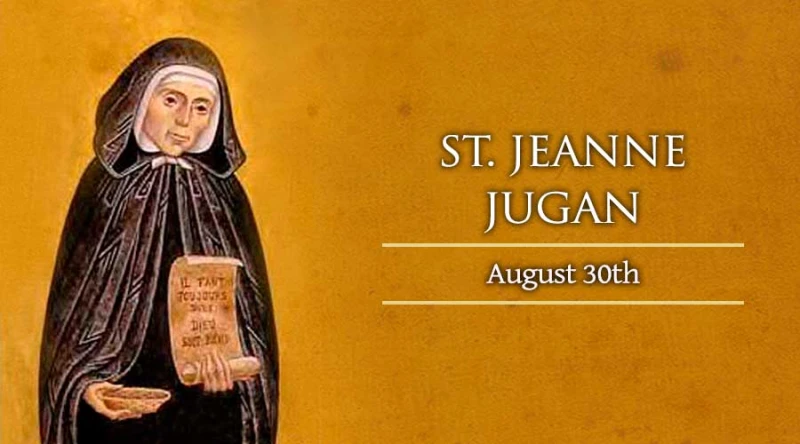
Saint Jeanne Jugan


Saint Jeanne Jugan

Feast date: Aug 30

On Aug. 30, the Catholic Church celebrates Saint Jeanne Jugan, also known as Sister Mary of the Cross. During the 19th century, she founded the Little Sisters of the Poor with the goal of imitating Christ’s humility through service to elderly people in need.

In his homily for her canonization in October 2009, Pope Benedict XVI praised St. Jeanne as “a beacon to guide our societies” toward a renewed love for those in old age. The Pope recalled how she “lived the mystery of love” in a way that remains “ever timely while so many elderly people are suffering from numerous forms of poverty and solitude and are sometimes also abandoned by their families.”

Born on Oct. 25, 1792 in a port city of the French region of Brittany, Jeanne Jugan grew up during the political and religious upheavals of the French Revolution. Four years after she was born, her father was lost at sea. Her mother struggled to provide for Jeanne and her three siblings, while also providing them secretly with religious instruction amid the anti-Catholic persecutions of the day.

Jeanne worked as a shepherdess, and later as a domestic servant. At age 18, and again six years later, she declined two marriage proposals from the same man. She told her mother that God had other plans, and was calling her to “a work which is not yet founded.”

At age 25, the young woman joined the Third Order of St. John Eudes, a religious association for laypersons founded during the 17th century. Jeanne worked as a nurse in the town of Saint-Servan for six years, but had to leave her position due to health troubles. Afterward she worked for 12 years as the servant of a fellow member of the third order, until the woman’s death in 1835.

During 1839, a year of economic hardship in Saint-Servan, Jeanne was sharing an apartment with an older woman and an orphaned young lady. It was during the winter of this year that Jeanne encountered Anne Chauvin, an elderly woman who was blind, partially paralyzed, and had no one to care for her.

Jeanne carried Anne home to her apartment and took her in from that day forward, letting the woman have her bed while Jeanne slept in the attic. She soon took in two more old women in need of help, and by 1841 she had rented a room to provide housing for a dozen elderly people. The following year, she acquired an unused convent building that could house 40 of them.

During the 1840s, many other young women joined Jeanne in her mission of service to the elderly poor. By begging in the streets, the foundress was able to establish four more homes for their beneficiaries by the end of the decade. By 1850, over 100 women had joined the congregation that had become known as the Little Sisters of the Poor.

However, Jeanne Jugan – known in religious life as Sister Mary of the Cross – had been forced out of her leadership role by Father Auguste Le Pailleur, the priest who had been appointed superior general of the congregation. In an apparent effort to suppress her true role as foundress, the superior general ordered her into retirement and a life of obscurity for 27 years.

During these years, she served the order through her prayers and by accepting the trial permitted by God. At the time of her death on Aug. 29, 1879, she was not known to have founded the order, which by then had 2,400 members serving internationally. Fr. Le Pailleur, however, was eventually investigated and disciplined, and St. Jeanne Jugan came to be acknowledged as their foundress.

Saint Jeanne Jugan Read More »

Memorial of the Passion of Saint John the Baptist

Reading 1 1 Cor 2:1-5

When I came to you, brothers and sisters,
proclaiming the mystery of God,
I did not come with sublimity of words or of wisdom.
For I resolved to know nothing while I was with you
except Jesus Christ, and him crucified.
I came to you in weakness and fear and much trembling,
and my message and my proclamation
were not with persuasive words of wisdom,
but with a demonstration of spirit and power,
so that your faith might rest not on human wisdom
but on the power of God.

Responsorial Psalm Ps 119:97, 98, 99, 100, 101, 102

R. (97) Lord, I love your commands.
How I love your law, O LORD!
It is my meditation all the day.
R. Lord, I love your commands.
Your command has made me wiser than my enemies,
for it is ever with me.
R. Lord, I love your commands.
I have more understanding than all my teachers
when your decrees are my meditation.
R. Lord, I love your commands.
I have more discernment than the elders,
because I observe your precepts.
R. Lord, I love your commands.
From every evil way I withhold my feet,
that I may keep your words.
R. Lord, I love your commands.
From your ordinances I turn not away,
for you have instructed me.
R. Lord, I love your commands.

Alleluia Mt 5:10

R. Alleluia, alleluia.
Blessed are those who are persecuted for the sake of righteousness,
for theirs is the Kingdom of heaven.
R. Alleluia, alleluia.

Gospel Mk 6:17-29

Herod was the one who had John the Baptist arrested and bound in prison
on account of Herodias,
the wife of his brother Philip, whom he had married.
John had said to Herod,
“It is not lawful for you to have your brother’s wife.”
Herodias harbored a grudge against him
and wanted to kill him but was unable to do so.
Herod feared John, knowing him to be a righteous and holy man,
and kept him in custody.
When he heard him speak he was very much perplexed,
yet he liked to listen to him.
She had an opportunity one day when Herod, on his birthday,
gave a banquet for his courtiers,
his military officers, and the leading men of Galilee.
Herodias’ own daughter came in
and performed a dance that delighted Herod and his guests.
The king said to the girl,
“Ask of me whatever you wish and I will grant it to you.”
He even swore many things to her,
“I will grant you whatever you ask of me,
even to half of my kingdom.”
She went out and said to her mother,
“What shall I ask for?”
She replied, “The head of John the Baptist.”
The girl hurried back to the king’s presence and made her request,
“I want you to give me at once
on a platter the head of John the Baptist.”
The king was deeply distressed,
but because of his oaths and the guests
he did not wish to break his word to her.
So he promptly dispatched an executioner with orders
to bring back his head.
He went off and beheaded him in the prison.
He brought in the head on a platter and gave it to the girl.
The girl in turn gave it to her mother.
When his disciples heard about it,
they came and took his body and laid it in a tomb.

– – –

Lectionary for Mass for Use in the Dioceses of the United States, second typical edition, Copyright © 2001, 1998, 1997, 1986, 1970 Confraternity of Christian Doctrine; Psalm refrain © 1968, 1981, 1997, International Committee on English in the Liturgy, Inc. All rights reserved. Neither this work nor any part of it may be reproduced, distributed, performed or displayed in any medium, including electronic or digital, without permission in writing from the copyright owner.

Memorial of the Passion of Saint John the Baptist Read More »