Please mind our dust!

We are currently working on revamping our website!
Thank you for your patience!

CRD Solutions

The Beheading of John the Baptist


The Beheading of John the Baptist

Feast date: Aug 29

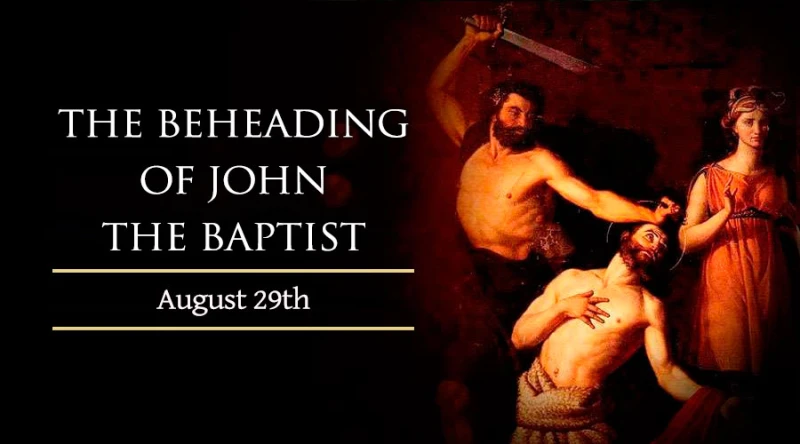
On this day, the universal Church marks the beheading of John the Baptist, who prepared the way for Jesus. As an adult, he lived as a hermit in the wilderness. After the Spirit inspired him, he went about preaching that the people should repent of their sins and be baptized in order to prepare for the Messiah.

Herod imprisoned John because he had condemned Herod for committing adultery by living with his brother’s wife, Herodias.

 At he celebration for Herod on his birthday, the daughter of Herodias danced for him, and Herod was so impressed that he said he would offer her anything she liked. She consulted with Herodias who told her to ask for the head of John the Baptist on a platter. Herod did not want to kill John for fear or what his follwers might do, but because of his promise to the girl he could not refuse, and so John was beheaded.

The Beheading of John the Baptist Read More »

St. Augustine


St. Augustine

Feast date: Aug 28

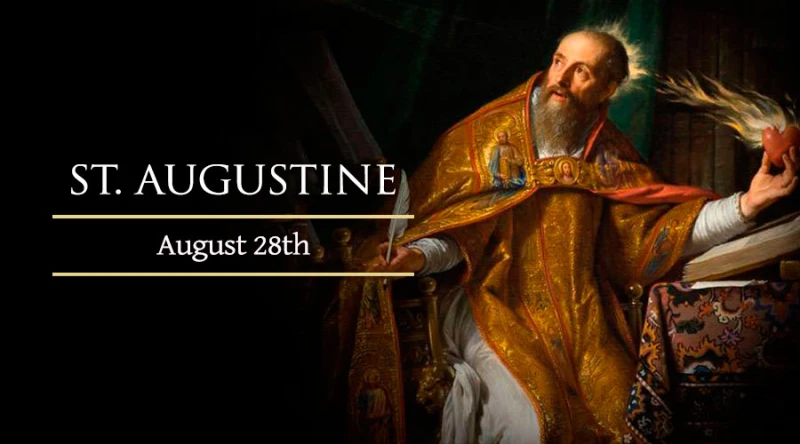
Today, August 28, the Church honors St. Augustine. St. Augustine was born at the town of Thagaste (now Souk-Ahras in modern day Algeria) on November 13, 354 and grew to become one the most significant and influential thinkers in the history of the Catholic Church. His teachings were the foundation of Christian doctrine for a millennium.

The story of his life, up until his conversion, is written in the autobiographical Confessions, the most intimate and well-known glimpse into an individual’s soul ever written, as well as a fascinating philosophical, theological, mystical, poetic and literary work.

Augustine, though being brought up in early childhood as a Christian, lived a dissolute life of revelry and sin, and soon drifted away from the Church – thinking that he wasn’t necessarily leaving Christ, of whose name he acknowledges “I kept it in the recesses of my heart; and all that presented itself to me without that Divine name, though it might be elegant, well written, and even replete with truth, did not altogether carry me away” (Confessions, I, iv).

He went to study in Carthage and became well-known in the city for his brilliant mind and rhetorical skills and sought a career as an orator or lawyer. But he also discovered and fell in love with philosophy at the age of 19, a love he pursued with great vehemence.

He was attracted to Manichaeanism at this time, after its devotees had promised him that they had scientific answers to the mystery of nature, could disprove the Scriptures, and could explain the problem of evil. Augustine became a follower for nine years, learning all there was to learn in it before rejecting it as incoherent and fraudulent.

He went to Rome and then Milan in 386 where he met Saint Ambrose, the bishop and Doctor of the Church, whose sermons inspired him to look for the truth he had always sought in the faith he had rejected. He received baptism and soon after, his mother, Saint Monica, died with the knowledge that all she had hoped for in this world had been fulfilled.

He returned to Africa, to his hometown of Tagaste, “having now cast off from himself the cares of the world, he lived for God with those who accompanied him, in fasting, prayers, and good works, meditating on the law of the Lord by day and by night.”

On a visit to Hippo he was proclaimed priest and then bishop against his will. He later accepted it as the will of God and spent the rest of his life as the pastor of the North African town, where he spent much time refuting the writings of heretics. 

Augustine also wrote, The City of God, against the pagans who charged that the fall of the Roman empire, which was taking place at the hands of the Vandals, was due to the spread of Christianity. 

On August 28, 430, as Hippo was under siege by the Vandals, Augustine died, at the age of 76. His legacy continues to deeply shape the face of the Church to this day.

St. Augustine Read More »

Twenty-second Sunday in Ordinary Time

Reading 1 Sir 3:17-18, 20, 28-29

My child, conduct your affairs with humility,
 and you will be loved more than a giver of gifts.
 Humble yourself the more, the greater you are,
 and you will find favor with God.
 What is too sublime for you, seek not,
 into things beyond your strength search not.
 The mind of a sage appreciates proverbs,
 and an attentive ear is the joy of the wise.
 Water quenches a flaming fire,
 and alms atone for sins.

Responsorial Psalm Ps 68:4-5, 6-7, 10-11

R. (cf. 11b)  God, in your goodness, you have made a home for the poor.
The just rejoice and exult before God;
they are glad and rejoice.
Sing to God, chant praise to his name;
whose name is the LORD.
R. God, in your goodness, you have made a home for the poor.
The father of orphans and the defender of widows
is God in his holy dwelling.
God gives a home to the forsaken;
he leads forth prisoners to prosperity.
R. God, in your goodness, you have made a home for the poor.
A bountiful rain you showered down, O God, upon your inheritance;
you restored the land when it languished;
your flock settled in it;
in your goodness, O God, you provided it for the needy.
R. God, in your goodness, you have made a home for the poor.

Reading 2 Heb 12:18-19, 22-24a

Brothers and sisters:
You have not approached that which could be touched
and a blazing fire and gloomy darkness
and storm and a trumpet blast
and a voice speaking words such that those who heard
begged that no message be further addressed to them.
No, you have approached Mount Zion
and the city of the living God, the heavenly Jerusalem,
and countless angels in festal gathering,
and the assembly of the firstborn enrolled in heaven,
and God the judge of all,
and the spirits of the just made perfect,
and Jesus, the mediator of a new covenant,
and the sprinkled blood that speaks more eloquently than that of Abel.

Alleluia Mt 11:29ab

R. Alleluia, alleluia.
Take my yoke upon you, says the Lord,
and learn from me, for I am meek and humble of heart.
R. Alleluia, alleluia.

Gospel Lk 14:1, 7-14

On a sabbath Jesus went to dine
at the home of one of the leading Pharisees,
and the people there were observing him carefully.

He told a parable to those who had been invited,
noticing how they were choosing the places of honor at the table.
“When you are invited by someone to a wedding banquet,
do not recline at table in the place of honor.
A more distinguished guest than you may have been invited by him,
and the host who invited both of you may approach you and say,
‘Give your place to this man,’
and then you would proceed with embarrassment
to take the lowest place.
Rather, when you are invited,
go and take the lowest place
so that when the host comes to you he may say,
‘My friend, move up to a higher position.’
Then you will enjoy the esteem of your companions at the table.
For every one who exalts himself will be humbled,
but the one who humbles himself will be exalted.”
Then he said to the host who invited him,
“When you hold a lunch or a dinner,
do not invite your friends or your brothers
or your relatives or your wealthy neighbors,
in case they may invite you back and you have repayment.
Rather, when you hold a banquet,
invite the poor, the crippled, the lame, the blind;
blessed indeed will you be because of their inability to repay you.
For you will be repaid at the resurrection of the righteous.”

– – –

Lectionary for Mass for Use in the Dioceses of the United States, second typical edition, Copyright © 2001, 1998, 1997, 1986, 1970 Confraternity of Christian Doctrine; Psalm refrain © 1968, 1981, 1997, International Committee on English in the Liturgy, Inc. All rights reserved. Neither this work nor any part of it may be reproduced, distributed, performed or displayed in any medium, including electronic or digital, without permission in writing from the copyright owner.

Twenty-second Sunday in Ordinary Time Read More »

St. Monica


St. Monica

Feast date: Aug 27

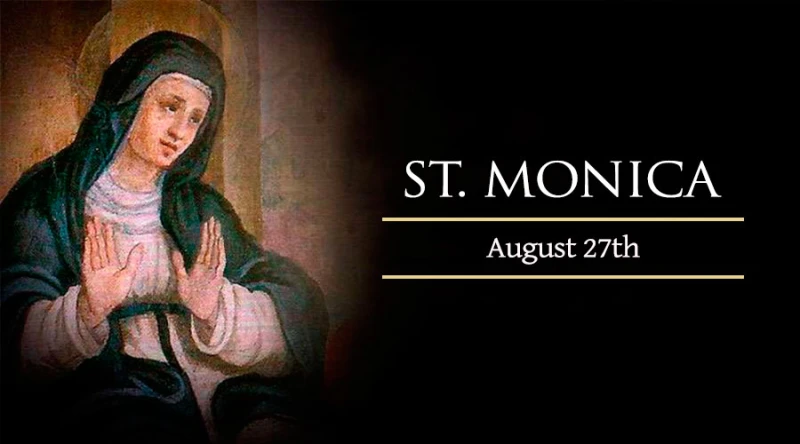
On August 27, one day before the feast of her son St. Augustine, the Catholic Church honors St. Monica, whose holy example and fervent intercession led to one of the most dramatic conversions in Church history.

Monica was born into a Catholic family in 332, in the North African city of Tagaste located in present-day Algeria. She was raised by a maidservant who taught her the virtues of obedience and temperance. While still relatively young, she married Patricius, a Roman civil servant with a bad temper and a disdain for his wife’s religion.

Patricius’ wife dealt patiently with his distressing behavior, which included infidelity to their marriage vows. But she experienced a greater grief when he would not allow their three children – Augustine, Nagivius, and Perpetua – to receive Baptism. When Augustine, the oldest, became sick and was in danger of death, Patricius gave consent for his Baptism, but withdrew it when he recovered.

Monica’s long-suffering patience and prayers eventually helped Patricius to see the error of his ways, and he was baptized into the Church one year before his death in 371. Her oldest son, however, soon embraced a way of life that brought her further grief, as he fathered a child out of wedlock in 372. One year later, he began to practice the occult religion of Manichaeism.

In her distress and grief, Monica initially shunned her oldest son. However, she experienced a mysterious dream that strengthened her hope for Augustine’s soul, in which a messenger assured her: “Your son is with you.” After this experience, which took place around 377, she allowed him back into her home, and continued to beg God for his conversion.

But this would not take place for another nine years. In the meantime, Monica sought the advice of local clergy, wondering what they might do to persuade her son away from the Manichean heresy. One bishop, who had once belonged to that sect himself, assured Monica that it was “impossible that the son of such tears should perish.”

These tears and prayers intensified when Augustine, at age 29, abandoned Monica without warning as she passed the night praying in a chapel. Without saying goodbye to his mother, Augustine boarded a ship bound for Rome. Yet even this painful event would serve God’s greater purpose, as Augustine left to become a teacher in the place where he was destined to become a Catholic.

Under the influence of the bishop St. Ambrose of Milan, Augustine renounced the teaching of the Manichees around 384. Monica followed her son to Milan, and drew encouragement from her son’s growing interest in the saintly bishop’s preaching. After three years of struggle against his own desires and perplexities, Augustine succumbed to God’s grace and was baptized in 387.

Shortly before her death, Monica shared a profound mystical experience of God with Augustine, who chronicled the event in his “Confessions.” Finally, she told him: “Son, for myself I have no longer any pleasure in anything in this life. Now that my hopes in this world are satisfied, I do not know what more I want here or why I am here.”

“The only thing I ask of you both,” she told Augustine and his brother Nagivius, “is that you make remembrance of me at the altar of the Lord wherever you are.”

St. Monica died at age 56, in the year 387. In modern times, she has become the inspiration for the St. Monica Sodality, which encourages prayer and penance among Catholics whose children have left the faith.

St. Monica Read More »

Memorial of Saint Monica

Reading 1 1 Cor 1:26-31

Consider your own calling, brothers and sisters.
Not many of you were wise by human standards,
not many were powerful,
not many were of noble birth.
Rather, God chose the foolish of the world to shame the wise,
and God chose the weak of the world to shame the strong,
and God chose the lowly and despised of the world,
those who count for nothing,
to reduce to nothing those who are something,
so that no human being might boast before God.
It is due to him that you are in Christ Jesus,
who became for us wisdom from God,
as well as righteousness, sanctification, and redemption,
so that, as it is written,
Whoever boasts, should boast in the Lord.

Responsorial Psalm Ps 33:12-13, 18-19, 20-21

R. (12) Blessed the people the Lord has chosen to be his own.
Blessed the nation whose God is the LORD,
the people he has chosen for his own inheritance.
From heaven the LORD looks down;
he sees all mankind.
R. Blessed the people the Lord has chosen to be his own.
But see, the eyes of the LORD are upon those who fear him,
upon those who hope for his kindness,
To deliver them from death
and preserve them in spite of famine.
R. Blessed the people the Lord has chosen to be his own.
Our soul waits for the LORD,
who is our help and our shield,
For in him our hearts rejoice;
in his holy name we trust.
R. Blessed the people the Lord has chosen to be his own.

Alleluia Jn 13:34

R. Alleluia, alleluia.
I give you a new commandment:
love one another as I have loved you.
R. Alleluia, alleluia.

Gospel Mt 25:14-30

Jesus told his disciples this parable:
“A man going on a journey
called in his servants and entrusted his possessions to them.
To one he gave five talents; to another, two; to a third, one–
to each according to his ability.
Then he went away.
Immediately the one who received five talents went and traded with them,
and made another five.
Likewise, the one who received two made another two.
But the man who received one went off and dug a hole in the ground
and buried his master’s money.
After a long time
the master of those servants came back and settled accounts with them.
The one who had received five talents
came forward bringing the additional five.
He said, ‘Master, you gave me five talents.
See, I have made five more.’
His master said to him, ‘Well done, my good and faithful servant.
Since you were faithful in small matters,
I will give you great responsibilities.
Come, share your master’s joy.’
Then the one who had received two talents also came forward and said,
‘Master, you gave me two talents.
See, I have made two more.’
His master said to him, ‘Well done, my good and faithful servant.
Since you were faithful in small matters,
I will give you great responsibilities.
Come, share your master’s joy.’
Then the one who had received the one talent came forward and said,
‘Master, I knew you were a demanding person,
harvesting where you did not plant
and gathering where you did not scatter;
so out of fear I went off and buried your talent in the ground.
Here it is back.’
His master said to him in reply, ‘You wicked, lazy servant!
So you knew that I harvest where I did not plant
and gather where I did not scatter?
Should you not then have put my money in the bank
so that I could have got it back with interest on my return?
Now then! Take the talent from him and give it to the one with ten.
For to everyone who has,
more will be given and he will grow rich;
but from the one who has not,
even what he has will be taken away.
And throw this useless servant into the darkness outside,
where there will be wailing and grinding of teeth.'”

– – –

Lectionary for Mass for Use in the Dioceses of the United States, second typical edition, Copyright © 2001, 1998, 1997, 1986, 1970 Confraternity of Christian Doctrine; Psalm refrain © 1968, 1981, 1997, International Committee on English in the Liturgy, Inc. All rights reserved. Neither this work nor any part of it may be reproduced, distributed, performed or displayed in any medium, including electronic or digital, without permission in writing from the copyright owner.

Memorial of Saint Monica Read More »