Please mind our dust!

We are currently working on revamping our website!
Thank you for your patience!

CRD Solutions

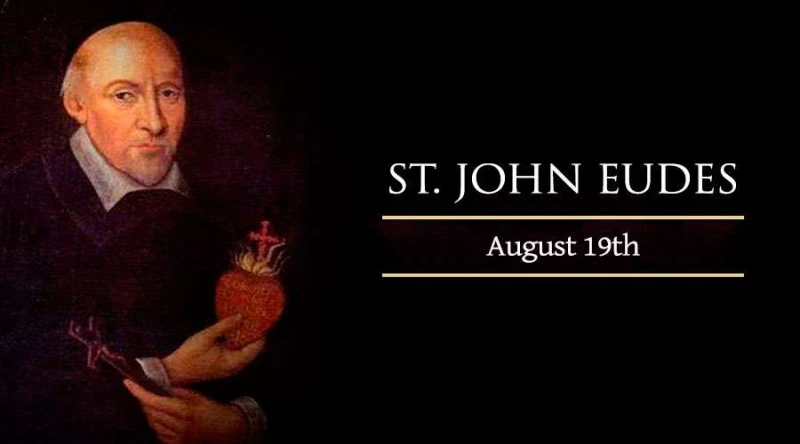
St. John Eudes


St. John Eudes

Feast date: Aug 19

St. John Eudes was a French missionary and the founder of the Congregation of Our Lady of Charity, and was also the author of the liturgical worship of the Sacred Hearts of Jesus and Mary. 

St. John was born at Ri, France on November 14th, 1601.  At the age of fourteen he took a vow of chastity and since the time he was a child he tried to live in imitation of the Lord Jesus. When he was ordained a priest in 1625, at the age of 24, he was immmediately thrust into the service of victims of the plague, whom he cared for at great risk to his own life. He also began preaching missions and was known as the greatest preacher of his age, preaching missions all over France, especially throughout Normandy.

In 1641 he founded the Congregation of Our Lady of Charity of the Refuge, to provide a refuge for prostitutes.  In 1643 he founded the Society of Jesus and Mary for the education of priests and for missionary work.

He was also instrumental in encouraging devotion to the Sacred Heart of Jesus and the Holy Heart of Mary, writing the first book ever on the devotion to the Sacred Hearts, “Le Coeur Admirable de la Très Sainte Mère de Dieu”. He died at Caen, on August 19th, 1680.

His virtues were declared heroic by Leo XIII, on January 6th, 1903. The miracles proposed for his beatification were approved by Pius X, May 3, 1908, and he was beatified April 25th, 1909.  He was canonized in 1925.

St. John Eudes Read More »

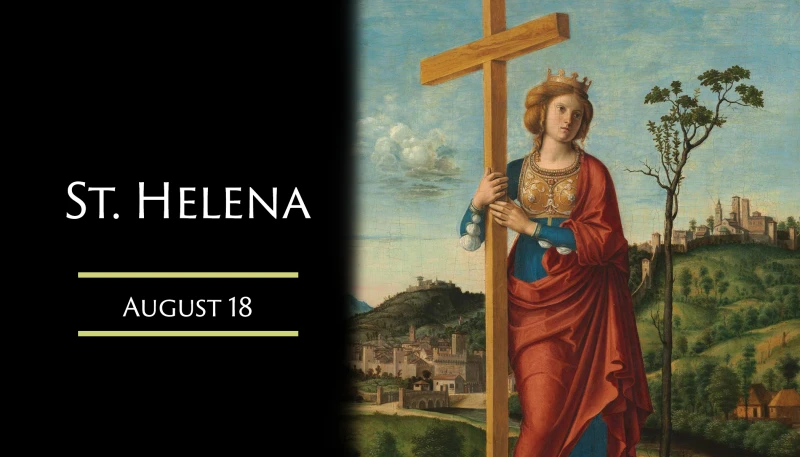
St. Helena


St. Helena

Feast date: Aug 18

Not much is known about Saint Helena but it is probable that she was born in the middle of the third century in Asia Minor. She worked as a stable maid as a young woman, according to Saint Anselm.

Helena later married a young Roman official, Constantius Chlorus, who took her as wife despite their difference in social status. In around the year 270 she gave birth to their first son, Constantine.

Constantius quickly rose in the ranks of the Roman military and due to political reasons he was forced to repudiate Helena and marry another. Helena remained at a distance as she watched her son rise in the court of Diocletian.

In 305, Constatius, now Augustus, and Constantine went to Britain to fight against the Picts. Constantine became emperor when his father died unexpectedly at York. As the new emperor, his first action was to recall his mother Helena.

Shortly after her son’s accession, Helena converted to Christianity. Her faith moved her to care for the poor by providing for their needs through generous almsgiving. She also worked to liberate prisoners and those sent to the mines or into exile.

Constantine’s reign took a downward turn when he ordered the death of his son and that of his second wife. The family tragedy pushed Helena to go on a pilgrimage to the Holy Land in 326. There she ordered the construction of the Basilicas of the Nativity in Bethlehem and of the Ascension on the Mount of Olives. The work was overseen by Helena whose faith was rewarded when the True Cross was discovered. The identity of the Cross was confirmed when a dead man was laid on the wood and was miraculously restored to life. The three nails from the Crucifixion were given by Helena to Constantine.

Helena died in an unknown location in 329. Constantine had her body brought back to Rome.

St. Helena Read More »

Thursday of the Twentieth Week in Ordinary Time

Reading 1 EZ 36:23-28

Thus says the LORD:
I will prove the holiness of my great name, 
profaned among the nations, 
in whose midst you have profaned it.
Thus the nations shall know that I am the LORD, says the Lord GOD,
when in their sight I prove my holiness through you.
For I will take you away from among the nations,
gather you from all the foreign lands,
and bring you back to your own land.
I will sprinkle clean water upon you
to cleanse you from all your impurities,
and from all your idols I will cleanse you.
I will give you a new heart and place a new spirit within you,
taking from your bodies your stony hearts
and giving you natural hearts.
I will put my spirit within you and make you live by my statutes,
careful to observe my decrees.
You shall live in the land I gave your ancestors;
you shall be my people, and I will be your God.

Responsorial Psalm PS 51:12-13, 14-15, 18-19

R.  (Ezekiel 36:25)  I will pour clean water on you and wash away all your sins.
A clean heart create for me, O God,
and a steadfast spirit renew within me.
Cast me not out from your presence,
and your Holy Spirit take not from me.
R. I will pour clean water on you and wash away all your sins.
Give me back the joy of your salvation,
and a willing spirit sustain in me.
I will teach transgressors your ways,
and sinners shall return to you.
R. I will pour clean water on you and wash away all your sins.
For you are not pleased with sacrifices;
should I offer a burnt offering, you would not accept it.
My sacrifice, O God, is a contrite spirit;
a heart contrite and humbled, O God, you will not spurn.
R. I will pour clean water on you and wash away all your sins.


Alleluia PS 95:8

R. Alleluia, alleluia.
If today you hear his voice,
harden not your hearts.
R. Alleluia, alleluia.

Gospel MT 22:1-14

Jesus again in reply spoke to the chief priests and the elders of the people in parables saying, 
“The Kingdom of heaven may be likened to a king
who gave a wedding feast for his son.
He dispatched his servants to summon the invited guests to the feast,
but they refused to come.
A second time he sent other servants, saying,
‘Tell those invited: “Behold, I have prepared my banquet,
my calves and fattened cattle are killed,
and everything is ready; come to the feast.”’
Some ignored the invitation and went away,
one to his farm, another to his business.
The rest laid hold of his servants,
mistreated them, and killed them.
The king was enraged and sent his troops,
destroyed those murderers, and burned their city.
Then the king said to his servants, ‘The feast is ready,
but those who were invited were not worthy to come.
Go out, therefore, into the main roads
and invite to the feast whomever you find.’
The servants went out into the streets
and gathered all they found, bad and good alike,
and the hall was filled with guests.
But when the king came in to meet the guests
he saw a man there not dressed in a wedding garment.
He said to him, ‘My friend, how is it
that you came in here without a wedding garment?’
But he was reduced to silence.
Then the king said to his attendants, ‘Bind his hands and feet,
and cast him into the darkness outside,
where there will be wailing and grinding of teeth.’
Many are invited, but few are chosen.”

– – –

Lectionary for Mass for Use in the Dioceses of the United States, second typical edition, Copyright © 2001, 1998, 1997, 1986, 1970 Confraternity of Christian Doctrine; Psalm refrain © 1968, 1981, 1997, International Committee on English in the Liturgy, Inc. All rights reserved. Neither this work nor any part of it may be reproduced, distributed, performed or displayed in any medium, including electronic or digital, without permission in writing from the copyright owner.

Thursday of the Twentieth Week in Ordinary Time Read More »

Wednesday of the Twentieth Week in Ordinary Time

Reading 1 EZ 34:1-11

The word of the Lord came to me:
Son of man, prophesy against the shepherds of Israel,
in these words prophesy to them to the shepherds:
Thus says the Lord GOD: Woe to the shepherds of Israel
who have been pasturing themselves!
Should not shepherds, rather, pasture sheep?
You have fed off their milk, worn their wool,
and slaughtered the fatlings,
but the sheep you have not pastured.
You did not strengthen the weak nor heal the sick
nor bind up the injured.
You did not bring back the strayed nor seek the lost,
but you lorded it over them harshly and brutally.
So they were scattered for the lack of a shepherd,
and became food for all the wild beasts.
My sheep were scattered
and wandered over all the mountains and high hills;
my sheep were scattered over the whole earth,
with no one to look after them or to search for them.

Therefore, shepherds, hear the word of the LORD:
As I live, says the Lord GOD,
because my sheep have been given over to pillage,
and because my sheep have become food for every wild beast,
for lack of a shepherd;
because my shepherds did not look after my sheep,
but pastured themselves and did not pasture my sheep;
because of this, shepherds, hear the word of the LORD:
Thus says the Lord GOD:
I swear I am coming against these shepherds.
I will claim my sheep from them
and put a stop to their shepherding my sheep
so that they may no longer pasture themselves.
I will save my sheep, 
that they may no longer be food for their mouths.

For thus says the Lord GOD: 
I myself will look after and tend my sheep.

Responsorial Psalm PS 23:1-3A, 3B-4, 5, 6

R. (1)  The Lord is my shepherd; there is nothing I shall want.
The LORD is my shepherd; I shall not want.
In verdant pastures he gives me repose;
Beside restful waters he leads me;
he refreshes my soul.
R. The Lord is my shepherd; there is nothing I shall want.
He guides me in right paths
for his name’s sake.
Even though I walk in the dark valley
I fear no evil; for you are at my side
With your rod and your staff
that give me courage.
R. The Lord is my shepherd; there is nothing I shall want.
You spread the table before me
in the sight of my foes;
You anoint my head with oil;
my cup overflows.
R. The Lord is my shepherd; there is nothing I shall want.
Only goodness and kindness will follow me
all the days of my life; 
And I shall dwell in the house of the LORD
for years to come.
R. The Lord is my shepherd; there is nothing I shall want.


Alleluia HEB 4:12

R. Alleluia, alleluia.
The word of God is living and effective,
able to discern the reflections and thoughts of the heart.
R. Alleluia, alleluia.

Gospel MT 20:1-16

Jesus told his disciples this parable:
“The Kingdom of heaven is like a landowner
who went out at dawn to hire laborers for his vineyard.
After agreeing with them for the usual daily wage,
he sent them into his vineyard.
Going out about nine o’clock,
he saw others standing idle in the marketplace,
and he said to them, ‘You too go into my vineyard,
and I will give you what is just.’
So they went off. 
And he went out again around noon,
and around three o’clock, and did likewise.
Going out about five o’clock,
he found others standing around, and said to them,
‘Why do you stand here idle all day?’
They answered, ‘Because no one has hired us.’
He said to them, ‘You too go into my vineyard.’
When it was evening the owner of the vineyard said to his foreman,
‘Summon the laborers and give them their pay,
beginning with the last and ending with the first.’
When those who had started about five o’clock came,
each received the usual daily wage.
So when the first came, they thought that they would receive more,
but each of them also got the usual wage.
And on receiving it they grumbled against the landowner, saying,
‘These last ones worked only one hour,
and you have made them equal to us,
who bore the day’s burden and the heat.’
He said to one of them in reply,
‘My friend, I am not cheating you.
Did you not agree with me for the usual daily wage?
Take what is yours and go.
What if I wish to give this last one the same as you?
Or am I not free to do as I wish with my own money?
Are you envious because I am generous?’
Thus, the last will be first, and the first will be last.”

– – –

Lectionary for Mass for Use in the Dioceses of the United States, second typical edition, Copyright © 2001, 1998, 1997, 1986, 1970 Confraternity of Christian Doctrine; Psalm refrain © 1968, 1981, 1997, International Committee on English in the Liturgy, Inc. All rights reserved. Neither this work nor any part of it may be reproduced, distributed, performed or displayed in any medium, including electronic or digital, without permission in writing from the copyright owner.
Wednesday of the Twentieth Week in Ordinary Time Read More »

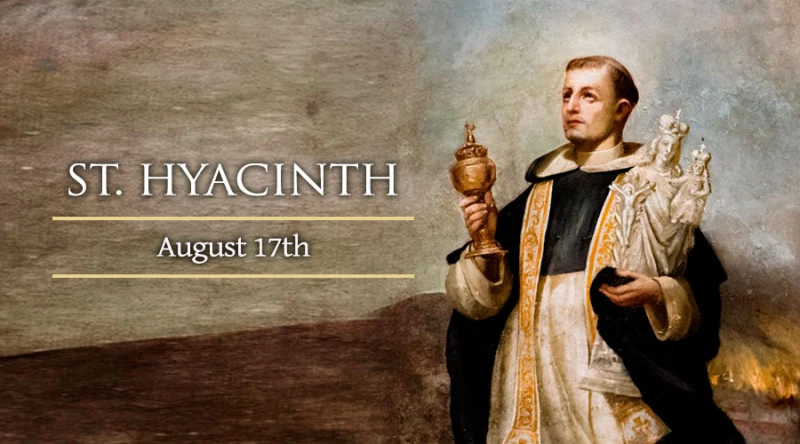
St. Hyacinth


St. Hyacinth

Feast date: Aug 17

St. Hyacinth was one of the first members of the Dominicans (the Order of Preachers) and the “apostle of the North”, and is also called the “Apostle of Poland.”

Hyacinth was born into nobility in 1185 at the castle of Lanka, at Kamin, in Silesia, Poland, and received an impressive education, becoming a Doctor of Law and Divinity before traveling to Rome with his uncle, Ivo Konski, the Bishop of Krakow.

In Rome he met St. Dominic and decided to join the Order of Preachers immediately, receiving his habit from Dominic himself in 1220.

After his novitiate he made his religious profession, and was made superior of the little band of missionaries sent to Poland to preach. In Poland the new preachers were well received and their sermons produced a deep conversion in the people.

Hyacinth also founded communities in Sandomir, Kracow, and at Plocko on the Vistula in Moravia. He extended his missionary work through Prussia, Pomerania, and Lithuania. Then, crossing the Baltic Sea, he preached in Denmark, Sweden, Norway, and Russia, reaching the shores of the Black Sea.

On his return to Krakow he died, on August 15, 1257.

Some of his relics can be found at the Dominican church in Paris.

St. Hyacinth is a patron of Poland.

St. Hyacinth Read More »