Please mind our dust!

We are currently working on revamping our website!
Thank you for your patience!

CRD Solutions

Tuesday of the Twentieth Week in Ordinary Time

Reading 1 EZ 28:1-10

The word of the LORD came to me: Son of man,
say to the prince of Tyre: 
Thus says the Lord GOD:

Because you are haughty of heart,
you say, “A god am I!
I occupy a godly throne
in the heart of the sea!”—
And yet you are a man, and not a god,
however you may think yourself like a god.
Oh yes, you are wiser than Daniel,
there is no secret that is beyond you.
By your wisdom and your intelligence
you have made riches for yourself;
You have put gold and silver
into your treasuries.
By your great wisdom applied to your trading
you have heaped up your riches;
your heart has grown haughty from your riches–
therefore thus says the Lord GOD:
Because you have thought yourself
to have the mind of a god,
Therefore I will bring against you
foreigners, the most barbarous of nations.
They shall draw their swords
against your beauteous wisdom,
they shall run them through your splendid apparel.
They shall thrust you down to the pit, there to die
a bloodied corpse, in the heart of the sea.
Will you then say, “I am a god!”
when you face your murderers?
No, you are man, not a god,
handed over to those who will slay you.
You shall die the death of the uncircumcised
at the hands of foreigners,
for I have spoken, says the Lord GOD.

Responsorial Psalm DEUTERONOMY 32:26-27AB, 27CD-28, 30, 35CD-36AB

R. (39c)  It is I who deal death and give life.
“I would have said, ‘I will make an end of them
and blot out their name from men’s memories,’
Had I not feared the insolence of their enemies,
feared that these foes would mistakenly boast.”
R. It is I who deal death and give life.
“‘Our own hand won the victory;
the LORD had nothing to do with it.’”
For they are a people devoid of reason,
having no understanding.
R. It is I who deal death and give life.
“How could one man rout a thousand,
or two men put ten thousand to flight,
Unless it was because their Rock sold them
and the LORD delivered them up?”
R. It is I who deal death and give life.
Close at hand is the day of their disaster,
and their doom is rushing upon them!
Surely, the LORD shall do justice for his people;
on his servants he shall have pity.
R. It is I who deal death and give life.


Alleluia 2 COR 8:9

R. Alleluia, alleluia.
Jesus Christ became poor although he was rich
So that by his poverty you might become rich.
R. Alleluia, alleluia.

Gospel MT 19:23-30

Jesus said to his disciples:
“Amen, I say to you, it will be hard for one who is rich
to enter the Kingdom of heaven.
Again I say to you,
it is easier for a camel to pass through the eye of a needle
than for one who is rich to enter the Kingdom of God.”
When the disciples heard this, they were greatly astonished and said,
“Who then can be saved?”
Jesus looked at them and said,
“For men this is impossible,
but for God all things are possible.”
Then Peter said to him in reply,
“We have given up everything and followed you.
What will there be for us?”
Jesus said to them, “Amen, I say to you
that you who have followed me, in the new age,
when the Son of Man is seated on his throne of glory,
will yourselves sit on twelve thrones,
judging the twelve tribes of Israel.
And everyone who has given up houses or brothers or sisters
or father or mother or children or lands
for the sake of my name will receive a hundred times more,
and will inherit eternal life.
But many who are first will be last, and the last will be first.”

– – –

Lectionary for Mass for Use in the Dioceses of the United States, second typical edition, Copyright © 2001, 1998, 1997, 1986, 1970 Confraternity of Christian Doctrine; Psalm refrain © 1968, 1981, 1997, International Committee on English in the Liturgy, Inc. All rights reserved. Neither this work nor any part of it may be reproduced, distributed, performed or displayed in any medium, including electronic or digital, without permission in writing from the copyright owner.

Tuesday of the Twentieth Week in Ordinary Time Read More »
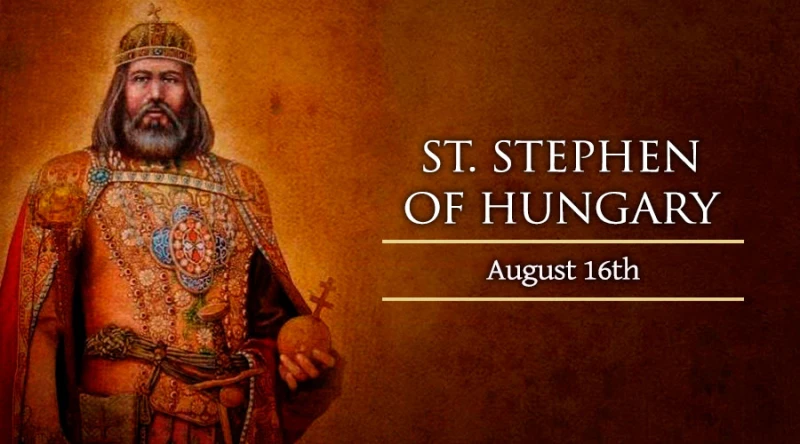
St. Stephen of Hungary


St. Stephen of Hungary

Feast date: Aug 16

On Aug. 16, the Catholic Church celebrates the feast day of King Saint Stephen of Hungary, the monarch who led his country to embrace the Christian faith during the 11th century.

Before the future saint’s birth in 975, his mother, the duchess Sarolt, is said to have received a vision in which the original Saint Stephen – the Church’s first martyr – appeared telling her she would bear a son who would evangelize their land.

Together with her husband, the Hungarian duke Geza, Sarolt is believed to have been converted and baptized by the bishop Saint Adalbert of Prague. The same saint baptized their son Vaik in 985, giving him the name of Stephen.

Geza had desired to convert the Hungarians to the Catholic faith, a passion shared by Stephen once he reached adulthood and succeeded him in power. After conclusively defeating an alliance of rival pagan nobility, he used their acquired wealth to build a monastery, and invited clergy to convert the people.

Stephen established laws favoring Christianity over paganism, and sent an emissary to Rome with a request for the Pope to proclaim him as king. Pope Sylvester II accepted the request, sending him a crown and a gold processional cross, while also giving Stephen certain religious privileges.

He showed great diligence as king, while devoting the rest of his time to his religious duties – including charity toward the poor and sick, as well as the worship of God – and to his household. Gisela, Stephen’s wife, was the sister of the ruler later canonized as the Holy Roman Emperor Saint Henry II.

Greatly devoted to the Virgin Mary, Stephen had several churches built in her honor both in Hungary and outside the kingdom. Her intercession is credited with preventing a war between Hungary and the Holy Roman Empire under Conrad II, and stopping an assassination plot against Stephen himself.

The Hungarian king also established a monastery in Jerusalem, and set up institutions to aid pilgrims in other major cities. Stephen counted saints among his friends and correspondents, and fulfilled the Pope’s charge to use his royal authority for the good of the Church.

Suffering came to the king, however, when only one of his children survived to adulthood. Stephen’s only living son Emeric received a strong Catholic upbringing, and was expected to succeed his father. But Emeric died before Stephen, after a hunting accident in 1031.

Emeric was later canonized as a saint in his own right, and Stephen eventually came to rejoice that his son had been permitted to enter God’s presence before him. The king’s final years, however, were marked by illness as well as a succession dispute among his relatives.

In 1038, on the feast of the Assumption of the Virgin Mary, Stephen delivered his final words to leaders of the Church and state, telling them to protect and spread the Catholic faith.

To the Virgin Mary, the king directed one of his final prayers: “To thee, O Queen of heaven, and to thy guardianship, I commend the holy Church, all the bishops and the clergy, the whole kingdom, its rulers and inhabitants; but before all, I commend my soul to thy care.”

St. Stephen of Hungary died on Aug. 15, 1038. He was buried alongside his son St. Emeric, and the two were canonized together in 1083.

St. Stephen of Hungary Read More »

Solemnity of the Assumption of the Blessed Virgin Mary

Reading 1 RV 11:19A; 12:1-6A, 10AB

God’s temple in heaven was opened,
and the ark of his covenant could be seen in the temple.

A great sign appeared in the sky, a woman clothed with the sun,
with the moon under her feet,
and on her head a crown of twelve stars.
She was with child and wailed aloud in pain as she labored to give birth.
Then another sign appeared in the sky;
it was a huge red dragon, with seven heads and ten horns,
and on its heads were seven diadems.
Its tail swept away a third of the stars in the sky
and hurled them down to the earth.
Then the dragon stood before the woman about to give birth,
to devour her child when she gave birth.
She gave birth to a son, a male child,
destined to rule all the nations with an iron rod.
Her child was caught up to God and his throne.
The woman herself fled into the desert
where she had a place prepared by God.

Then I heard a loud voice in heaven say:
“Now have salvation and power come,
and the Kingdom of our God
and the authority of his Anointed One.”

Responsorial Psalm PS 45:10, 11, 12, 16

R. (10bc)  The queen stands at your right hand, arrayed in gold.
The queen takes her place at your right hand in gold of Ophir.
R. The queen stands at your right hand, arrayed in gold.
Hear, O daughter, and see; turn your ear,
forget your people and your father’s house.
R. The queen stands at your right hand, arrayed in gold.
So shall the king desire your beauty;
for he is your lord.
R. The queen stands at your right hand, arrayed in gold.
They are borne in with gladness and joy;
they enter the palace of the king.
R. The queen stands at your right hand, arrayed in gold.

Reading 2 1 COR 15:20-27

Brothers and sisters:
Christ has been raised from the dead,
the firstfruits of those who have fallen asleep.
For since death came through man,
the resurrection of the dead came also through man.
For just as in Adam all die,
so too in Christ shall all be brought to life,
but each one in proper order:
Christ the firstfruits;
then, at his coming, those who belong to Christ;
then comes the end,
when he hands over the Kingdom to his God and Father,
when he has destroyed every sovereignty
and every authority and power.
For he must reign until he has put all his enemies under his feet.
The last enemy to be destroyed is death,
for “he subjected everything under his feet.”

Alleluia

R. Alleluia, alleluia.
Mary is taken up to heaven;
a chorus of angels exults.
R. Alleluia, alleluia.

Gospel LK 1:39-56

Mary set out
and traveled to the hill country in haste
to a town of Judah,
where she entered the house of Zechariah
and greeted Elizabeth.
When Elizabeth heard Mary’s greeting,
the infant leaped in her womb,
and Elizabeth, filled with the Holy Spirit,
cried out in a loud voice and said,
“Blessed are you among women,
and blessed is the fruit of your womb.
And how does this happen to me,
that the mother of my Lord should come to me?
For at the moment the sound of your greeting reached my ears,
the infant in my womb leaped for joy.
Blessed are you who believed
that what was spoken to you by the Lord
would be fulfilled.”

And Mary said:
“My soul proclaims the greatness of the Lord;
my spirit rejoices in God my Savior
for he has looked with favor on his lowly servant.
From this day all generations will call me blessed:
the Almighty has done great things for me
and holy is his Name.
He has mercy on those who fear him
in every generation.
He has shown the strength of his arm,
and has scattered the proud in their conceit.
He has cast down the mighty from their thrones,
and has lifted up the lowly.
He has filled the hungry with good things,
and the rich he has sent away empty.
He has come to the help of his servant Israel
for he has remembered his promise of mercy,
the promise he made to our fathers,
to Abraham and his children forever.”

Mary remained with her about three months
and then returned to her home.

– – –

Lectionary for Mass for Use in the Dioceses of the United States, second typical edition, Copyright © 2001, 1998, 1997, 1986, 1970 Confraternity of Christian Doctrine; Psalm refrain © 1968, 1981, 1997, International Committee on English in the Liturgy, Inc. All rights reserved. Neither this work nor any part of it may be reproduced, distributed, performed or displayed in any medium, including electronic or digital, without permission in writing from the copyright owner.

Solemnity of the Assumption of the Blessed Virgin Mary Read More »

The Assumption of the Blessed Virgin Mary


The Assumption of the Blessed Virgin Mary

Feast date: Aug 15

Today, Catholics and many other Christians celebrate the feast of the Assumption of the Blessed Virgin Mary. This significant feast day recalls the spiritual and physical departure of the mother of Jesus Christ from the earth, when both her soul and her body were taken into the presence of God.

Venerable Pope Pius XII confirmed this belief about the Virgin Mary as the perennial teaching of the Church when he defined it formally as a dogma of Catholic faith in 1950, invoking papal infallibility to proclaim, “that the Immaculate Mother of God, the ever-Virgin Mary, having completed the course of her earthly life, was assumed body and soul into heavenly glory.”

His Apostolic Constitution “Munificentissimus Deus” (Most Bountiful God), which defined the dogma,

contained the Pontiff’s accounts of many longstanding traditions by which the Church has celebrated the Assumption throughout its history.

The constitution also cited testimonies from the early Church fathers on the subject, and described the history of theological reflection on many Biblical passages which are seen as indicating that Mary was assumed into heaven following her death.

Although the bodily assumption of Mary is not explicitly recorded in Scripture, Catholic tradition identifies her with the “woman clothed with the sun” who is described in the 12th chapter of the Book of Revelation.

The passage calls that woman’s appearance “a great sign” which “appeared in heaven,” indicating that she is the mother of the Jewish Messiah and has “the moon under her feet, and on her head a crown of twelve stars.” Accordingly, Catholic iconography of the Western tradition often depicts the Virgin Mary’s assumption into heaven in this manner.

Eastern Christians have also traditionally held Mary’s assumption into heaven as an essential component of their faith. Pius XII cited several early Byzantine liturgical texts, as well as the eighth-century Arab Christian theologian St. John of Damascus, in his own authoritative definition of her assumption.

“It was fitting,” St. John of Damascus wrote in a sermon on the assumption, “that she, who had kept her virginity intact in childbirth, should keep her own body free from all corruption even after death,” and “that she, who had carried the creator as a child at her breast, should dwell in the divine tabernacles.”

In Eastern Christian tradition, the same feast is celebrated on the same calendar date, although typically known as the Dormition (falling asleep) of Mary. Eastern Catholic celebration of the Dormition is preceded by a two-week period of fasting which is similar to Lent. Pius XII, in “Munificentissimus Deus,” mentioned this same fasting period as belonging to the traditional patrimony of Western Christians as well.

The feast of the Assumption is always a Holy Day of Obligation for both Roman and Eastern-rite Catholics, on which they are obliged to attend Mass or Divine Liturgy.

The Assumption of the Blessed Virgin Mary Read More »

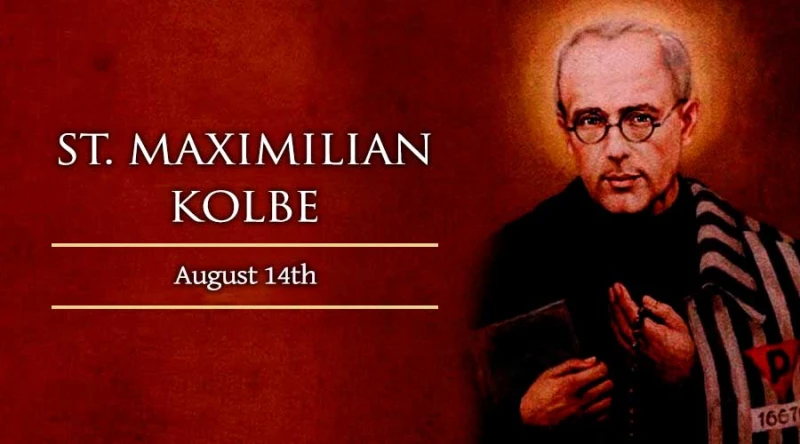
Saint Maximilian Kolbe


Saint Maximilian Kolbe

Feast date: Aug 14

Saint Maximilian Kolbe, the Polish Franciscan priest, missionary and martyr, is celebrated throughout the Church today, August 14.

The saint died in the concentration camp at Auschwitz, during World War II, and is remembered as a “martyr of charity” for dying in place of another prisoner who had a wife and children. He was canonized by Pope John Paul II on October 10, 1982.

St. Maximilian is also celebrated for his missionary work, his evangelistic use of modern means of communication, and for his lifelong devotion to the Virgin Mary under her title of the Immaculate Conception.

All these aspects of St. Maximilian’s life converged in his founding of the Militia Immaculata. The worldwide organization continues St. Maximilian Kolbe’s mission of bringing individuals and societies into the Catholic Church, through dedication to the Virgin Mary.

St. Maximilian, according to several biographies, was personally called by the Virgin Mary, both to his holy life and to his eventual martyrdom. As an impulsive and badly-behaved child, he prayed to her for guidance, and later described how she miraculously appeared to him holding two crowns: one was white, representing purity, the other red, for martyrdom.

When he was asked to choose between these two destinies, the troublesome child and future saint said he wanted both. Radically changed by the incident, he entered the minor seminary of the Conventual Franciscans at age 13, in 1907.

At age 20 he made his solemn vows as a Franciscan, earning a doctorate in philosophy the next year. Soon after, however, he developed chronic tuberculosis, which eventually destroyed one of his lungs and weakened the other.

On October 16, 1917, in response to anti-Catholic demonstrations by Italian Freemasons, Friar Maximilian led six other Franciscans in Rome to form the association they called the Militia Immaculata. The group’s founding coincided almost exactly with the Bolshevik revolution in Russia, and the Marian apparitions at Fatima, Portugal.

As a Franciscan priest, Fr. Maximilian returned to work in Poland during the 1920s. There, he promoted the Catholic faith through newspapers and magazines which eventually reached an extraordinary circulation, published from a monastery so large it was called the “City of the Immaculata.”

In 1930 he moved to Japan, and had established a Japanese Catholic press by 1936, along with a similarly ambitious monastery.

That year, however, he returned to Poland for the last time. In 1939, Germany invaded Poland, and Fr. Kolbe was arrested. Briefly freed during 1940, he published one last issue of the Knight of the Immaculata before his final arrest and transportation to Auschwitz in 1941.

At the beginning of August that year, 10 prisoners were sentenced to death by starvation in punishment for another inmate’s escape. Moved by one man’s lamentation for his wife and children, Fr. Kolbe volunteered to die in his place.

Survivors of the camp testified that the starving prisoners could be heard praying and singing hymns, led by the priest who had volunteered for an agonizing death. After two weeks, on the night before the Church’s feast of the Assumption of the Blessed Virgin Mary, the camp officials decided to hasten Fr. Kolbe’s death, injecting him with carbolic acid.

St. Maximilian Kolbe’s body was cremated by the camp officials on the feast of the Assumption. He had stated years earlier: “I would like to be reduced to ashes for the cause of the Immaculata, and may this dust be carried over the whole world, so that nothing would remain.”

Saint Maximilian Kolbe Read More »