Please mind our dust!

We are currently working on revamping our website!
Thank you for your patience!

CRD Solutions

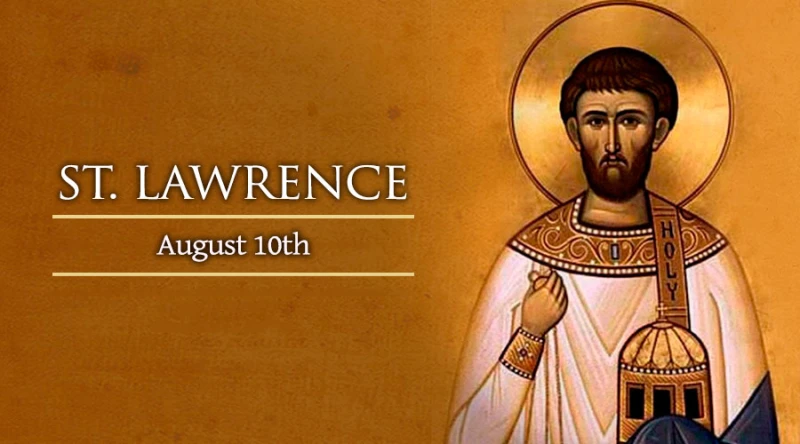
St. Lawrence


St. Lawrence

Feast date: Aug 10

“‘Just as Christ laid down his life for us, so we ought to lay down our lives for the brethren.’ My brethren, Lawrence understood this and, understanding, he acted on it. In his life he loved Christ; in his death he followed in his footsteps.”
 – St. Augustine, in a sermon on the feast of Saint Lawrence

Saint Lawrence was martyred on August 10, 258 during the persecution of the emperor Valerian along with many other members of the Roman clergy. He was the last of the seven deacons of Rome to die.

After the pope, Sixtus II, was martyred on August 6, Lawrence became the principal authority of the Roman Church, having been the Church’s treasurer. When he was summoned before the executioners he was ordered to bring all the wealth of the Church with him.  He showed up with a handful of crippled, poor, and sick men, and when questioned, replied that “These are the true wealth of the Church.” He was immediately sent to his death, being cooked alive on a gridiron

He is venerated as one of the patrons of Rome, along with Sts. Peter and Paul.

St. Lawrence Read More »

Tuesday of the Nineteenth Week in Ordinary Time

Reading 1 EZ 2:8—3:4

The Lord GOD said to me:
As for you, son of man, obey me when I speak to you:
be not rebellious like this house of rebellion,
but open your mouth and eat what I shall give you.

It was then I saw a hand stretched out to me,
in which was a written scroll which he unrolled before me.
It was covered with writing front and back,
and written on it was: 
Lamentation and wailing and woe!

He said to me: Son of man, eat what is before you;
eat this scroll, then go, speak to the house of Israel.
So I opened my mouth and he gave me the scroll to eat.
Son of man, he then said to me,
feed your belly and fill your stomach
with this scroll I am giving you.
I ate it, and it was as sweet as honey in my mouth.
He said: Son of man, go now to the house of Israel,
and speak my words to them.

Responsorial Psalm PS 119:14, 24, 72, 103, 111, 131

R. (103a)  How sweet to my taste is your promise!
In the way of your decrees I rejoice,
as much as in all riches.
R. How sweet to my taste is your promise!
Yes, your decrees are my delight;
they are my counselors.
R. How sweet to my taste is your promise!
The law of your mouth is to me more precious
than thousands of gold and silver pieces.
R. How sweet to my taste is your promise!
How sweet to my palate are your promises,
sweeter than honey to my mouth!
R.  How sweet to my taste is your promise!
Your decrees are my inheritance forever;
the joy of my heart they are.
R.  How sweet to my taste is your promise!
I gasp with open mouth,
in my yearning for your commands.
R.  How sweet to my taste is your promise!


Alleluia MT 11:29

R. Alleluia, alleluia.
Take my yoke upon you and learn from me,
for I am meek and humble of heart.
R. Alleluia, alleluia.

Gospel MT 18:1-5, 10, 12-14

The disciples approached Jesus and said,
“Who is the greatest in the Kingdom of heaven?”
He called a child over, placed it in their midst, and said,
“Amen, I say to you, unless you turn and become like children,
you will not enter the Kingdom of heaven.
Whoever becomes humble like this child
is the greatest in the Kingdom of heaven.
And whoever receives one child such as this in my name receives me.

“See that you do not despise one of these little ones,
for I say to you that their angels in heaven
always look upon the face of my heavenly Father.
What is your opinion?
If a man has a hundred sheep and one of them goes astray,
will he not leave the ninety-nine in the hills
and go in search of the stray?
And if he finds it, amen, I say to you, he rejoices more over it
than over the ninety-nine that did not stray. 
In just the same way, it is not the will of your heavenly Father
that one of these little ones be lost.”

– – –

Lectionary for Mass for Use in the Dioceses of the United States, second typical edition, Copyright © 2001, 1998, 1997, 1986, 1970 Confraternity of Christian Doctrine; Psalm refrain © 1968, 1981, 1997, International Committee on English in the Liturgy, Inc. All rights reserved. Neither this work nor any part of it may be reproduced, distributed, performed or displayed in any medium, including electronic or digital, without permission in writing from the copyright owner.

Tuesday of the Nineteenth Week in Ordinary Time Read More »

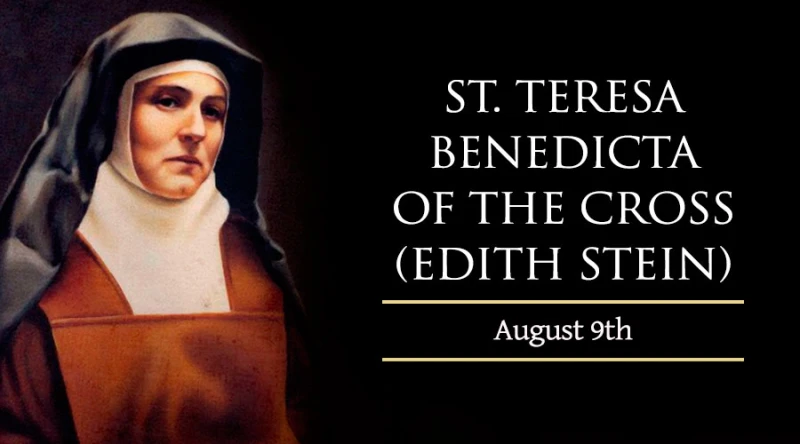
St. Teresa Benedicta of the Cross (Edith Stein)


St. Teresa Benedicta of the Cross (Edith Stein)

Feast date: Aug 09

On August 9 the Catholic Church remembers St. Teresa Benedicta of the Cross, also known as St. Edith Stein. St. Teresa converted from Judaism to Catholicism in the course of her work as a philosopher, and later entered the Carmelite Order. She died in the Nazi concentration camp at Auschwitz in 1942.

Edith Stein was born on October 12, 1891 – a date that coincided with her family’s celebration of Yom Kippur, the Jewish “day of atonement.” Edith’s father died when she was just two years old, and she gave up the practice of her Jewish faith as an adolescent.

As a young woman with profound intellectual gifts, Edith gravitated toward the study of philosophy and became a pupil of the renowned professor Edmund Husserl in 1913. Through her studies, the non-religious Edith met several Christians whose intellectual and spiritual lives she admired.

After earning her degree with the highest honors from Gottingen University in 1915, she served as a nurse in an Austrian field hospital during World War I. She returned to academic work in 1916, earning her doctorate after writing a highly-regarded thesis on the phenomenon of empathy. She remained interested in the idea of religious commitment, but had not yet made such a commitment herself.

In 1921, while visiting friends, Edith spent an entire night reading the autobiography of the 16th century Carmelite nun St. Teresa of Avila. “When I had finished the book,” she later recalled, “I said to myself: This is the truth.” She was baptized into the Catholic Church on the first day of January, 1922.

Edith intended to join the Carmelites immediately after her conversion, but would ultimately have to wait another 11 years before taking this step. Instead, she taught at a Dominican school, and gave numerous public lectures on women’s issues. She spent 1931 writing a study of St. Thomas Aquinas, and took a university teaching position in 1932.

In 1933, the rise of Nazism, combined with Edith’s Jewish ethnicity, put an end to her teaching career. After a painful parting with her mother, who did not understand her Christian conversion, she entered a Carmelite convent in 1934, taking the name “Teresa Benedicta of the Cross” as a symbol of her acceptance of suffering.

“I felt,” she wrote, “that those who understood the Cross of Christ should take upon themselves on everybody’s behalf.” She saw it as her vocation “to intercede with God for everyone,” but she prayed especially for the Jews of Germany whose tragic fate was becoming clear.

“I ask the Lord to accept my life and my death,” she wrote in 1939, “so that the Lord will be accepted by his people and that his kingdom may come in glory, for the salvation of Germany and the peace of the world.”

After completing her final work, a study of St. John of the Cross entitled “The Science of the Cross,” Teresa Benedicta was arrested along with her sister Rosa (who had also become a Catholic), and the members of her religious community, on August 7, 1942. The arrests came in retaliation against a protest letter by the Dutch Bishops, decrying the Nazi treatment of Jews.

St. Teresa Benedicta of the Cross died in the concentration camp at Auschwitz on August 9, 1942. Blessed John Paul II canonized her in 1998, and proclaimed her a co-patroness of Europe the next year.

St. Teresa Benedicta of the Cross (Edith Stein) Read More »

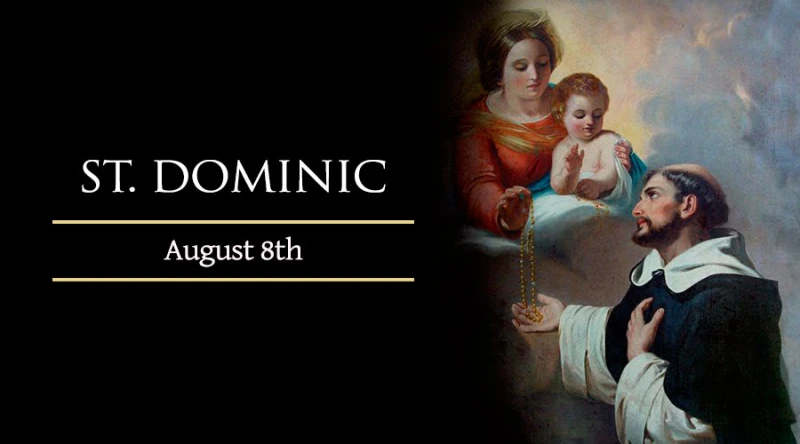
St. Dominic


St. Dominic

Feast date: Aug 08

 On Aug. 8, the Catholic Church celebrates the feast day of St. Dominic Guzman, who helped the cause of orthodoxy in the medieval Church by founding the Order of Preachers, also known as Dominicans.

“This great saint reminds us that in the heart of the Church a missionary fire must always burn,” Pope Benedict XVI said in a February 2010 General Audience talk on the life of St. Dominic. In his life, the Pope said, “the search for God’s glory and the salvation of souls” went “hand in hand.”

Born in Caleruega, Spain around the year 1170, Dominic was the son of Felix Guzman and Joanna of Aza, members of the nobility. His mother would eventually be beatified by the Church, as would his brother Manes who became a Dominican. The family’s oldest son Antonio also became a priest.

Dominic received his early education from his uncle, who was a priest, before entering the University of Palencia where he studied for ten years. In one notable incident from this period, he sold his entire collection of rare books to provide for the relief of the poor in the city.

After his ordination to the priesthood, Dominic was asked by Bishop Diego of Osma to participate in local church reforms. He spent nine years in Osma, pursuing a life of intense prayer, before being called to accompany the bishop on a piece of business for King Alfonso IX of Castile in 1203.

While traveling in France with the bishop, Dominic observed the bad effects of the Albigensian heresy, which had taken hold in southern France during the preceding century. The sect revived an earlier heresy, Manicheanism, which condemned the material world as an evil realm not created by God.

Dreading the spread of heresy, Dominic began to think about founding a religious order to promote the truth. In 1204 he and Bishop Diego were sent by Pope Innocent III to assist in the effort against the Albigensians, which eventually involved both military force and theological persuasion.

In France, Dominic engaged in doctrinal debates and set up a convent whose rule would eventually become a template for the life of female Dominicans. He continued his preaching mission from 1208 to 1215, during the intensification of the military effort against the Albigensians.

In 1214, Dominic’s extreme physical asceticism caused him to fall into a coma, during which the Virgin Mary is said to have appeared to him and instructed him to promote the prayer of the Rosary. Its focus on the incarnation and life of Christ directly countered the Albigensian attitude towards matter as evil.

During that same year, Dominic returned to Tolouse and obtained the bishop’s approval of his plan for an order dedicated to preaching. He and a group of followers gained local recognition as a religious congregation, and Dominic accompanied Tolouse’s bishop to Rome for an ecumenical council in 1215.

The council stressed the Church’s need for better preaching, but also set up a barrier to the institution of new religious orders. Dominic, however, obtained papal approval for his plan in 1216, and was named as the Pope’s chief theologian. The Order of Preachers expanded in Europe with papal help in 1218.

The founder spent the last several years of his life building up the order and continuing his preaching missions, during which he is said to have converted some 100,000 people. After several weeks of illness, St. Dominic died in Italy on August 6, 1221. He was canonized in 1234 by Pope Gregory IX.

St. Dominic Read More »

Memorial of Saint Dominic, Priest

Reading 1 Ez 1:2-5, 24-28c

On the fifth day of the fourth month of the fifth year,
that is, of King Jehoiachin’s exile,
The word of the LORD came to the priest Ezekiel,
the son of Buzi,
in the land of the Chaldeans by the river Chebar.—
There the hand of the LORD came upon me.

As I looked, a stormwind came from the North,
a huge cloud with flashing fire enveloped in brightness,
from the midst of which (the midst of the fire)
something gleamed like electrum.
Within it were figures resembling four living creatures
that looked like this: their form was human.

Then I heard the sound of their wings,
like the roaring of mighty waters,
like the voice of the Almighty.
When they moved, the sound of the tumult was like the din of an army.
And when they stood still, they lowered their wings.

Above the firmament over their heads
something like a throne could be seen,
looking like sapphire.
Upon it was seated, up above, one who had the appearance of a man.
Upward from what resembled his waist I saw what gleamed like electrum;
downward from what resembled his waist I saw what looked like fire;
he was surrounded with splendor.
Like the bow which appears in the clouds on a rainy day
was the splendor that surrounded him.
Such was the vision of the likeness of the glory of the LORD.

Responsorial Psalm PS 148:1-2, 11-12, 13, 14

R. Heaven and earth are filled with your glory.
or:
R. Alleluia.
Praise the LORD from the heavens;
praise him in the heights;
Praise him, all you his angels;
praise him, all you his hosts.
R. Heaven and earth are filled with your glory.
or:
R. Alleluia.
Let the kings of the earth and all peoples,
the princes and all the judges of the earth,
Young men too, and maidens,
old men and boys,
R. Heaven and earth are filled with your glory.
or:
R. Alleluia.
Praise the name of the LORD,
for his name alone is exalted;
His majesty is above earth and heaven.
R. Heaven and earth are filled with your glory.
or:
R. Alleluia.
And he has lifted up the horn of his people.
Be this his praise from all his faithful ones,
from the children of Israel, the people close to him.
Alleluia.
R. Heaven and earth are filled with your glory.
or:
R. Alleluia.

Alleluia See 2 Thes 2:14

R. Alleluia, alleluia.
God has called you through the Gospel
To possess the glory of our Lord Jesus Christ.
R. Alleluia, alleluia.

Gospel Mt 17:22-27

As Jesus and his disciples were gathering in Galilee,
Jesus said to them,
“The Son of Man is to be handed over to men,
and they will kill him, and he will be raised on the third day.”
And they were overwhelmed with grief.

When they came to Capernaum,
the collectors of the temple tax approached Peter and said,
“Does not your teacher pay the temple tax?”
“Yes,” he said.
When he came into the house, before he had time to speak,
Jesus asked him, “What is your opinion, Simon?
From whom do the kings of the earth take tolls or census tax?
From their subjects or from foreigners?”
When he said, “From foreigners,” Jesus said to him,
“Then the subjects are exempt.
But that we may not offend them, go to the sea, drop in a hook,
and take the first fish that comes up.
Open its mouth and you will find a coin worth twice the temple tax.
Give that to them for me and for you.”

– – –

Lectionary for Mass for Use in the Dioceses of the United States, second typical edition, Copyright © 2001, 1998, 1997, 1986, 1970 Confraternity of Christian Doctrine; Psalm refrain © 1968, 1981, 1997, International Committee on English in the Liturgy, Inc. All rights reserved. Neither this work nor any part of it may be reproduced, distributed, performed or displayed in any medium, including electronic or digital, without permission in writing from the copyright owner.

Memorial of Saint Dominic, Priest Read More »