Please mind our dust!

We are currently working on revamping our website!
Thank you for your patience!

CRD Solutions

Eighteenth Sunday in Ordinary Time

Reading 1 Ecc 1:2; 2:21-23

Vanity of vanities, says Qoheleth,
vanity of vanities!  All things are vanity!

Here is one who has labored with wisdom and knowledge and skill,
and yet to another who has not labored over it,
he must leave property.
This also is vanity and a great misfortune.
For what profit comes to man from all the toil and anxiety of heart
with which he has labored under the sun?
All his days sorrow and grief are his occupation;
even at night his mind is not at rest.
This also is vanity.

Responsorial Psalm Ps 90:3-4, 5-6, 12-13, 14 and 17

R. (1) If today you hear his voice, harden not your hearts.
You turn man back to dust,
saying, “Return, O children of men.”
For a thousand years in your sight
 are as yesterday, now that it is past,
 or as a watch of the night.
R. If today you hear his voice, harden not your hearts.
You make an end of them in their sleep;
 the next morning they are like the changing grass,
Which at dawn springs up anew,
but by evening wilts and fades.
R. If today you hear his voice, harden not your hearts.
Teach us to number our days aright,
 that we may gain wisdom of heart.
Return, O LORD! How long?
 Have pity on your servants!
R. If today you hear his voice, harden not your hearts.
Fill us at daybreak with your kindness,
 that we may shout for joy and gladness all our days.
And may the gracious care of the LORD our God be ours;
 prosper the work of our hands for us!
 Prosper the work of our hands!
R. If today you hear his voice, harden not your hearts.

Reading 2 Col 3:1-5, 9-11

Brothers and sisters:
If you were raised with Christ, seek what is above,
where Christ is seated at the right hand of God.
Think of what is above, not of what is on earth.
For you have died,
and your life is hidden with Christ in God.
When Christ your life appears,
then you too will appear with him in glory.

Put to death, then, the parts of you that are earthly:
immorality, impurity, passion, evil desire,
and the greed that is idolatry.
Stop lying to one another,
since you have taken off the old self with its practices
and have put on the new self,
which is being renewed, for knowledge,
in the image of its creator.
Here there is not Greek and Jew,
circumcision and uncircumcision,
barbarian, Scythian, slave, free;
but Christ is all and in all.

Alleluia Mt 5:3

R. Alleluia, alleluia.
Blessed are the poor in spirit,
for theirs is the kingdom of heaven.
R. Alleluia, alleluia.

Gospel Lk 12:13-21

Someone in the crowd said to Jesus,
“Teacher, tell my brother to share the inheritance with me.”
He replied to him,
“Friend, who appointed me as your judge and arbitrator?”
Then he said to the crowd,
“Take care to guard against all greed,
for though one may be rich,
one’s life does not consist of possessions.”

Then he told them a parable.
“There was a rich man whose land produced a bountiful harvest.
He asked himself, ‘What shall I do,
for I do not have space to store my harvest?’
And he said, ‘This is what I shall do:
I shall tear down my barns and build larger ones.
There I shall store all my grain and other goods
and I shall say to myself, “Now as for you,
you have so many good things stored up for many years,
rest, eat, drink, be merry!”’
But God said to him,
‘You fool, this night your life will be demanded of you;
and the things you have prepared, to whom will they belong?’
Thus will it be for all who store up treasure for themselves
but are not rich in what matters to God.”

– – –

Lectionary for Mass for Use in the Dioceses of the United States, second typical edition, Copyright © 2001, 1998, 1997, 1986, 1970 Confraternity of Christian Doctrine; Psalm refrain © 1968, 1981, 1997, International Committee on English in the Liturgy, Inc. All rights reserved. Neither this work nor any part of it may be reproduced, distributed, performed or displayed in any medium, including electronic or digital, without permission in writing from the copyright owner.

Eighteenth Sunday in Ordinary Time Read More »
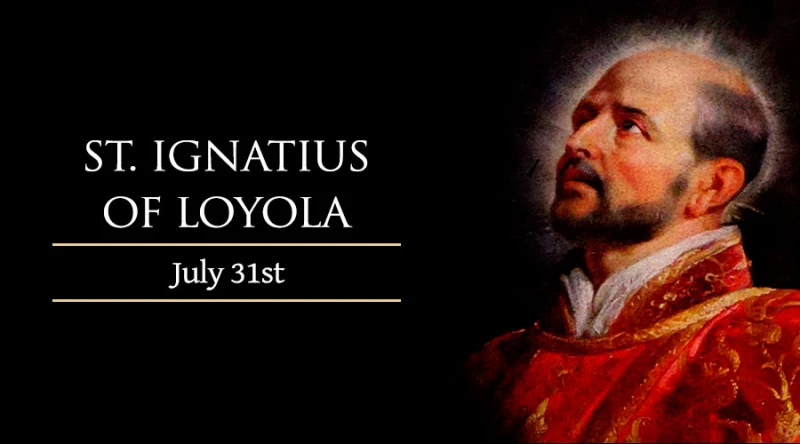
St. Ignatius of Loyola


St. Ignatius of Loyola

Feast date: Jul 31

On July 31, the Universal Church marks the feast day of St. Ignatius of Loyola. The Spanish saint is known for founding the Society of Jesus, also known as the Jesuits, as well as for creating the “Spiritual Exercises” often used today for retreats and individual discernment.

St. Ignatius was born into a noble family in 1491 in Guipuzcoa, Spain. He served as a page in the Spanish court of Ferdinand and Isabella.

He then became a soldier in the Spanish army and wounded his leg during the siege of Pamplona in 1521. During his recuperation, he read “Lives of the Saints.” The experience led him to undergo a profound conversion, and he dedicated himself to the Catholic faith.

After making a general confession in a monastery in Montserrat, St. Ignatius proceeded to spend almost a year in solitude. He wrote his famous “Spiritual Exercises” and then made a pilgrimage to Rome and the Holy Land, where he worked to convert Muslims.

St. Ignatius returned to complete his studies in Spain and then France, where he received his theology degree. While many held him in contempt because of his holy lifestyle, his wisdom and virtue attracted some followers, and the Society of Jesus was born.

The Society was approved by Pope Paul III in 1540, and it grew rapidly. St. Ignatius remained in Rome, where he governed the Society and became friends with St. Philip Neri.

St. Ignatius died peacefully on July 31, 1556. He was canonized by Pope Gregory XV in 1622.

The Jesuits remain numerous today, particularly in several hundred universities and colleges worldwide.

On April 22, 2006, Pope Benedict XVI presided over a Eucharistic concelebration for the Society of Jesus. He addressed the fathers and brothers of the Society present at the Vatican Basilica, calling to mind the dedication and fidelity of their founder.

“St. Ignatius of Loyola was first and foremost a man of God who in his life put God, his greatest glory and his greatest service, first,” the Pope said. “He was a profoundly prayerful man for whom the daily celebration of the Eucharist was the heart and crowning point of his day.”

“Precisely because he was a man of God, St Ignatius was a faithful servant of the Church,” Benedict continued, recalling the saint’s “special vow of obedience to the Pope, which he himself describes as ‘our first and principal foundation.’”

Highlighting the need for “an intense spiritual and cultural training,” Pope Benedict called upon the Society of Jesus to follow in the footsteps of St. Ignatius and continue his work of service to the Church and obedience to the Pope, so that it’s members “may faithfully meet the urgent needs of the Church today.” 

St. Ignatius of Loyola Read More »

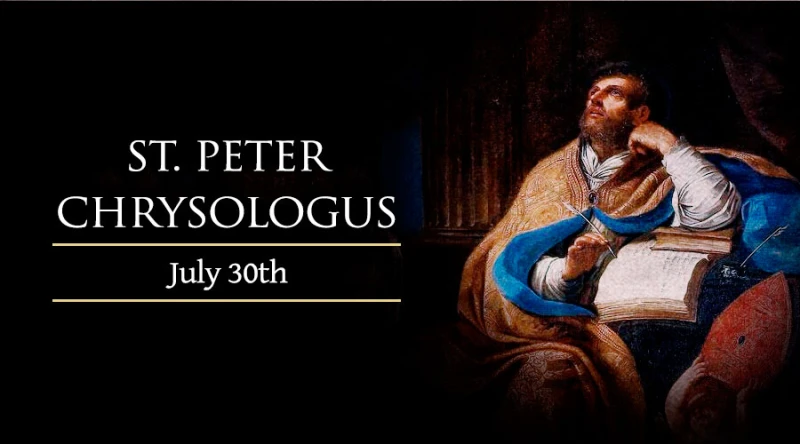
St. Peter Chrysologus


St. Peter Chrysologus

Feast date: Jul 30

On July 30, the Catholic Church celebrates Saint Peter Chrysologus, a fifth-century Italian bishop known for testifying courageously to Christ’s full humanity and divinity during a period of doctrinal confusion in the Church.

The saint’s title, Chrysologus, signifies “golden speech” in Greek. Named as a Doctor of the Church in 1729, he is distinguished as the “Doctor of Homilies” for the concise but theologically rich reflections he delivered during his time as the Bishop of Ravenna.

His surviving works offer eloquent testimony to the Church’s traditional beliefs about Mary’s perpetual virginity, the penitential value of Lent, Christ’s Eucharistic presence, and the primacy of St. Peter and his successors in the Church.

Few details of St. Peter Chrysologus’ biography are known. He was born in the Italian town of Imola in either the late fourth or early fifth century, but sources differ as to whether this occurred around 380 or as late as 406.

Following his study of theology, Peter was ordained to the diaconate by Imola’s local bishop Cornelius, whom he greatly admired and regarded as his spiritual father. Cornelius not only ordained Peter, but taught him the value of humility and self-denial.

The lessons of his mentor inspired Peter to live as a monk for many years, embracing a lifestyle of asceticism, simplicity, and prayer. His simple monastic life came to an end, however, after the death of Archbishop John of Ravenna in 430.

After John’s death, the clergy and people of Ravenna chose a successor and asked Cornelius, still the Bishop of Imola, to journey to Rome and obtain papal approval for the candidate. Cornelius brought Peter, then still a deacon, along with him on the visit to Pope Sixtus III.

Tradition relates that the Pope had experienced a vision from God on the night before the meeting, commanding him to overrule Ravenna’s choice of a new archbishop. The Pope declared that Peter, instead, was to be ordained as John’s successor.

In Ravenna, Peter was received warmly by the Western Roman Emperor Valentinian III, and his mother Galla Placidia. She is said to have given him the title of “Chrysologus” because of his preaching skills.

Throughout the archdiocese, however, he encountered the surviving remnants of paganism along with various abuses and distortions of the Catholic faith. Peter exercised zeal and pastoral care in curbing abuses and evangelizing non-Christians during his leadership of the Church in Ravenna.

One of the major heresies of his age, monophysitism, held that Christ did not possess a distinct human nature in union with his eternal divine nature. Peter laboured to prevent the westward spread of this error, promoted from Constantinople by the monk Eutyches.

The Archbishop of Ravenna also made improvements to the city’s cathedral and built several new churches. Near the end of his life he addressed a significant letter to Eutyches, stressing the Pope’s authority in the monophysite controversy.

Having returned to Imola in anticipation of his death, St. Peter Chrysologus died in 450, one year before the Church’s official condemnation of monophysitism. He is credited as the author of around 176 surviving homilies, which contributed to his later proclamation as a Doctor of the Church.

St. Peter Chrysologus Read More »

Saturday of the Seventeenth Week in Ordinary Time

Reading 1  JER 26:11-16, 24

The priests and prophets said to the princes and to all the people,
“This man deserves death;
he has prophesied against this city,
as you have heard with your own ears.”
Jeremiah gave this answer to the princes and all the people:
“It was the LORD who sent me to prophesy against this house and city
all that you have heard.
Now, therefore, reform your ways and your deeds;
listen to the voice of the LORD your God,
so that the LORD will repent of the evil with which he threatens you.
As for me, I am in your hands; 
do with me what you think good and right.
But mark well: if you put me to death,
it is innocent blood you bring on yourselves,
on this city and its citizens.
For in truth it was the LORD who sent me to you,
to speak all these things for you to hear.”

Thereupon the princes and all the people
said to the priests and the prophets,
“This man does not deserve death;
it is in the name of the LORD, our God, that he speaks to us.” 

So Ahikam, son of Shaphan, protected Jeremiah,
so that he was not handed over to the people to be put to death.

Responsorial Psalm  PS 69:15-16, 30-31, 33-34

R.(14c)  Lord, in your great love, answer me.
Rescue me out of the mire; may I not sink!
may I be rescued from my foes,
and from the watery depths.
Let not the flood-waters overwhelm me,
nor the abyss swallow me up,
nor the pit close its mouth over me.
R. Lord, in your great love, answer me.
But I am afflicted and in pain;
let your saving help, O God, protect me.
I will praise the name of God in song,
and I will glorify him with thanksgiving.
R. Lord, in your great love, answer me.
“See, you lowly ones, and be glad;
you who seek God, may your hearts revive!
For the LORD hears the poor,
and his own who are in bonds he spurns not.”
R. Lord, in your great love, answer me.

Alleluia  MT 5:10

R. Alleluia, alleluia.
Blessed are they who are persecuted for the sake of righteousness
for theirs is the Kingdom of heaven.
R. Alleluia, alleluia.

Gospel Mt 14:1-12

Herod the tetrarch heard of the reputation of Jesus
and said to his servants, “This man is John the Baptist.
He has been raised from the dead;
that is why mighty powers are at work in him.”

Now Herod had arrested John, bound him, and put him in prison
on account of Herodias, the wife of his brother Philip,
for John had said to him,
“It is not lawful for you to have her.”
Although he wanted to kill him, he feared the people,
for they regarded him as a prophet.
But at a birthday celebration for Herod,
the daughter of Herodias performed a dance before the guests
and delighted Herod so much
that he swore to give her whatever she might ask for.
Prompted by her mother, she said,
“Give me here on a platter the head of John the Baptist.”
The king was distressed,
but because of his oaths and the guests who were present,
he ordered that it be given, and he had John beheaded in the prison.
His head was brought in on a platter and given to the girl,
who took it to her mother.
His disciples came and took away the corpse
and buried him; and they went and told Jesus.

– – –

Lectionary for Mass for Use in the Dioceses of the United States, second typical edition, Copyright © 2001, 1998, 1997, 1986, 1970 Confraternity of Christian Doctrine; Psalm refrain © 1968, 1981, 1997, International Committee on English in the Liturgy, Inc. All rights reserved. Neither this work nor any part of it may be reproduced, distributed, performed or displayed in any medium, including electronic or digital, without permission in writing from the copyright owner.

Saturday of the Seventeenth Week in Ordinary Time Read More »

Memorial of Saints Martha, Mary, and Lazarus

Reading I Jer 26:1-9

In the beginning of the reign of Jehoiakim,
son of Josiah, king of Judah,
this message came from the LORD: 
Thus says the LORD:
Stand in the court of the house of the LORD
and speak to the people of all the cities of Judah
who come to worship in the house of the LORD;
whatever I command you, tell them, and omit nothing.
Perhaps they will listen and turn back,
each from his evil way,
so that I may repent of the evil I have planned to inflict upon them
for their evil deeds.
Say to them:  Thus says the LORD:
If you disobey me,
not living according to the law I placed before you
and not listening to the words of my servants the prophets,
whom I send you constantly though you do not obey them,
I will treat this house like Shiloh,
and make this the city to which all the nations of the earth
shall refer when cursing another.

Now the priests, the prophets, and all the people
heard Jeremiah speak these words in the house of the LORD.
When Jeremiah finished speaking
all that the LORD bade him speak to all the people,
the priests and prophets laid hold of him, crying,
“You must be put to death!
Why do you prophesy in the name of the LORD:
‘This house shall be like Shiloh,’ and
‘This city shall be desolate and deserted’?”
And all the people gathered about Jeremiah in the house of the LORD.
 

Responsorial Psalm 69:5, 8-10, 14

R.        (14c)  Lord, in your great love, answer me.
Those outnumber the hairs of my head
who hate me without cause.
Too many for my strength
are they who wrongfully are my enemies.
Must I restore what I did not steal?
R.        Lord, in your great love, answer me.
Since for your sake I bear insult,
and shame covers my face.
I have become an outcast to my brothers,
a stranger to my mother’s sons,
Because zeal for your house consumes me,
and the insults of those who blaspheme you fall upon me.
R.        Lord, in your great love, answer me.
But I pray to you, O LORD,
for the time of your favor, O God!
In your great kindness answer me
with your constant help.
R.        Lord, in your great love, answer me.


Alleluia Jn 8:12

R. Alleluia, alleluia.
I am the light of the world, says the Lord;
whoever follows me will have the light of life.

R. Alleluia, alleluia.
 

Gospel Jn 11:19-27

Many of the Jews had come to Martha and Mary
to comfort them about their brother [Lazarus, who had died].
When Martha heard that Jesus was coming,
she went to meet him;
but Mary sat at home.
Martha said to Jesus,
“Lord, if you had been here,
my brother would not have died.
But even now I know that whatever you ask of God,
God will give you.”
Jesus said to her,
“Your brother will rise.”
Martha said to him,
“I know he will rise,
in the resurrection on the last day.”
Jesus told her,
“I am the resurrection and the life;
whoever believes in me, even if he dies, will live,
and anyone who lives and believes in me will never die.
Do you believe this?”
She said to him, “Yes, Lord.
I have come to believe that you are the Christ, the Son of God,
the one who is coming into the world.”

OR:
Lk 10:38-42

Jesus entered a village
where a woman whose name was Martha welcomed him.
She had a sister named Mary
who sat beside the Lord at his feet listening to him speak.
Martha, burdened with much serving, came to him and said,
“Lord, do you not care
that my sister has left me by myself to do the serving?
Tell her to help me.”
The Lord said to her in reply,
“Martha, Martha, you are anxious and worried about many things.
There is need of only one thing.
Mary has chosen the better part
and it will not be taken from her.”


– – –

Lectionary for Mass for Use in the Dioceses of the United States, second typical edition, Copyright © 2001, 1998, 1997, 1986, 1970 Confraternity of Christian Doctrine; Psalm refrain © 1968, 1981, 1997, International Committee on English in the Liturgy, Inc. All rights reserved. Neither this work nor any part of it may be reproduced, distributed, performed or displayed in any medium, including electronic or digital, without permission in writing from the copyright owner.

Memorial of Saints Martha, Mary, and Lazarus Read More »