
Please mind our dust!

We are currently working on revamping our website!
Thank you for your patience!

CRD Solutions

St. Charbel Makhlouf
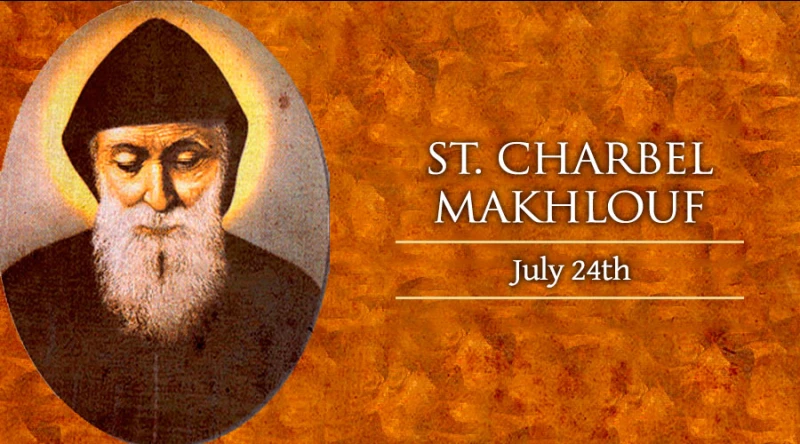

St. Charbel Makhlouf

Feast date: Jul 24

On July 24, the Catholic Church celebrates the life of St. Charbel Makhlouf, a Maronite Catholic priest, monk, and hermit who is known for working miracles both during his life and after his death.

On the occasion of his beatification in 1965, the Eastern Catholic hermit was described by Pope Paul VI as “ a new, eminent member of monastic sanctity,” who “through his example and his intercession is enriching the entire Christian people.”

Born into humble circumstances in Lebanon during 1828, Yussef Antoun Makhlouf was the youngest of Antoun Zaarour Makhlouf and Brigitta Elias al-Shediyaq’s five children. Antoun, who had been taken away from the family and forced into hard labor, died when his youngest son was only three.

Yussef studied at the parish school and tended to his family’s cow. Engaged in prayer and solitude from a early age, he spent a great deal of time outdoors in the fields and pastures near his village, contemplating God amid the inspiring views of Lebanon’s valleys and mountains.

His uncle and guardian Tanious wanted the boy to continue working with him, while his mother wanted him to marry a young woman. Yussef had other plans, however, and left home in 1851 without informing anyone.

Yussef would become “Brother Charbel,” after making a pilgrimage on foot to his new monastic home. In this, he followed the example of his maternal uncles, who were already living as solitary monks at the Hermitage of Saint Paul in the Qadisha Valley.

Charbel took his monastic vows in November of 1853, during a solemn ceremony which was closed to the public and off-limits even to his family. He subsequently studied for the priesthood and was ordained, returning to the Monastery of St. Maron.

The priest-monk lived and served in the monastery for 19 years, showing great devotion to the life of prayer, manual work, and contemplative silence.

Charbel’s superiors observed God’s “supernatural power” at work in his life, and he became known as a wonder-worker even among some Muslims. In 1875, he was granted permission to live as a solitary monk in a nearby hermitage dedicated to Saints Peter and Paul.

Rigorous asceticism, and a profound union with God, continued to characterise the monk’s life for the next 23 years. Deeply devoted to God’s Eucharistic presence, he suffered a stroke while celebrating the Divine Liturgy of the Maronite Catholic Church on December 16, 1898. He died on Christmas Eve of that year.

St. Charbel’s tomb has been a site for pilgrimages since his death. Hundreds of miracles are believed to have occurred through his intercession with God, both in Lebanon and around the world.

He was canonised in 1977 by Pope Paul VI, who had earlier hailed the Lebanese Maronite saint as an “admirable flower of sanctity blooming on the stem of the ancient monastic traditions of the East.”

St. Charbel Makhlouf Read More »
Seventeenth Sunday in Ordinary Time

Reading 1 Gn 18:20-32

In those days, the LORD said: “The outcry against Sodom and Gomorrah is so great,
and their sin so grave,
that I must go down and see whether or not their actions
fully correspond to the cry against them that comes to me.
I mean to find out.”

While Abraham’s visitors walked on farther toward Sodom,
the LORD remained standing before Abraham.
Then Abraham drew nearer and said:
“Will you sweep away the innocent with the guilty?
Suppose there were fifty innocent people in the city;
would you wipe out the place, rather than spare it
for the sake of the fifty innocent people within it?
Far be it from you to do such a thing,
to make the innocent die with the guilty
so that the innocent and the guilty would be treated alike!
Should not the judge of all the world act with justice?”
The LORD replied,
“If I find fifty innocent people in the city of Sodom,
I will spare the whole place for their sake.”
Abraham spoke up again:
“See how I am presuming to speak to my Lord,
though I am but dust and ashes!
What if there are five less than fifty innocent people?
Will you destroy the whole city because of those five?”
He answered, “I will not destroy it, if I find forty-five there.”
But Abraham persisted, saying “What if only forty are found there?”
He replied, “I will forbear doing it for the sake of the forty.”
Then Abraham said, “Let not my Lord grow impatient if I go on.
What if only thirty are found there?”
He replied, “I will forbear doing it if I can find but thirty there.”
Still Abraham went on,
“Since I have thus dared to speak to my Lord,
what if there are no more than twenty?”
The LORD answered, “I will not destroy it, for the sake of the twenty.”
But he still persisted:
“Please, let not my Lord grow angry if I speak up this last time.
What if there are at least ten there?”
He replied, “For the sake of those ten, I will not destroy it.”

Responsorial Psalm Ps 138:1-2, 2-3, 6-7, 7-8

R.(3a) Lord, on the day I called for help, you answered me.
I will give thanks to you, O LORD, with all my heart,
for you have heard the words of my mouth;
in the presence of the angels I will sing your praise;
I will worship at your holy temple
and give thanks to your name.
R. Lord, on the day I called for help, you answered me.
Because of your kindness and your truth;
for you have made great above all things
your name and your promise.
When I called you answered me;
you built up strength within me.
R. Lord, on the day I called for help, you answered me.
The LORD is exalted, yet the lowly he sees,
and the proud he knows from afar.
Though I walk amid distress, you preserve me;
against the anger of my enemies you raise your hand.
R. Lord, on the day I called for help, you answered me.
Your right hand saves me.
The LORD will complete what he has done for me;
your kindness, O LORD, endures forever;
forsake not the work of your hands.
R. Lord, on the day I called for help, you answered me.

Reading 2 Col 2:12-14

Brothers and sisters:
You were buried with him in baptism,
in which you were also raised with him
through faith in the power of God,
who raised him from the dead.
And even when you were dead
in transgressions and the uncircumcision of your flesh,
he brought you to life along with him,
having forgiven us all our transgressions;
 obliterating the bond against us, with its legal claims,
which was opposed to us,
he also removed it from our midst, nailing it to the cross.

Alleluia Rom 8:15bc

R. Alleluia, alleluia.
You have received a Spirit of adoption,
through which we cry, Abba, Father.
R. Alleluia, alleluia.

Gospel Lk 11:1-13

Jesus was praying in a certain place, and when he had finished,
one of his disciples said to him,
“Lord, teach us to pray just as John taught his disciples.”
He said to them, “When you pray, say:
Father, hallowed be your name,
your kingdom come.
Give us each day our daily bread
and forgive us our sins
for we ourselves forgive everyone in debt to us,
and do not subject us to the final test.”

And he said to them, “Suppose one of you has a friend
to whom he goes at midnight and says,
‘Friend, lend me three loaves of bread,
for a friend of mine has arrived at my house from a journey
and I have nothing to offer him,’
and he says in reply from within,
‘Do not bother me; the door has already been locked
and my children and I are already in bed.
I cannot get up to give you anything.’
I tell you,
if he does not get up to give the visitor the loaves
because of their friendship,
he will get up to give him whatever he needs
because of his persistence.

“And I tell you, ask and you will receive;
seek and you will find;
knock and the door will be opened to you.
For everyone who asks, receives;
and the one who seeks, finds;
and to the one who knocks, the door will be opened.
What father among you would hand his son a snake
when he asks for a fish?
Or hand him a scorpion when he asks for an egg?
If you then, who are wicked,
know how to give good gifts to your children,
how much more will the Father in heaven
give the Holy Spirit to those who ask him?”

– – –

Lectionary for Mass for Use in the Dioceses of the United States, second typical edition, Copyright © 2001, 1998, 1997, 1986, 1970 Confraternity of Christian Doctrine; Psalm refrain © 1968, 1981, 1997, International Committee on English in the Liturgy, Inc. All rights reserved. Neither this work nor any part of it may be reproduced, distributed, performed or displayed in any medium, including electronic or digital, without permission in writing from the copyright owner.

Seventeenth Sunday in Ordinary Time Read More »

St. John Cassian

Feast date: Jul 23

The Church celebrates the feast of St. John Cassian on July 23, an eastern monk and theological writer. He went to Palestine in 380 with a companion, Germanus, and became a monk in Egypt. In 400 he entered into the discipleship of St. John Chrysostom, going to Rome to defend the much-oppressed saint before Pope Innocent I.

Ordained in Rome, John founded several monasteries in southern France, near Marseilles, thus helping to pioneer monasticism in Europe. His two main writings, Institutes of the Monastic Life and Conferences on the Egyptian Monks, were much praised by St. Benedict and were extremelly influential for a very long time; the former had a direct impact upon Benedict during the time that he was composing his famed Rule.

John also authored the work De Incarnatione Doniini, in seven books, at the behest of Pope Leo I the Great so as to inform the Western Church of the details of the teachings of the heresiarch Nestorius. He died in 433 A.D

Printed with permission from Catholic-Defense.

St. John Cassian Read More »

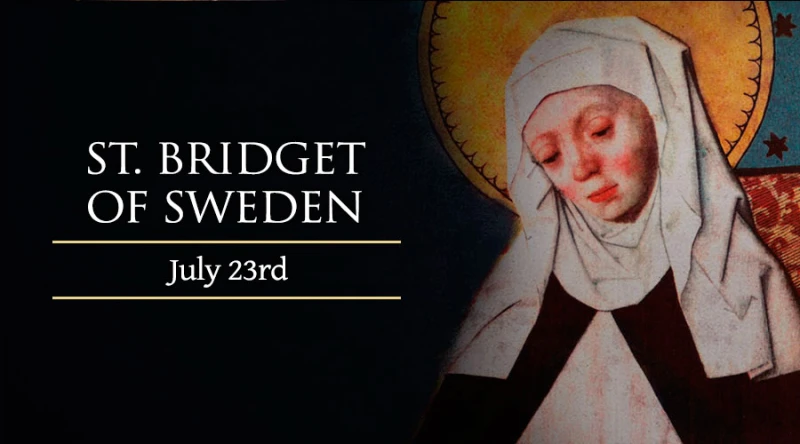
St. Bridget of Sweden


St. Bridget of Sweden

Feast date: Jul 23

Today, July 23, the Church celebrates the feast day of St. Bridget of Sweden.  Bridget received visions of Christ’s suffering many times throughout her life, and went on to found the order of the Most Holy Savior.

Daughter of Birger Persson, the governor and provincial judge of Uppland, and of Ingeborg Bengtsdotter, Bridget was born in Sweden in 1303. From the time she was a child, she was greatly devoted to the passion of Jesus.

When she was only ten, it is recorded that she had a vision of Jesus on the cross and heard him say, “Look at me, my daughter.”

“Who has treated you like this?” cried little Bridget.

Jesus answered, “Those who despise me and refuse my love for them.”  From that moment on, Bridget tried to stop people from offending Jesus.

When she was 14, Bridget married an 18-year old man named Ulf. Like Bridget, Ulf had set his heart on serving God. They had eight children, of whom one was St. Catherine of Sweden. Bridget and Ulf also served the Swedish court, Bridget as the queen’s personal maid. Bridget tried to help King Magnus and Queen Blanche lead better lives, however for the most part, they did not listen to her.

All her life, Bridget had marvelous visions and received special messages from God. In obedience to them, she visited many rulers and important people in the Church. She explained humbly what God expected of them.

After her husband died, Bridget put away her rich clothes and lived as a poor nun. Later, in 1346, she began the order of the Most Holy Savior, also known as Bridgettines. She still kept up her own busy life, traveling about doing good everywhere she went. And through all this activity, Jesus continued to reveal many secrets to her, which she received without the least bit of pride.

Shortly before she died, the saint went on a pilgrimage to the Holy Land. At the shrines there, she had visions of what Jesus had said and done in each place.

All St. Bridget’s revelations on the sufferings of Jesus were published after her death.

St. Bridget died in Rome on July 23, 1373. She was proclaimed a saint by Pope Boniface IX in 1391.

“True wisdom, then, consists in works, not in great talents, which the world admires; for the wise in the world’s estimation . . . are the foolish who set at naught the will of God, and know not how to control their passions.” –Saint Bridget of Sweden.

St. Bridget of Sweden Read More »

Saturday of the Sixteenth Week in Ordinary Time

Reading 1 Jer 7:1-11

The following message came to Jeremiah from the LORD:
Stand at the gate of the house of the LORD,
and there proclaim this message:
Hear the word of the LORD, all you of Judah
who enter these gates to worship the LORD!
Thus says the LORD of hosts, the God of Israel:
Reform your ways and your deeds,
so that I may remain with you in this place.
Put not your trust in the deceitful words:
“This is the temple of the LORD!
The temple of the LORD! The temple of the LORD!”
Only if you thoroughly reform your ways and your deeds;
if each of you deals justly with his neighbor;
if you no longer oppress the resident alien,
the orphan, and the widow;
if you no longer shed innocent blood in this place,
or follow strange gods to your own harm,
will I remain with you in this place,
in the land I gave your fathers long ago and forever.

But here you are, putting your trust in deceitful words to your own loss!
Are you to steal and murder, commit adultery and perjury,
burn incense to Baal,
go after strange gods that you know not,
and yet come to stand before me
in this house which bears my name, and say:
“We are safe; we can commit all these abominations again”?
Has this house which bears my name
become in your eyes a den of thieves?
I too see what is being done, says the LORD.

Responsorial Psalm Ps 84:3, 4, 5-6a and 8a, 11

R. (2) How lovely is your dwelling place, Lord, mighty God!
My soul yearns and pines
for the courts of the LORD.
My heart and my flesh
cry out for the living God.
R. How lovely is your dwelling place, Lord, mighty God!
Even the sparrow finds a home,
and the swallow a nest
in which she puts her young—
Your altars, O LORD of hosts,
my king and my God!
R. How lovely is your dwelling place, Lord, mighty God!
Blessed they who dwell in your house!
continually they praise you.
Blessed the men whose strength you are!
They go from strength to strength.
R. How lovely is your dwelling place, Lord, mighty God!
I had rather one day in your courts
than a thousand elsewhere;
I had rather lie at the threshold of the house of my God
than dwell in the tents of the wicked.
R. How lovely is your dwelling place, Lord, mighty God!

Alleluia Jas 1:21bc

R. Alleluia, alleluia.
Humbly welcome the word that has been planted in you
and is able to save your souls.
R. Alleluia, alleluia.

Gospel Mt 13:24-30

Jesus proposed a parable to the crowds.
“The Kingdom of heaven may be likened to a man
who sowed good seed in his field.
While everyone was asleep his enemy came
and sowed weeds all through the wheat, and then went off.
When the crop grew and bore fruit, the weeds appeared as well.
The slaves of the householder came to him and said,
‘Master, did you not sow good seed in your field?
Where have the weeds come from?’
He answered, ‘An enemy has done this.’
His slaves said to him, ‘Do you want us to go and pull them up?’
He replied, ‘No, if you pull up the weeds
you might uproot the wheat along with them.
Let them grow together until harvest;
then at harvest time I will say to the harvesters,
“First collect the weeds and tie them in bundles for burning;
but gather the wheat into my barn.”‘”

– – –

Lectionary for Mass for Use in the Dioceses of the United States, second typical edition, Copyright © 2001, 1998, 1997, 1986, 1970 Confraternity of Christian Doctrine; Psalm refrain © 1968, 1981, 1997, International Committee on English in the Liturgy, Inc. All rights reserved. Neither this work nor any part of it may be reproduced, distributed, performed or displayed in any medium, including electronic or digital, without permission in writing from the copyright owner.

Saturday of the Sixteenth Week in Ordinary Time Read More »