Please mind our dust!

We are currently working on revamping our website!
Thank you for your patience!

CRD Solutions

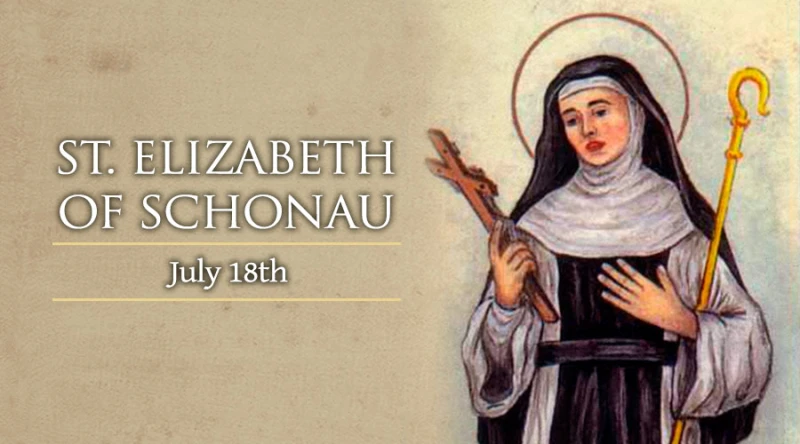
St. Elizabeth of Schonau


St. Elizabeth of Schonau

Feast date: Jul 18

St. Elizabeth was a Benedictine visionary, who had the gift of prophecy. She also suffered the assaults of demonic forces.

Elizabeth was born in Bonn, Germany, in 1126. She was raised and educated in a Benedictine monastery near her birthplace from the age of 12. Elizabeth came to see the monastery as home, and she took vows in 1147.

With the help of her brother Egbert, a monk and abbot, she wrote three volumes describing her visions.

She served as the abbess at Schonau from 1157 until her death in 1164.

St. Elizabeth was never formally canonized but was added to the list of saints due to great popular devotion.

St. Elizabeth of Schonau Read More »

Sixteenth Sunday in Ordinary Time

Reading 1 Gn 18:1-10a

The LORD appeared to Abraham by the terebinth of Mamre,
as he sat in the entrance of his tent,
while the day was growing hot.
Looking up, Abraham saw three men standing nearby.
When he saw them, he ran from the entrance of the tent to greet them;
and bowing to the ground, he said:
“Sir, if I may ask you this favor,
please do not go on past your servant.
Let some water be brought, that you may bathe your feet,
and then rest yourselves under the tree.
Now that you have come this close to your servant,
let me bring you a little food, that you may refresh yourselves;
and afterward you may go on your way.”
The men replied, “Very well, do as you have said.”

Abraham hastened into the tent and told Sarah,
“Quick, three measures of fine flour! Knead it and make rolls.”
He ran to the herd, picked out a tender, choice steer,
and gave it to a servant, who quickly prepared it.
Then Abraham got some curds and milk,
as well as the steer that had been prepared,
and set these before the three men;
and he waited on them under the tree while they ate.

They asked Abraham, “Where is your wife Sarah?”
He replied, “There in the tent.”
One of them said, “I will surely return to you about this time next year,
and Sarah will then have a son.”

Responsorial Psalm Ps 15:2-3, 3-4, 5

R.(1a) He who does justice will live in the presence of the Lord.
One who walks blamelessly and does justice;
who thinks the truth in his heart
and slanders not with his tongue.
R. He who does justice will live in the presence of the Lord.
Who harms not his fellow man,
nor takes up a reproach against his neighbor;
by whom the reprobate is despised,
while he honors those who fear the LORD.
R. He who does justice will live in the presence of the Lord.
Who lends not his money at usury
and accepts no bribe against the innocent.
One who does these things
shall never be disturbed.
R. He who does justice will live in the presence of the Lord.

Reading 2 Col 1:24-28

Brothers and sisters:
Now I rejoice in my sufferings for your sake,
and in my flesh I am filling up
what is lacking in the afflictions of Christ
on behalf of his body, which is the church,
of which I am a minister
in accordance with God’s stewardship given to me
to bring to completion for you the word of God,
the mystery hidden from ages and from generations past.
But now it has been manifested to his holy ones,
to whom God chose to make known the riches of the glory
of this mystery among the Gentiles;
it is Christ in you, the hope for glory.
It is he whom we proclaim,
admonishing everyone and teaching everyone with all wisdom,
that we may present everyone perfect in Christ.

Alleluia Cf. Lk 8:15

R. Alleluia, alleluia.
Blessed are they who have kept the word with a generous heart
and yield a harvest through perseverance.
R. Alleluia, alleluia.

Gospel Lk 10:38-42

Jesus entered a village
where a woman whose name was Martha welcomed him.
She had a sister named Mary
who sat beside the Lord at his feet listening to him speak.
Martha, burdened with much serving, came to him and said,
“Lord, do you not care
that my sister has left me by myself to do the serving?
Tell her to help me.”
The Lord said to her in reply,
“Martha, Martha, you are anxious and worried about many things.
There is need of only one thing.
Mary has chosen the better part
and it will not be taken from her.”

– – –

Lectionary for Mass for Use in the Dioceses of the United States, second typical edition, Copyright © 2001, 1998, 1997, 1986, 1970 Confraternity of Christian Doctrine; Psalm refrain © 1968, 1981, 1997, International Committee on English in the Liturgy, Inc. All rights reserved. Neither this work nor any part of it may be reproduced, distributed, performed or displayed in any medium, including electronic or digital, without permission in writing from the copyright owner.

Sixteenth Sunday in Ordinary Time Read More »

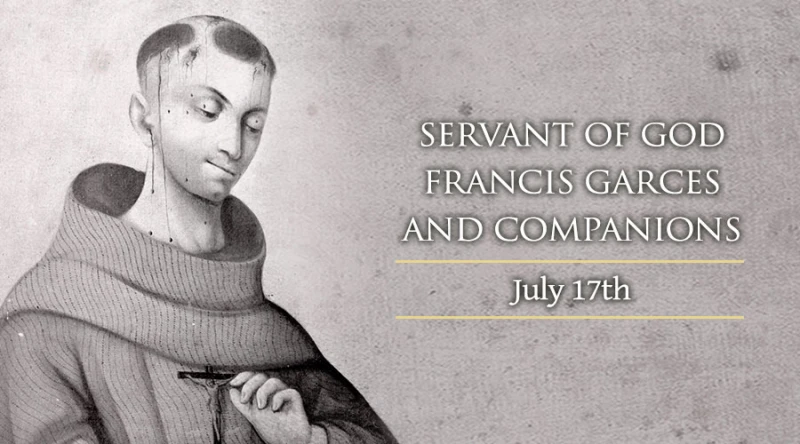
Servant of God Francis Garces and Companions


Servant of God Francis Garces and Companions

Feast date: Jul 17

A contemporary of the American Revolution and of Blessed Junipero Serra, Francisco Garcés was born in 1738 in Spain, where he joined the Franciscans.

After ordination in 1763, he was sent to Mexico. Five years later he was assigned to San Xavier del Bac near Tucson, one of several missions the Jesuits had founded in Arizona and New Mexico before being expelled in 1767 from all territories controlled by the Catholic king of Spain. In Arizona, Francisco worked among the Papago, Yuma, Pima and Apache Native Americans. His missionary travels took him to many places, including the Grand Canyon and California.

Friar Francisco Palou, a contemporary, writes that Father Garcés was greatly loved by the indigenous peoples, among whom he lived unharmed for a long time. They regularly gave him food and referred to him as “Viva Jesus,” which was the greeting he taught them to use.

For the sake of their indigenous converts, the Spanish missionaries wanted to organize settlements away from the Spanish soldiers and colonists. But the commandant in Mexico insisted that two new missions on the Colorado River, Misión San Pedro y San Pablo and Misión La Purísima Concepción, be mixed settlements.

A revolt among the Yumas against the Spanish left Friars Juan Diaz and Matias Moreno dead at Misión San Pedro y San Pablo. Friars Francisco Garcés and Juan Barreneche were killed at Misión La Purísima Concepción, the site of Fort Yuma.

Servant of God Francis Garces and Companions Read More »

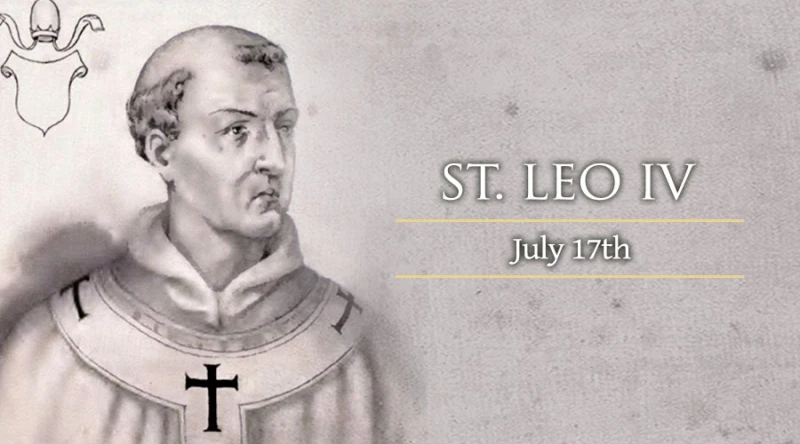
St. Leo IV


St. Leo IV

Feast date: Jul 17

The universal Church celebrates the life of St. Leo IV on July 17. Both a Roman and the son of Radoald, Leo was unanimously elected to succeed Sergius II as Pope. At the time of his election, there was an alarming attack of the Saracens on Rome in 846, which caused the people to fear the safety of the city. Because of the tension of the situation, Leo was consecrated on April 10, 847 without the consent of the emperor.

Leo received his early education at Rome in the monastery of St. Martin, near St. Peter’s Basillica. His pious behaviour drew the attention of Gregory IV, who made him a subdeacon, and he was later created Cardinal-Priest of the church of the Quatuor Coronati by Sergius II.

As soon as Leo, much against his will, became Pope, he began to take precautions against a repetitious acts of the Saracen raid of 846. He began a project to put the walls of the city into a thorough state of repair, entirely rebuilding fifteen of the great towers. He was the first to enclose the Vatican hill by a wall. In order to do this, he received money from the emperor, and help from all the cities and agricultural colonies (domus cultae) of the Duchy of Rome. The work took him four years to accomplish, and the newly fortified portion was called the Leonine City, after him. In 852 the fortifications were completed, and were blessed by the Pope with great solemnity.

It was by this Pope that the church of S. Maria Nova was built, to replace S. Maria Antiqua, which the decaying Palace of the Caesars threatened to engulf, and of which the ruins have recently been brought to light. In 850, Leo associated with Lothair in the empire of his son Louis, by imposing on him the imperial crown. Three years later “he hallowed the child Alfred to king [says an old English historian] by anointing; and receiving him for his own child by adoption, gave him confirmation, and sent him back [to England] with the blessing of St. Peter the Apostle.”

In the same year, 853, he held an important synod in Rome, in which various decrees were passed for the furtherance of ecclesiastical discipline and learning, and for the condemnation of the refractory Anastasius, Cardinal of St. Marcellus, and sometime librarian of the Roman Church. Equally rebellious conduct on the part of John, Archbishop of Ravenna, forced Leo to undertake a journey to that city to inspire John and his accomplices with respect for the law. It was duing his engaging endeavour to inspire another archbishop, Hincmar of Reims, with this same reverence, that Leo died.

He was buried in St. Peter’s on July 17, 855. He is credited with being a worker of miracles both by his biographer and by the Patriarch Photius. His name is found in the Roman Martyrology.

St. Leo IV Read More »

Saturday of the Fifteenth Week in Ordinary Time

Reading 1  MI 2:1-5

Woe to those who plan iniquity,
and work out evil on their couches;
In the morning light they accomplish it
when it lies within their power.
They covet fields, and seize them;
houses, and they take them;
They cheat an owner of his house,
a man of his inheritance.
Therefore thus says the LORD:
Behold, I am planning against this race an evil
from which you shall not withdraw your necks;
Nor shall you walk with head high,
for it will be a time of evil.

On that day a satire shall be sung over you,
and there shall be a plaintive chant:
“Our ruin is complete,
our fields are portioned out among our captors,
The fields of my people are measured out,
and no one can get them back!”
Thus you shall have no one
to mark out boundaries by lot
in the assembly of the LORD.

Responsorial Psalm PS 10:1-2, 3-4, 7-8, 14

R. (12b) Do not forget the poor, O Lord!
Why, O LORD, do you stand aloof?
Why hide in times of distress?
Proudly the wicked harass the afflicted,
who are caught in the devices the wicked have contrived. 
R. Do not forget the poor, O Lord!
For the wicked man glories in his greed,
and the covetous blasphemes, sets the LORD at nought.
The wicked man boasts, “He will not avenge it”;
“There is no God,” sums up his thoughts. 
R. Do not forget the poor, O Lord!
His mouth is full of cursing, guile and deceit;
under his tongue are mischief and iniquity.
He lurks in ambush near the villages;
in hiding he murders the innocent;
his eyes spy upon the unfortunate. 
R. Do not forget the poor, O Lord!
You do see, for you behold misery and sorrow,
taking them in your hands.
On you the unfortunate man depends;
of the fatherless you are the helper.
R. Do not forget the poor, O Lord!

Alleluia  2 COR 5:19

R. Alleluia, alleluia.
God was reconciling the world to himself in Christ,
and entrusting to us the message of reconciliation.
R. Alleluia, alleluia.

Gospel  MT 12:14-21

The Pharisees went out and took counsel against Jesus
to put him to death.

When Jesus realized this, he withdrew from that place.
Many people followed him, and he cured them all,
but he warned them not to make him known.
This was to fulfill what had been spoken through Isaiah the prophet:

Behold, my servant whom I have chosen,
my beloved in whom I delight;
I shall place my Spirit upon him,
and he will proclaim justice to the Gentiles.
He will not contend or cry out,
nor will anyone hear his voice in the streets.
A bruised reed he will not break,
a smoldering wick he will not quench,
until he brings justice to victory.
And in his name the Gentiles will hope.


– – –

Lectionary for Mass for Use in the Dioceses of the United States, second typical edition, Copyright © 2001, 1998, 1997, 1986, 1970 Confraternity of Christian Doctrine; Psalm refrain © 1968, 1981, 1997, International Committee on English in the Liturgy, Inc. All rights reserved. Neither this work nor any part of it may be reproduced, distributed, performed or displayed in any medium, including electronic or digital, without permission in writing from the copyright owner.
Saturday of the Fifteenth Week in Ordinary Time Read More »