Please mind our dust!

We are currently working on revamping our website!
Thank you for your patience!

CRD Solutions

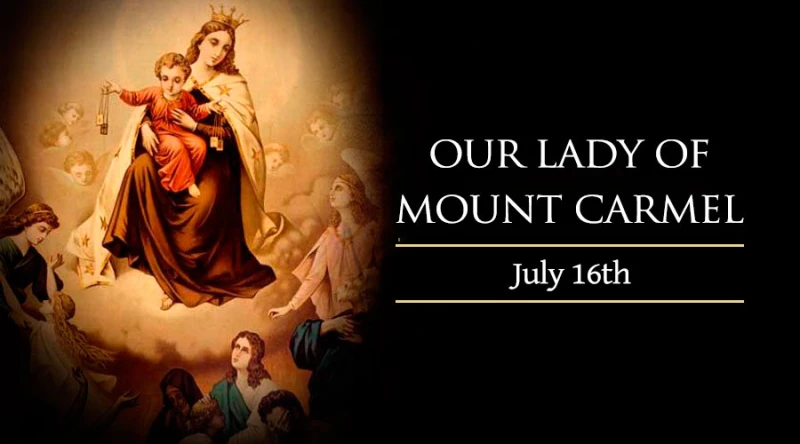
Our Lady of Mount Carmel


Our Lady of Mount Carmel

Feast date: Jul 16

On July 16 the Church celebrates the feast of Our Lady of Mount Carmel.

Mount Carmel is the mountain in the middle of the plain of Galilee on which the prophet Elijah called down a miracle of fire from the Lord, to show the people of Israel who had strayed that “The Lord is God!” and that the prophets of Baal were worshipping a false god.

There is a tradition that traces the Carmelite Order’s informal beginnings to the prophet Elijah himself, even though there is no evidence of this.

The formal beginnings are attributed to a group of monks who, in the 13th century, began living and praying on the mountain. They venerated the Virgin Mary as Our Lady of Mount Carmel, and from this veneration was derived the name Carmelite.

In 1226 the rule of the order was approved by Pope Honorius III, and 21 years later St. Simon Stock, an Englishman, was elected superior of the order. On July 16, 1251, the Blessed Virgin appeared to Simon and gave him the brown scapular and promised her protection to all those who wear the brown habit.

Pope Pius X decreed in the early 20th century that this blessing of the Blessed Virgin would extend to all who wear the medal of Our Lady of Mount Carmel.

The feast of Our Lady of Mount Carmel was instituted by the Carmelites sometime between 1376 and 1386.

Our Lady of Mount Carmel Read More »

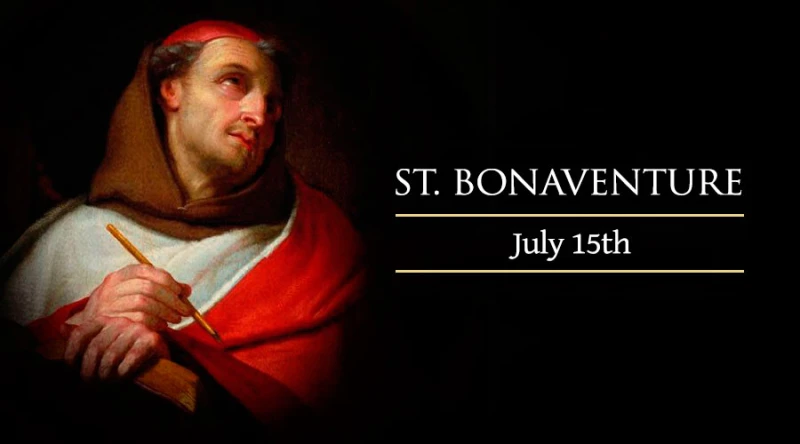
St. Bonaventure


St. Bonaventure

Feast date: Jul 15

Today, July 15, marks the feast day of St. Bonaventure, who is called “The Seraphic Doctor” of the Church. St. Bonaventure is known for his leadership of the Franciscans and his great intellectual contributions to theology and philosophy.

St. Bonaventure was born in Bagnorea in Tuscany, Italy. He is widely believed to have been born in the year 1221, although some accounts say 1217.

Sources recount that in his youth, St. Bonaventure was cured of a dangerous illness by the intercession of St. Francis of Assisi. He went on to join the Franciscan Order of Friars Minor in 1243.

After making his vows, he was sent to complete his studies in Paris. He was taught first by Alexander of Hales, an English doctor and Franciscan, and later by John of Rochelle.

While in Paris, he became good friends with St. Thomas Aquinas, with whom he received the degree of Doctor. He also developed a friendship with St. Louis, King of France.

In 1257, St. Bonaventure was chosen to serve as the superior of the Friars Minor. In this position, which he filled for 17 years, he brought peace and order. His impact was so great that today he is sometimes referred to as the second founder of the Franciscans.

Taking on the position after a period of extraordinary expansion for the order, St. Bonaventure worked to preserve a spirit of unity. He calmed the threat of internal dissension that arose over differences in interpreting the message of St. Francis of Assisi. Central to this work was his understanding that the study of philosophy and theology did not oppose the call to poverty that was so central to Franciscan spirituality.

St. Bonaventure proposed a unified and collected text regulating the daily life of the Friars Minor. The text was accepted and ratified in 1260 by the General Chapter of the Order in Narbonne.

Wishing to present an authentic image of the life and teaching of their founder, he zealously collected documents about St. Francis of Assisi and heard testimonies of those who had actually known him. From this information, he compiled a biography of the saint that was adopted as his official biography by the General Chapter of the Friars Minor in 1263.

St. Bonaventure also wrote numerous mystical and ascetical treatises, most famously, “The Soul’s Journey into God.”

In 1273, he was appointed by Pope Gregory X as Cardinal and Bishop of Albano. The Pope also asked him to help prepare the Second Ecumenical Council of Lyons, an ecclesial event aimed at re-establishing communion between the Latin and Greek Churches.

St. Bonaventure worked to prepare the Ecumenical Council, but never saw its completion. He died on July 15, 1274, while the council was still in session. He was canonized in 1482 by Pope Sixtus IV.

In his General Audience on March 3, 2010, Pope Benedict XVI spoke about the life of St. Bonaventure. He called to mind the great works of literature, art, philosophy and theology that were inspired by the Christian faith during the time period in which the saint lived.

“Among the great Christian figures who contributed to the composition of this harmony between faith and culture Bonaventure stands out, a man of action and contemplation, of profound piety and prudent government,” Pope Benedict said.

The Pope called on the faithful to take note of “the central role that Christ always played in Bonaventure’s life and teaching,” and to imitate the way in which “the whole of his thinking was profoundly Christocentric.”

“Meditation on Christ in His humanity is corporeal in deed, in fact, but spiritual in mind. . . . By adopting this habit, you will steady your mind, be trained to virtues, and receive strength of soul….Let meditation of Christ’s life be your one and only aim, your rest, your food, your desire, your study.”  –  St. Bonaventure

St. Bonaventure Read More »

Memorial of Saint Bonaventure, Bishop and Doctor of the Church

Reading 1  IS 38:1-6, 21-22, 7-8

When Hezekiah was mortally ill,
the prophet Isaiah, son of Amoz, came and said to him:
“Thus says the LORD: Put your house in order,
for you are about to die; you shall not recover.”
Then Hezekiah turned his face to the wall and prayed to the Lord:

“O LORD, remember how faithfully and wholeheartedly
I conducted myself in your presence,
doing what was pleasing to you!”
And Hezekiah wept bitterly.

Then the word of the LORD came to Isaiah: “Go, tell Hezekiah:
Thus says the LORD, the God of your father David:
I have heard your prayer and seen your tears.
I will heal you: in three days you shall go up to the Lord’s temple;
I will add fifteen years to your life.
I will rescue you and this city from the hand of the king of Assyria;
I will be a shield to this city.”

Isaiah then ordered a poultice of figs to be taken
and applied to the boil, that he might recover.
Then Hezekiah asked,
“What is the sign that I shall go up to the temple of the LORD?”

Isaiah answered:
“This will be the sign for you from the LORD
that he will do what he has promised:
See, I will make the shadow cast by the sun
on the stairway to the terrace of Ahaz
go back the ten steps it has advanced.”
So the sun came back the ten steps it had advanced.

Responsorial Psalm IS 38:10, 11, 12ABCD, 16

R. (see 17b) You saved my life, O Lord; I shall not die.
Once I said,
“In the noontime of life I must depart!
To the gates of the nether world I shall be consigned
for the rest of my years.” 
R. You saved my life, O Lord; I shall not die.
I said, “I shall see the LORD no more
in the land of the living.
No longer shall I behold my fellow men
among those who dwell in the world.”
R. You saved my life, O Lord; I shall not die.
My dwelling, like a shepherd’s tent,
is struck down and borne away from me;
You have folded up my life, like a weaver
who severs the last thread.
R. You saved my life, O Lord; I shall not die.
Those live whom the LORD protects;
yours is the life of my spirit.
You have given me health and life.
R. You saved my life, O Lord; I shall not die.

Alleluia  JN 10:27

R. Alleluia, alleluia.
My sheep hear my voice, says the Lord;
I know them, and they follow me.
R. Alleluia, alleluia.

Gospel  MT 12:1-8

Jesus was going through a field of grain on the sabbath.
His disciples were hungry
and began to pick the heads of grain and eat them.
When the Pharisees saw this, they said to him,
“See, your disciples are doing what is unlawful to do on the sabbath.”
He said to the them, “Have you not read what David did
when he and his companions were hungry,
how he went into the house of God and ate the bread of offering,
which neither he nor his companions
but only the priests could lawfully eat?
Or have you not read in the law that on the sabbath
the priests serving in the temple violate the sabbath
and are innocent?
I say to you, something greater than the temple is here.
If you knew what this meant, I desire mercy, not sacrifice,
you would not have condemned these innocent men.
For the Son of Man is Lord of the sabbath.”

– – –

Lectionary for Mass for Use in the Dioceses of the United States, second typical edition, Copyright © 2001, 1998, 1997, 1986, 1970 Confraternity of Christian Doctrine; Psalm refrain © 1968, 1981, 1997, International Committee on English in the Liturgy, Inc. All rights reserved. Neither this work nor any part of it may be reproduced, distributed, performed or displayed in any medium, including electronic or digital, without permission in writing from the copyright owner.

Memorial of Saint Bonaventure, Bishop and Doctor of the Church Read More »

Memorial of Saint Kateri Tekakwitha, Virgin

Reading 1  IS 26:7-9, 12, 16-19

The way of the just is smooth;
the path of the just you make level.
Yes, for your way and your judgments, O LORD,
we look to you;
Your name and your title
are the desire of our souls.
My soul yearns for you in the night,
yes, my spirit within me keeps vigil for you;
When your judgment dawns upon the earth,
the world’s inhabitants learn justice.
O LORD, you mete out peace to us,
for it is you who have accomplished all we have done.

O LORD, oppressed by your punishment,
we cried out in anguish under your chastising.
As a woman about to give birth
writhes and cries out in her pains,
so were we in your presence, O LORD.
We conceived and writhed in pain,
giving birth to wind;
Salvation we have not achieved for the earth,
the inhabitants of the world cannot bring it forth.
But your dead shall live, their corpses shall rise;
awake and sing, you who lie in the dust.
For your dew is a dew of light,
and the land of shades gives birth.

Responsorial Psalm PS 102:13-14AB AND 15, 16-18, 19-21

R. (20b) From heaven the Lord looks down on the earth.
You, O LORD, abide forever,
and your name through all generations.
You will arise and have mercy on Zion,
for it is time to pity her.
For her stones are dear to your servants,
and her dust moves them to pity. 
R. From heaven the Lord looks down on the earth.
The nations shall revere your name, O LORD,
and all the kings of the earth your glory,
When the LORD has rebuilt Zion
and appeared in his glory;
When he has regarded the prayer of the destitute,
and not despised their prayer.
R. From heaven the Lord looks down on the earth.
Let this be written for the generation to come,
and let his future creatures praise the LORD:
“The LORD looked down from his holy height,
from heaven he beheld the earth,
To hear the groaning of the prisoners,
to release those doomed to die.”
R. From heaven the Lord looks down on the earth.

Alleluia  MT 11:28

R. Alleluia, alleluia.
Come to me, all you who labor and are burdened,
and I will give you rest, says the Lord.
R. Alleluia, alleluia.

Gospel  MT 11:28-30

Jesus said:
“Come to me, all you who labor and are burdened,
and I will give you rest.
Take my yoke upon you and learn from me,
for I am meek and humble of heart;
and you will find rest for yourselves.
For my yoke is easy, and my burden light.”
 

– – –

Lectionary for Mass for Use in the Dioceses of the United States, second typical edition, Copyright © 2001, 1998, 1997, 1986, 1970 Confraternity of Christian Doctrine; Psalm refrain © 1968, 1981, 1997, International Committee on English in the Liturgy, Inc. All rights reserved. Neither this work nor any part of it may be reproduced, distributed, performed or displayed in any medium, including electronic or digital, without permission in writing from the copyright owner.

Memorial of Saint Kateri Tekakwitha, Virgin Read More »

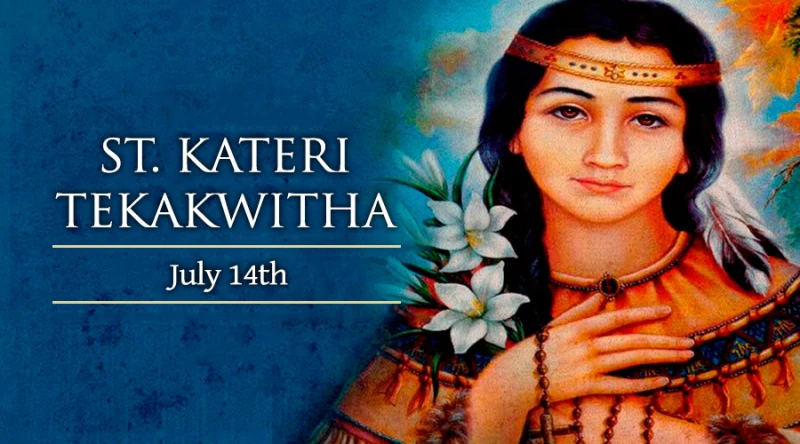
St. Kateri Tekakwitha


St. Kateri Tekakwitha

Feast date: Jul 14

On July 14, the Church celebrates the feast day of St. Kateri Tekakwitha, the first Native American to be canonized. Known as the “Lily of the Mohawks,” Kateri lived a life of holiness and virtue, despite obstacles and opposition within her tribe.

Kateri was born in Auriesville, New York, in 1656 to a Christian Algonquin woman and a pagan Mohawk chief. When she was a child, a smallpox epidemic attacked her tribe and both her parents died. She was left with permanent scars on her face and impaired eyesight. Her uncle, who had now become chief of the tribe, adopted her and her aunts began planning her marriage while she was still very young.

When three Jesuit fathers were visiting the tribe in 1667 and staying in the tent of her uncle, they spoke to her of Christ, and though she did not ask to be baptized, she believed in Jesus with an incredible intensity. She also realized that she was called into an intimate union with God as a consecrated virgin.

Kateri had to struggle to maintain her faith amidst the opposition of her tribe who ridiculed her for it and ostracized her for refusing the marriage that had been planned for her. When she was 18, Fr. Jacques de Lamberville returned to the Mohawk village, and she asked to be baptized.

The life of the Mohawk village had become violent and debauchery was commonplace. Realizing that this was proving too dangerous to her life and her call to perpetual virginity, Kateri escaped to the town of Caughnawaga in Quebec, near Montreal, where she grew in holiness and devotion to the Blessed Sacrament.

Kateri lived out the last years of her short life here, practicing austere penance and constant prayer. She was said to have reached the highest levels of mystical union with God, and many miracles were attributed to her while she was still alive.

She died on April 17, 1680 at the age of 24. Witnesses reported that within minutes of her death, the scars from smallpox completely vanished and her face shone with radiant beauty.

Devotion to Kateri began immediately after her death and her body, enshrined in Caughnawaga, is visited by many pilgrims each year. She was beatified by Pope John Paul II in 1980, and canonized by Pope Benedict XVI on October 21, 2012.

St. Kateri Tekakwitha Read More »