Please mind our dust!

We are currently working on revamping our website!
Thank you for your patience!

CRD Solutions

Wednesday of the Fifteenth Week in Ordinary Time

Reading 1  IS 10:5-7, 13B-16

Thus says the LORD:
Woe to Assyria! My rod in anger,
my staff in wrath.
Against an impious nation I send him,
and against a people under my wrath I order him
To seize plunder, carry off loot,
and tread them down like the mud of the streets.
But this is not what he intends,
nor does he have this in mind;
Rather, it is in his heart to destroy,
to make an end of nations not a few.

For he says:
“By my own power I have done it,
and by my wisdom, for I am shrewd.
I have moved the boundaries of peoples,
their treasures I have pillaged,
and, like a giant, I have put down the enthroned.
My hand has seized like a nest
the riches of nations;
As one takes eggs left alone,
so I took in all the earth;
No one fluttered a wing,
or opened a mouth, or chirped!”

Will the axe boast against him who hews with it?
Will the saw exalt itself above him who wields it?
As if a rod could sway him who lifts it,
or a staff him who is not wood!
Therefore the Lord, the LORD of hosts,
will send among his fat ones leanness,
And instead of his glory there will be kindling
like the kindling of fire.

Responsorial Psalm PS 94:5-6, 7-8, 9-10, 14-15

R. (14a) The Lord will not abandon his people.
Your people, O LORD, they trample down,
your inheritance they afflict.
Widow and stranger they slay,
the fatherless they murder. 
R. The Lord will not abandon his people.
And they say, “The LORD sees not;
the God of Jacob perceives not.”
Understand, you senseless ones among the people;
and, you fools, when will you be wise?
R. The Lord will not abandon his people.
Shall he who shaped the ear not hear?
or he who formed the eye not see?
Shall he who instructs nations not chastise,
he who teaches men knowledge?
R. The Lord will not abandon his people.
For the LORD will not cast off his people,
nor abandon his inheritance;
But judgment shall again be with justice,
and all the upright of heart shall follow it. 
R. The Lord will not abandon his people.

Alleluia  MT 11:25

R. Alleluia, alleluia.
Blessed are you, Father, Lord of heaven and earth,
you have revealed to little ones the mysteries of the Kingdom.
R. Alleluia, alleluia.
 

Gospel  MT 11:25-27

At that time Jesus exclaimed: 
“I give praise to you, Father, Lord of heaven and earth,
for although you have hidden these things
from the wise and the learned
you have revealed them to the childlike.
Yes, Father, such has been your gracious will.
All things have been handed over to me by my Father.
No one knows the Son except the Father,
and no one knows the Father except the Son
and anyone to whom the Son wishes to reveal him.”

– – –

Lectionary for Mass for Use in the Dioceses of the United States, second typical edition, Copyright © 2001, 1998, 1997, 1986, 1970 Confraternity of Christian Doctrine; Psalm refrain © 1968, 1981, 1997, International Committee on English in the Liturgy, Inc. All rights reserved. Neither this work nor any part of it may be reproduced, distributed, performed or displayed in any medium, including electronic or digital, without permission in writing from the copyright owner.

Wednesday of the Fifteenth Week in Ordinary Time Read More »
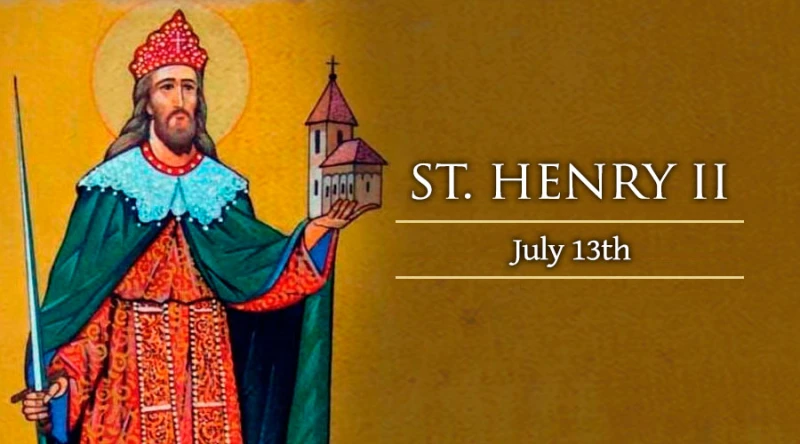
St. Henry II


St. Henry II

Feast date: Jul 13

On July 13, the Catholic Church celebrates the memory of St. Henry II, a German king who led and defended Europe’s Holy Roman Empire at the beginning of the first millennium.

St. Henry was born in 972 to Duke Henry of Bavaria and Princess Gisela of Burgundy. During his youth, Henry received both an education and spiritual guidance from a bishop who was himself canonized, St. Wolfgang of Regensberg. Henry was an intelligent and devout student, and for a period of time he was considered for the priesthood.

St. Wolfgang’s lessons in piety and charity left a lasting mark on Henry’s soul. But it was ultimately in the political realm, not the Church, that he would seek to exercise these virtues. He took on his father’s position as Duke of Bavaria in 995, one year after St. Wolfgang’s death. The Church supported his accession to the throne as King of Germany in 1002.

As king, Henry encouraged the German bishops to reform the practices of the Church in accordance with canon law. During the same period he is said to have brought a peaceful end to a revolt in his territory, which ended with the king mercifully pardoning the rebels. Henry also acted decisively, but not harshly, against an Italian nobleman who set himself up as a rival king.

In 1014, the German king journeyed to Rome where Pope Benedict VIII formally crowned him as head of the Holy Roman Empire. The emperor demonstrated his loyalty to the Pope by confirming Benedict VIII’s authority over the city of Rome. Henry made his journey from Rome back to Germany into a pilgrimage of sorts, stopping at various monasteries along the way.

Henry became a great patron of churches and monasteries, donating so much of his wealth to them that his relatives complained that he was behaving irresponsibly. But Henry was far from irresponsible, as his leadership of the Western Empire in both war and peace demonstrated. The emperor was also a great patron of the poor, making enormous contributions for their relief.

The emperor’s extraordinary generosity was made possible in part by his lack of an heir. He was married to a woman who was later canonized in her own right, St. Cunigunde of Luxembourg, but the two had no children. Some accounts say that the couple took vows of virginity and never consummated their marriage, though this explanation of their childlessness is not universally accepted.

For the last several years of his life, Henry had to deal with serious illness, and an additional ailment that crippled his left leg, along with his imperial responsibilities. He found support in prayer during these trials, and seriously considered resigning his imperial leadership in order to become a monk.

After several years of illness, St. Henry II died in July of 1024. The public mourned sincerely for the monarch who had managed to lead his earthly kingdom so responsibly without losing sight of the Kingdom of God. Pope Eugene III canonized him in 1146.

St. Henry II Read More »

St. Ignatius Delgado

Feast date: Jul 12

St. Ignatius Delgado, whose feast we celebrate on July 12, was a Spanish missionary and is now one of the martyrs of Vietnam.

He was born in Villafeliche, Spain, in 1761, and was raised in a pious family. He became a Dominican priest and served as a missionary in Vietnam for almost 50 years.

He was named coadjutor vicar-apostolic at East Tonkin, Vietnam. However, government-sanctioned persecution of Christians began soon after. Ignatius was arrested and locked in a cage, then put on public display for ridicule and abuse, and left to die. He died of hunger and exposure in 1838.

The martyr was canonized by Pope John Paul II in 1988.

St. Ignatius Delgado Read More »

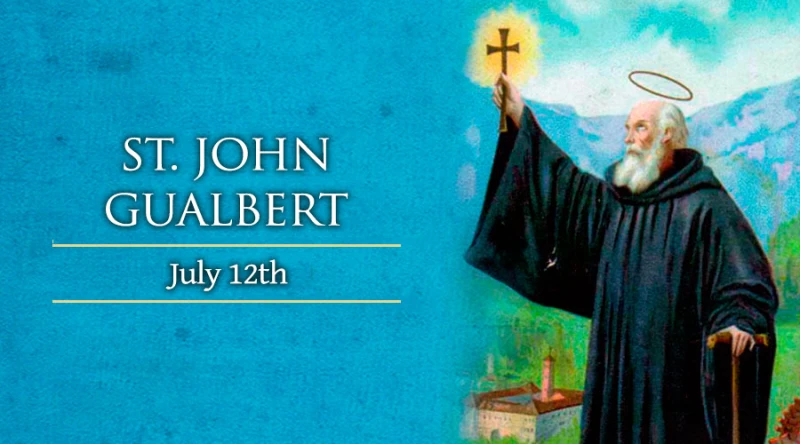
St. John Gualbert


St. John Gualbert

Feast date: Jul 12

Born in Florence, Italy, around the year 993, John was born into a noble family, and led a predictably frivolous life as a youth, being concerned only with the pursuit of vain amusements and romantic intrigues.

However, when he was still a young man, his elder brother Hugh was murdered, and John was so overtaken with grief that he vowed to avenge him. His only desire was to find the murderer and kill him.

One day – it was Good Friday – as he was riding through the town, John spotted his brother’s murderer and drew his sword to kill him. The man fell to his knees and begged for mercy.  At this instant John had a vision of Christ on the Cross, and powerfully moved by the example of the love of Christ who forgave His enemies, and he did the same.

After this encounter, he went straight to a monastery and begged to join.  As a sign of his earnest desire, he shaved off all his hair. The abbot, who had been reluctant to admit John because he feared the displeasure of his influential father, agreed and John lived in the monastery for a few years before moving on to find a more solitary and strict life.

Discovering that many of the orders that he had looked into joining were tainted with the corruption that was rampant in the Church at the time, he decided that God was calling him to found something new.

On a plot of land east of Florence called Vallombrosa, together with men who were equally committed to a more austere and stricter following of the Rule of St. Benedict, he founded a humble monastery devoted to contemplation and prayer and care of the poor and sick.

Renowned for his humility, holiness of life, and his wisdom – he refused any office of privilege, and declined to receive holy orders of any kind – he was often consulted by popes.

John died at the age of 80, in 1073, and was canonized in 1193.

The Vallombrosan Benedictines are still existent today, mainly in the region of Tuscany and Lombardy, and number a handful of monasteries.

St. John Gualbert Read More »

Tuesday of the Fifteenth Week in Ordinary Time

Reading 1  IS 7:1-9

In the days of Ahaz, king of Judah, son of Jotham, son of Uzziah,
Rezin, king of Aram,
and Pekah, king of Israel, son of Remaliah,
went up to attack Jerusalem,
but they were not able to conquer it.
When word came to the house of David that Aram
was encamped in Ephraim,
the heart of the king and the heart of the people trembled,
as the trees of the forest tremble in the wind.

Then the LORD said to Isaiah: Go out to meet Ahaz,
you and your son Shear-jashub,
at the end of the conduit of the upper pool,
on the highway of the fuller’s field, and say to him:
Take care you remain tranquil and do not fear;
let not your courage fail
before these two stumps of smoldering brands
the blazing anger of Rezin and the Arameans,
and of the son Remaliah,
because of the mischief that
Aram, Ephraim and the son of Remaliah,
plots against you, saying,
“Let us go up and tear Judah asunder, make it our own by force,
and appoint the son of Tabeel king there.”

Thus says the LORD:
This shall not stand, it shall not be!
Damascus is the capital of Aram,
and Rezin is the head of Damascus;
Samaria is the capital of Ephraim,
and Remaliah’s son the head of Samaria.

But within sixty years and five,
Ephraim shall be crushed, no longer a nation.
Unless your faith is firm
you shall not be firm!

Responsorial Psalm PS 48:2-3A, 3B-4, 5-6, 7-8

R. (see 9d) God upholds his city for ever.
Great is the LORD and wholly to be praised
in the city of our God.
His holy mountain, fairest of heights,
is the joy of all the earth.
R. God upholds his city for ever.
Mount Zion, “the recesses of the North,”
is the city of the great King.
God is with her castles;
renowned is he as a stronghold. 
R. God upholds his city for ever.
For lo! the kings assemble,
they come on together;
They also see, and at once are stunned,
terrified, routed.
R. God upholds his city for ever.
Quaking seizes them there;
anguish, like a woman’s in labor,
As though a wind from the east
were shattering ships of Tarshish. 
R. God upholds his city for ever.

Alleluia  PS 95:8

R. Alleluia, alleluia.
If today you hear his voice,
harden not your hearts.
R. Alleluia, alleluia.

Gospel  MT 11:20-24

Jesus began to reproach the towns
where most of his mighty deeds had been done,
since they had not repented.
“Woe to you, Chorazin! Woe to you, Bethsaida!
For if the mighty deeds done in your midst
had been done in Tyre and Sidon,
they would long ago have repented in sackcloth and ashes.
But I tell you, it will be more tolerable
for Tyre and Sidon on the day of judgment than for you.
And as for you, Capernaum:

Will you be exalted to heaven?
You will go down to the nether world.

For if the mighty deeds done in your midst had been done in Sodom,
it would have remained until this day.
But I tell you, it will be more tolerable
for the land of Sodom on the day of judgment than for you.”

– – –

Lectionary for Mass for Use in the Dioceses of the United States, second typical edition, Copyright © 2001, 1998, 1997, 1986, 1970 Confraternity of Christian Doctrine; Psalm refrain © 1968, 1981, 1997, International Committee on English in the Liturgy, Inc. All rights reserved. Neither this work nor any part of it may be reproduced, distributed, performed or displayed in any medium, including electronic or digital, without permission in writing from the copyright owner.

Tuesday of the Fifteenth Week in Ordinary Time Read More »