Please mind our dust!

We are currently working on revamping our website!
Thank you for your patience!

CRD Solutions

Memorial of Saint Benedict, Abbot

Reading 1  IS 1:10-17

Hear the word of the LORD,
princes of Sodom!
Listen to the instruction of our God,
people of Gomorrah!
What care I for the number of your sacrifices?
says the LORD.
I have had enough of whole-burnt rams
and fat of fatlings;
In the blood of calves, lambs and goats
I find no pleasure.

When you come in to visit me,
who asks these things of you?
Trample my courts no more!
Bring no more worthless offerings;
your incense is loathsome to me.
New moon and sabbath, calling of assemblies,
octaves with wickedness: these I cannot bear.
Your new moons and festivals I detest;
they weigh me down, I tire of the load.
When you spread out your hands,
I close my eyes to you;
Though you pray the more,
I will not listen.
Your hands are full of blood!
Wash yourselves clean!
Put away your misdeeds from before my eyes;
cease doing evil; learn to do good.
Make justice your aim: redress the wronged,
hear the orphan’s plea, defend the widow.

Responsorial Psalm PS 50:8-9, 16BC-17, 21 AND 23

R. (23b) To the upright I will show the saving power of God.
“Not for your sacrifices do I rebuke you,
for your burnt offerings are before me always.
I take from your house no bullock,
no goats out of your fold.”
R. To the upright I will show the saving power of God.
“Why do you recite my statutes,
and profess my covenant with your mouth,
Though you hate discipline
and cast my words behind you?”
R. To the upright I will show the saving power of God.
“When you do these things, shall I be deaf to it?
Or do you think you that I am like yourself?
I will correct you by drawing them up before your eyes.
He that offers praise as a sacrifice glorifies me;
and to him that goes the right way I will show the salvation of God.”
R. To the upright I will show the saving power of God.

Alleluia  MT 5:10

R. Alleluia, alleluia.
Blessed are they who are persecuted for the sake of righteousness,
for theirs is the Kingdom of heaven.
R. Alleluia, alleluia.

Gospel  MT 10:34-11:1

Jesus said to his Apostles:
“Do not think that I have come to bring peace upon the earth.
I have come to bring not peace but the sword.
For I have come to set
a man against his father,
a daughter against her mother,
and a daughter-in-law against her mother-in-law;
and one’s enemies will be those of his household.

“Whoever loves father or mother more than me is not worthy of me,
and whoever loves son or daughter more than me is not worthy of me;
and whoever does not take up his cross
and follow after me is not worthy of me.
Whoever finds his life will lose it,
and whoever loses his life for my sake will find it.

“Whoever receives you receives me,
and whoever receives me receives the one who sent me.
Whoever receives a prophet because he is a prophet
will receive a prophet’s reward,
and whoever receives a righteous man
because he is righteous 
will receive a righteous man’s reward.
And whoever gives only a cup of cold water
to one of these little ones to drink
because he is a disciple–
amen, I say to you, he will surely not lose his reward.”

When Jesus finished giving these commands to his Twelve disciples,
he went away from that place to teach and to preach in their towns.

– – –

Lectionary for Mass for Use in the Dioceses of the United States, second typical edition, Copyright © 2001, 1998, 1997, 1986, 1970 Confraternity of Christian Doctrine; Psalm refrain © 1968, 1981, 1997, International Committee on English in the Liturgy, Inc. All rights reserved. Neither this work nor any part of it may be reproduced, distributed, performed or displayed in any medium, including electronic or digital, without permission in writing from the copyright owner.

Memorial of Saint Benedict, Abbot Read More »
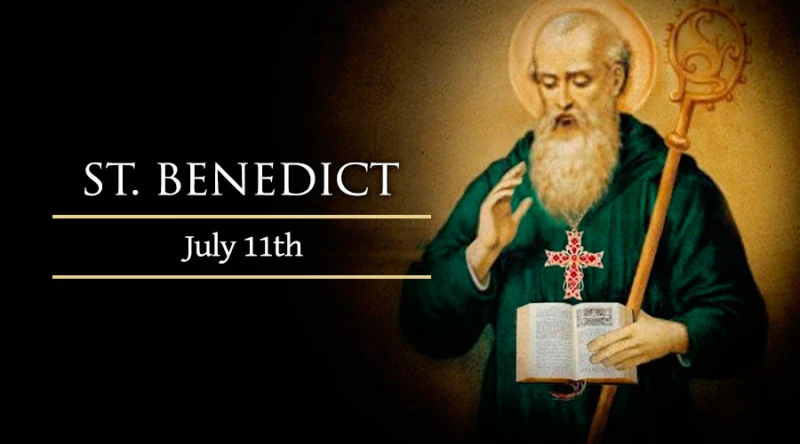
St. Benedict


St. Benedict

Feast date: Jul 11

On July 11, the Catholic Church celebrates the feast of Saint Benedict of Nursia, the sixth-century abbot who gave Christian monasticism its lasting foundation in Western Europe.

For his historic role as the “Father of Western Monasticism,” St. Benedict was declared a co-patron of Europe (along with Saints Cyril and Methodius). St. Benedict is also the patron saint of Pope Benedict XVI’s pontificate.

In a 2005 general audience, Pope Benedict XVI said St. Benedict was a “powerful reminder of the indispensable Christian roots” of Europe. He cited the monk’s instruction to “prefer nothing to the love of Christ,” and asked his intercession “to help us keep Christ firmly at the heart of our lives.”

Born to upper-class parents in modern-day Italy during the year 480, Benedict was sent to Rome to study the humanities. However, he soon became disgusted with the loose morals that prevailed among the students. Withdrawing from the city, he lived briefly with a group of monks, then as a hermit.

The young man spent three years in solitude, facing and overcoming severe temptations through prayer and asceticism. Only after doing so, did he have the confidence to emerge as an organizer of monastic communities. His first monasteries were established in the Anio valley outside Subiaco.

Benedict’s monasteries in Subiaco became centers of education for children, a tradition which would continue in the order during his lifetime and beyond. His monastic movement, like its forebears in the Christian East, attracted large numbers of people who were looking to live their faith more deeply.

During 529, Benedict left Subiaco for Monte Cassino, 80 miles south of Rome. The move was geographically and spiritually significant, marking a more public emergence of the Western monastic movement. Benedict destroyed a pagan temple atop the mountain, and built two oratories in its place.

It was most likely at Monte Cassino that the abbot drew up a rule of life, the famous “Rule of St. Benedict,” which emphasised prayer, work, simplicity, and hospitality. Though known as a rule for monks, it is addressed to all those who seek “to do battle for Christ the Lord, the true King.”

Benedict’s life was marked by various intrigues and miraculous incidents, which are described in his biography written by Pope St. Gregory the Great. One of the most remarkable was his meeting in 543 with Totila, King of the Goths, in which the abbot rebuked the king’s lifestyle and prophesied his death.

St. Scholastica, Benedict’s sister, also embraced religious life as a nun. She most likely died shortly before him, around the year 543. In his final years, the abbot himself had a profound mystical experience, which is said to have involved a supernatural vision of God and the whole of creation.

Around the age of 63, Benedict suffered his final illness. He was carried into the church by his fellow monks, where he received the Eucharist for the last time. Held up by his disciples, he raised his hands in prayer for the last time, before dying in their arms.

Although his influence was primarily felt in Western Europe, St. Benedict is also celebrated by the Eastern Catholic churches, and by Eastern Orthodox Christians, on March 14.

St. Benedict Read More »

Fifteenth Sunday in Ordinary Time

Reading 1 Dt 30:10-14

Moses said to the people:
“If only you would heed the voice of the LORD, your God,
and keep his commandments and statutes
that are written in this book of the law,
when you return to the LORD, your God,
with all your heart and all your soul.

“For this command that I enjoin on you today
is not too mysterious and remote for you.
It is not up in the sky, that you should say,
‘Who will go up in the sky to get it for us
and tell us of it, that we may carry it out?’
Nor is it across the sea, that you should say,
‘Who will cross the sea to get it for us
and tell us of it, that we may carry it out?’
No, it is something very near to you,
already in your mouths and in your hearts;
you have only to carry it out.”

Responsorial Psalm Ps 69:14, 17, 30-31, 33-34, 36, 37

R. (cf. 33)  Turn to the Lord in your need, and you will live.
I pray to you, O LORD,
 for the time of your favor, O God!
In your great kindness answer me
 with your constant help.
Answer me, O LORD, for bounteous is your kindness:
 in your great mercy turn toward me.
R. Turn to the Lord in your need, and you will live.
I am afflicted and in pain;
 let your saving help, O God, protect me.
I will praise the name of God in song,
 and I will glorify him with thanksgiving.
R. Turn to the Lord in your need, and you will live.
“See, you lowly ones, and be glad;
 you who seek God, may your hearts revive!
For the LORD hears the poor,
 and his own who are in bonds he spurns not.”
R. Turn to the Lord in your need, and you will live.
For God will save Zion
 and rebuild the cities of Judah.
The descendants of his servants shall inherit it,
 and those who love his name shall inhabit it.
R. Turn to the Lord in your need, and you will live.

or Ps 19:8, 9, 10, 11

R.(9a) Your words, Lord, are Spirit and life.
The law of the LORD is perfect,
 refreshing the soul;
the decree of the LORD is trustworthy,
 giving wisdom to the simple.
R. Your words, Lord, are Spirit and life.
The precepts of the LORD are right,
 rejoicing the heart;
the command of the LORD is clear,
 enlightening the eye.
R. Your words, Lord, are Spirit and life.
The fear of the LORD is pure,
 enduring forever;
the ordinances of the LORD are true,
 all of them just.
R. Your words, Lord, are Spirit and life.
They are more precious than gold,
 than a heap of purest gold;
sweeter also than syrup
 or honey from the comb.
R. Your words, Lord, are Spirit and life.

Reading 2 Col1:15-20

Christ Jesus is the image of the invisible God,
the firstborn of all creation.
For in him were created all things in heaven and on earth,
the visible and the invisible,
whether thrones or dominions or principalities or powers;
all things were created through him and for him.
He is before all things,
and in him all things hold together.
He is the head of the body, the church.
He is the beginning, the firstborn from the dead,
that in all things he himself might be preeminent.
For in him all the fullness was pleased to dwell,
and through him to reconcile all things for him,
making peace by the blood of his cross
through him, whether those on earth or those in heaven.

Alleluia Cf. Jn 6:63c, 68c

R. Alleluia, alleluia.
Your words, Lord, are Spirit and life;
you have the words of everlasting life.
R. Alleluia, alleluia.

Gospel Lk 10:25-37

There was a scholar of the law who stood up to test Jesus and said,
“Teacher, what must I do to inherit eternal life?”
Jesus said to him, “What is written in the law?
How do you read it?”
He said in reply,
“You shall love the Lord, your God,
with all your heart,
with all your being,
with all your strength,
and with all your mind,
and your neighbor as yourself.”

He replied to him, “You have answered correctly;
do this and you will live.”

But because he wished to justify himself, he said to Jesus,
“And who is my neighbor?”
Jesus replied,
“A man fell victim to robbers
as he went down from Jerusalem to Jericho.
They stripped and beat him and went off leaving him half-dead.
A priest happened to be going down that road,
but when he saw him, he passed by on the opposite side.
Likewise a Levite came to the place,
and when he saw him, he passed by on the opposite side.
But a Samaritan traveler who came upon him
was moved with compassion at the sight.
He approached the victim,
poured oil and wine over his wounds and bandaged them.
Then he lifted him up on his own animal,
took him to an inn, and cared for him.
The next day he took out two silver coins
and gave them to the innkeeper with the instruction,
‘Take care of him.
If you spend more than what I have given you,
I shall repay you on my way back.’
Which of these three, in your opinion,
was neighbor to the robbers’ victim?”
He answered, “The one who treated him with mercy.”
Jesus said to him, “Go and do likewise.”


– – –

Lectionary for Mass for Use in the Dioceses of the United States, second typical edition, Copyright © 2001, 1998, 1997, 1986, 1970 Confraternity of Christian Doctrine; Psalm refrain © 1968, 1981, 1997, International Committee on English in the Liturgy, Inc. All rights reserved. Neither this work nor any part of it may be reproduced, distributed, performed or displayed in any medium, including electronic or digital, without permission in writing from the copyright owner.

Fifteenth Sunday in Ordinary Time Read More »

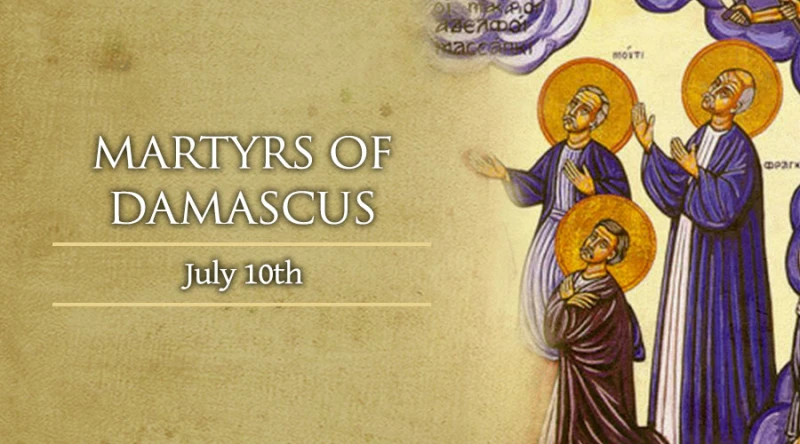
Martyrs of Damascus


Martyrs of Damascus

Feast date: Jul 10

Beatified by Pope Pius XI in 1926, these eight Franciscan friars and three Maronite laymen were offered the choice of converting to Islam or suffering death in Damascus on July 9, 1860.

Thousands of Maronite Christians had already been killed by the Druz in Southern Lebanon in that year and the Druz, an offshoot sect of Shiite Islam, had turned their attention to Damascus where they killed nearly two thousand more.

When they had reached the Franciscan convent there, the superior, a spaniard named Fr. Emmanuel Ruiz, who had sheltered the Christians that lived around the convent inside the chapel, was threatened with death if he did not convert immediately.

He refused and they cut him to pieces and killed the rest of his community and the three Maronites who, refusing to flee with the other Christians, chose to die rather than deny their faith.

Martyrs of Damascus Read More »

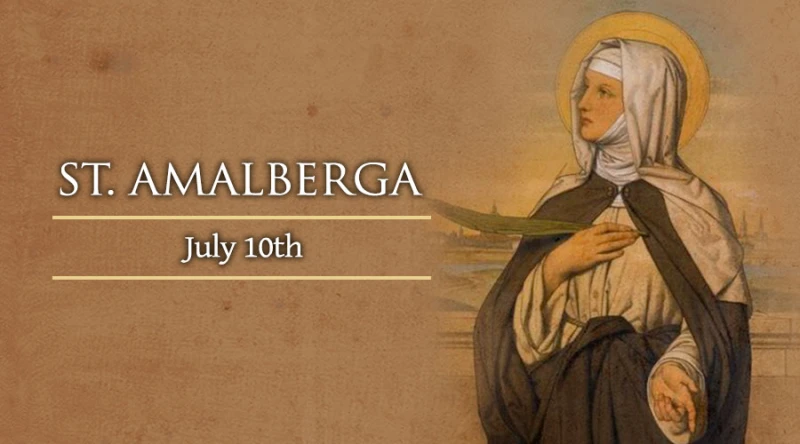
St. Amalberga


St. Amalberga

Feast date: Jul 10

St. Amalberga, otherwise Amelia, was born at Brabantrelated, and was in some way related to Pepin of Landen. Whether she was a sister or niece, the Bollandists are not sure. She was married to Witger and became the mother of three saints: Gudila, Reinelda, and Emembertus.

The Norman chroniclers speak of her as having been married twice, which seems to be erroneous. Nor are Pharailda and Ermelende admitted by the Bollandists to have been her children. She and her husband ultimately withdrew from the world; he becoming a monk, and she a nun. There is very great confusion in the records of this saint, and of a virgin who came a century after. To add to the difficulty a third St. Amalberga, also a virgin, appears in the twelfth century. The first two are celebrated simultaneously on July 10.

She died in 690 and is buried beside her husband at the Lobbes monastery. Her relics have been in Saint Peter’s abbey church in Ghent, Belgium since 1073. She is known to protect people against arm pain, bruises, and fever.

In art she is represented holding a palm and open book with a crown at her feet, standing on a giant sturgeon or other fish.

St. Amalberga Read More »