Please mind our dust!

We are currently working on revamping our website!
Thank you for your patience!

CRD Solutions

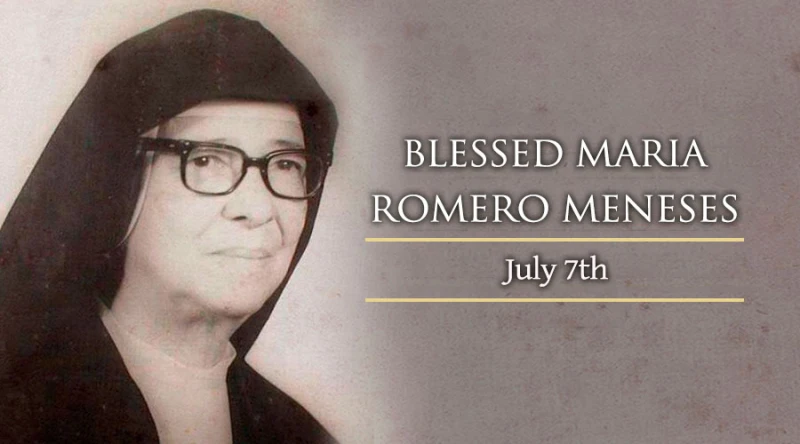
Blessed Maria Romero Meneses


Blessed Maria Romero Meneses

Feast date: Jul 07

Blessed Maria Romero Meneses is a saint of the new millennium. She was beatified by Pope John Paul II in 2002.

Maria was born in Granada, Nicaragua, in 1902 to a wealthy family, her father being a government minister. At the age of 12, she became extremely sick and was paralysed for six months with rheumatic fever. She was cured through the intercession and apparition of Our Lady Help of Christians, during which she discovered her vocation to be a Salesian sister.

She entered the Daughters of Mary Help of Christians (Salesian Sisters) and made her final profession in 1929. Two years later, she was transferred to San Jose, Costa Rica. She taught music, drawing, and typing to rich girls. She also trained catechists and taught the poor. She inspired many of her students to join her in her work with the poor, and was known for helping people to come to know God in a personal way.

More and more, her ministry became focused on social development, helping the rich to see how they could help the poor. She set up recreational centers in 1945, food distribution centers in 1953, a school for poor girls in 1961, and a clinic in 1966. In 1973, she organized the construction of seven homes, which became the foundation of the village of Centro San Jose, a community where poor families could have decent homes.

She died of a heart attack in 1977 in Nicaragua.

Blessed Maria Romero Meneses Read More »

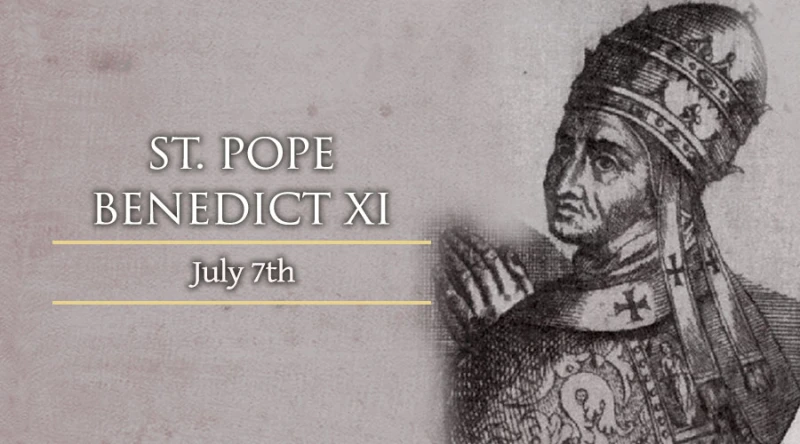
St. Pope Benedict XI


St. Pope Benedict XI

Feast date: Jul 07

Nicholas Boccasini was born at Treviso, Italy, in 1240. Hhe entered the Dominican Order at the age of 14. After 14 years of study, he became lector of theology, an office he filled for several years.

In 1296 he was elected Master General of the Order. At this same time hostility towards Boniface VIII was becoming more pronounced, and the new general issued an ordinance forbidding his subjects to favour in any way the opponents of the reigning pontiff. He also enjoined them to defend in their sermons, when opportune, the legitimacy of the election of Boniface. This loyalty of Boccasini, which remained unshaken until the end, was recognized by Boniface, who showed him many marks of favour and confidence. Thus with the two cardinal-legates, the Dominican General formed the important embassy, the purpose of which was the concluding of an armistice between Edward I of England and Philip IV of France, then at war with each other.

In the year 1298 Boccasini was elevated to the cardinalate, and was afterwards appointed Bishop of Ostia and Dean of the Sacred College. During this time Hungary was rent by civil war, so the cardinal-bishop was sent there by the Holy See as legate a latere to labour for the restoration of peace. At the time of his return of the legate to Rome, the famous feud between Boniface VIII with Philip the Fair had reached its height. When, in 1303, the enemies of the pope had made themselves masters of the sacred palace, of all the cardinals and prelates only the two Cardinal-Bishops of Ostia and Sabina remained at the side of the venerable Pontiff to defend him from the violence of William of Nogaret and Sciarra Colonna.

A month after this scene of violence, Boniface died, and Boccasini was unanimously elected Pope on October 22, taking the name of Benedict XI. The principal event of his pontificate was the restoration of peace with the French court. He was Pope for only one year (1303-1304), dying in Perugia on July 7, 1304.

Benedict XI was beatified in the year 1773. His feast is celebrated in Rome and throughout the Dominican Order on the 7th of July. He is the author of a volume of sermons and commentaries on a segment of the Gospel of St. Matthew, on the Psalms, the Book of Job, and the Apocalypse.

St. Pope Benedict XI Read More »

Wednesday of the Fourteenth Week in Ordinary Time

Reading 1  HOS 10:1-3, 7-8, 12

Israel is a luxuriant vine
whose fruit matches its growth.
The more abundant his fruit,
the more altars he built;
The more productive his land,
the more sacred pillars he set up.
Their heart is false,
now they pay for their guilt;
God shall break down their altars
and destroy their sacred pillars.
If they would say,
“We have no king”—
Since they do not fear the LORD,
what can the king do for them?

The king of Samaria shall disappear,
like foam upon the waters.
The high places of Aven shall be destroyed,
the sin of Israel;
thorns and thistles shall overgrow their altars.
Then they shall cry out to the mountains, “Cover us!”
and to the hills, “Fall upon us!”

“Sow for yourselves justice,
reap the fruit of piety;
break up for yourselves a new field,
for it is time to seek the LORD,
till he come and rain down justice upon you.”

Responsorial Psalm PS 105:2-3, 4-5, 6-7

R. (4b) Seek always the face of the Lord.
or:
R. Alleluia.
Sing to him, sing his praise,
proclaim all his wondrous deeds.
Glory in his holy name;
rejoice, O hearts that seek the LORD!
R. Seek always the face of the Lord.
or:
R. Alleluia.
Look to the LORD in his strength;
seek to serve him constantly.
Recall the wondrous deeds that he has wrought,
his portents, and the judgments he has uttered.
R. Seek always the face of the Lord.
or:
R. Alleluia.
You descendants of Abraham, his servants,
sons of Jacob, his chosen ones!
He, the LORD, is our God;
throughout the earth his judgments prevail.
R. Seek always the face of the Lord.
or:
R. Alleluia.

Alleluia  MK 1:15

R. Alleluia, alleluia.
The Kingdom of God is at hand:
repent and believe in the Gospel.
R. Alleluia, alleluia.

Gospel  MT 10:1-7

Jesus summoned his Twelve disciples
and gave them authority over unclean spirits to drive them out
and to cure every disease and every illness.
The names of the Twelve Apostles are these:
first, Simon called Peter, and his brother Andrew;
James, the son of Zebedee, and his brother John;
Philip and Bartholomew,
Thomas and Matthew the tax collector;
James, the son of Alphaeus, and Thaddeus;
Simon the Cananean, and Judas Iscariot
who betrayed Jesus.

Jesus sent out these Twelve after instructing them thus,
“Do not go into pagan territory or enter a Samaritan town.
Go rather to the lost sheep of the house of Israel.
As you go, make this proclamation: ‘The Kingdom of heaven is at hand.’”

– – –

Lectionary for Mass for Use in the Dioceses of the United States, second typical edition, Copyright © 2001, 1998, 1997, 1986, 1970 Confraternity of Christian Doctrine; Psalm refrain © 1968, 1981, 1997, International Committee on English in the Liturgy, Inc. All rights reserved. Neither this work nor any part of it may be reproduced, distributed, performed or displayed in any medium, including electronic or digital, without permission in writing from the copyright owner.

Wednesday of the Fourteenth Week in Ordinary Time Read More »

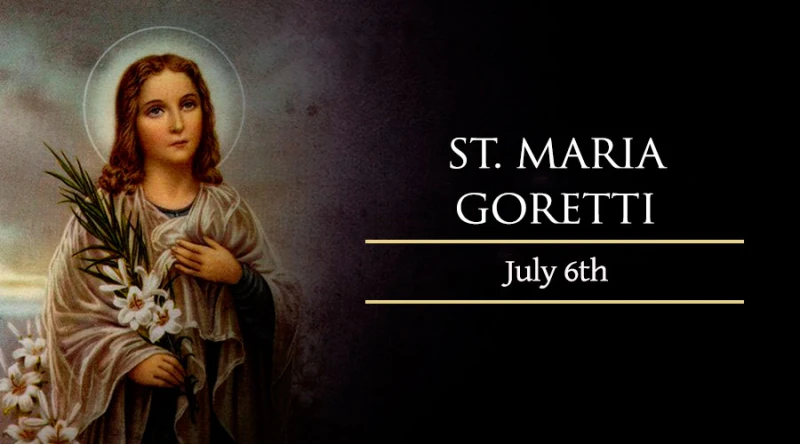
St. Maria Goretti


St. Maria Goretti

Feast date: Jul 06

July 6 marks the feast day of St. Maria Goretti, a young virgin and martyr whose life is an example of purity and mercy for all Christians.

St. Maria Goretti is best known for her commitment to purity and the courageous defence of her faith at the young age of eleven that made her willing to undergo death rather than participate in a sin against God. She is also remarkable for the forgiveness she willingly granted her attacker as she lay on her deathbed.

Maria was born in Corinaldo, Italy on October 16, 1890. Her father, a farmer, died of malaria when she was young, and her mother had to work to support their six children.

Maria took care of the younger children while her mother worked, and she prayed the Rosary every night for the repose of her father’s soul. She grew in grace and maturity, and her cheerful obedience and piety were noticed by those around her.

On July 5, 1902, a neighbouring farm hand, Alessandro Serenelli, tried to rape Maria. On several prior occasions, Alessandro had harassed Maria with impure advances, all of which she has vehemently rejected. This time, he locked her in a room and tried to force himself upon her. She fought against him, shouting, “No! It is a sin! God does not want it!” and warning him that this was the path towards hell. When Maria declared that she would rather die than submit to this sin, Alessandro angrily grabbed her and stabbed her 14 times with a knife.

Maria was found bleeding to death and rushed to the hospital. As she lay dying, she forgave Alessandro for the crime he had committed against her, saying, “Yes, for the love of Jesus I forgive him…and I want him to be with me in Paradise.”

Although the doctors tried to save her, she died two agonizing days later, only eleven years old.

Alessandro was sentenced to 30 years in prison. He remained unrepentant until one night, eight years into his prison term, when Maria appeared to him, dressed in white, gathering lilies in a garden. She smiled, turned towards Alessandro, and offered him the flowers. Each lily he took transformed into a white flame. Then Maria disappeared.

From that moment, Alessandro converted and found peace. He repented of his crime and changed his life. He was released from prison three years early and begged forgiveness from Maria’s mother, which she duly granted.

Alessandro moved to a Capuchin monastery, working in the garden as a tertiary for the remainder of his life. He was one of the witnesses who testified to Maria’s holiness during her cause of beatification, citing the crime and the vision in prison.

Many miracles were attributed to Maria Goretti after her death. In 1950, she was canonised by Pope Pius XII, becoming the youngest Roman Catholic saint officially recognised by name. Her feast day is celebrated by the Church on July 6, and she is the patron saint of purity, rape victims, young women, and youth in general.

On her feast day in 2003, Pope John Paul II spoke about St. Maria Goretti at his Sunday Angelus, noting that her life provides an exemplary witness of what it means to be “pure of heart.”

“What does this fragile but christianly mature girl say to today’s young people, through her life and above all through her heroic death?” asked the Pope.

“Marietta, as she was lovingly called, reminds the youth of the third millennium that true happiness demands courage and a spirit of sacrifice, refusing every compromise with evil and having the disposition to pay personally, even with death, faithful to God and his commandments.”

“How timely this message is,” the Holy Father continued. “Today, pleasure, selfishness and directly immoral actions are often exalted in the name of the false ideals of liberty and happiness. It is essential to reaffirm clearly that purity of heart and of body go together, because chastity ‘is the custodian’ of authentic love.”

St. Maria Goretti Read More »

Tuesday of the Fourteenth Week in Ordinary Time

Reading 1  HOS 8:4-7, 11-13

Thus says the LORD:
They made kings in Israel, but not by my authority;
they established princes, but without my approval.
With their silver and gold they made
idols for themselves, to their own destruction.
Cast away your calf, O Samaria!
my wrath is kindled against them;
How long will they be unable to attain
innocence in Israel?
The work of an artisan,
no god at all,
Destined for the flames—
such is the calf of Samaria!

When they sow the wind, 
they shall reap the whirlwind;
The stalk of grain that forms no ear
can yield no flour;
Even if it could,
strangers would swallow it.

When Ephraim made many altars to expiate sin,
his altars became occasions of sin.
Though I write for him my many ordinances,
they are considered as a stranger’s.
Though they offer sacrifice,
immolate flesh and eat it,
the LORD is not pleased with them.
He shall still remember their guilt
and punish their sins;
they shall return to Egypt.

Responsorial Psalm PS 115:3-4, 5-6, 7AB-8, 9-10

R. (9a) The house of Israel trusts in the Lord.
or:
R. Alleluia.
Our God is in heaven;
whatever he wills, he does.
Their idols are silver and gold,
the handiwork of men.
R. The house of Israel trusts in the Lord.
or:
R. Alleluia.
They have mouths but speak not;
they have eyes but see not;
They have ears but hear not;
they have noses but smell not.
R. The house of Israel trusts in the Lord.
or:
R. Alleluia.
They have hands but feel not;
they have feet but walk not.
Their makers shall be like them,
everyone that trusts in them.
R. The house of Israel trusts in the Lord.
or:
R. Alleluia.

Alleluia  JN 10:14

R. Alleluia, alleluia.
I am the good shepherd, says the Lord;
I know my sheep, and mine know me.
R. Alleluia, alleluia.

Gospel  MT 9:32-38

A demoniac who could not speak was brought to Jesus,
and when the demon was driven out the mute man spoke.
The crowds were amazed and said,
“Nothing like this has ever been seen in Israel.”
But the Pharisees said,
“He drives out demons by the prince of demons.”

Jesus went around to all the towns and villages,
teaching in their synagogues,
proclaiming the Gospel of the Kingdom,
and curing every disease and illness.
At the sight of the crowds, his heart was moved with pity for them
because they were troubled and abandoned,
like sheep without a shepherd.
Then he said to his disciples,
“The harvest is abundant but the laborers are few;
so ask the master of the harvest
to send out laborers for his harvest.”

– – –

Lectionary for Mass for Use in the Dioceses of the United States, second typical edition, Copyright © 2001, 1998, 1997, 1986, 1970 Confraternity of Christian Doctrine; Psalm refrain © 1968, 1981, 1997, International Committee on English in the Liturgy, Inc. All rights reserved. Neither this work nor any part of it may be reproduced, distributed, performed or displayed in any medium, including electronic or digital, without permission in writing from the copyright owner.

Tuesday of the Fourteenth Week in Ordinary Time Read More »