Please mind our dust!

We are currently working on revamping our website!
Thank you for your patience!

CRD Solutions

St. Anthony Mary Zaccaria
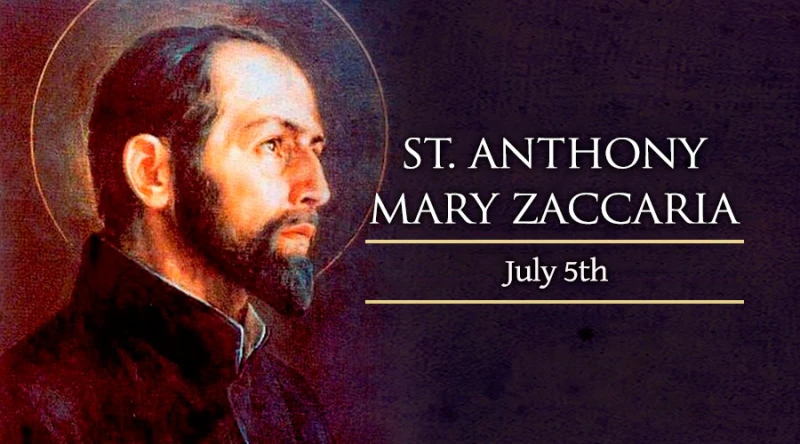

St. Anthony Mary Zaccaria

Feast date: Jul 05

On July 5, the Catholic Church remembers Saint Anthony Mary Zaccaria. A renowned preacher and promoter of Eucharistic adoration, he founded the order of priests now known as the Barnabites.

In 2001, the future Pope Benedict XVI, Cardinal Joseph Ratzinger, wrote the preface for a book on St. Anthony Mary Zaccaria, praising the saint as “one of the great figures of Catholic reform in the 1500s,” who was involved “in the renewal of Christian life in an era of profound crisis.”

The Italian saint, Cardinal Ratzinger wrote, “deserves to be rediscovered” as “an authentic man of God and of the Church, a man burning with zeal, a demanding forger of consciences, a true leader able to convert and lead others to good.”

Anthony Mary Zaccaria was born into an Italian family of nobility in Cremona during 1502. His father Lazzaro died shortly after Anthony’s birth, and his mother Antonietta – though only 18 years old – chose not to marry again, preferring to devote herself to charitable works and her son’s education.

Antonietta’s son took after her in devotion to God and generosity toward the poor. He studied Latin and Greek with tutors in his youth, and was afterward sent to Pavia to study philosophy. He went on to study medicine at the University of Padua, earning his degree at age 22 and returning to Cremona.

Despite his noble background and secular profession, the young doctor had no intention of either marrying or accumulating wealth. While caring for the physical conditions of his patients, he also encouraged them to find spiritual healing through repentance and the sacraments.

Anthony also taught catechism to children, and went on to participate in the religious formation of young adults. He eventually decided to withdraw from the practice of medicine, and with the encouragement of his spiritual director he began to study for the priesthood.

Ordained a priest at age 26, Anthony is said to have experienced a miraculous occurrence during his first Mass, being surrounded by a supernatural light and a multitude of angels during the consecration of the Eucharist. Contemporary witnesses marveled at the event, and testified to it after his death.

Church life in Cremona had suffered decline in the late 15th and early 16th centuries. The new priest encountered widespread ignorance and religious indifference among laypersons, while many of the clergy were either weak or corrupt.

In these dire circumstances, Anthony Mary Zaccaria devoted his life to proclaiming the truths of the Gospel both clearly and charitably. Within two years, his eloquent preaching and tireless pastoral care is said to have changed the moral character of the city dramatically.

In 1530, Anthony moved to Milan, where a similar spirit of corruption and religious neglect prevailed. There, he decided to form a priestly society, the Clerics Regular of St. Paul.

Inspired by the apostle’s life and writings, the order was founded on a vision of humility, asceticism, poverty, and preaching. After the founder’s death, they were entrusted with a prominent church named for St. Barnabas, and became commonly known as the “Barnabites.”

The priest also founded a women’s religious order, the Angelic Sisters of St. Paul; and an organization, the Laity of St. Paul, geared toward the sanctification of those outside the priesthood and religious life. He pioneered the “40 Hours” devotion, involving continuous prayer before the Blessed Sacrament.

In 1539, Anthony became seriously ill and returned to his mother’s house in Cremona. The founder of the Clerics Regular of St. Paul died on July 5, during the liturgical octave of the Feast of Sts. Peter and Paul, at the age of only 36.

Nearly three decades after his death, St. Anthony Mary Zaccaria’s body was found to be incorrupt. He was beatified by Blessed Pope Pius IX in 1849, and declared a saint by Pope Leo XIII in 1897.

St. Anthony Mary Zaccaria Read More »

Monday of the Fourteenth Week in Ordinary Time

Reading 1  HOS 2:16, 17C-18, 21-22

Thus says the LORD:
I will allure her;
I will lead her into the desert
and speak to her heart.
She shall respond there as in the days of her youth,
when she came up from the land of Egypt.

On that day, says the LORD,
She shall call me “My husband,”
and never again “My baal.”

I will espouse you to me forever:
I will espouse you in right and in justice,
in love and in mercy;
I will espouse you in fidelity,
and you shall know the LORD.
 

Responsorial Psalm PS 145:2-3, 4-5, 6-7, 8-9

R. (8a) The Lord is gracious and merciful.
Every day will I bless you,
and I will praise your name forever and ever.
Great is the LORD and highly to be praised;
his greatness is unsearchable.
R. The Lord is gracious and merciful.
Generation after generation praises your works
and proclaims your might.
They speak of the splendor of your glorious majesty
and tell of your wondrous works. 
R. The Lord is gracious and merciful.
They discourse of the power of your terrible deeds
and declare your greatness.
They publish the fame of your abundant goodness
and joyfully sing of your justice. 
R. The Lord is gracious and merciful.
The LORD is gracious and merciful,
slow to anger and of great kindness.
The LORD is good to all
and compassionate toward all his works.
R. The Lord is gracious and merciful.

Alleluia  2 TM 1:10

R. Alleluia, alleluia.
Our Savior Jesus Christ has destroyed death
and brought life to light through the Gospel.
R. Alleluia, alleluia.

Gospel  MT 9:18-26

While Jesus was speaking, an official came forward,
knelt down before him, and said,
“My daughter has just died.
But come, lay your hand on her, and she will live.”
Jesus rose and followed him, and so did his disciples.
A woman suffering hemorrhages for twelve years came up behind him
and touched the tassel on his cloak.
She said to herself, “If only I can touch his cloak, I shall be cured.”
Jesus turned around and saw her, and said,
“Courage, daughter! Your faith has saved you.”
And from that hour the woman was cured.
When Jesus arrived at the official’s house
and saw the flute players and the crowd who were making a commotion,
he said, “Go away! The girl is not dead but sleeping.”
And they ridiculed him.
When the crowd was put out, he came and took her by the hand,
and the little girl arose.
And news of this spread throughout all that land.

– – –

Lectionary for Mass for Use in the Dioceses of the United States, second typical edition, Copyright © 2001, 1998, 1997, 1986, 1970 Confraternity of Christian Doctrine; Psalm refrain © 1968, 1981, 1997, International Committee on English in the Liturgy, Inc. All rights reserved. Neither this work nor any part of it may be reproduced, distributed, performed or displayed in any medium, including electronic or digital, without permission in writing from the copyright owner.

Monday of the Fourteenth Week in Ordinary Time Read More »

Blessed Pier Giorgio Frassati


Blessed Pier Giorgio Frassati

Feast date: Jul 04

July 4 marks the feast day of Pier Giorgio Frassati, a well-known young blessed of modern times. Born on April 6, 1901 in Turin to a wealthy agnostic family, he early in life found himself drawn to the faith and serving Christ in the poor. He was particularly known for his prayer and his great love of the outdoors.

Pier Giorgio’s friends described him as “an explosion of joy.” His sister Luciana in her biography of her brother says that “He represented the finest in Christian youth: pure, happy, enthusiastic about everything that is good and beautiful.” He loved sharing his faith and praying with his many friends.

At a young age after starting at a Jesuit school, Pier Giorgio received permission to receive communion daily, which was rare at the time. He also joined the Marian Sodality and Apostleship of Prayer. Often, he would spend hours of the night in an adoration chapel.

He was also known as an avid sportsman and loved the outdoors, particularly mountain climbing. He cultivated a deep appreciation for theater, opera, museums, and poetry, loving to quote Dante.

Pier Giorgio was deeply devoted to Catholic social teaching and serving the poor. He joined the People’s Party, based on the principles of Pope Leo XIII’s encyclical Rerum Novarum, and was known to go to serve the poor in the slums, even giving away his bus fare money and running home to be on time for meals. As his sister said, “Catholic social teaching could never remain simply a theory with [Pier Giorgio].” He would forgo vacations as the family summer home because “If everybody leaves Turin, who will take care of the poor?”

He desired to become a mining engineer, studying at the Royal Polytechnic University of Turin, because he desired to “serve Christ better among the miners.”

He was also politically active, both against the communist as well as fascist causes in early 20th-century Italy. He stood up to police harassing a Church-sponsored protest in Rome once, grabbing a fallen banner and using it to rally his fellow students.

His love for balancing contemplation and action naturally led him to a love for the Dominican order, particularly after reading the sermons of Girolamo Savonarola and writings of St. Catherine of Siena. In 1922, he joined the Lay Dominicans, taking the name Girolamo after the fierce Renaissance preacher.

Pier Giorgio contracted polio shortly before he was to receive his degree, and doctors believed this was due to his tending to the sick in the slums. But even on his last night of life, his concern remained for the poor, using his paralyzed hand to scrawl a note asking a friend to take medicine to a poor man Converso.

Thousands turned out for his funeral. Many of the poor and needy who he had served for the past seven years came, and it was through their presence that his parents learned of his service. Just as his parents were surprised at the multitude of destitute and needy, those their son had served were surprised to learn that their friend was the heir to the wealthy and famous Frassati family.

In 1981, his remains were found to be incorrupt, and his body was transferred from the family tomb to the Cathedral of St. John the Baptist in Turin.

At his beatification in 1990, St. John Paul II referred to him as the “Man of the Eight Beatitudes,” and recalled fondly that “I wanted to pay homage to a young man who was able to witness to Christ with singular effectiveness in this century of ours. When I was a young man, I, too, felt the beneficial influence of his example and, as a student, I was impressed by the force of his testimony.”

Photo: Saint Joseph via Flickr CC BY-NC-ND 2.0

Blessed Pier Giorgio Frassati Read More »

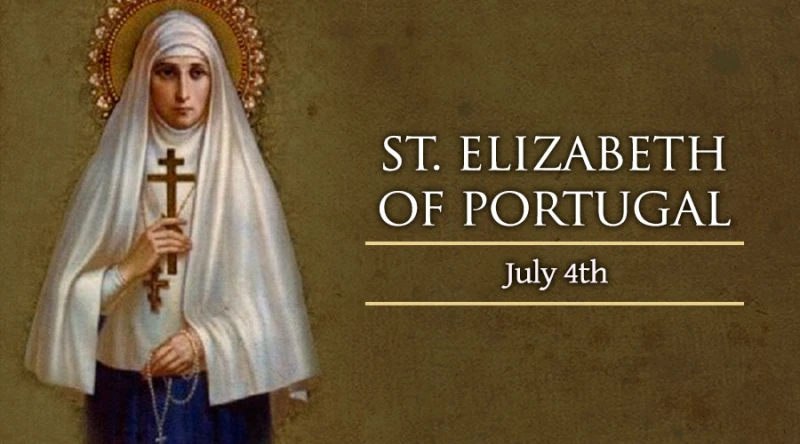
St. Elizabeth of Portugal


St. Elizabeth of Portugal

Feast date: Jul 04

On July 4, the Catholic Church celebrates St. Elizabeth of Portugal, a queen who served the poor and helped her country avoid war during the 13th and 14th centuries.

Elizabeth of Portugal was named for her great-aunt, St. Elizabeth of Hungary, who was canonized in 1235. Their lives were similar in some important ways: both of them were married at very young ages, they sought to live the precepts of the Gospel despite their status as royalty, and finished their lives as members of the Third Order of St. Francis.

The younger Elizabeth was born in 1271, the daughter of King Pedro III of Aragon and his wife Constantia. Even in her youth, Elizabeth showed a notable devotion to God through fasting, regular prayer, and a sense of life’s seriousness. While still very young, she was married to King Diniz of Portugal, a marriage that would put her faith and patience to the test.

King Diniz was faithfully devoted to his country, known as the “Worker King” because of his diligence. Unfortunately, he generally failed to live out the same faithfulness toward his wife, although he is said to have repented of his years of infidelity before his death. Diniz and Elizabeth had two children, but the king fathered an additional seven children with other women.

Many members of the king’s court likewise embraced or accepted various forms of immorality, and it would have been easy for the young queen to fall into these vices herself. But Elizabeth remained intent on doing God’s will with a humble and charitable attitude. Rather than using her status as queen to pursue her own satisfaction, she sought to advance Christ’s reign on earth.

Like her namesake and great-aunt Elizabeth of Hungary, Elizabeth of Portugal was a devoted patroness and personal friend of the poor and sick, and she compelled the women who served her at court to care for them as well. The queen’s bishop testified that she had a custom of secretly inviting in lepers, whom she would bathe and clothe, even though the law of the land barred them from approaching the castle.

Elizabeth’s commitment to the Gospel also became evident when she intervened to prevent civil war in the kingdom on two occasions. Alfonso, the only son of Diniz and Elizabeth, resented the king’s indulgent treatment of one of his illegitimate sons, to the point that the father and son gathered together rival armies that were on the brink of open war in 1323.

On this occasion, St. Elizabeth placed herself between the two opposing armies, insisting that Diniz and Alfonso come to terms and make peace with one another. In 1336, the last year of her life, she intervened in a similar manner to prevent her son from waging war against the King of Castile for his poor treatment of Alfonso’s own daughter.

Following King Diniz’s death in 1325, Elizabeth had become a Franciscan of the Third Order, and had gone to live in a convent that she had established some years before. The testimony of miracles accomplished through her intercession, after her death in 1336, contributed to her canonization by Pope Urban VIII in 1625.

St. Elizabeth of Portugal Read More »

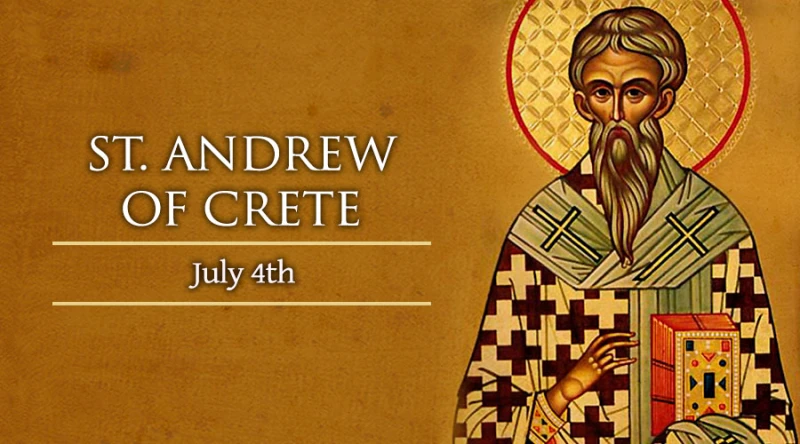
St. Andrew of Crete


St. Andrew of Crete

Feast date: Jul 04

Celebrated by Eastern Catholics of the Byzantine tradition on July 4, Saint Andrew of Crete was a seventh-and eighth-century monk, bishop, and hymn-writer.

Among Eastern Christians he is best known as the author of the “Great Canon,” a lengthy prayer service traditionally offered as a penitential practice during Lent. He is also venerated as a saint in the Roman Catholic Church, where he is better known for his writings on the Blessed Virgin Mary.

He should not be confused with a different “Saint Andrew of Crete,” celebrated on Oct. 17, who suffered martyrdom while defending the veneration of icons during the eighth century.

The author of the “Great Canon” was born in the Syrian city of Damascus in the mid-seventh century. He is said to have remained mute for the first seven years of his life, gaining the power of speech at age seven after the reception of Holy Communion.

Devoted to God from that time on, Andrew went to Jerusalem and entered the Monastery of Saint Sava when he was 15 years old. He went on to serve as a cleric of the Jerusalem Patriarchate, and was sent as a representative to the Sixth Ecumenical Council in Constantinople (680-681).

The council took up the monothelite controversy, a disagreement as to whether Christ had both a divine and a human will (as the Church teaches), or only a divine will. Though the question may seem abstract to modern ears, it was an important point, bearing on the reality of Jesus’ full humanity.

In 685 Andrew returned to Constantinople, where he did charitable work for orphans and the poor, and served as a deacon in the great Hagia Sophia church. Around the year 700 he became archbishop of the city of Gortyna, on the island of Crete.

In 712, during a resurgence of the monothelite heresy, Andrew was forced to attend an illegitimate gathering in which the Byzantine emperor Philippicus Bardanes tried to reverse the decisions of the Sixth Council. Andrew’s coerced attendance was questioned, but forgiven, by the reigning Pope Constantine.

Little is known about the rest of the archbishop’s life, which ended peacefully, probably in 740. While his participation in the historic Sixth Council is important, St. Andrew of Crete’s legacy has more to do with his outstanding sermons and liturgical hymns, reflective of a deep interior life of faith.

The Great Canon, his most ambitious known work, takes around three hours to chant. It incorporates more than 200 full-body prostrations along with its many litanies, odes, and refrains. Surveying the Old and New Testaments, it stresses the urgency of repentance and conversion.

The service begins: “Where shall I begin to lament the deeds of my wretched life? What first-fruit shall I offer, O Christ, for my present lamentation? But in Thy compassion grant me release from my falls.”

“Come, wretched soul, with your flesh, confess to the Creator of all. In future refrain from your former brutishness, and offer to God tears in repentance.”

Interspersed throughout, is the Great Canon’s defining plea: “Have mercy on me, O God, have mercy on me!”

St. Andrew of Crete Read More »