
Please mind our dust!

We are currently working on revamping our website!
Thank you for your patience!

CRD Solutions

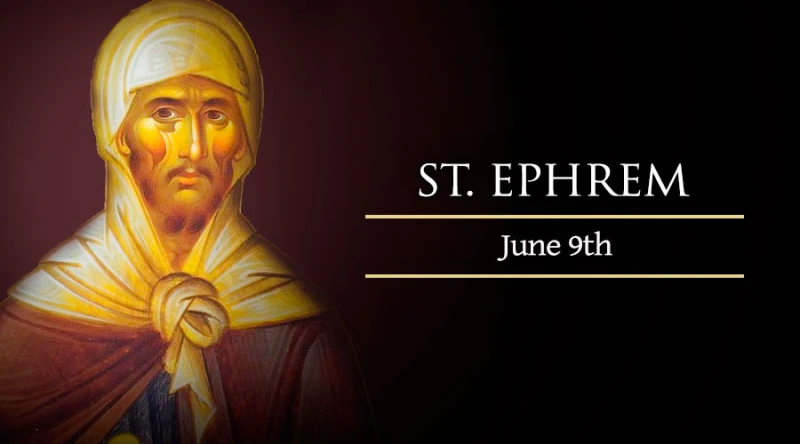
St. Ephrem


St. Ephrem

Feast date: Jun 09

On June 9, the Roman Catholic Church honors Saint Ephrem of Syria, a deacon, hermit, and Doctor of the Church who made important contributions to the spirituality and theology of the Christian East during the fourth century.

Eastern Catholics and Eastern Orthodox Christian celebrate his feast on January 28. Ephrem is especially beloved in the Syriac Orthodox Church, and counted as a Venerable Father (i.e., a sainted Monk) in the Eastern Orthodox Church. His feast day is celebrated on 28 January and on the Saturday of the Venerable Fathers. He was declared a Doctor of the Church in the Catholic Church in 1920.

In a 2007 General Audience on St. Ephrem’s life, Pope Benedict XVI noted that St. Ephrem became known as the “Harp of the Holy Spirit,” for the hymns and writings that sang the praises of God “in an unparalleled way” and “with rare skill.”

Ephrem was born in the city of Nisibis in approximately 306. Traditions differ on the question of his family background, with some sources attesting that his father was at one time a pagan priest. Other sources suggest that his family either was, or later became, entirely Christian.

Ephrem received baptism and began to consider the salvation of his soul more seriously. He embraced an ascetic lifestyle under the direction of an elder, who gave him permission to live as a hermit. Ephrem supported himself with manual labor, making sails for ships, while living in a remarkably austere manner with few comforts and little food.

Ephrem’s spiritual director and friend, Bishop James of Nisibis, died in 338. Soon after, Ephrem left his solitude and moved to Edessa in present-day Turkey. Ordained as a deacon in Edessa, he was known for sermons which combined articulate expressions of Catholic orthodoxy with urgent and fruitful calls to repentance.

The deacon was also a voluminous author, producing commentaries on the entire Bible as well as the theological poetry for which he is best known. Ephrem used Syriac-language verse as a means to explain and popularize theological truths, a technique he appropriated from others who had used poetry to promote religious error.

Late in his life, the deacon made a pilgrimage to the city of Caesarea, where God had directed him to seek the guidance of the archbishop later canonized as Saint Basil the Great. Basil helped Ephrem to resolve some of his own spiritual troubles, giving him advice which he would follow as he spent his final years in solitary prayer and writing.

Near the end of his life, Ephrem briefly left his hermitage to serve the poor and sick during a famine. His last illness came in 373, most likely from a disease he contracted through this service.

When his own death approached, he told his friends: “Sing no funeral hymns at Ephrem’s burial … Wrap not my carcass in any costly shroud: erect no monument to my memory. Allow me only the portion and place of a pilgrim; for I am a pilgrim and a stranger as all my fathers were on earth.”

St. Ephrem of Syria died in June of 373. Soon after his death, he was remembered in a public address by his contemporary Saint Gregory of Nyssa, who closed his remarks by asking Ephrem’s intercession.

“You are now assisting at the divine altar, and before the Prince of life, with the angels, praising the most holy Trinity,” said Gregory. “Remember us all, and obtain for us the pardon of our sins.”
St. Ephrem Read More »

Wednesday of the Tenth Week in Ordinary Time

Reading I 1 Kgs18:20-39

Ahab sent to all the children of Israel
and had the prophets assemble on Mount Carmel.

Elijah appealed to all the people and said,
“How long will you straddle the issue?
If the LORD is God, follow him; if Baal, follow him.”
The people, however, did not answer him.
So Elijah said to the people,
“I am the only surviving prophet of the LORD,
and there are four hundred and fifty prophets of Baal.
Give us two young bulls.
Let them choose one, cut it into pieces, and place it on the wood,
but start no fire.
I shall prepare the other and place it on the wood,
but shall start no fire.
You shall call on your gods, and I will call on the LORD.
The God who answers with fire is God.”
All the people answered, “Agreed!”

Elijah then said to the prophets of Baal,
“Choose one young bull and prepare it first,
for there are more of you.
Call upon your gods, but do not start the fire.”
Taking the young bull that was turned over to them, they prepared it
and called on Baal from morning to noon, saying,
“Answer us, Baal!”
But there was no sound, and no one answering.
And they hopped around the altar they had prepared.
When it was noon, Elijah taunted them:
“Call louder, for he is a god and may be meditating,
or may have retired, or may be on a journey.
Perhaps he is asleep and must be awakened.”
They called out louder and slashed themselves with swords and spears,
as was their custom, until blood gushed over them.
Noon passed and they remained in a prophetic state
until the time for offering sacrifice.
But there was not a sound;
no one answered, and no one was listening.

Then Elijah said to all the people, “Come here to me.”
When the people had done so, he repaired the altar of the LORD
that had been destroyed.
He took twelve stones, for the number of tribes of the sons of Jacob,
to whom the LORD had said, “Your name shall be Israel.”
He built an altar in honor of the LORD with the stones,
and made a trench around the altar
large enough for two measures of grain.
When he had arranged the wood,
he cut up the young bull and laid it on the wood.
“Fill four jars with water,” he said,
“and pour it over the burnt offering and over the wood.”
“Do it again,” he said, and they did it again.
“Do it a third time,” he said,
and they did it a third time.
The water flowed around the altar,
and the trench was filled with the water.

At the time for offering sacrifice,
the prophet Elijah came forward and said,
“LORD, God of Abraham, Isaac, and Israel,
let it be known this day that you are God in Israel
and that I am your servant
and have done all these things by your command.
Answer me, LORD!
Answer me, that this people may know that you, LORD, are God
and that you have brought them back to their senses.”
The LORD’s fire came down
and consumed the burnt offering, wood, stones, and dust,
and it lapped up the water in the trench.
Seeing this, all the people fell prostrate and said,
“The LORD is God! The LORD is God!”

Responsorial Psalm 16:1b-2ab, 4, 5ab and 8, 11

R. (1b) Keep me safe, O God; you are my hope.
Keep me, O God, for in you I take refuge;
I say to the LORD, “My Lord are you.”
R. Keep me safe, O God; you are my hope.
They multiply their sorrows
who court other gods.
Blood libations to them I will not pour out,
nor will I take their names upon my lips.
R. Keep me safe, O God; you are my hope.
O LORD, my allotted portion and cup,
you it is who hold fast my lot.
I set the LORD ever before me;
with him at my right hand I shall not be disturbed.
R. Keep me safe, O God; you are my hope.
You will show me the path to life,
fullness of joys in your presence,
the delights at your right hand forever.
R. Keep me safe, O God; you are my hope.


Alleluia Ps 25:4b, 5a

R. Alleluia, alleluia.
Teach me your paths, my God,
and guide me in your truth.
R. Alleluia, alleluia.

Gospel Mt 5:17-19

Jesus said to his disciples:
“Do not think that I have come to abolish the law or the prophets.
I have come not to abolish but to fulfill.
Amen, I say to you, until heaven and earth pass away,
not the smallest letter or the smallest part of a letter
will pass from the law,
until all things have taken place.
Therefore, whoever breaks one of the least of these commandments
and teaches others to do so
will be called least in the Kingdom of heaven.
But whoever obeys and teaches these commandments
will be called greatest in the Kingdom of heaven.”


– – –

Lectionary for Mass for Use in the Dioceses of the United States, second typical edition, Copyright © 2001, 1998, 1997, 1986, 1970 Confraternity of Christian Doctrine; Psalm refrain © 1968, 1981, 1997, International Committee on English in the Liturgy, Inc. All rights reserved. Neither this work nor any part of it may be reproduced, distributed, performed or displayed in any medium, including electronic or digital, without permission in writing from the copyright owner.

Wednesday of the Tenth Week in Ordinary Time Read More »

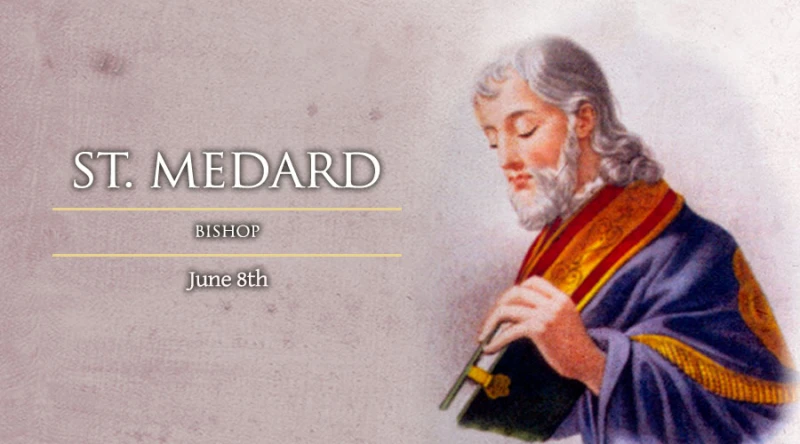
St. Medard, bishop


St. Medard, bishop

Feast date: Jun 08

St. Medard was born around 456 in Salency, France. His father Nectard was a noble Frenchman, and his mother, Protogia, descended from a Roman family that settled in Gaul.

He was ordained at the age of 33, and did not wish to be made a bishop, but reluctantly became the Bishop of Vermand in 530. Medardus was one of the most honoured bishops of his time, his memory has always been venerated in northern France, and he soon became the hero of numerous legends.

Each year on his memorial the Rosiere is awarded to the young girl who has been judged the most virtuous and exemplary in the region of Salency, France; she is escorted by 12 boys and 12 girls to the church, where she is crowned with roses and given a gift of money. This is a continuation of a yearly stipend or “scholarship” he apparently instituted when bishop. His younger sister was the first to be crowned the Rosiere.

Legend says that when he was a child, Medard was once sheltered from the rain by a hovering eagle. This is his most common depiction in art, and it led to his patronage of good weather, against bad weather, for people who work the fields, etc. Legend has it that if it rains on his feast day, the next 40 days will be wet; if the weather is good, the next 40 will be fine as well. He was also often depicted as laughing aloud with his mouth wide open; this led to his patronage against toothache.

St. Medard, bishop Read More »

Tuesday of the Tenth Week in Ordinary Time

Reading I 1 Kgs 17:7-16

The brook near where Elijah was hiding ran dry,
because no rain had fallen in the land.
So the LORD said to Elijah:
“Move on to Zarephath of Sidon and stay there.
I have designated a widow there to provide for you.”
He left and went to Zarephath.
As he arrived at the entrance of the city,
a widow was gathering sticks there; he called out to her,
“Please bring me a small cupful of water to drink.”
She left to get it, and he called out after her,
“Please bring along a bit of bread.”
She answered, “As the LORD, your God, lives,
I have nothing baked;
there is only a handful of flour in my jar
and a little oil in my jug.
Just now I was collecting a couple of sticks,
to go in and prepare something for myself and my son;
when we have eaten it, we shall die.”
Elijah said to her, “Do not be afraid.
Go and do as you propose.
But first make me a little cake and bring it to me.
Then you can prepare something for yourself and your son.
For the LORD, the God of Israel, says,
‘The jar of flour shall not go empty,
nor the jug of oil run dry,
until the day when the LORD sends rain upon the earth.’”
She left and did as Elijah had said.
She was able to eat for a year, and Elijah and her son as well;
the jar of flour did not go empty,
nor the jug of oil run dry,
as the LORD had foretold through Elijah.

Responsorial Psalm 4:2-3, 4-5, 7b-8

R. (7a) Lord, let your face shine on us.
When I call, answer me, O my just God,
you who relieve me when I am in distress;
Have pity on me, and hear my prayer!
Men of rank, how long will you be dull of heart?
Why do you love what is vain and seek after falsehood?
R. Lord, let your face shine on us.
Know that the LORD does wonders for his faithful one;
the LORD will hear me when I call upon him.
Tremble, and sin not;
reflect, upon your beds, in silence.
R. Lord, let your face shine on us.
O LORD, let the light of your countenance shine upon us!
You put gladness into my heart,
more than when grain and wine abound.
R. Lord, let your face shine on us.

Alleluia Mt 5:16

R. Alleluia, alleluia.
Let your light shine before others
That they may see your good deeds and glorify your heavenly Father.
R. Alleluia, alleluia.

Gospel Mt 5:13-16

Jesus said to his disciples:
“You are the salt of the earth.
But if salt loses its taste, with what can it be seasoned?
It is no longer good for anything
but to be thrown out and trampled underfoot.
You are the light of the world.
A city set on a mountain cannot be hidden.
Nor do they light a lamp and then put it under a bushel basket;
it is set on a lampstand,
where it gives light to all in the house.
Just so, your light must shine before others,
that they may see your good deeds
and glorify your heavenly Father.”


– – –

Lectionary for Mass for Use in the Dioceses of the United States, second typical edition, Copyright © 2001, 1998, 1997, 1986, 1970 Confraternity of Christian Doctrine; Psalm refrain © 1968, 1981, 1997, International Committee on English in the Liturgy, Inc. All rights reserved. Neither this work nor any part of it may be reproduced, distributed, performed or displayed in any medium, including electronic or digital, without permission in writing from the copyright owner.

Tuesday of the Tenth Week in Ordinary Time Read More »

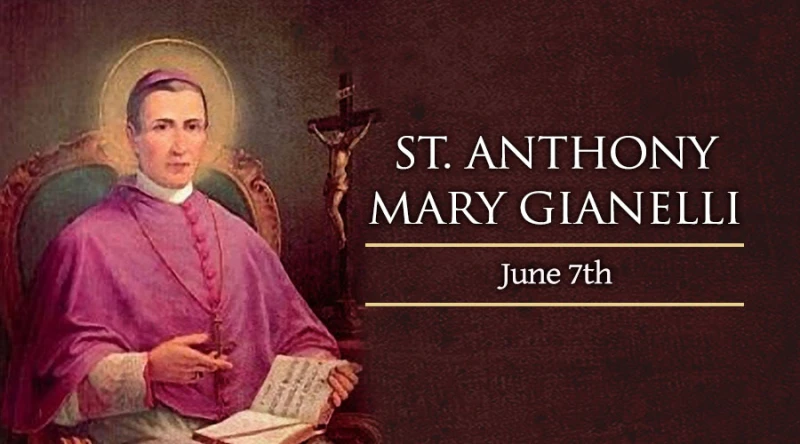
St. Anthony Mary Gianelli


St. Anthony Mary Gianelli

Feast date: Jun 07

Anthony grew up in a poor but pious family in a small farming village in Lombardy, Italy. The owner of his family farm paid for Anthony’s seminary education because he was such a promising student. He was very young for ordination and required a special dispensation, however he was ordained in 1812 and served as a parish priest, and eventually founded several religious communities, some of them short-lived.

In 1827, he founded the Missionaries of St. Alphonsus, which lasted until 1856. He also founded the Oblates of Saint Alphonsus in 1828, which lasted only 20 years. The Daughters of Our Lady of the Garden, which he founded in 1829, still continue their ministry in education and among the sick in Europe, Asia and the United States.

He was named bishop of Bobbio, Italy in 1837 and actively restored devotions and instructed the faithful. He was a people’s bishop, visiting with his parishes and organizing two synods. He died after nine years as bishop on June 7, 1846 due to a serious fever and tuberculosis.

He was canonized in 1951.

St. Anthony Mary Gianelli Read More »